REVIEW · POMPEII
Pompeii: Skip the line ticket (art) + audioguide + map
Book on Viator →Operated by Pompei Tour Organizer_Tempio Travel · Bookable on Viator
Pompeii, with less waiting. This skip-the-line package pairs pre-booked artecard entry with an authorized audioguide so you can tour the ruins by your own rhythm, while the story of volcanic ash explains how the city survived for millennia.
The two biggest wins for me are self-paced wandering (you choose what to linger on) and numbered audio cues that match what you’re seeing, with explanations designed to stay current. One possible drawback: the “skip the line” part can still involve voucher or office steps and some queuing if your check-in instructions aren’t crystal clear.
In This Review
- Key Things to Know Before You Go
- Pompeii Artecard + Audioguide: What This Package Really Delivers
- Getting In From Porta Marina Inferiore (Piazza Esedra) Without Losing Time
- The Authorized Audioguide System: Number Cues and Phone-Style Practicalities
- Your Self-Guided Pompeii Walk: Houses, Temples, Theatres, and Street Life
- Timing, Heat, and Comfort: How to Make the 2–4 Hours Feel Worth It
- Price and Value: Is $44.31 a Good Deal for Skip-the-Line?
- Who This Pompeii Tour Fits Best (and Who Might Want a Live Guide)
- Should You Book This Pompeii Skip-the-Line Audioguide Tour?
- FAQ
- How long is the Pompeii skip-the-line audioguide experience?
- Is the audioguide offered in English?
- Where is the dedicated entry for this package?
- Are headphones included with the audioguide device?
- What do I need for the audioguide deposit?
- Does this package truly skip the line?
- Is free cancellation available?
Key Things to Know Before You Go
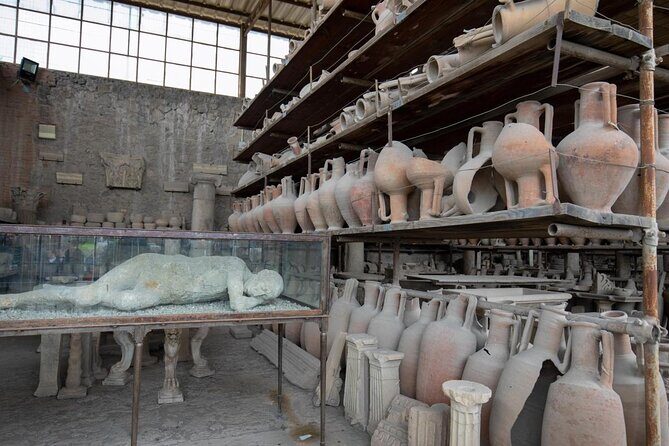
- Authorized audioguide, numbered explanations tied to the ruins you’re walking past
- Dedicated priority entry from Porta Marina Inferiore in Piazza Esedra
- Artecard express entry ticket to reduce the usual scramble
- Self-guided format with a map, so you can move faster than group tours
- Practical hardware notes: headphones aren’t included, and you may hold a phone-like device unless you use the hands-free option
- Plan for time at check-in, because some processes involve swapping a voucher near the station
Pompeii Artecard + Audioguide: What This Package Really Delivers

This isn’t just a ticket. It’s a combo built for one goal: get you into Pompeii with less friction, then let you explore without a live group pace.
You get an Archaeological Park entry express ticket (artecard) plus a physical audioguide device and a map. The audioguide is described as the authorized one for tour operators by the Pompeii Archaeological Park, and it uses numbers on the device to point you to the right stops. That matters, because Pompeii is huge and easy to feel lost in, especially if you’re hopping between houses, temples, and theaters.
The other value piece is pacing. Pompeii is the kind of place where your attention can change minute to minute. A guided tour can be great, but it’s also one more schedule you have to obey. With this, you can slow down for a particularly detailed mosaic or speed through an area you don’t care about that day.
You can also read our reviews of more tours and experiences in Pompeii



Getting In From Porta Marina Inferiore (Piazza Esedra) Without Losing Time

This package includes dedicated access from the entrance at Porta Marina Inferiore, located in Piazza Esedra. That’s the part that’s supposed to make your arrival feel smoother compared with everyone funneling into the same entry point.
Here’s the practical reality: several reviews describe a voucher-to-ticket moment near the station (often tied to an office exchange). If your experience follows that same workflow, don’t treat it like a casual stop. It can mean walking to the office, then returning to enter, plus security and a gate line.
So I’d plan like this:
- Give yourself extra buffer time before your scheduled entry, especially in peak season.
- When you receive your confirmation or voucher, read it for the exact meeting/check-in place and the exact entrance you should use.
- If you show up at the wrong gate or with the wrong document type, you may get turned back and sent to the exchange point.
In other words: the ticket is pre-booked, but you still need to follow the “where to go next” instructions carefully. That’s how you protect the time savings.
The Authorized Audioguide System: Number Cues and Phone-Style Practicalities
The audioguide approach is simple on paper: the device shows you explanations keyed to numbers so you can match the talk to the site you’re standing in. You can use it hands-free or with standard jack headphones, but headphones are not included.
In practice, you’ll want to be ready for two common situations:
- If you don’t bring headphones, you may end up using the device more like a phone, holding it closer to your ear.
- If your hands-free setup isn’t comfortable or you’re walking fast, you might find it easier to pause at a doorway or overlook and listen fully before moving on.
Either way, the biggest advantage of the numbered system is confidence. You’re less likely to wander past something important and only realize later you missed the point.
One more detail that’s easy to forget until you’re standing there: you need a valid ID as a deposit to use the audioguide device, and it’s returned when you bring the device back. Bring the ID you’re told to use, even if you’re tempted to travel light.
Your Self-Guided Pompeii Walk: Houses, Temples, Theatres, and Street Life
Once you’re in, the structure of your visit is your choice—but the highlights follow a classic Pompeii flow. The audioguide is set up to guide you through houses, temples, theatres, and streets, with the story anchored to how volcanic ash preserved the city.
What I love about this kind of self-guided route is that Pompeii rewards curiosity. You can stop at a doorway and look into a house layout. You can step back for the theater space and understand how performances and public life fit together. You can take the street segments in order and feel the “city” instead of treating it like a pile of ruins.
Potential drawback: without a live guide, the site can still feel like a maze. Pompeii isn’t one clear straight line. It’s clusters. If your map isn’t detailed enough for your style, you may spend time confirming where you are and which numbered stop comes next.
A few reviews also note that audio can feel confusing if you’re trying to use it while walking quickly. My advice is to keep it low-stress: start each audio segment when you pause, not while you’re racing to the next spot. You’ll get more out of it and you’ll avoid that “wait, what did I just hear?” feeling.
Timing, Heat, and Comfort: How to Make the 2–4 Hours Feel Worth It
The suggested time is 2 to 4 hours, which is a realistic window if you move steadily and listen to many stops. Pompeii can also stretch longer if you linger or if you’re the kind of visitor who zooms in on details.
But here’s the comfort math: Pompeii has limited shade in many areas. Even if you’re not going in the hottest month, plan for sun, and plan for walking. Reviews mention the practical need to bring water and wear a hat, and I agree. This is not the place for an ultra-light “just shoes and vibes” approach.
What you can do to protect your energy:
- Wear comfortable shoes. The ground can be uneven and you’ll spend a lot of time standing.
- Bring water, then plan to keep refilling if your route brings you past any open spots.
- Consider starting earlier if you can. One of the most consistent travel truths about major ruins is that the morning tends to be more manageable.
If you’re visiting with limited time (like a tight cruise schedule), the audioguide is still workable, but you’ll want to be selective. Pick the areas you most want (for example, street life and a key theater/civic area) so your limited time isn’t burned by getting oriented.
You can also read our reviews of more tours and experiences in Pompeii






Price and Value: Is $44.31 a Good Deal for Skip-the-Line?
At $44.31 per person, you’re paying for a bundle: express artecard entry, the audioguide device, and a map, plus dedicated access from Porta Marina Inferiore. You’re also not paying extra for the “do I have to arrange this myself” hassle.
What makes it good value is the combination:
- Express/priority entrance helps you avoid the worst crowds.
- Audioguide + map means you’re not buying or scrambling for your own interpretation after you arrive.
- A private group is included (so it’s not a group tour that constantly changes your pace).
What might reduce the value is the part that sometimes breaks the “skip the line” promise for certain people: if your voucher requires an exchange step near the station and that step involves lines, you can lose time anyway. If that happens, the trade-off becomes less about “skip the line” and more about “I bought a bundled guide device.”
So I’d treat it like this: it’s a convenient way to handle entry and interpretation in one package, not a magical teleport past every human barrier.
Who This Pompeii Tour Fits Best (and Who Might Want a Live Guide)
This package is a smart fit if you:
- Like exploring at your own pace
- Want an easy on-site learning layer without committing to a full guided tour
- Are comfortable following instructions to the letter, especially for where to check in and where to enter
It may feel less satisfying if you:
- Want a true, no-stops, no-queues entry experience (the system can still involve lines at exchange or gates)
- Prefer a clear human narrative to keep you oriented in a large, branching site
- Are visiting with very tight timing and no flexibility for a check-in detour
Some reviews strongly recommend paying more for a guide when the ticketing and orientation process gets confusing. That’s not wrong. If you know you get flustered by logistics, a live guide can reduce stress and get you to the most important places faster.
For everyone else, the self-guided model shines because Pompeii is so visually distinctive. When you stop at the right corner and hear the right explanation, it clicks instantly.
Should You Book This Pompeii Skip-the-Line Audioguide Tour?
Book it if you want organized entry support plus an English audioguide with numbered explanations and you’re happy to self-navigate with a map. The best outcomes happen when you arrive with enough buffer time, follow the check-in steps in your voucher instructions, and use the audioguide in a calm, pause-and-listen way.
Skip it or consider alternatives if you hate logistical steps at major attractions, have a razor-thin schedule, or you’re expecting to pass through without any lines at all. In those situations, it can turn into frustrating “paperwork then queue” time instead of a smooth Pompeii morning.
FAQ
How long is the Pompeii skip-the-line audioguide experience?
It’s listed as about 2 to 4 hours.
Is the audioguide offered in English?
Yes, the experience is offered in English.
Where is the dedicated entry for this package?
The dedicated access is from Porta Marina Inferiore, located in Piazza Esedra.
Are headphones included with the audioguide device?
No. Headphones are not included, though the device can be used with standard jack headphones.
What do I need for the audioguide deposit?
You need a valid ID as a deposit to use the audioguide device, and it’s returned when you return the device.
Does this package truly skip the line?
It includes express/priority entry via artecard and dedicated access. However, if you need to exchange a voucher at an office point, you may still wait in lines as part of that process and for entry checks.
Is free cancellation available?
Yes. You can cancel up to 24 hours in advance for a full refund. Cancellation cut-off is based on local time.
If you want, tell me when you’re going (month + time of day) and how many hours you have at Pompeii, and I’ll suggest the smartest way to use the 2–4 hour window so you don’t rush the best parts.