REVIEW · POMPEII
Pompeii: Guided Tour with Priority Entrance
Book on Viator →Operated by IAMME IA! - Gray Line Amalfi Coast · Bookable on Viator
Pompeii works best with a plan. This guided, priority entrance tour gets you past the worst of the crowd pressure and funnels you through the site’s biggest stories in about 2.5 hours. You’ll move through key public spaces like the Civil Forum and Temple area, then pivot to the baths, the famous Lupanar, and the art-filled House of the Faun.
I especially like that it includes headsets (so you can hear your guide even in a busy outdoor crush) and that the route targets major buildings you’d otherwise miss or misread. One thing to consider: it’s still a lot of walking on uneven ground in strong sun, and the stops are timed—so you’ll see highlights, not every corner.
Why this tour is worth your time
- Skip-the-line priority access that can save you from long, hot waits
- Headsets that help you keep up with commentary without drifting off the group
- A tight route built around Pompeii’s public life, bathing culture, entertainment, and art
- Priority stops include the Civil Forum, Temple of Jupiter, and the Basilica (big, central structures)
- Limited size (up to 25 travelers) helps the guide keep control and pace
- Guided storytelling with real names showing up in the rotation, like Giulia, Claudio, Max, and Vincenzo
In This Review
- Skip the Line, Then Use the Time Wisely
- A quick reality check
- Where You Meet: Zeus Car Park and a Smooth Start
- The Civil Forum: Pompeii’s Daily-Life Hub
- How to look at it
- Temple of Jupiter: A Capitolium With Vesuvius Watching
- Why this stop is more than scenery
- Macellum and Via dell’Abbondanza: Food, Shops, and Street Energy
- Macellum: the market shaped like a ritual space
- Via dell’Abbondanza: the main street with real noise potential
- Stabian Baths (Terme Stabiane): What People Did After Work
- A practical note
- Lupanar: Famous Brothel, Famous Wall Art
- How I’d handle this stop
- House of the Faun and the Alexander Mosaic: Art With a Plot
- Large Theater: Entertainment in Open Air
- Basilica: Where Business and Justice Happened
- One thing to watch for
- What You’ll Actually Get: Pace, Headsets, and Group Size
- One caution from real-world experience
- Price and Value for a 2.5-Hour Priority Tour
- Timing Tips: Morning Helps You Move and Feel Less Frazzled
- Who Should Book This Pompeii Priority Tour
- Should You Book This Priority Entrance Tour?
Skip the Line, Then Use the Time Wisely
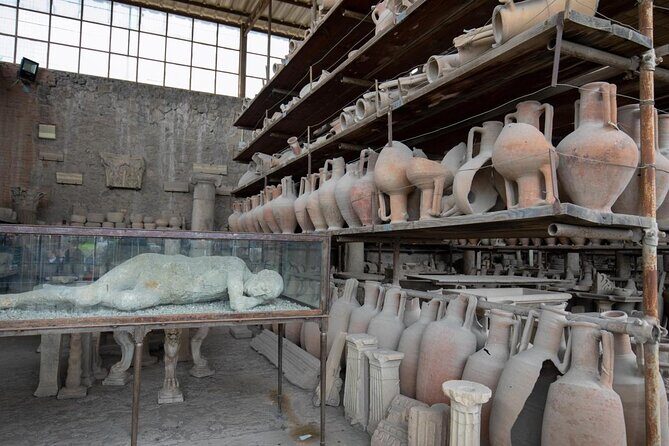
Pompeii is one of those places where the site is the star—and crowds are the spoiler. This tour’s biggest practical win is priority admission, which means less time stuck at entry doors and more time inside the ruins where your guide can explain what you’re looking at.
The tour clocks in at about 2 hours 30 minutes, with an initial block of time devoted to the Pompeii archaeological area. That matters because Pompeii is spread out. If you try to “wander and hope,” you often end up chasing the tallest-ticket sights without understanding how they connect.
You also get an official, licensed guide, which helps a lot here. Pompeii isn’t just a set of pretty ruins. It’s a functioning city that tells you how Romans lived—who worked where, how they shopped, where they argued, and what they worshipped.
A quick reality check
This is a highlights plan. You won’t have hours to roam every street. If you want to linger for photos at every doorway and mosaic, you’ll need a follow-up visit on your own.
You can also read our reviews of more guided tours in Pompeii

Where You Meet: Zeus Car Park and a Smooth Start
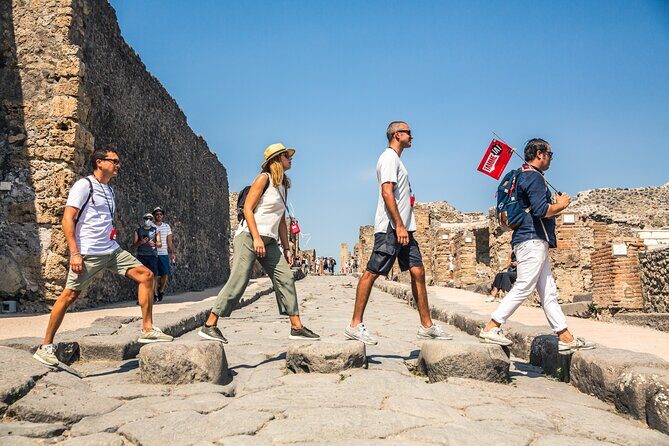
You meet at the Camping Zeus / Zeus Car Park meeting point (Via Villa dei Misteri, 3, 80045 Pompei NA, Italy). Your tour ends back at the same meeting spot, so you’re not juggling complicated logistics after you’re done.
This kind of fixed meeting point is a big deal at Pompeii. The ruins cover a lot of ground, and the “where’s the group?” chaos is real—especially if you arrive late. A tighter start tends to mean fewer stress moments later, and your experience stays focused on the site itself.
Tip: plan to arrive a few minutes early and keep your phone quiet. In full sun, you’ll be surprised how quickly you can lose track of time while regrouping.
The Civil Forum: Pompeii’s Daily-Life Hub
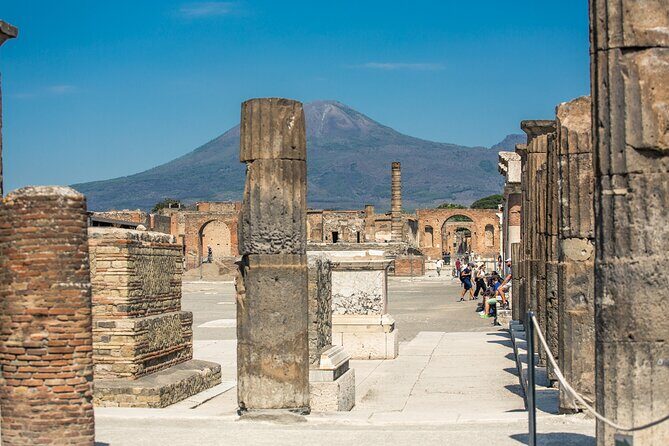
Your tour centers early on the Forum area, where the city’s rhythm shows up in stone. The Civil Forum is described as the core of daily life—where administration and justice happened, and where business and trade unfolded. Think markets, civic decisions, and public worship all in the same neighborhood.
What I like about this stop is that it gives you a mental map fast. Once you understand the Forum’s role, the rest of Pompeii clicks. You start noticing how buildings face the square, how entrances funnel movement, and how “public space” worked.
How to look at it
Don’t rush through your first pass. Pause long enough to figure out direction and layout. The Forum is basically a stage, and the buildings are the scenery designed to draw people into civic life.
Temple of Jupiter: A Capitolium With Vesuvius Watching
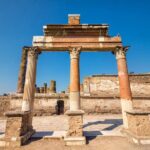
Next comes the Temple of Jupiter, which dominates the north side of the Forum. A big visual detail is the way Mount Vesuvius rises behind it. It’s a reminder that this city’s fate wasn’t far away, even when daily life felt normal.
Your guide also ties the temple to the city’s political identity. When Pompeii became a colony in 80 BC, the temple underwent radical renovation and effectively became a Capitolium—with cult statues of Jupiter, Juno, and Minerva set on a high base so they could be seen across the Forum square.
Why this stop is more than scenery
It’s not just a tall structure. It’s propaganda in architecture form. When you see how the statues were positioned for visibility, you understand how religion and civic authority reinforced each other.
Macellum and Via dell’Abbondanza: Food, Shops, and Street Energy
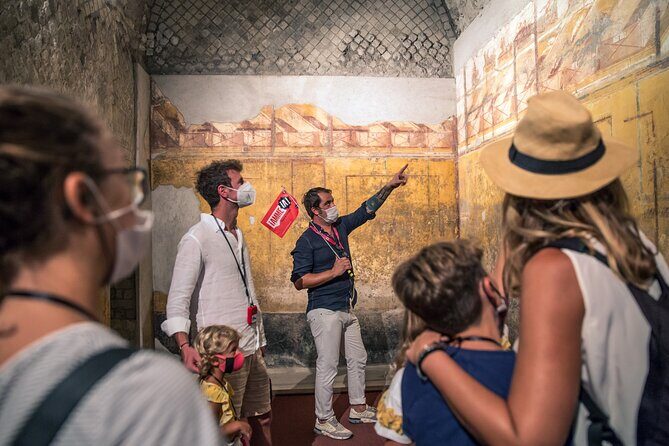
After the civic and religious core, your route shifts into everyday life through the Macellum and the famous street scene of Via dell’Abbondanza.
Macellum: the market shaped like a ritual space
The Macellum is the city’s market complex. You’ll see a tuff quadriporticus with an elevated area for worship. There are notes about statue niches—small details, but they matter because they show how even commercial space had religious layers. The layout also suggests how imperial cult influence was woven into public life.
Via dell’Abbondanza: the main street with real noise potential
Via dell’Abbondanza was the ancient main street (a decumanus maximus) running east/west from the Forum toward Porta Sarno. The street was crowded and noisy, lined with shops, workshops, cafes, and quick bites.
Even if you visit in modern quiet, your guide’s job is to help you imagine the original traffic patterns and the shopfront life. This is where Pompeii stops feeling like history text and starts feeling like a functioning neighborhood.
Stabian Baths (Terme Stabiane): What People Did After Work
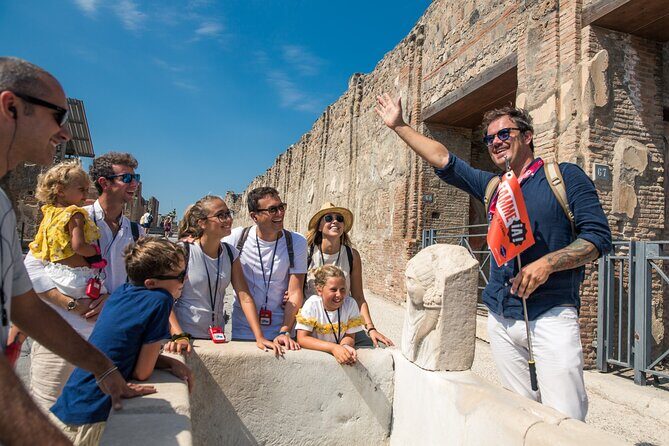
Behind the Temple of Jupiter sits the Stabian Baths, dating to just after the colony of veterans founded around 80 BC. This is one of the most human stops on the route because baths were part of daily routine—social time, hygiene, and relaxation.
The layout is key. Women’s and men’s quarters had separate entrances. For the men’s section, you’ll hear about sequential rooms: an apodyterium (dressing room), then a tepidarium (medium temperature), frigidarium (cold baths), and calidarium (hot baths). Even without stepping inside every room in full depth, the sequence explains the experience.
Then comes the shock-of-reality detail: like much of Pompeii, the baths were heavily damaged during the earthquake of 62 AD. It’s a reminder that the city wasn’t just paused by one disaster. It was already living with damage and recovery.
A practical note
This stop is timed (about 10 minutes). If you’re the type who loves to linger in preserved spaces, you might want to come back later on your own. Still, the guided framing here is worth it because it tells you what the rooms were for.
Lupanar: Famous Brothel, Famous Wall Art
The route also includes the Lupanar (also known as Lupanare Grande), and it’s exactly what you expect from Pompeii’s reputation: a brothel with well-known erotic wall paintings.
Your guide ties the site to economics. The brothel is described as housing mostly Greek and Oriental slaves, paid between two and eight asses for services, with a glass of wine costing one As. Those numbers turn the story from scandal into social and economic context.
How I’d handle this stop
Keep your expectations balanced. Yes, it’s famous. But your goal here should be context: how space was organized, what the paintings were doing, and how this fits into urban life. A short stop works best if you go in curious, not shocked.
House of the Faun and the Alexander Mosaic: Art With a Plot
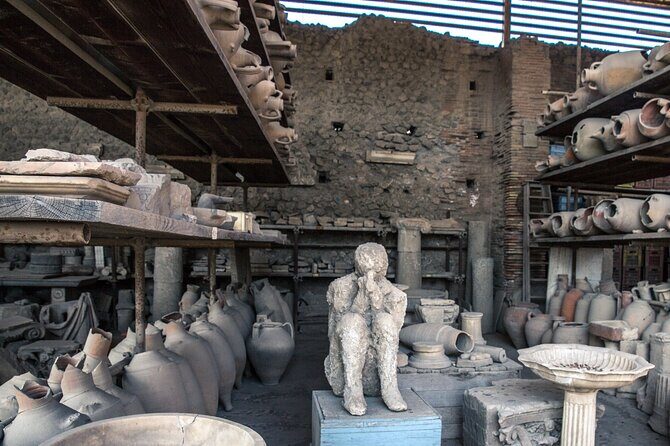
From the Lupanar, the tour steps into the House of the Faun, one of the most celebrated Roman villas in Pompeii, known for its mosaics. The star is the Alexander Mosaic, described as a striking masterpiece of ancient art and storytelling.
This is a major contrast point. You’ve been in civic spaces and street life, then you jump into elite domestic design. The guide’s commentary is what helps this land. Look for how the mansion’s luxury isn’t random decoration—it’s part of identity, status, and how the household wanted to be seen.
If you’re a fan of art, this is usually the emotional high point of the route. It’s one of those moments where your brain quietly goes, Oh. They really did think in pictures and symbols.
Large Theater: Entertainment in Open Air
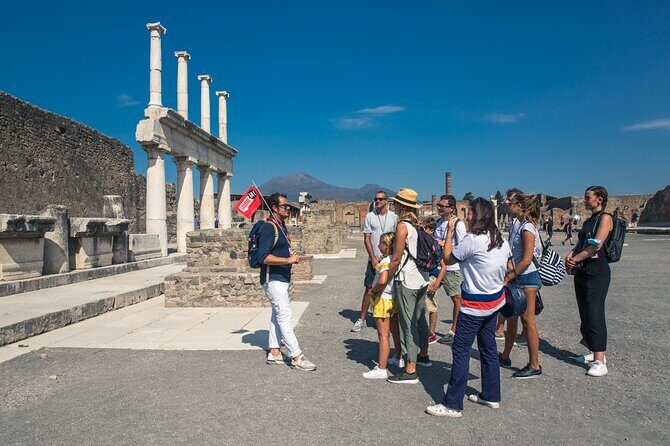
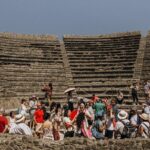
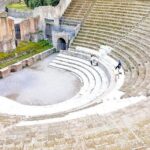
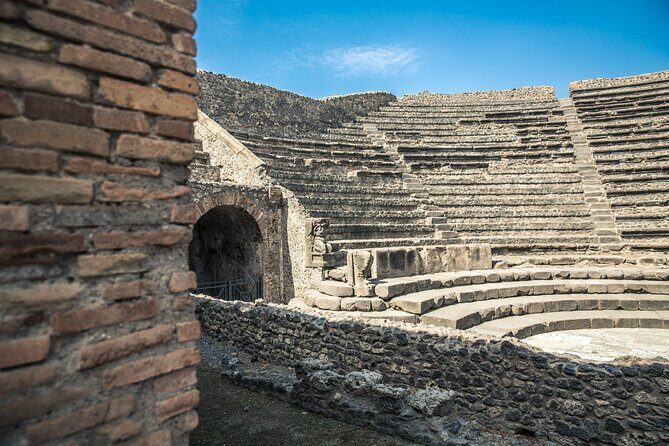
Next up: the Large Theater, an open-air venue where crowds once gathered for comedies, dramas, and musical performances.
The practical value here is understanding Pompeii as a full cultural system, not just a city of houses and streets. Even the entertainment spaces were built to serve civic life—people didn’t separate “work” from “fun” as sharply as we do now.
If you’re pressed for time, the theater stop helps you anchor the idea that Pompeii was socially active, not just economically busy.
Basilica: Where Business and Justice Happened
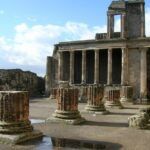
The tour wraps with the Basilica, described as the most sumptuous building of the Forum area. It’s big—about 1,500 square meters—and the space was used for business and for administration of justice.
You enter from the Forum through five entrances separated by tuff pillars. Inside, it’s divided into three naves with brick columns and Ionic capitals. These architectural notes matter because they explain how the Basilica was designed for movement and crowd control, while still keeping it functional for commerce and legal matters.
One thing to watch for
In a short guided visit, you can miss the “why this architecture matters” part. Spend a minute orienting yourself at the entrance and imagining how people would have flowed through the spaces.
What You’ll Actually Get: Pace, Headsets, and Group Size
This tour is set for a group max of 25 travelers. That’s a helpful size for Pompeii. If the group is smaller, you usually get more room for questions and less rushing. If it’s closer to the cap, you’ll move at a smoother “herding” pace.
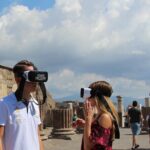
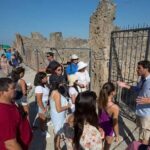
A major quality factor here is the headsets. The tour includes headphones/headsets so you can hear the guide clearly, especially for groups bigger than 10. In practice, this is one of those small inclusions that completely changes the experience. Pompeii isn’t quiet. Headsets keep you connected to the story instead of straining to hear over footsteps and other groups.
One caution from real-world experience
A few travelers noted times when the audio system or timing didn’t go as planned. That’s not the norm you should plan around, but it’s fair to know. If you’re the type who gets stressed by delays, arrive early, keep buffer time, and have realistic expectations for a site as busy as Pompeii.
Price and Value for a 2.5-Hour Priority Tour
At $59.13 per person, you’re paying for three things that matter in Pompeii:
- Priority admission to reduce time wasted in lines
- A licensed guide who connects the architecture to daily life
- Headsets to make the narration usable in a noisy outdoor environment
Is it cheaper than going alone? Usually, yes. But Pompeii isn’t just “see buildings.” It’s “understand what you’re seeing.” A good guide turns a pile of ruins into a city story—and you only get so much time before heat and crowd flow nudge you onward.
Also, the tour is structured with short stops like the baths and the Lupanar, which means your ticket time is being actively used. That’s a big part of the value equation.
Timing Tips: Morning Helps You Move and Feel Less Frazzled
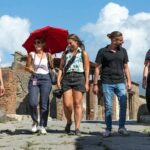
You’ll feel Pompeii most in the sun. The tour itself suggests sunscreen and comfortable shoes, which is exactly what you should plan for. Uneven surfaces come with the territory, and you’ll be on your feet more than you might expect.
If you have flexibility, choose an earlier departure. People often recommend morning tours because you can get through faster and the heat is usually less punishing than later in the day. Either way, bring water and expect at least some standing.
And yes: don’t carry heavy bags. Light kit keeps your pace steady and your mood intact.
Who Should Book This Pompeii Priority Tour
This tour fits best if you want:
- A high-impact highlights route in about 2.5 hours
- A guide-led framework for the Forum → Temple → markets → baths → Lupanar → elite homes arc
- Headsets so you can actually follow the commentary in a crowded site
- A manageable group size with an official guide
It might feel less ideal if you’re the type who wants to spend long stretches inside each building, or if you’re planning to bring kids and you’ll struggle with crowd control and timed stops. In that case, consider whether you want a slower, more flexible pace, or be ready to do part of Pompeii independently after the guided segment.
Should You Book This Priority Entrance Tour?
Yes, if you want Pompeii to feel like a coherent story instead of a random walk.
Book this tour if you care about priority access, want headsets, and like seeing a set route that hits Pompeii’s biggest landmarks: the Civil Forum, Temple of Jupiter, the Basilica, the Stabian Baths, the Lupanar, and the House of the Faun with the Alexander Mosaic.
Skip it (or plan a hybrid) if your priority is slow wandering, deep interior time, or you’re easily thrown by tight group pacing. Pompeii rewards curiosity—and this tour gives you a strong starting map so you can decide what to revisit afterward.
If you do book, aim for good shoes, water in hand, and a curious attitude. Pompeii is intense, but it’s also unbelievably readable once someone points out the logic in the streets and buildings.