REVIEW · CITY TOURS
Rome: Walking Tour through the Marvel of the city
Book on Viator →Operated by Custom tours Italy · Bookable on Viator
Rome turns into a story fast. This walking route strings together major Roman landmarks in a tight 2 hours 30 minutes loop, with an official guide and a Bluetooth headset so you can actually hear the details without chasing the group. I like the way the stops connect big themes—empire, faith, and everyday life—so each site feels less like a random photo stop. I also love that the format gives you short, focused moments at places like Largo Argentina, where Julius Caesar’s assassination happened, without bogging you down.
One thing to keep in mind: Pantheon admission isn’t included, so you’ll want to plan for that cost and the visit timing at the stop. Also, each stop is brief (about 20 minutes), so if you want long wandering time, you’ll need to do extra exploring on your own after the tour.
In This Review
- Key highlights to look for
- A 6 pm route that links Rome’s biggest turns
- Meeting at Castel Sant’Angelo and hearing the guide clearly
- Castel Sant’Angelo: Hadrian’s Mausoleum with an Archangel name
- Piazza Navona’s Fountain of the Four Rivers and Sant’Agnese
- Pantheon: the one stop where you should budget for entry
- Largo Argentina: Julius Caesar’s assassination site and cat-famous ruins
- The Ghetto Ebraico: community life in the middle of Rome
- Piazza del Campidoglio: why the word capital comes from Rome
- Price and value: what $47.06 buys you in real Rome time
- Guide quality: the difference between seeing and getting it
- Timing, pacing, and what to expect between stops
- Who should book this Rome walking tour
- Should you book it?
- FAQ
- How much does the Rome walking tour cost?
- How long is the tour?
- What language is the tour offered in?
- Where does the tour start and what time does it begin?
- Where does the tour end?
- What’s included in the tour price?
- Is Pantheon admission included?
- How big is the group?
- Do I need a passport for this tour?
- Is there free cancellation?
Key highlights to look for
- Bluetooth headset included so your guide’s explanations stay clear on busy streets
- Castel Sant’Angelo: from Hadrian’s Mausoleum (139 AD) to its Archangel Michael name
- Piazza Navona: the Fountain of the Four Rivers plus Sant’Agnese in Agone
- Largo Argentina: Julius Caesar’s assassination site (and the cat-famous archaeological area)
- Ghetto Ebraico: the Jewish District and the core of Jewish-Roman community life
- Piazza del Campidoglio: the Capitolium Hill link to the word capital
A 6 pm route that links Rome’s biggest turns
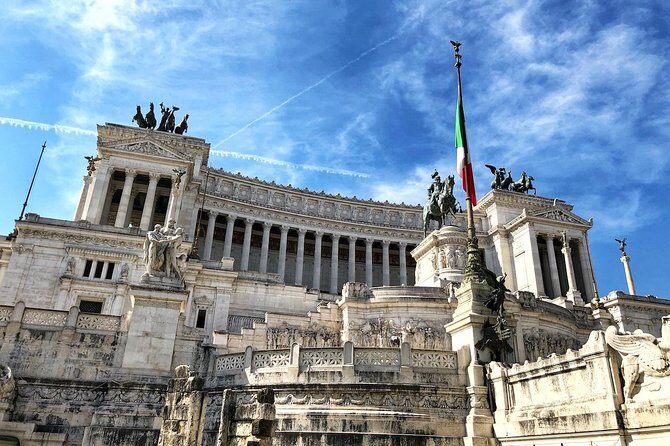
This is the kind of Rome tour you’ll appreciate if you like order. You get a set route, a short time at each stop, and enough guidance to understand why these places matter. Starting at 6:00 pm also fits well with how Rome often works best for walking tours: you’re in the city during evening hours, when you can stay out and keep moving.
The pace is built for attention. With a maximum group size of 15 travelers, you’re not lost in a crowd of people who are all standing still at once. Instead, you can keep up, ask questions, and actually learn what you’re looking at—especially at stops like Castel Sant’Angelo, where the story behind the name is its own mini plot twist.
You’re also getting a “marvels” mix: monumental (Castel Sant’Angelo, Campidoglio), religious (Pantheon), political (Largo Argentina), and community life (the Ghetto). That variety is the whole point. It keeps the walk from feeling like a checklist.
You can also read our reviews of more walking tours in Rome


Meeting at Castel Sant’Angelo and hearing the guide clearly
Your tour starts near Castel Sant’Angelo at Lungotevere Castello, 50, 00193 Roma RM. The meeting instruction is to arrive 15 minutes early, which I like. In Rome, that buffer is how you avoid stress when streets, signage, and meeting points get a little chaotic.
From there, the biggest practical win is the Bluetooth headset. Rome streets can be noisy, and groups naturally get spread out. With the headset, you don’t have to guess what your guide is saying while you’re trying to take in big buildings and crowded squares.
Also, the tour uses a mobile ticket, which is handy because you’re not hunting for paper confirmations. One more important note: you need a current valid passport on the day of travel. That’s not the usual “keep it with you just in case” advice—this one is explicitly required.
Castel Sant’Angelo: Hadrian’s Mausoleum with an Archangel name
The first stop is Castel Sant’Angelo, a site with a double identity. It was originally built as the Mausoleum of Emperor Hadrian in 139 AD, but it’s named after the Archangel Michael. That contrast matters because it shows you how Rome keeps re-labeling and re-using its own spaces over time.
You’re there for about 20 minutes, with the tour listing admission ticket free for this stop. Even if you don’t have time for a deep, slow museum-style visit, this is still a strong start because it frames the rest of the route. Once you understand that this place already carries layered meanings, the rest of the walk feels more connected.
The main drawback here is simple timing: with only about 20 minutes, you’ll need to pick your focus. If you’re the type who always reads every label, this stop may feel brief. If you’re the type who wants the story plus a quick orientation, it’s a good opener.
Piazza Navona’s Fountain of the Four Rivers and Sant’Agnese
Next up is Piazza Navona, a favorite because it’s visually loud in a good way. The headline is the Fountain of the Four Rivers, and there’s also the church of Sant’Agnese in Agone in the same area. This is one of those Roman spaces where art and architecture crowd each other—exactly what you want on a short tour.
Again, you’re looking at about 20 minutes at this stop. That means you’ll likely get the fountain-focused explanation first, then enough time to glance toward the church and take in the square as a whole. The tour listing indicates admission is free for this stop, so there’s no ticket puzzle mid-walk.
What I like about Piazza Navona in this kind of guided format is that it helps you avoid the classic Rome problem: you see a famous place, take photos, then leave without knowing what makes it special. A quick, focused guide talk turns it from scenery into context.
Pantheon: the one stop where you should budget for entry
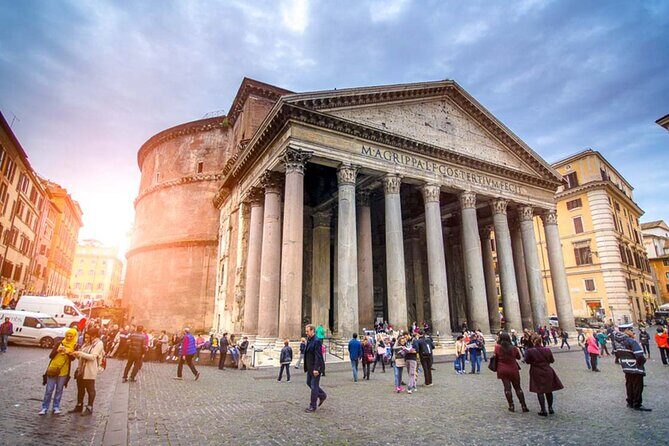
Then comes the Pantheon, described as the Temple of all the gods. It’s a huge concept in a single phrase, and you feel that contrast right away: the Pantheon is about more than one era, and the language around it reflects how broad ancient Rome’s religious world could be.
Here’s the practical catch: Pantheon admission isn’t included. So while the tour gets you to the right place and gives you guidance, you’ll want to have a plan for entry costs. This also affects timing. If you arrive without tickets ready, you may lose minutes that you would rather spend inside.
If you’re coming from earlier stops, it’s smart to mentally switch gears here. The earlier stops are mostly about seeing and understanding the site from the outside and in the square. The Pantheon is the stop where you’ll likely want the inside time, so treat it as your real “spend your attention” moment.
You can also read our reviews of more city tours in Rome




Largo Argentina: Julius Caesar’s assassination site and cat-famous ruins
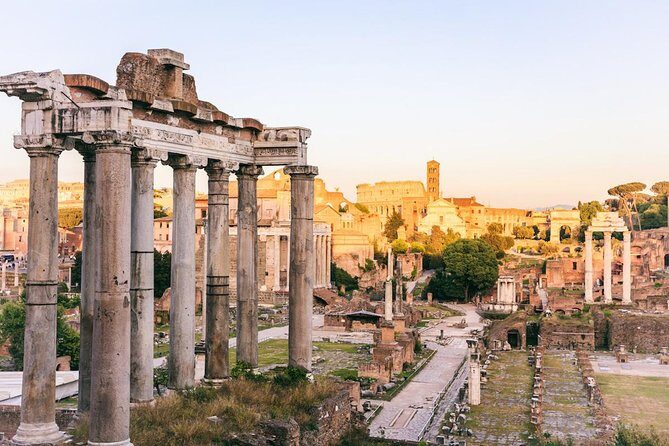
Now you hit one of the most memorable stops on the walk: Area Sacra di Largo Argentina (the tour calls it Largo Argentina). This is where Julius Caesar was assassinated. But you’ll also hear another detail tied to the present-day vibe: it’s described as the most popular cat shelter of the city.
That combination is why this stop lands. It’s political violence from the Roman era, sitting in an archaeological area that now has a living, everyday character. In a short tour, you rarely get to see that kind of time jump—past and present sharing the same footprint.
The tour listing has admission free for this stop, and you get about 20 minutes. You’ll want to use that time well. Look for how the ruins and the open area work together, and pay attention to what your guide says about why this location is famous.
Possible drawback: because it’s so well known, this is one of those places where groups can overlap visually. The headset helps here, and you’ll be happiest if you focus on listening and orientation rather than trying to study everything at once.
The Ghetto Ebraico: community life in the middle of Rome
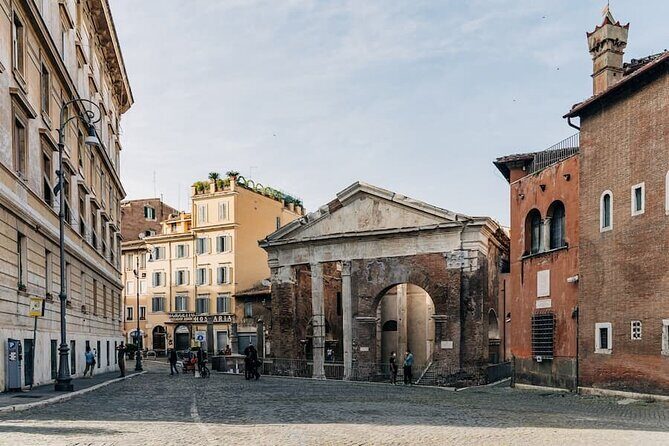
After Largo Argentina, you walk into the Ghetto area—specifically the Ghetto Ebraico, Rome’s Jewish District. This stop is built on a major fact from the tour description: it’s the oldest Jewish community of the western world and the core of the Jewish-Roman community today.
That’s not trivia. It changes how you should think about the area. Instead of treating it like a “historic neighborhood you pass through,” this is a place where identity and community continuity matter. In a two-and-a-half-hour tour, you’re getting just a slice, but it’s a meaningful slice.
You’ll spend about 20 minutes here, and the tour listing says admission is free. The value is in the guide’s framing: what it means that the community has continuity, not just artifacts. This is the kind of stop that makes the rest of the walk click, because it shows Rome isn’t only monuments. It’s also people living through time.
One consideration: since it’s a district, your experience will depend on the street conditions and how the group moves. The headset helps with that, but you’ll still want comfortable shoes and the willingness to keep walking.
Piazza del Campidoglio: why the word capital comes from Rome
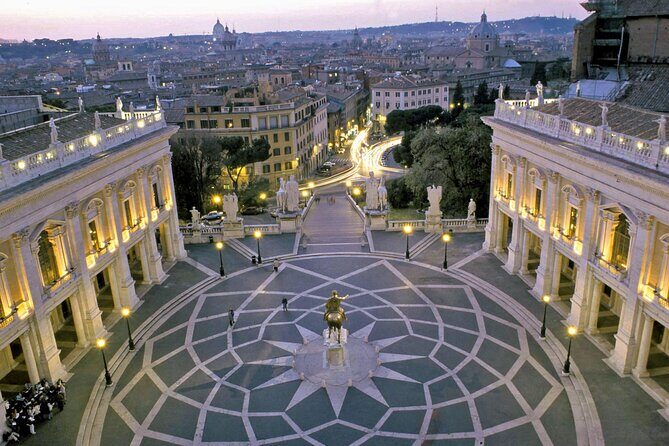
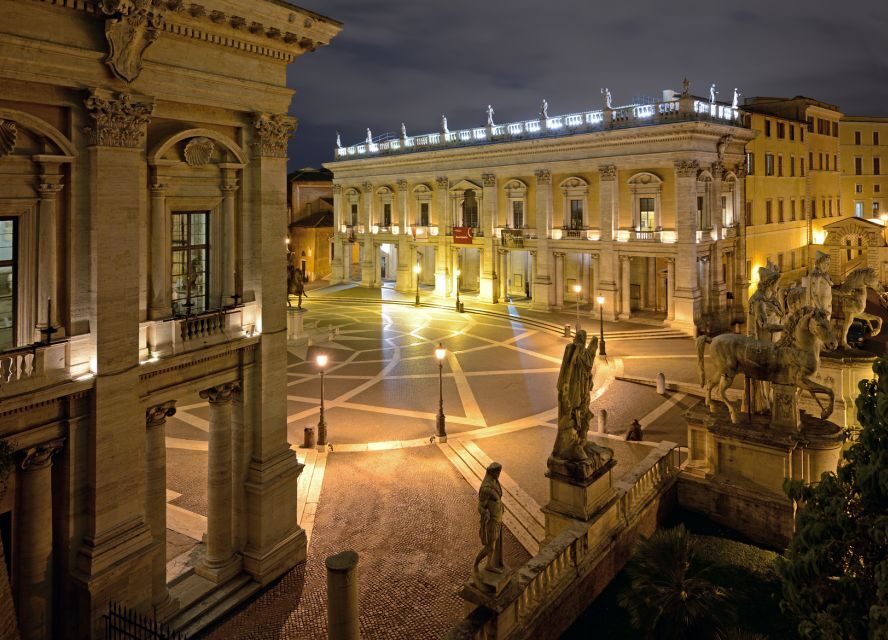
The last major stop is Piazza del Campidoglio, on Capitolium Hill. This is where you connect a modern word to an ancient location: the tour notes that we get the word capital from here.
You also learn why it was important in ancient times. This area is described as home to the temple of Jupiter in Ancient Rome, and today it houses the city hall and the Musei Capitolini. That mix is the real takeaway: the site didn’t just get remembered. It got reused.
You get about 20 minutes here, and admission is listed as free. Because it’s the final stop, it’s also where your brain does a quick “wrap-up scan.” If you’ve been listening through the headset, this is a satisfying place to notice how Roman power and later administration share space.
After Piazza del Campidoglio, the tour ends at Piazza Venezia. This end point is convenient if you want to keep exploring on your own, because it connects you to a broader sense of central Rome.
Price and value: what $47.06 buys you in real Rome time
At $47.06 per person for about 2.5 hours, this tour is priced like a practical orientation walk: you’re paying for an official guide plus the Bluetooth headset, and you’re getting multiple major stops grouped efficiently.
What makes the value stronger is that several stops are listed with free admission tickets in the tour flow (Castel Sant’Angelo, Piazza Navona, Largo Argentina, the Ghetto, and Piazza del Campidoglio). That matters because it reduces the “surprise budget math” that can happen when tours only cover the guide and not the actual entry.
The one place where you should plan extra is the Pantheon, since admission isn’t included. If you treat that as your main paid entry of the day, you’ll feel prepared instead of caught off guard.
Also, the tour runs with a maximum of 15 people. That smaller-group setup is a value multiplier. You move as a group, yes, but you’re not stuck behind a wall of shoulders and camera arms.
If you like to travel light on logistics and heavy on context, this price usually makes sense. If you already know the basics and you’re only there for wandering time, you might feel like you could do it alone. But if you want the “why” behind each stop in a short window, this tour fits.
Guide quality: the difference between seeing and getting it
The most consistent praise tied to this kind of walking tour is the guide. Names that stand out in the feedback include Lorenzo and Amit—and the common thread is clear explanations and a willingness to answer questions.
I like tours where the guide doesn’t just talk, but also adjusts to what you’re trying to do. One way this shows up is in how guides point out good photo angles. Even if you don’t care about photography, those little direction cues help you see the site better and faster.
Another quality that matters on a walking tour is how confidently the guide keeps the group moving without rushing you. When you have a headset, you can follow along while still taking in what’s in front of you.
Timing, pacing, and what to expect between stops
The schedule is designed around short visits—about 20 minutes per stop. That gives you a sampler platter without turning Rome into a marathon. But it does mean you should avoid planning to do major side missions during the tour.
Here’s how to make it work:
- Keep your expectations realistic. You’re learning and orienting, not doing a full museum day.
- Be ready for walking time between sites. Your best experience comes when you stay mentally in “listen and look” mode.
- If you want extra time at one place, decide after Pantheon or Largo Argentina. Those two tend to grab attention.
The tour also lists good weather as a requirement. Since it’s a walking format, rain or unpleasant conditions can affect comfort. If weather looks doubtful, keep your options open and be ready to adjust your day.
Who should book this Rome walking tour
This tour is a strong fit if you want:
- A guided Rome route that connects key sites with clear context
- A small group experience (max 15)
- Short stop times that help you cover more without feeling trapped
It’s also a good choice if you hate the Rome guessing game. You know the places—Castel Sant’Angelo, Piazza Navona, the Pantheon, Largo Argentina, the Ghetto, and Campidoglio—but you want help tying them together.
If you already speak fluent Italian and you love self-guided wandering without structure, you might prefer to build your own route. But if your goal is “see the marvels and understand what I’m seeing,” this format is built for you.
Should you book it?
Yes, if you want a well-paced Rome walk with a guide who helps you connect the dots. The combination of Bluetooth headset, a small group, and stops that range from Hadrian’s mausoleum to Julius Caesar’s assassination site to today’s Jewish community makes the tour feel focused, not random.
Book it with one caveat: plan for Pantheon admission because it’s not included, and be okay with about 20 minutes per stop. If that timing suits how you like to travel, this is a smart way to spend an evening in Rome and come away with more than just photos.
FAQ
How much does the Rome walking tour cost?
It costs $47.06 per person.
How long is the tour?
The tour lasts about 2 hours 30 minutes.
What language is the tour offered in?
The tour is offered in English.
Where does the tour start and what time does it begin?
It starts at Castel Sant’Angelo, Lungotevere Castello, 50, 00193 Roma RM, Italy at 6:00 pm.
Where does the tour end?
The tour ends at Piazza Venezia, Roma RM.
What’s included in the tour price?
You get an official guide and a Bluetooth headset.
Is Pantheon admission included?
No. Pantheon admission is listed as not included.
How big is the group?
The tour has a maximum of 15 travelers.
Do I need a passport for this tour?
Yes. A current valid passport is required on the day of travel.
Is there free cancellation?
Yes. You can cancel up to 24 hours in advance for a full refund.