REVIEW · PRIVATE
Jewish Quarter and Trastevere District Private Walking Tour
Book on Viator →Operated by Crazy4Rome Private Tours · Bookable on Viator
Rome changes fast on this route.
This private 3.5-hour walk links the Jewish Ghetto with some of Rome’s most memorable river-and-bridge moments, then slides you into Trastevere on cobblestones. I love the way the guide can connect street corners to big, real human stories, and I love that you’re not stuck in one neighborhood—you get ancient Rome plus everyday Rome without feeling rushed.
The one thing to watch: the plan includes the synagogue as an outside view stop, so I’d set expectations for seeing it from the street and confirm what access is possible with your guide the day of your tour.
In This Review
- Quick reasons this walk works (even if you think you’ve seen Rome)
- Jewish Ghetto to Trastevere: the point of this exact route
- Starting at Teatro di Marcello: a Roman anchor before the walk
- Piazza Mattei and the Fountain of Turtles: where Rome gets weird (in a good way)
- Portico di Ottavia and the old market space
- The synagogue stop by the Tiber: plan for an outside look
- Ponte Rotto and Pont Fabricius: walking Roman time
- Isola Tiberina: Rome’s only river island and its healing link
- Trastevere’s streets: slow down without getting stuck
- Santa Cecilia in Trastevere and Santa Maria in Trastevere: two very different church moments
- Price and value for up to 10 people: is it worth $437.68?
- Who this tour fits best (and who might want a different plan)
- Should you book this Jewish Quarter and Trastevere private walk?
- FAQ
- How long is the private walking tour?
- How much does the tour cost?
- Is this tour private or shared?
- What language is the tour offered in?
- Is there a mobile ticket?
- Where does the tour start?
- What is included in the price?
- What is not included?
- Does the tour include the synagogue?
- Can I cancel for a full refund?
Quick reasons this walk works (even if you think you’ve seen Rome)
- Licensed guide time for a group up to 10, with a route that’s tailored enough to answer questions
- Teatro di Marcello + Tiber crossings back-to-back, so you get Roman context while the streets are still fresh
- Piazza Mattei’s Fountain of Turtles with the Bernini connection and theft history you can actually picture
- Ancient bridges you can stand on: the oldest still in original state, plus the “Broken Bridge” remains
- Tiber Island (Isola Tiberina), Rome’s only river island, tied to healing and medicine
- Trastevere churches and mosaics, including Santa Maria in Trastevere’s Pietro Cavallini mosaics
Jewish Ghetto to Trastevere: the point of this exact route
This tour is built like a story with moving chapters. You start at an ancient theatre near the Tiber, then you shift into the Jewish Quarter, cross into the river’s historical zone, and end in Trastevere where the streets feel less like a checklist and more like a neighborhood.
That order matters. In Rome, a lot of sights feel “separate.” Here, the guide can weave connections across time—Roman Republic culture at Teatro di Marcello, then the density of community life around the old ghetto area, then the Tiber as a physical spine of the city. Finally, you land in Trastevere, where the architecture and churches slow the pace just enough for you to feel like you’ve arrived.
And because it’s private, you don’t have to match the pace of a random group. If you want more time at Piazza Mattei for photos or a question about a bridge, you can usually ask and adjust.
You can also read our reviews of more walking tours in Rome

Starting at Teatro di Marcello: a Roman anchor before the walk
Your meeting point is at Antico caffè del teatro di Marcello, Via del Teatro di Marcello 42. It’s a smart start because Teatro di Marcello gives you instant “Rome scale.” This is an ancient open-air theatre built in the closing years of the Roman Republic, with construction carried through as Julius Caesar cleared space for it, then the project advanced by 17 BC, completed by 13 BC, and inaugurated in 12 BC under Augustus.
The plan keeps the theatre as an outside stop, but that’s fine. You’re using it as a reference point: how Romans built for performance and crowds, and how they used major urban structures as durable landmarks. It also helps with orientation early on, so the rest of the route feels like it’s unfolding in the right direction.
Practical tip: you’ll cover multiple spots and each one is timed, so wear shoes you don’t mind in old stone streets.
Piazza Mattei and the Fountain of Turtles: where Rome gets weird (in a good way)
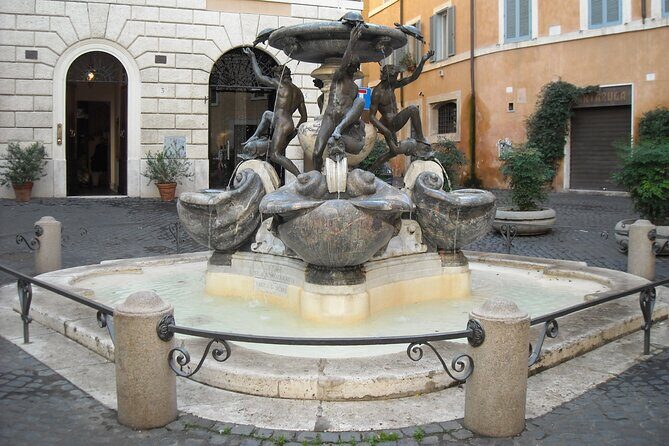
Then you get to Piazza Mattei, and the star is the Fountain of Turtles. Even if you’ve walked past Roman fountains before, this one earns a pause.
Here are the details worth knowing while you’re standing there:
- The fountain was built in the second half of the 1500s to a design by Giacomo Della Porta
- Taddeo Landini created the bronze sculptures
- The turtles were probably added in 1658 after restoration tied to Pope Alexander VII Chigi
- The turtles have been stolen multiple times (notably 1906, 1944, and 1981)
- The turtles you see now are copies, while the originals are preserved at the Capitoline Museums (with three surviving originals)
That theft story is why this fountain feels lived-in rather than static. It’s not just “pretty rocks and water.” It’s a thing Romans tried to protect—and sometimes couldn’t.
If your group likes photos, this stop is set up for it. The fountain sits in the middle of a small square, so you can circle for angles without feeling like you’re blocking anyone for long.
Portico di Ottavia and the old market space
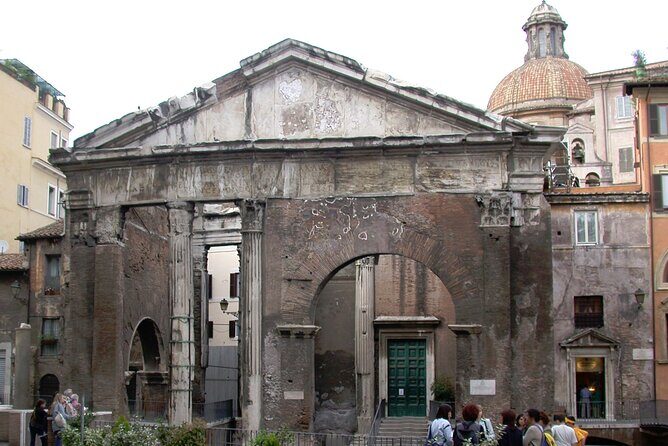
From there, the route touches the Portico di Ottavia (Porticus Octaviae). This is one of those places that rewards you for paying attention even if you’re outside.
What makes it interesting:
- It enclosed colonnaded walks that housed temples of Jupiter Stator and Juno Regina
- It also included a library
- In medieval times, it was used as a fish market, lasting into the end of the 19th century
That timeline is useful for understanding Rome. One building can shift roles for centuries. In a city where people keep building on top of older building, these “in-between” structures are often where the human story shows.
Time check: this is a shorter stop. So focus on two things: the scale of the columns and the idea that this same space has served worship, learning, commerce, and then tourism.
The synagogue stop by the Tiber: plan for an outside look
Next comes the Jewish Quarter’s synagogue area. The synagogue on the route is described as an outside stop, built 1901–1904 on the Tiber’s banks overlooking the former ghetto.
It’s also architecturally specific:
- Designed by Vincenzo Costa and Osvaldo Armanni
- It mixes elements described as Assyrian-Babylonian, Egyptian, and Greco-Roman
- The interior is described as lavishly decorated in Art Nouveau style
Here’s the practical consideration: because the stop is listed as outside, don’t assume you’ll automatically get interior time. If a synagogue visit is a highlight for you, ask your guide directly what you’ll be able to do on your date. This is also the kind of question worth asking early, before you’re already “mentally committed” to one version of the experience.
On the positive side, having a guide who knows Jewish history matters here. One guide name you may hear in feedback is Karin, described as highly specialized in Jewish history. Even if you don’t get her, it’s a signal to look for that level of care in your guide’s explanations.
You can also read our reviews of more private tours in Rome




Ponte Rotto and Pont Fabricius: walking Roman time
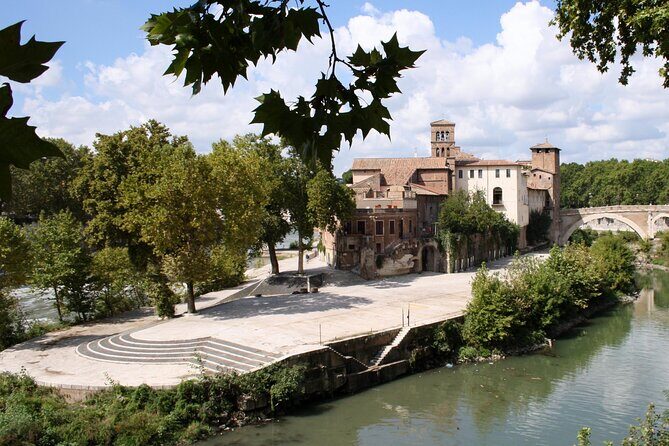
Now you shift fully into Tiber-country. First up: Ponte Rotto, the “Broken Bridge” vibe. The arch rising out of the water looks poetic, but here’s the key fact that makes it more than scenery: the structure is what remains of the ancient Pons Aemilius, originally made of wood in the 2nd century BC, then reconstructed in stone about a century later.
Then comes Pont Fabricius (Ponte dei Quattro Capi)—the real flex. It’s described as the oldest Roman bridge in Rome still existing in its original state, built in 62 BC.
Two details you can actually spot:
- It spans the Tiber from the Campus Martius side to Tiber Island
- The “Quattro Capi” name comes from two-faced Janus herms on the parapet, with the four heads referencing their placement
- Those marble pieces were moved here in the 14th century from a nearby church
Standing near older bridges like this makes you realize something: Rome’s “big look” is everywhere, but it’s the infrastructure that keeps surviving. It also makes your later arrival at the island feel logical, not random.
If your group doesn’t love walking between stops, this segment is where a private guide can help by choosing the best small paths. No private transport is included, so you’re walking anyway—might as well make it efficient.
Isola Tiberina: Rome’s only river island and its healing link
Next is Tiber Island (Isola Tiberina), and yes, it really is the only river island in the part of the Tiber that runs through Rome.
The description is delightfully concrete:
- It’s about 270 meters long and 67 meters wide
- It’s boat-shaped
- Bridges connect it to both sides of the river since antiquity
The island’s identity connects to medicine:
- It was associated with an ancient temple of Asclepius
- Later it became a seat of healing-related institutions, including the Fatebenefratelli Hospital founded in the 16th century
- San Bartolomeo all’Isola dates from the 10th century
This stop is short, so you won’t become an expert on the island’s medical history—but you will leave with a mental hook. In Rome, a lot of sights are impressive because they’re old. This one stands out because it’s old and it has a theme you can carry with you: healing.
Trastevere’s streets: slow down without getting stuck
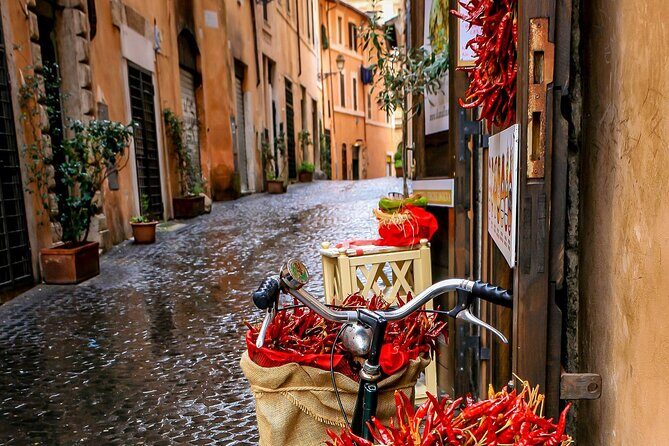
After the Tiber crossing theme, the tour lands in Trastevere, Rome’s 13th rione (R. XIII), in Municipio I. The name comes from Latin trans Tiberim, meaning beyond the Tiber.
That origin matters because it sets the neighborhood’s “feel.” You’re not in the city’s administrative center anymore. You’re in an area where the streets and churches tend to make more of the day-to-day sense.
This part of the walk is where you’ll appreciate the private format most. In a shared group tour, you often end up shuffling at the same speed as everyone else. With your own guide, you can ask for a small detour for a better view down a lane or for a quick explanation of what you’re seeing.
You’ll also pass:
- Piazza in Piscinula, with medieval Case Mattei nearby and the small Church of San Benedetto in Piscinula
- The stop is timed, so it works like a palate cleanser—quiet enough to notice stonework and church facades, not enough to overwhelm the schedule
Then you move to churches, which brings the day to a calmer rhythm.
Santa Cecilia in Trastevere and Santa Maria in Trastevere: two very different church moments
The tour includes Santa Cecilia in Trastevere, a church tied to Saint Cecilia. The site tradition places:
- A church founded probably in the 3rd century by Pope Urban I
- The church devoted to Cecilia, martyred under Marcus Aurelius Severus Alexander (dated 222–235)
- The existing church is described as 5th-century
Even if you’re not a church person, this is a good stop because it gives you a story with a human anchor. You can stand in front of a Roman church and remember it was built because a community believed something and needed a place to hold that belief.
Then you reach Basilica di Santa Maria in Trastevere (Our Lady in Trastevere). This basilica is one of Rome’s older ones, and the specifics help you appreciate why people keep coming:
- Floor plan and wall structure date back to the 340s
- Much of the structure dates to 1140–43
- The first sanctuary was built by Pope Callixtus I in 221 and 227
- It was later completed by Pope Julius I
- You’ll find important mosaics from the late 13th century by Pietro Cavallini
This stop is where Rome shows you that not all “old” is the same. You have a base that’s ancient, but the decoration reflects a later era’s artistic choices. It’s a helpful reminder that cities don’t freeze—they keep painting and rebuilding.
Price and value for up to 10 people: is it worth $437.68?
The price is $437.68 per group (up to 10) for about 3 hours 30 minutes, with a mobile ticket and a licensed local guide. Admission tickets are listed as included for the stops.
So the value question is simple: are you getting something more than a basic walking route?
I think you are, because:
- You’re paying for a private guide, not just “access” to sights
- Admission tickets are included on the plan, which matters on a day when you’re stacking several major stops
- You get a route that mixes sacred sites, Jewish Ghetto context, and Tiber geography—something you can’t easily recreate in the right order without research
Where it can feel less like a bargain is if you’re traveling solo or as a couple and you don’t plan to ask many questions. Private tours work best when you want interaction, not just movement.
Best math tip: if you can fill the group size with friends or family, this becomes a very reasonable way to buy time with an expert.
Who this tour fits best (and who might want a different plan)
This tour fits best if you:
- Want Jewish Ghetto context paired with Tiber sites and then Trastevere
- Like church mosaics and stone stories, even if you’re not chasing every museum
- Travel with a mix of ages and energy levels, since a good guide can pace it
It may not fit as well if you:
- Want only inside-access to everything (the synagogue stop is listed outside)
- Hate walking on uneven ground or don’t want to do multiple short stops in one day
One more note: the feedback you’re likely to see highlights guide quality. Names like Yev, Yevgen, and Karin come up with strong praise, including adaptability and keeping groups engaged (even jetlagged students). That’s a good sign that the operator cares about guide performance for this type of route.
Should you book this Jewish Quarter and Trastevere private walk?
Yes, if you want a structured day that makes Rome feel connected—Jewish Ghetto, river time, then Trastevere churches—without spending your day fighting maps.
Book it especially if:
- You’re going with 3–10 people and want a guided story thread
- You care about Jewish history context from a specialist-type guide
- You’d like ticketed stops handled for you
Consider skipping (or asking extra questions before booking) if:
- You need guaranteed interior access at the synagogue stop
- You prefer long stays in fewer places instead of a tight set of timed highlights
If you book, do one thing that pays off fast: ask your guide, at the start, what access you’ll have at the synagogue stop and what you’ll focus on most in your group.
FAQ
How long is the private walking tour?
It runs for about 3 hours 30 minutes.
How much does the tour cost?
The price is $437.68 per group, up to 10 people.
Is this tour private or shared?
It’s private. Only your group participates.
What language is the tour offered in?
The tour is offered in English.
Is there a mobile ticket?
Yes, the tour includes a mobile ticket.
Where does the tour start?
The meeting point is at Antico caffè del teatro di Marcello, Via del Teatro di Marcello 42, 00186 Roma RM, Italy.
What is included in the price?
A private guide service with a licensed local guide (3.5 hours) is included, and admission tickets are included on the listed stops.
What is not included?
Private transportation and bottled water are not included.
Does the tour include the synagogue?
The synagogue is listed as an outside stop on the route, and admission tickets are listed as included on the plan.
Can I cancel for a full refund?
Yes. You can cancel up to 24 hours in advance for a full refund. If you cancel less than 24 hours before the start time, the amount paid is not refunded.