REVIEW · CYCLING TOURS
Appian Way and Aqueducts Electric Bike Tour
Book on Viator →Operated by Easy Bike Rent Rome · Bookable on Viator
Fast history, slow cruise.
This Appian Way and Aqueducts electric bike tour turns central Rome into an ancient out-of-town ride, with an expert English-speaking guide (I loved the clear guidance I’ve seen from guides like Monica). You’ll get a real mix: big landmarks like Circus Maximus and the Catacombs of Saint Callixtus, plus quieter stretches in the Parco degli Acquedotti and Parco della Caffarella.
Two things I really like: the electric bike makes the route feel doable for most adults with moderate fitness, and the stops feel thoughtfully spread out instead of shoehorned into one crowded museum hour. One thing to consider: parts of the route can be bouncy or rocky, so if you’re sensitive to uneven ground, plan for slower moments and take care.
In This Review
- Key highlights worth planning for
- Why this Appian Way e-bike route works better than museum hopping
- Meeting point: Via dei Cerchi, and getting rolling fast
- Circus Maximus to Porta San Sebastiano: Rome at full scale, then a surviving wall gate
- Baths of Caracalla: the civic power of Roman public life
- Catacombs of Saint Callixtus and Circus of Maxentius: the quieter drama
- Tombs and villas beyond the fifth milestone: Caecilia Metella and the Quintilii brothers
- Parco degli Acquedotti and Parco della Caffarella: aqueducts and open green space
- Ninfeo di Egeria: the myth behind the water
- The ride itself: pace, terrain, and what moderate fitness means
- Price and value: what $90.02 buys you, and what to budget for
- Should you book the Appian Way and Aqueducts e-bike tour?
- FAQ
- How long is the Appian Way and Aqueducts electric bike tour?
- Where does the tour start and end?
- Is the tour in English?
- What is included in the price?
- What is not included?
- Are there admission fees for all stops?
- Is it suitable for kids?
- Do I need to be able to ride a bike?
- What fitness level is required?
- What’s the cancellation policy?
Key highlights worth planning for
- Electric mountain bikes that actually help you cover more ancient ground in about 4 hours without feeling like you’re sprinting uphill.
- English-first guiding, with past guides such as Monica, Adriana, Monika, Filipe, and Milton leading the way.
- A strong lineup of Appian Way sites, from Porta San Sebastiano to the aqueduct parks.
- Catacombs plus outdoor ruins, so you’re not stuck indoors for the whole tour.
- Aqueduct parks on pedal power, including Aqua Felix and parts of Aqua Claudia in the Parco degli Acquedotti.
- Egeria’s story at the Ninfeo, tying a legendary early-Rome figure to what you see on the ground.
Why this Appian Way e-bike route works better than museum hopping
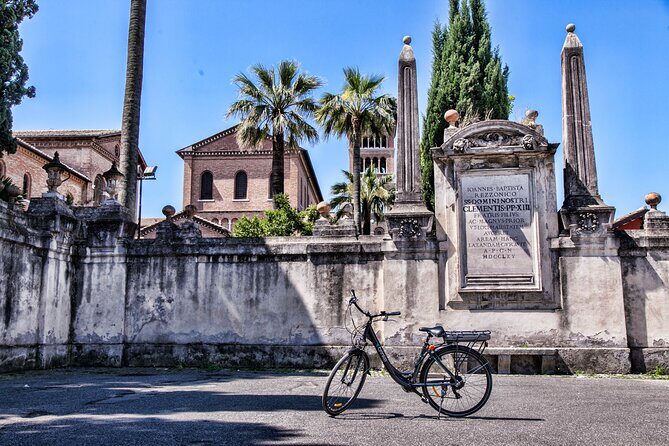
Rome is loud up close. This tour quietly changes the pace. In about 4 hours, you’ll move from major city-sized monuments to calmer open-air landscapes tied to the Via Appia Antica area and the parks built around the aqueduct remains.
The best part is the balance. You’re not just grabbing photos at one or two headlines. You ride, pause, ride again, and each stop adds a different angle on how ancient Rome functioned: entertainment (Circus Maximus), civic life (Baths of Caracalla), boundary walls (Porta San Sebastiano), burial spaces (catacombs), and everyday prestige (tombs and villas), capped with aqueduct scenery and Egeria’s legend.
And yes, the electric bike matters. Even on a route that includes rough sections, you’re not fighting the bike the whole time—you’re using the power to keep momentum, then focusing on staying steady when the ground turns uneven.
You can also read our reviews of more cycling tours in Rome
Meeting point: Via dei Cerchi, and getting rolling fast
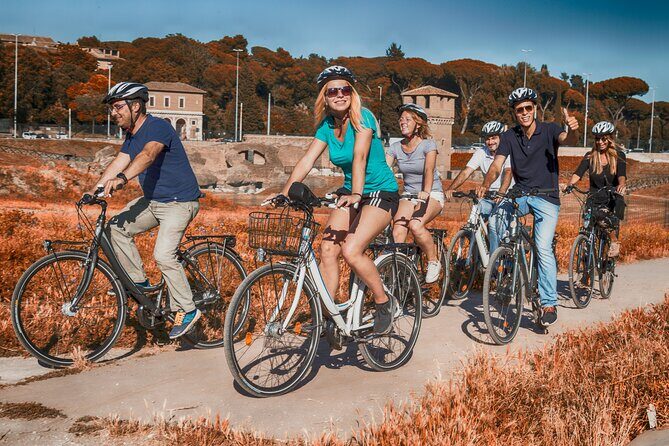
You’ll meet at Via dei Cerchi, 59, 00186 Roma RM. The tour is designed to be efficient: once you’re equipped, you’re out in the route instead of spending the morning in a classroom-style briefing.
Included equipment is simple and practical:
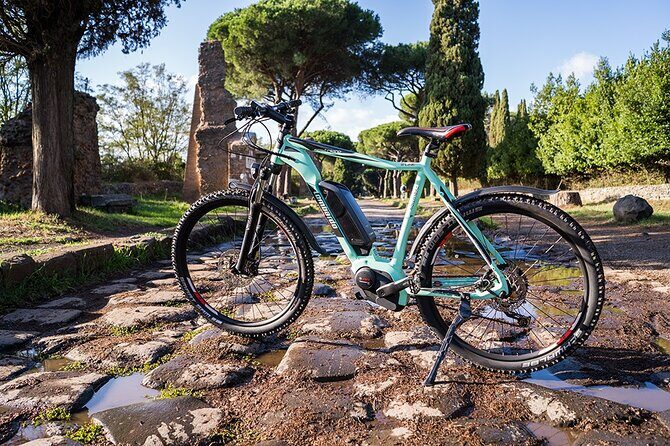
- E-bike (several sizes)
- Helmet
- Mobile phone holder
That last item is small, but useful. You’ll be stopping often, and having your phone where you can grab it without fumbling bags makes the ride smoother.
Because the group size is capped at 10 travelers, you should expect tighter control on transitions—getting on/off the e-bike, regrouping, and moving between stops.
Circus Maximus to Porta San Sebastiano: Rome at full scale, then a surviving wall gate
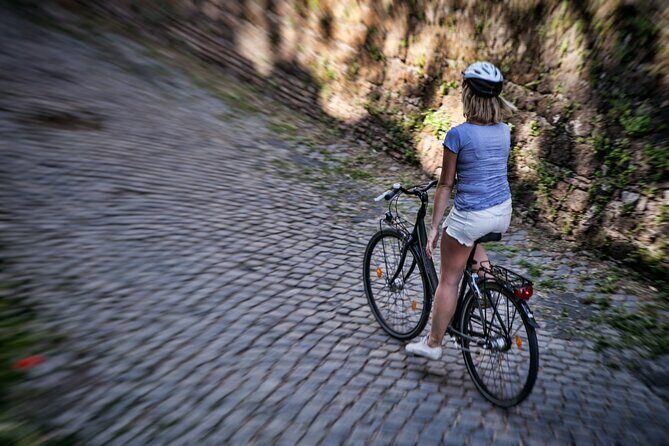
Your first big stop is Circo Massimo (Circus Maximus). This isn’t a tiny relic—you’re looking at a site that was once the first and largest chariot-racing stadium in Rome. The numbers help you picture it: about 621 meters long, 118 meters wide, and capable of seating over 150,000 spectators. You’re also in a valley setting between the Aventine and Palatine hills, which is exactly why this area feels like a natural amphitheater.
Then you roll to Porta San Sebastiano, one of the gates along the Aurelian Walls. This one is notable for being the largest and among the best-preserved in that wall system. Gates are great tour stops because they show you how Rome controlled movement. Even if you’ve seen other ruins, a preserved wall gate gives you a stronger sense of what the city edge once meant.
If you’re the type who likes “how did people live and move” history instead of just “look at the stones,” this pairing is a strong start.
Baths of Caracalla: the civic power of Roman public life
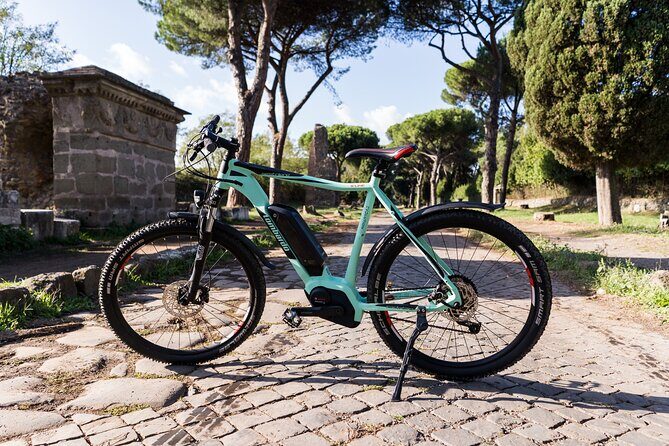
Next up: Terme di Caracalla (Baths of Caracalla). These were the city’s second largest thermae, after the Baths of Diocletian. The timeline is a big part of why I like this stop: built around AD 212 (or 211) to 216/217, then operating until the 530s, before falling into ruin.
Two practical notes matter here:
- Admission is not included.
- Plan on some time to take in scale and layout, even if the ruins feel less “whole” than you expected.
If you’re wondering what the electric bike adds here, it’s this: you’re not just learning about Roman baths as an isolated site. You’re seeing them as a real part of a network of movement—later you’ll ride through parks tied to aqueducts and water systems, so the baths connect more than they would on a purely museum day.
Catacombs of Saint Callixtus and Circus of Maxentius: the quieter drama
Then comes the jump into a very different atmosphere: Catacombs of Saint Callixtus. One of the most helpful details in the tour plan is where it sits in the day. The catacombs are described as being in a nice, almost pedestrian area, which matters because it reduces the stress of switching from road riding to walking in a dense urban knot.
The tour time also respects this transition: you’ve got a 30-minute stop. And it’s marked as free admission in the plan, so you can focus on the visit rather than recalculating budget mid-ride.
After that, you head to Circus of Maxentius, built as part of a complex commissioned by Emperor Maxentius on the Via Appia between AD 306 and 312. Even if you’ve never studied Roman sports, circuses are a great “people history” window: entertainment was political and social, not just leisure.
A useful mindset: this part of the tour feels like it’s slowing down just enough that the history sticks.
You can also read our reviews of more tours and experiences in Rome


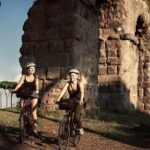

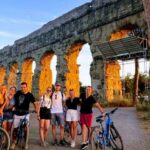
Tombs and villas beyond the fifth milestone: Caecilia Metella and the Quintilii brothers
This stretch is where the day turns into “read the landscape” history.
First, you’ll stop at Mausoleo di Cecilia Metella e Castrum Caetani (Parco Archeologico dell’Appia Antica). It’s one of the best-preserved monuments along the Via Appia area, built in the 1st century BC for Caecilia Metella. The details that help you remember her are family ties: she was the daughter of Quintus Caecilius Metellus Creticus.
Admission at this stop is not included, so it’s smart to plan a little extra for the sites marked that way.
Then you’ll see Villa dei Quintilii and Santa Maria Nova. The villa is described as being beyond the fifth milestone along the Via Appia Antica. That milestone detail is gold for your imagination, because it turns the landscape into a timeline: you’re not guessing how far out you are; you’re moving along a measured ancient route. This villa was built by the brothers Sextus Quintilius Valerius Maximus and Sextus Quintilius Condianus, who were consuls in 151 AD.
Admission is also listed as not included here. Still, this part is often worth budgeting for because it adds a different layer than the big public sites: wealth, status, and country estates built into the travel corridor.
Parco degli Acquedotti and Parco della Caffarella: aqueducts and open green space
Now you get the scenery most people hope for when they choose an Appian Way bike tour: parks that feel like you’ve stepped out of the city without leaving it behind.
In Parco degli Acquedotti, the park’s name tells you what matters. It’s tied to the aqueducts running through the area, including a stretch crossed by the Aqua Felix, plus part of the Aqua Claudia. You’ll also see remains of Villa delle Vignacce and, to the north west, a short stretch of the original Roman Via Latina.
Then you move to Parco Della Caffarella, which sits in the heart of Rome as part of the Parco Regionale Appia Antica. It’s described as the Caffarella Valley, bordered on the north by Via Latina and on the south by the Appian Way. This is the kind of detail you can use while riding: it helps you understand you’re not just in a random park. You’re in a valley shaped by the ancient routes themselves.
Time-wise, you get 40 minutes in the aqueduct park and 30 minutes in Caffarella. That’s enough to take photos, catch your breath, and still keep the momentum of the bike ride.
If you’re heat-sensitive, take this seriously. One hot-day experience mentioned that the ride included drink stops and that the guide handled pacing thoughtfully. You’ll be outdoors, so bring water if you can, and don’t assume food is part of the tour.
Ninfeo di Egeria: the myth behind the water
You finish with Ninfeo di Egeria, a stop built around a legendary early-Rome figure. Egeria is described as a nymph who played a counselor role in early Roman history—associated with Numa Pompilius, Rome’s second king. The story says she imparted laws and rituals tied to ancient Roman religion.
Even if you don’t care about legends, the value here is how it ties culture to place. “Nymph” is myth, but it makes the site feel like more than stones. The information notes that the name Egeria became an eponym for a female advisor or counselor, which is a neat detail to carry with you when you’re looking at a fountain-like structure.
Admission is listed as free in the tour plan, and the stop is 20 minutes, which keeps it from turning into a long mythology lecture.
The ride itself: pace, terrain, and what moderate fitness means
This tour is rated for people with moderate physical fitness. That’s realistic, but here’s the key part: you also need to know how to ride a bike, because this isn’t a learn-to-ride lesson.
Also, the terrain matters more than the distance. Several experiences call out that parts of the route can be bouncy and even rocky. One rider mentioned a minor accident, and another pointed out that you need to handle rough ground. Translation for you: the e-bike helps, but it doesn’t erase uneven stone paths and dirt trails.
What to do with that information:
- Wear your helmet correctly and keep both hands ready for a slightly uneven ride.
- Expect short slower segments where the guide guides the group across rougher stretches.
- If you’re a new rider, this tour might still be doable with an experienced guide, but only if you’re comfortable handling the bike on uneven terrain.
On the plus side, multiple experiences praised how guides navigated busy streets safely and explained things in clear English. Guides like Adriana and Monika were specifically praised for organization and attention to riders, which is exactly what you want when the route mixes city edges with older roads.
Price and value: what $90.02 buys you, and what to budget for
At $90.02 per person for about 4 hours, the headline value is that you’re paying for three things at once:
1) A guided route linking multiple ancient sites,
2) Quality e-bike use (plus helmet and phone holder), and
3) A small group format (max 10).
So you’re not just buying a bike. You’re buying a day plan with stops like Baths of Caracalla, catacombs, circus ruins, aqueduct park scenery, and a myth stop tied to Egeria.
What’s not included matters for your budget:
- Food and drink are not included.
- Tips are not included.
- Admission isn’t included for certain sites: Baths of Caracalla, Mausoleo di Cecilia Metella, and Villa dei Quintilii. (Other stops are marked free in the plan.)
A smart move: treat your total day budget as bike + guidance + a few likely admission fees. If you’re traveling with kids, keep in mind the tour isn’t recommended for children under 12.
Should you book the Appian Way and Aqueducts e-bike tour?
I’d book it if you want Rome history outside the dense central grid. This route is built for people who like variety: major monuments, catacombs, aqueduct parks, and legendary storytelling at a fountain stop. The small group and the guided navigation also make it feel calmer than you’d expect for a bike day.
I’d think twice if you’re uneasy on rocky, bumpy ground or you’re not confident riding a bike yet. The e-bike is helpful, but the terrain is still real.
If you’re planning ahead: this tour is commonly booked about 68 days in advance, so grabbing your spot earlier can help you lock in a time that works with your other Rome plans.
FAQ
How long is the Appian Way and Aqueducts electric bike tour?
It runs for about 4 hours.
Where does the tour start and end?
It starts at Via dei Cerchi, 59, 00186 Roma RM, Italy, and ends back at the meeting point.
Is the tour in English?
Yes, it’s offered in English.
What is included in the price?
Included items are e-bikes (several sizes), a helmet, and a mobile phone holder.
What is not included?
Food and drink and tips are not included. Also, admission is listed as not included for certain stops such as Terme di Caracalla, Mausoleo di Cecilia Metella, and Villa dei Quintilii.
Are there admission fees for all stops?
No. Some stops are marked as free (for example Circo Massimo, Porta San Sebastiano, Catacombs of Saint Callixtus, Circus of Maxentius, Parco degli Acquedotti, Parco della Caffarella, and Ninfeo di Egeria), while others are marked as not included for admission.
Is it suitable for kids?
It’s not recommended for kids under 12.
Do I need to be able to ride a bike?
Yes. It’s not recommended for those who don’t know how to ride a bike.
What fitness level is required?
The tour is recommended for people with a moderate physical fitness level.
What’s the cancellation policy?
You can cancel for a full refund up to 24 hours in advance of the experience start time. If you cancel less than 24 hours before, the amount paid is not refunded.