REVIEW · CATACOMBS TOURS
Appian Way, Catacombs and Aqueducts Park Tour with Top E-Bike
Book on Viator →Operated by Topbike Rental & Tours Di Ciro Muratori Societ Societa' Inaccomandita Semplice · Bookable on Viator
Ancient Rome, two wheels, zero slog. This Appian Way, Catacombs and Aqueducts Park tour links you from Porta San Sebastiano into the Appian Way Park, then out toward the aqueducts and (on the longer option) guided catacombs. I love the e-bikes with anti-puncture tires and the fact the assist helps you enjoy the sights instead of grinding your legs, and I love the small group setup that keeps the day from feeling like a human conveyor belt. The trade-off: you’ll still ride on narrow bike paths and some stretches of city traffic, so this is not the time to “wing it” if you’re a shaky bike rider.
You start at Via Labicana 49, and you get a free helmet plus a front bag and a biodegradable water bottle setup. The route covers about 17 miles (27 km), with roughly 60% off-road in parks—so it’s not just flat pavement sightseeing. I’m also a big fan of how the guides are described (names like Arina, Stefan, Zac, Bita, Lorenzo, Fabio, and Claudia show up), because they tend to slow down at the right moments and explain what you’re actually looking at.
Choose between a 4-hour vs 6-hour plan depending on how much underground time you want. On Wednesdays, the catacombs swap (San Callisto isn’t included in the 4-hour version, and the 6-hour version visits San Sebastiano instead), and the tour can run up to about 30 minutes longer.
In This Review
- Key points worth knowing before you pedal
- Porta San Sebastiano to the Appian Way: the start matters
- Appian Way (Via Appia Antica): where a road becomes a relic
- Catacombs: choosing between a pause and a guided underground visit
- The Wednesday twist (and Easter closure)
- A tone-setter for comfort
- Circus of Maxentius and Cecilia Metella: big ruins, quick meaning
- Quintili Villas and Caracalla Baths: what you gain with the 6-hour route
- Villa dei Quintili and Santa Maria Nova
- Terme di Caracalla
- Parco degli Acquedotti: aqueducts you can actually understand
- The ride reality: traffic, rough paths, and how to stay comfortable
- E-bike value: what you’re really paying for
- Who should book this tour, and who should pass
- Final call: should you book the Appian Way e-bike tour?
- FAQ
- How long is the tour?
- What’s included on the 4-hour vs 6-hour tours?
- Which catacombs are visited?
- What happens on Wednesdays?
- Are there any dates when the 6-hour tour won’t run?
- Do you provide helmets and bike equipment?
- How much of the route is off-road?
- Is the route mostly traffic-free?
- Is food included?
- Can I cancel for a full refund?
Key points worth knowing before you pedal
- Two tour lengths: the 6-hour version adds a guided catacombs visit plus extra major stops.
- Porta San Sebastiano start: you begin at the monumental San Sebastiano gate in the Aurelian Walls.
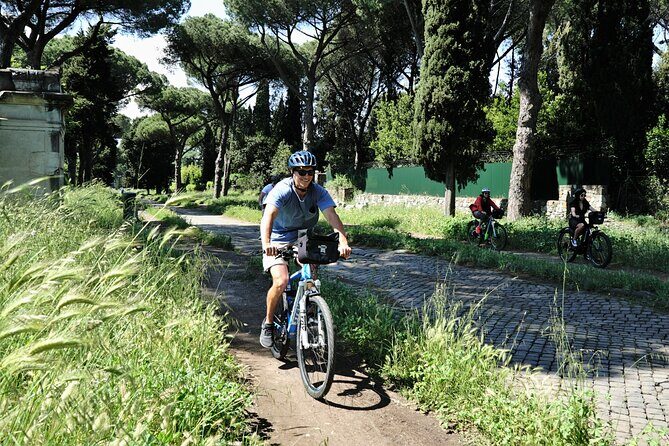
- Real park riding: about 60% of the route is off-road, with limited/no traffic once you’re in the parks.
- Aqueducts with context: you get a guided look at the water-supply system, not just a view from a corner.
- Small groups (max 10): more attention from your guide when questions come up.
- Gear that matters: anti-puncture tires, a required helmet, and a front bag for an easier ride.
Porta San Sebastiano to the Appian Way: the start matters
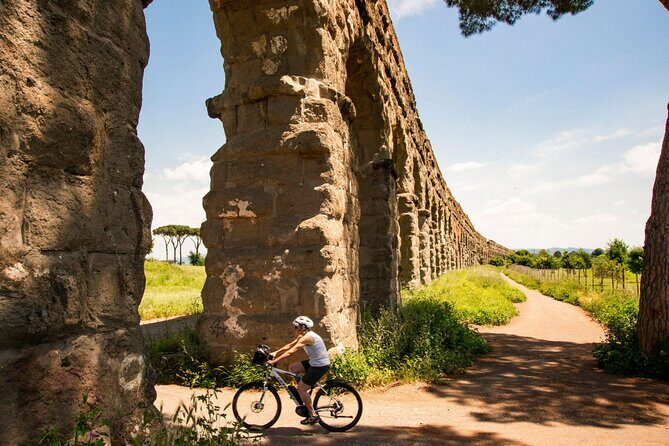
The best part of this tour is how it gets you out of central Rome fast, while still easing you into the day. You begin at Porta San Sebastiano, a gate built into the 3rd-century Aurelian Walls. It’s a dramatic “before and after” moment: city streets give way to the slower rhythm of the Appian Way zone.
Porta San Sebastiano also sets expectations. You’re not just grabbing photos outside a fence. You’re riding, stopping, and learning how this part of Rome functioned—like a guided walk, except you’re moving through the landscape at bike pace.
Practical note: this is a guided tour, but it still includes real riding time. If you want to feel in control, arrive on time so the safety check and helmet fitting don’t cut into your first ride segment.
You can also read our reviews of more cycling tours in Rome
Appian Way (Via Appia Antica): where a road becomes a relic
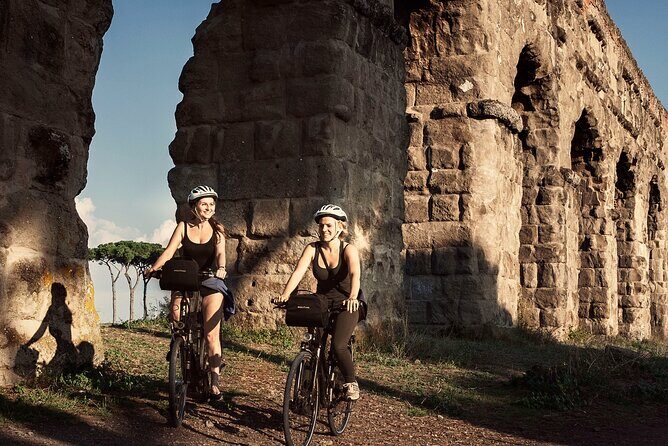
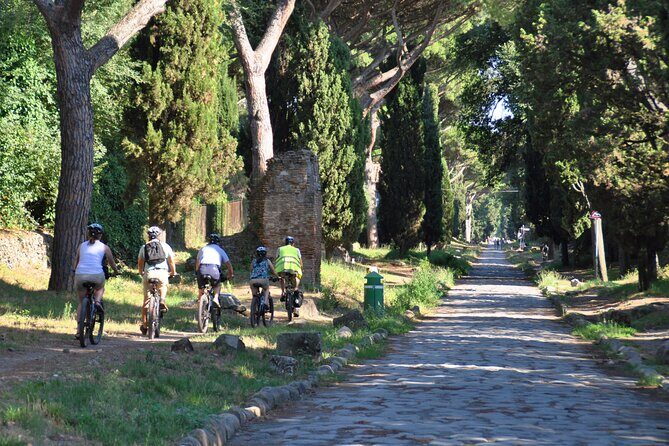
Once you hit the Appian Way, the vibe changes quickly. Via Appia Antica is the kind of road where the present feels quieter because the ancient one is still doing its job: connecting, shaping routes, and keeping history visible.
On this tour, you’ll get a short stop (about 15 minutes) as the road transitions into a more preserved area within the Appian Way Park. That short guided window is exactly what you want if your time in Rome is limited. You’ll see enough to understand the scale, and you won’t burn half your day trying to “master” the area on your own.
Here’s the practical tip: take your photo stops seriously, but don’t expect long “stand here and aim for 10 angles” breaks. You’re on an e-bike, moving through a route, and the guide is managing group flow. If you’re the type who wants more time for photos, do quick captures while the group pauses, and use your longer breaks for the closer shots.
Catacombs: choosing between a pause and a guided underground visit
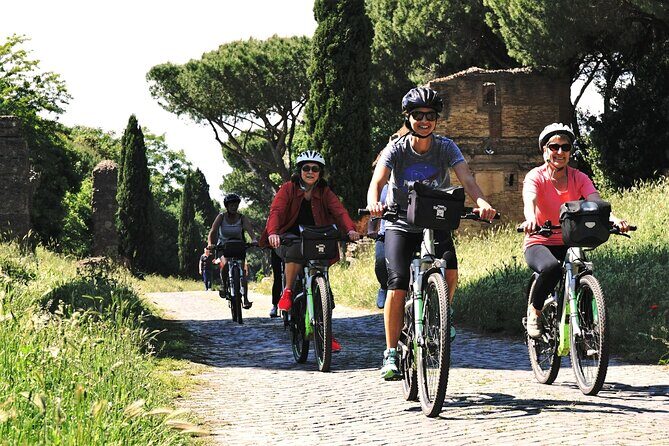
Catacombs are where this tour turns from scenic riding into a real Rome story.
In the 4-hour option, you’ll have a brief pause at Catacombe di San Callisto to contemplate the underground burial site. That’s valuable if you want the stop without committing to a longer indoor schedule.
In the 6-hour option, you get a guided visit of the catacombs—about 45 minutes—so you’re not just looking at passageways. You’re hearing what you’re seeing and how the complex works.
The Wednesday twist (and Easter closure)
This matters enough to plan around it. On Wednesdays:
- The 4-hour tour does not include the Catacombe di San Callisto stop.
- The 6-hour tour visits the Catacombs of San Sebastiano instead of those of San Callixtus.
And one more calendar heads-up: on Easter Sunday (April 5, 2026), the catacombs are closed, so the 6-hour tour won’t run.
A tone-setter for comfort
Catacombs involve tight, enclosed spaces. If you’re someone who gets uncomfortable with claustrophobic areas or crowded entrances, this is where you should choose carefully between the 4-hour pause and the 6-hour guided underground time. The tour is run with safety in mind, but the setting is the setting.
You can also read our reviews of more tours and experiences in Rome




Circus of Maxentius and Cecilia Metella: big ruins, quick meaning
After the Appian Way and catacombs portion (depending on your tour length), you’ll move through a set of major ancient landmarks with short stops. That approach works well on a bike tour: it keeps the day flowing and prevents “ruin fatigue.”
At the Circus of Maxentius, you’ll see the vestiges of a 4th-century Imperial complex that included a villa, a mausoleum, and a circus (a chariot racetrack venue). The stop is brief, but it’s a good primer on how ancient Rome wasn’t just temples and streets—it was also entertainment and power.
Then comes Mausoleo di Cecilia Metella e Castrum Caetani, one of the largest and best-preserved monuments on this stretch. It’s a 1st-century funerary building dedicated to the memory of a young girl from a patrician family. Even with limited time at the site, the scale lands fast because you’re actually seeing a landmark that’s meant to dominate.
Short stops sound “quick,” but they’re efficient. You’ll leave each one knowing what it is and why it mattered, without sacrificing the ride time that makes this day special.
Quintili Villas and Caracalla Baths: what you gain with the 6-hour route
If you go for the 6-hour option, you’ll add two major “wow” elements that you miss in the shorter plan.
Villa dei Quintili and Santa Maria Nova
You’ll stop at the Villa dei Quintili complex—an expansive 2nd-century private villa tied to two of the richest brothers in Roman Imperial history. This is one of those places where a short guided explanation helps more than you might expect. You can see the scale without needing a long lecture, and the guide ties the ruins to how elite life worked back then.
This stop is only included in the 6-hour tour, so it’s the clearest reason to choose the longer day if you like variety.
Terme di Caracalla
You’ll also see Terme di Caracalla from a strong viewpoint. The tour connects the baths to daily social life in ancient Rome, which helps you understand why baths were more than “public showers.” They were a hub for meetings, routines, and status—part of how people organized their day.
If you’re a Colosseum-and-Vatican person, this is the curveball you might not plan on. Baths aren’t always on the first draft of a Rome itinerary, but they fit beautifully here because you’re already riding through the machinery of the city—roads, water, and public spaces.
Parco degli Acquedotti: aqueducts you can actually understand
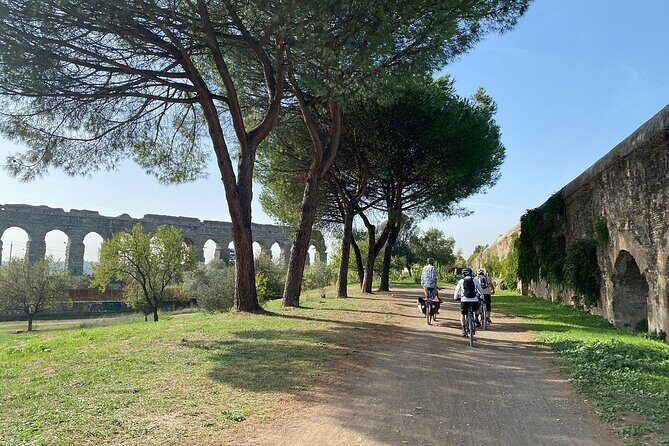
This is the moment you start noticing why aqueducts changed Rome so much. It’s easy to look at an aqueduct and think it’s just stone arches. The guide work here is what turns it into a system.
At Parco degli Acquedotti, you’ll get a guided explanation of the massive water-supply system that combined underground and arch-borne sections. You’re seeing a structure built to move water across distance, and you’re hearing how that shaped daily life in the city.
The ride also helps your brain. When you travel by bike, you’re not trapped inside a bus viewpoint. You can feel the approach to the park, and you get those quiet stretches where the sounds drop and the stones dominate your attention.
The ride reality: traffic, rough paths, and how to stay comfortable
Let’s talk about what makes or breaks bike tours in Rome: the riding surface and the traffic patches.
This route includes about 40% city streets, with carefully chosen roads and some unavoidable traffic to connect the parks. The good news is that in the remaining 60%—when you’re in the parks—you encounter no traffic. That “no-traffic rhythm” is one of the biggest reasons the day feels manageable.
That said, parks can be bumpy. Trails here aren’t smooth like a bike path at home. If you have back or neck issues, keep that in mind and expect jolts on rougher ground. The e-bike helps with effort, but it doesn’t magically erase road texture.
Speed is another factor. This is a group tour, and the guide keeps everyone together for safety. So you’re unlikely to feel like you’re racing down the Appian Way. If you like slow, steady, photo-friendly pacing, you’ll probably love it. If you’re hoping to sprint, this isn’t that kind of day.
And yes—helmets are mandatory and provided. You’ll be asked to wear one, which is a good sign that the operator is treating safety as part of the experience, not an afterthought.
E-bike value: what you’re really paying for
At $102.79 per person, you’re paying for more than a rental. You’re buying:
- a top-quality e-bike setup (including anti-puncture tires),
- a local guide who leads you between ancient sites,
- and, on the 6-hour version, a guided catacombs visit.
You also get a front bag and a water bottle, and the tour includes admission ticket access for the stops listed as free. Food and drinks aren’t included, but there are chances to buy something along the route during breaks.
Here’s how I’d think about value: if you tried to DIY this area by public transport and walking, you’d spend real time getting between ruins. The bike portion solves the distance problem, and the guide portion solves the meaning problem. For many people, that combo is the sweet spot—especially if you’re doing only a few days in Rome.
One more small indicator: this tour is booked, on average, about 53 days in advance. That usually means it’s popular with good reason. If your dates are fixed, booking earlier helps you get the time slot you want.
Who should book this tour, and who should pass
This tour fits best if you:
- want to see several major Appian Way and aqueduct sites in one day,
- like a guided stop style (short pauses, then back on the bike),
- and you can ride a bike with confidence on mixed surfaces.
You should be cautious if you:
- are not self-confident on a bike (the operator explicitly says it’s not recommended),
- have concerns with bumpy terrain (back/neck comfort),
- or you’re very sensitive to enclosed spaces if you choose the guided catacombs version.
It’s also a strong fit for older kids who can ride independently. For ages 5–8, a child extension is provided; ages 9 and above can ride an appropriately sized e-bike. If you’re bringing a child seat or extension, the difficulty can feel tougher.
Final call: should you book the Appian Way e-bike tour?
Book this tour if you want the Appian Way and aqueduct area without the walking slog, and you want a guide connecting ruins, roads, water, and underground spaces into one coherent day. The small group size and the mix of off-road park time with short, purposeful stops make it a practical way to see “out there” Rome.
Skip it (or choose the shorter approach) if bike confidence is shaky for you, your comfort level with enclosed areas is low, or rough surfaces would likely bother you. In that case, you might enjoy a different style of tour that’s more walking-based or more strictly accessible.
If you’re on the fence between durations, the 6-hour version is the choice when catacombs and extra ruins like the Quintili villas and Caracalla baths matter to you. If you want a lighter underground commitment, the 4-hour option still gets you onto the Appian Way with a calmer schedule.
FAQ
How long is the tour?
The tour runs about 4 to 6 hours, depending on the version you choose.
What’s included on the 4-hour vs 6-hour tours?
On the 4-hour tour, you get a short catacombs pause at Catacombe di San Callisto (and on Wednesdays, that stop isn’t included). On the 6-hour tour, you get a guided catacombs visit (about 45 minutes) plus additional stops like Villa dei Quintili/Santa Maria Nova and Terme di Caracalla.
Which catacombs are visited?
For the 6-hour tour, it’s Catacombe di San Callisto normally, but on Wednesdays it switches to the Catacombs of San Sebastiano. The 4-hour tour includes a pause at San Callisto normally, but not on Wednesdays.
What happens on Wednesdays?
On Wednesdays, the route deviates. The catacombs stop changes: the 4-hour tour does not include Catacombe di San Callisto, and the 6-hour tour goes to Catacombs of San Sebastiano instead. The tour may also run up to about 30 minutes longer.
Are there any dates when the 6-hour tour won’t run?
On Easter Sunday (April 5, 2026), the catacombs are closed, so the 6-hour tour won’t run.
Do you provide helmets and bike equipment?
Yes. Helmets are mandatory and provided for free. You also get a top-quality e-bike with anti-puncture tires, plus a front bag and a water bottle (biodegradable).
How much of the route is off-road?
You’ll cover about 17 miles (27 km) overall, with about 60% of the route taking place off-road.
Is the route mostly traffic-free?
Not entirely. About 40% of the route is in the city, where carefully chosen streets include some traffic connections. The remaining 60% is in parks with no traffic.
Is food included?
No. The tour doesn’t include food or drinks, but the route offers a few possibilities to purchase items during a break.
Can I cancel for a full refund?
Yes. You can cancel up to 24 hours in advance for a full refund. If you cancel less than 24 hours before the start time, the amount paid isn’t refunded.