REVIEW · 1-DAY TOURS
From Rome: Ostia Antica Guided Half-Day Trip by Train
Book on GetYourGuide →Operated by City Wonders Ltd. · Bookable on GetYourGuide
This Roman port is shockingly easy to reach.
A guided half-day to Ostia Antica lets you step into a working corner of ancient Rome: a commercial and military seaport that fed the city and shaped daily life. You take the train from central Rome with your guide, then spend about three hours walking the archaeological park like a local—down the main street, past warehouses and taverns, and through spaces that tell you how ordinary Romans really lived.
What I really like is how train-and-walk simple it feels, thanks to a small-group format (up to 12). Two things I love are the Decumanus Maximus stroll with Roman statue-lined walkways, and the Baths of Neptune stop with its famous sea-god mosaic (the one showing the sea god drawn by a 4-horse chariot). One possible drawback: Ostia Antica involves lots of walking on uneven ground, and the tour isn’t suitable for wheelchair users.
In This Review
- Key highlights worth your time
- Why Ostia Antica feels different from the big-name ruins
- Meeting at Cafe Piramide and getting to the ruins by train
- The guided walk along Decumanus Maximus: the closest thing to time travel
- Baths of Neptune: the mosaic that makes the whole room glow
- Forica public washrooms: the most human moment in the park
- Amphitheater seating for 3,500: imagining the noise
- What to do after the tour: Ostia Antica, modern Ostia, or the beach
- Guides make the difference: Rob, Cat, Alberto, Laura, and more
- Price and value: what you’re paying for at $58
- Who should book this Ostia Antica by-train tour
- Tips that actually help on the ground
- Should you book this train-guided Ostia Antica trip?
- FAQ
- How long is the Ostia Antica guided half-day trip?
- Where do I meet the group in Rome?
- What’s included in the price?
- How do I return to Rome after the tour?
- Is there time for a break or snacks?
- Can I stay in Ostia after the guided portion?
- What are the main ruins and sites visited?
- Are baby strollers allowed?
- Is the tour wheelchair accessible?
- What should I bring for the day?
Key highlights worth your time
- Ostia Antica, the Roman harbor city: Built up from the 4th century BC and once home to more than 100,000 people.
- Main-street atmosphere: You’ll walk the Decumanus Maximus thoroughfare, not just bounce between monuments.
- Baths of Neptune mosaic: A crisp, eye-catching reminder that even “everyday” places were decorated.
- Forica public washrooms: The marble bench with 20 spaced holes gives a rare, human feel to the site.
- Amphitheater scale: Built in 12 BC for about 3,500 spectators—big enough to make the crowds feel real.
- Optional free time in Ostia: Stay for the modern town and possibly the beach after your guided portion.
Why Ostia Antica feels different from the big-name ruins
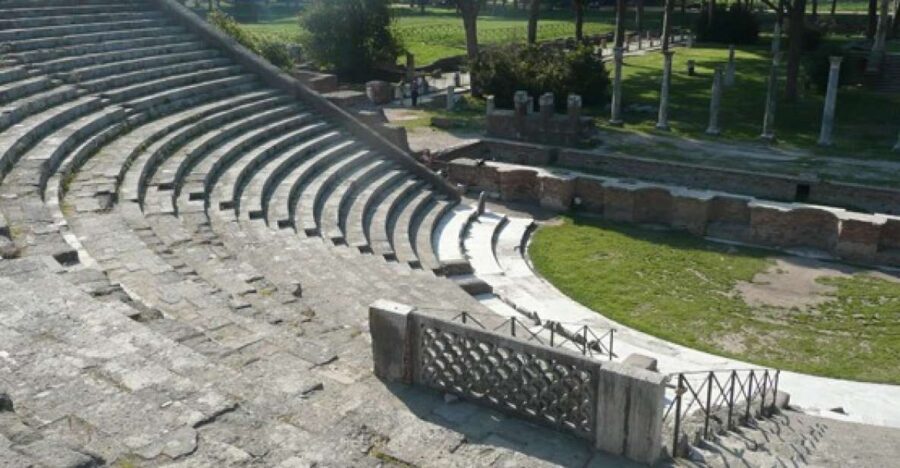
Rome gets all the fireworks, but Ostia Antica is where you see the system behind the story. This was a working harbor town—commercial and military—serving the Roman Republic and beyond. Instead of emperors in marble portraits, you get trade, storage, food, crowds, and routine.
The archaeological park is also big enough to feel like a real place, not just a set of highlights. You’re walking through neighborhoods that once held taverns, thermal baths, warehouses, and theaters, all connected by streets. And because it’s not as crowded as some other famous sites near Rome, you can actually take in details without the “stop, pose, shuffle” rhythm.
It helps that the guided format is built around everyday life. The goal isn’t only to show what’s standing—it’s to explain what that space was used for. When your guide points out how public spaces worked (like bathing, eating, and even using communal washrooms), the ruins become more than stone. They become routine.
You can also read our reviews of more guided tours in Rome



Meeting at Cafe Piramide and getting to the ruins by train
The trip starts with a very Rome-style meetup: Cafe Piramide by the Piramide Metro station (Line B, the blue line). When you’re facing the metro, the café is on your right, in view of the tracks and the exit from the trains. You’ll spot it fast by the white umbrellas outside.
From there, you’ll board the train and head toward Ostia Antica—about 15 minutes on the way out. The pace is easy: you’re not wrestling with parking, and you’re not doing complicated transfers. Your guide handles the group and provides return train tickets. The group itself is limited to 12 participants, which makes it easier to hear explanations without craning your neck.
A practical point: the tour ends back in Rome at Piramide Metro Station at about 1:00 PM. If you choose to stay in Ostia Antica or the modern town, your return journey on the train is unescorted—but you’ll still have the tickets provided. And if public transport ever gets disrupted, a minibus can be arranged at no extra cost to transfer people to and from Ostia.
The guided walk along Decumanus Maximus: the closest thing to time travel
Once you’re in Ostia Antica, the guide’s job is to help you read the site. You’re not just seeing isolated ruins; you’re following a route that mirrors how people moved through the town.
The headline street is Decumanus Maximus—the main thoroughfare. Walking it gives you the “streets of a city” feeling you don’t get when you only pop into one building at a time. As you go, you’ll see Roman statues lining the walkways and understand where they were placed in relation to public life.
This is also where the “Roman port town” theme becomes real. Ostia wasn’t built for tourists. It was built for work and movement. So your guide connects architecture to function—how commerce spaces fed the economy, how thermal baths were part of daily social time, and how theaters and other public areas pulled people together.
Even if you’ve visited other ancient sites, Ostia has a different texture. You get a more grounded sense of daily rhythms. And because the site is large, having someone who can keep the group moving to the right zones makes your three hours feel like real progress, not aimless wandering.
Baths of Neptune: the mosaic that makes the whole room glow
One stop you should look forward to is the Baths of Neptune. The key feature is the mosaic showing Neptune (the sea god) being drawn by a 4-horse chariot. It’s visually striking, but what’s more important is what it tells you: even “routine” places—places for bathing and relaxing—were treated like important public spaces.
Your guide will point out how the bath complex fit into everyday life. You’re not just seeing decoration. You’re seeing leisure and social time built into Roman routines. And mosaics like this one help you picture how bright, colorful, and intentionally designed these areas were.
If you’re visiting in warm months (and you should be ready for sun and heat in Lazio), this area also helps you break the day into manageable chunks: you walk, you stop, you look closely, then you move on. Some guides are especially good at timing shade and breaks. In the reviews, guides are praised for finding comfort on hot days, which is a real quality-of-life factor at Ostia.
Forica public washrooms: the most human moment in the park
If there’s one place that turns ancient history into something you can almost feel, it’s the Forica, the communal washrooms. This isn’t glamorous, and that’s the point.
You’ll see a marble bench lined with 20 well-spaced holes along four walls in a large open room. It’s specific, structured, and very practical. The guide’s explanation makes it clear this was a shared facility—part of normal life in a dense city.
For me, this is where Ostia gets under your skin in a good way. Most ruins teach you about power. The Forica teaches you about bodies, routine, and public space design. It’s one of those moments where you realize Roman cities weren’t only temples and speeches—they were also sanitation and daily logistics.
And yes, you’ll likely want a break around here anyway. The tour includes a toilet stop with time for a snack or drink at the snack bar, so you’re not stuck waiting until the end.
You can also read our reviews of more tours and experiences in Rome





Amphitheater seating for 3,500: imagining the noise
The amphitheater is another highlight that works even if you’re not a “sports history” person. It was first built in 12 BC, and it originally held about 3,500 spectators. Standing in or near the space, you can start to picture how loud it must have been when the crowds packed in.
Your guide will set the scene so you’re not only looking at seating patterns. You’ll get a sense of why this kind of venue mattered—public entertainment as a civic experience. Ostia, being a port town, had a steady rhythm of workers and visitors, and that kind of space fits into a world where people needed regular entertainment and social outlets.
This stop also helps your brain connect the dots between earlier areas. You’ve seen daily routines and civic services; now you see where people gathered in a shared public mood.
What to do after the tour: Ostia Antica, modern Ostia, or the beach
One of the smartest parts of this experience is that the guided portion doesn’t trap you on a tight leash. After your walkthrough, you can stay in Ostia Antica and also explore the modern town at your leisure.
There’s even an easy “pick your vibe” option: for those who want more relaxation, the beach can be added on afterward. That’s a nice contrast to the history-heavy morning/early afternoon energy.
A couple useful notes to help you plan your time: some visitors mention that a museum inside the area can close earlier in winter (around 1:30 PM). If you’re visiting in colder months, build your schedule so you’re not counting on late museum hours.
Also, since the tour ends around the museum area, you’re set up to keep walking without losing time. If you love mosaics, streets, and finding details at your own pace, this is a good place to slow down for another hour or two.
Guides make the difference: Rob, Cat, Alberto, Laura, and more
This type of site is big, and the difference between a good day and a great day is often one thing: how well your guide turns ruins into stories you can picture.
The tour is praised for guides who explain clearly and keep the group moving between key zones without feeling rushed. Names that show up in bookings include Rob and Cat, with other guides mentioned like Alberto and Laura. You’ll also see guides described as using humor and even light acting to make Roman life easier to imagine.
It’s not just about facts. At Ostia, the “why” matters: why the Roman city was shaped as a port town, why certain public buildings mattered, and how daily life worked in a place that once held a huge population.
If you’re even slightly interested in how regular people lived, not only what leaders built, a live guide is the entire point of paying for this tour instead of wandering solo.
Price and value: what you’re paying for at $58
At $58 per person, this is one of those deals that feels fair because it bundles the expensive parts. You’re not just paying for a guide—you’re also getting a return train ticket from Rome to the Ostia Antica area and an entry ticket for the archaeological site.
Then there’s the time value. The whole outing runs about 4 hours, including train time and the guided walking portion. You’re getting a structured hit of the site’s most meaningful spaces: the Decumanus Maximus walk, the Baths of Neptune, the Forica, and the amphitheater. For many people, that’s exactly what they want from a half-day—enough depth to feel like you understood the town, without losing a whole afternoon to logistics.
If you’re comparing this to a self-guided visit, the difference is that self-guided means you’re trying to decode a huge, spread-out site with limited context. With a guide, you’re handed the “map” for what you’re seeing—and how it connects to real Roman life.
Who should book this Ostia Antica by-train tour
This tour is a strong match for you if:
- you want a Roman day-trip that feels quieter and less exhausting than the biggest tourist magnets
- you’ve already done something like Pompeii and want a different angle—port town life instead of city-in-disaster
- you like hands-on interpretation: daily routines, public spaces, and the practical side of Roman culture
It’s not a great fit if:
- you need wheelchair accessibility (the tour is not suitable for wheelchair users)
- you’re bringing very young kids who need a stroller (strollers aren’t allowed)
If your goal is to get context fast and see the standout stops without wasting energy, this hits that sweet spot.
Tips that actually help on the ground
Bring comfortable shoes. Ostia is walkable, but it’s also uneven and spread out. If you’re wearing fashion sneakers, you might regret it after the third stop.
Also pack a towel and beachwear if you think you’ll add the beach afterward. You don’t want to change plans just because you forgot one simple item.
Sports shoes are a safe bet for people who hate thinking about footwear mid-tour. And since there’s a toilet break plus snack time built into the flow, you don’t need to freestyle your timing—just use the pause to reset.
Should you book this train-guided Ostia Antica trip?
Yes, if you want the Roman port city experience without stress. This tour works because it combines easy Rome-to-Ostia train logistics, a small-group walk, and a guide who can connect ruins to daily life. The Baths of Neptune mosaic, the Forica washrooms, and the amphitheater scale are exactly the kind of “this makes sense now” moments that a guided format helps you get.
Skip it if mobility is an issue or if you need stroller access. And if you’re the type who only wants a quick photo circuit, you may feel you’re paying for interpretation you won’t use.
If you’re planning a Rome trip and you want one day that feels like real history in real space, Ostia Antica is worth your half-day. And the train makes it one of the least complicated ways to get there.
FAQ
How long is the Ostia Antica guided half-day trip?
The total experience runs about 4 hours, including train time and around 3 hours of guided touring at Ostia Antica.
Where do I meet the group in Rome?
Meet at Cafe Piramide, near the Piramide Metro station (Line B, blue line). The café is visible near the train tracks and the guides will have a City Wonders sign.
What’s included in the price?
You get a return train ticket from Rome to Ostia Antica, the Ostia Antica entry ticket, and a live English-speaking guide.
How do I return to Rome after the tour?
After the tour ends in Rome at Piramide Metro Station (around 1:00 PM), you are free to return by train using the provided tickets, but the return journey is unescorted.
Is there time for a break or snacks?
Yes. There is a toilet break with time for a snack and/or drink at the snack bar.
Can I stay in Ostia after the guided portion?
Yes. You can remain in Ostia and explore the modern town at your leisure after the tour, or head to a nearby beach.
What are the main ruins and sites visited?
You’ll see highlights such as the Decumanus Maximus thoroughfare, the Forica public washrooms, the Baths of Neptune (with its mosaic), and the amphitheater.
Are baby strollers allowed?
No, baby strollers are not allowed.
Is the tour wheelchair accessible?
No. The tour is not suitable for wheelchair users.
What should I bring for the day?
Wear comfortable shoes, and consider bringing a towel, beachwear, and sports shoes, especially if you plan to go to the beach after the tour.