REVIEW · WALKING TOURS
Small-Group Walking Tour of Rome Center with Guide
Book on Viator →Operated by Rome Walkers · Bookable on Viator
Rome’s center clicks faster with a guide. This small-group walking tour threads together big Roman landmarks and everyday city corners, starting at Trajan’s Column and ending by Trevi Fountain. You get clear commentary as you walk, so the streets stop feeling like a blur and start feeling like a timeline.
I especially like the small-group format (max 12), because you’re not stuck staring at someone else’s head. And I really like how the route mixes headline sights with lived-in neighborhoods, like the Jewish Ghetto and the market square of Campo de’ Fiori.
One thing to consider: this experience depends on good weather. If rain hits, the operator may adjust, so you’ll want a flexible day.
In This Review
- Key takeaways
- What You’re Really Buying in This 2.5-Hour Rome Center Walk
- Starting at Trajan’s Column and Trajan’s Market
- Piazza Venezia: Where Rome’s Power Comes Into Focus
- The Jewish Ghetto and Campo de’ Fiori: Two Stops With Real Atmosphere
- Piazza Navona: Baroque Drama You Can Walk Around
- The Pantheon: Ancient Design That Still Reads Clearly
- Piazza di Pietra and Temple of Hadrian: A Small Stop With Big Context
- Trevi Fountain Finish: Closing the Loop in Piazza di Trevi
- Why the Licensed Guide Changes the Experience
- Price Check: Does $40.52 Feel Like Good Value?
- Who Should Book This Walking Tour, and Who Might Skip It
- Should You Book This Small-Group Rome Center Walking Tour?
- FAQ
- How much does the Small-Group Walking Tour of Rome Center cost?
- How long is the tour?
- What group size should I expect?
- Where do I meet, and where does the tour end?
- Do I need a mobile ticket?
- What sights are included on the route?
- What’s included with the tour?
- What happens if weather is poor or I cancel?
Key takeaways
- Max 12 people means more personal attention and easier questions
- Trajan’s Column + Trajan’s Market set up the Roman story from the start
- Jewish Ghetto and Campo de’ Fiori add character beyond the usual monument route
- Piazza Navona and the Pantheon deliver two of Rome’s most impressive set pieces
- Ends at Trevi Fountain, so you finish right where your photos usually begin
What You’re Really Buying in This 2.5-Hour Rome Center Walk
For around $40.52 per person, you’re buying two things: a focused route and a licensed guide to explain what you’re seeing. At 2 hours 30 minutes, the pacing is built for getting your bearings without turning the day into a sprint.
The schedule is straightforward: you meet in the Trajan’s Column area, then you gradually work your way through central Rome, with stops designed to keep you moving but not rushed. You also use a mobile ticket, which is handy in a city where paper can get lost faster than a gelato spoon.
Group size matters here. With a maximum of 12 people, you’re more likely to hear details without constant jostling. And in at least one experience, the group ended up tiny—so the guide could basically talk at full volume to just two people.
You can also read our reviews of more walking tours in Rome


Starting at Trajan’s Column and Trajan’s Market
You begin at Colonna Traiana, completed in AD 113. It’s famous for the spiral bas-relief that shows the wars between Romans and Dacians. Even if you only catch parts of the carvings as you walk around the column, the guide context helps you read it like a story, not just stone.
Right after, you move to Mercati di Traiano – Museo dei Fori Imperiali (Trajan’s Market). This is where the tour’s “Roman logic” really clicks. Trajan’s Market is often described as an early shopping-mall concept, though many now think the arcades served as administrative offices for Emperor Trajan. That small twist is exactly the kind of thing a guide is good at—keeping you curious instead of only impressed.
Both of these stops are listed with admission free, which makes the experience feel like a true walking value. You’re not paying extra to access the viewpoints and main features the guide is explaining.
Piazza Venezia: Where Rome’s Power Comes Into Focus
Next comes Piazza Venezia, one of the city’s best-known squares. It’s a big space with major landmarks pulling your attention in different directions, including the Victor Emmanuel II Monument and Palazzo Venezia.
What I like about this stop is how it functions as an orientation point. You’re no longer just collecting photos—you’re understanding the geography of the city center and how monuments relate to each other. The guide commentary helps you place what came before (ancient Rome) beside what came later (modern national symbolism), and it stops the contrast from feeling random.
If you want one tip for this part: keep your eyes up. In a square like this, the buildings do a lot of the talking.
The Jewish Ghetto and Campo de’ Fiori: Two Stops With Real Atmosphere
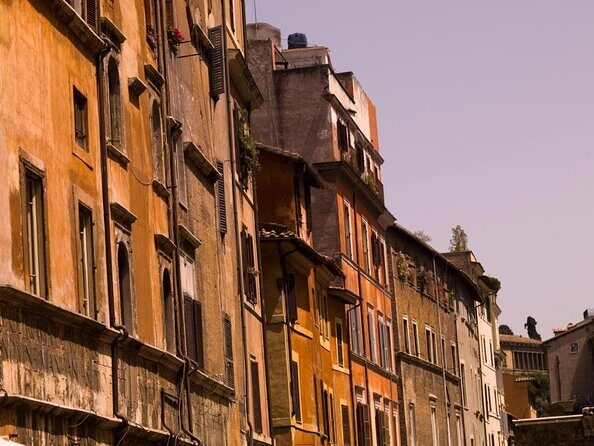
After the major monument area, you step into Antico Quartiere Ebraico, the Jewish Ghetto of Rome. It sits between the Tiber and Piazza Venezia, and it’s one of the less obvious sights for people who plan only the top “postcard list.” The guide framing is important here: it highlights that the Jewish community in Rome is among the oldest in Europe, and it explains how the area has grown into a working neighborhood.
You’ll also learn that the area now includes restaurants, churches, and synagogues—so you see a mix of Jewish culture alongside classic Roman architecture. That blend is what makes this stop feel different from a museum wall: it’s not only history, it’s also daily life layered over time.
Then the tour shifts to Campo de’ Fiori, a square known for its street market. You can browse stalls, soak up the energy, and pick up souvenirs if you want something easy and local. I like pairing these two stops because you get contrast: one is about identity and continuity, and the other is about street rhythm and shopping—both very Rome.
Note: both stops are listed with admission free, so this is all about walking, looking, and hearing the guide’s story.
Piazza Navona: Baroque Drama You Can Walk Around
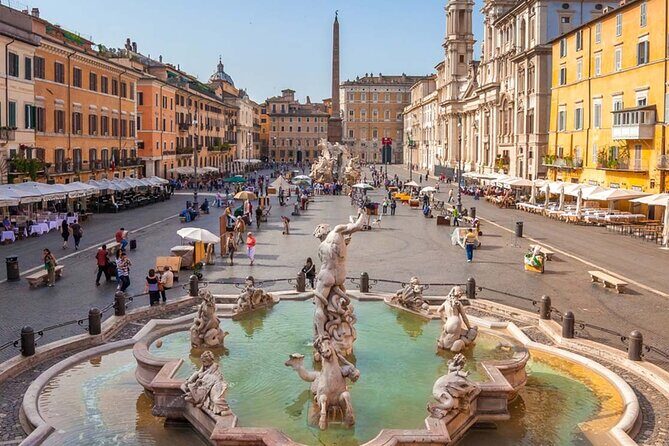
Piazza Navona is one of those places where your camera does most of the work—but your guide still adds the missing layer. The square’s origins trace back to Roman times, when the area hosted a stadium. That matters because it gives you a reason for the shape of the space, not just the pretty facades.
Two landmarks anchor the stop. First is the Fontana dei Quattro Fiumi (Fountain of the Four Rivers) by Bernini. Second is Santa Agnese in Agone, a church that adds height and detail at the edges of the square. The guide helps connect why a baroque square sits on ancient ground, instead of leaving you with only “wow” reactions.
If you tend to get overwhelmed by big plazas, this is a good moment to slow down. Take a few steps around the fountain viewpoint the guide points out, and let the story settle before moving on.
You can also read our reviews of more guided tours in Rome




The Pantheon: Ancient Design That Still Reads Clearly
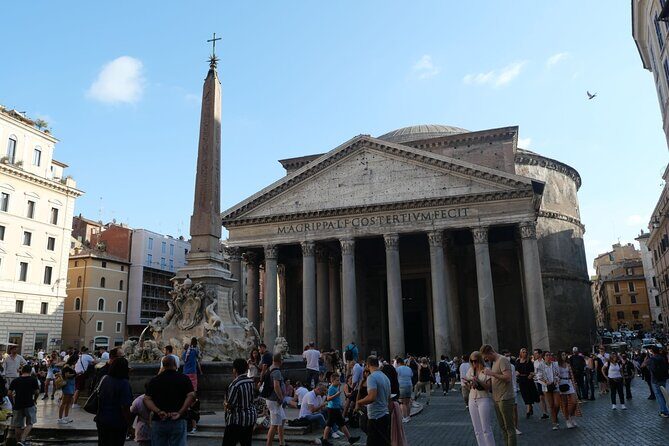
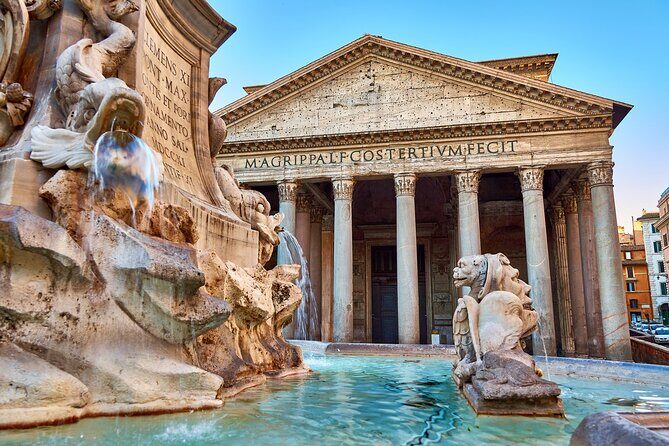
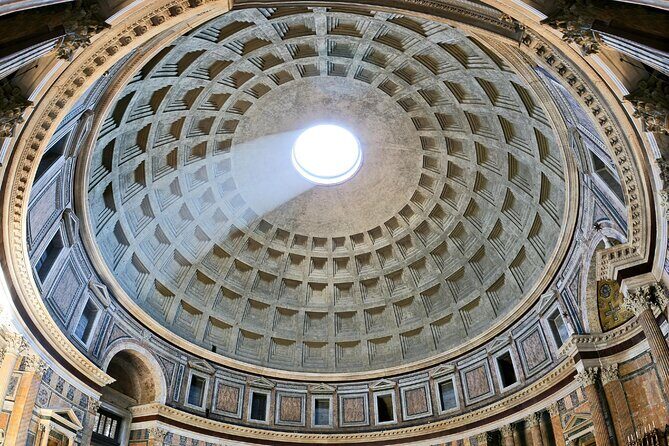
From Piazza Navona, you head to the Pantheon, and this stop is the one that usually makes people quiet (in a good way). The tour highlights how exceptionally well preserved it is and why that matters: it’s a top example of Roman ingenuity.
The key idea the guide gives you is simple and powerful. Originally, it was a temple dedicated to all the gods. Then it was converted into a church in the 7th century. That’s why the building looks so much like the ancient version. Instead of feeling like a ruined shell, it reads like an intentional structure that survived cultural change.
You’ll feel the payoff of the earlier stops here. After Trajan’s column and market, you’re already thinking in terms of “how Rome built and why.” At the Pantheon, you see that approach in stone that still holds up.
The Pantheon stop is listed with admission free. Even if your own experience matches how it works on the ground, the guide’s explanation of the temple-to-church shift is worth the time.
Piazza di Pietra and Temple of Hadrian: A Small Stop With Big Context
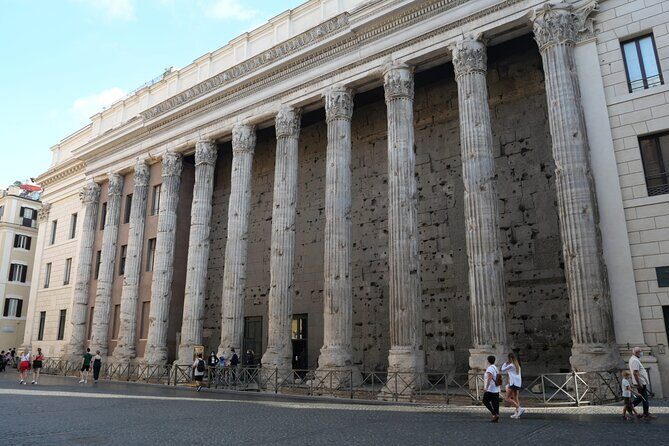
The tour includes Piazza Di Pietra and the Temple of Hadrian. This is a good place for a different kind of attention. Instead of “look at the most famous thing,” you get “look at a specific Roman structure and understand what it represents.”
Because the Temple of Hadrian is dedicated to Emperor Hadrian, the guide framing turns the stop into another chapter of Roman rule and identity. It also breaks up the day so you’re not only going from square to square. A shorter stop here can feel like a mental breather.
You’re again told admission is free at this point, so the stop stays lightweight and focused.
Trevi Fountain Finish: Closing the Loop in Piazza di Trevi
You end at Fontana di Trevi in Piazza di Trevi. The Trevi Fountain is described as the largest Baroque fountain in Rome and arguably the most famous and beautiful fountain in the world—and the guide makes sure you understand what makes it more than a photo background.
Finishing here is a smart design choice. Trevi is the kind of landmark that keeps pulling people back at night and into the next day. By ending there, you can decide what comes next: linger for more photos, grab a nearby bite, or use it as your starting point for a later stroll.
One practical note: bring patience for the ending. Trevi is famous for a reason, and that means it can be busy. The upside of ending the tour here is that you’re not cramming the experience into the middle of your day.
Why the Licensed Guide Changes the Experience
With a route like this, you’ll still see the sights without a guide. But the guide is what turns the walk into something you can actually remember.
I like the way the commentary focuses on basics of Rome’s long history. You start with Roman political messaging at Trajan’s Column, move into Imperial-era architecture at Trajan’s Market, then shift through key public squares and religious community space in the Ghetto. By the time you reach the Pantheon, the story has already been building in your head.
The small-group format makes that easier. With fewer people around, you can ask questions, pause when something grabs your attention, and still keep the overall timing under control.
And the review where the group became just the two of them and their husband highlights the best-case scenario of this setup. A tiny group can make a standard walking tour feel like a private orientation.
Price Check: Does $40.52 Feel Like Good Value?
At $40.52 per person, this is priced like a budget-friendly way to cover a lot of major landmarks quickly. The value comes from the combination of things you get for that price:
- A licensed tour guide for the full 2.5 hours
- A route that hits major sights like Piazza Navona, the Pantheon, and Trevi Fountain
- Additional context-heavy stops like Trajan’s Column and the Jewish Ghetto
- A small group (max 12)
- Admission is listed as free at each stop
If you’re trying to avoid the Rome planning headache—map app scrolling, guesswork, and indecision—this gives you a clear path. You pay once, then you can spend your attention looking up and listening.
Who Should Book This Walking Tour, and Who Might Skip It
This tour fits you if you want a solid overview of central Rome without turning your day into research. It’s great for first-time visitors who want the big monuments plus a couple of parts of the city that feel more local, like Campo de’ Fiori and the Jewish Ghetto.
It can also be a good choice if you like your history in bite-sized, understandable pieces. You’re not being asked to sit through long lectures. You’re walking, stopping, and learning what to notice next.
You might think twice if you want a long, slow deep look at one site. This route is designed for coverage and pacing, not extended stays inside major attractions.
Should You Book This Small-Group Rome Center Walking Tour?
If your goal is to see major central Rome highlights, pick up the basics from a real guide, and end in the Trevi area with energy left for dinner, I’d say yes. The pricing feels fair for what you cover, and the small group makes it more comfortable than the big-bus, big-crowd version of “Rome in a hurry.”
Just plan your day around weather. If the forecast looks unstable, keep a flexible mindset. Rome is Rome—sometimes you walk anyway, sometimes you adjust. This tour is built for good conditions, so check what happens if the weather turns.
FAQ
How much does the Small-Group Walking Tour of Rome Center cost?
It costs $40.52 per person.
How long is the tour?
The duration is about 2 hours 30 minutes.
What group size should I expect?
The tour has a maximum of 12 travelers.
Where do I meet, and where does the tour end?
You start at Trajan’s Column, Via dei Fori Imperiali, 00187 Roma RM, Italy, and you end at Trevi Fountain, Piazza di Trevi, 00187 Roma RM, Italy.
Do I need a mobile ticket?
Yes, the tour uses a mobile ticket.
What sights are included on the route?
The tour includes Trajan’s Column, Mercati di Traiano, Piazza Venezia, the Jewish Ghetto (Antico Quartiere Ebraico), Campo de’ Fiori, Piazza Navona, the Pantheon, Piazza di Pietra (Temple of Hadrian), and Fontana di Trevi.
What’s included with the tour?
A licensed tour guide is included.
What happens if weather is poor or I cancel?
The experience requires good weather. If it’s canceled due to poor weather, you’ll be offered a different date or a full refund. You can cancel for a full refund up to 24 hours in advance.