REVIEW · POMPEII
Private Pompeii & Amalfi Coast Tour: Sorrento & Positano -Tickets
Book on Viator →Operated by Leisure Italy · Bookable on Viator
Roman ruins meet coast views in one day.
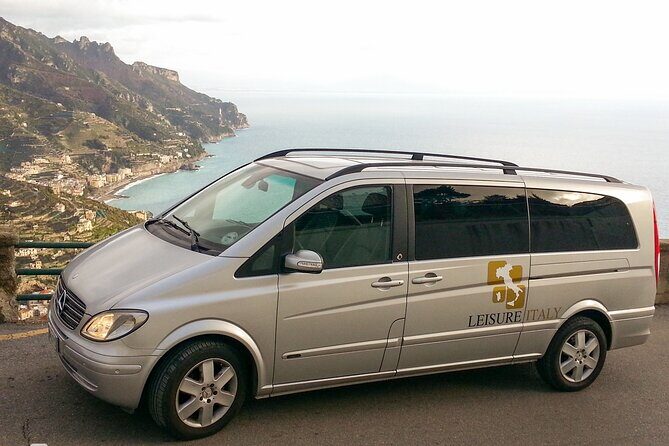
What makes this tour click is the mix of Pompeii priority access with a private Mercedes minivan (A/C, English-speaking driver, live commentary) and then real time to wander Sorrento and Positano on your own. Pompeii is handled with a smart route and an optional guide, so you’re not just shuffled through big-name spots—you get the context that helps the stones make sense.
Two things I like a lot: first, Pompeii is built into the day with admission included and skip-the-line tickets, which matters when you’re squeezed for time. Second, the Amalfi portion isn’t just a bus window—you get a cliff-road entrance via SS145 and then actual town time in both Sorrento and Positano.
One consideration: it’s an 8 to 9 hour day with a fair amount of walking at Pompeii, plus shorter “stop-and-look” moments throughout the ruins. If you want very slow pacing or minimal walking, you’ll need to plan your energy carefully (and use the option to take breaks outside the main entrance).
In This Review
- Key things to know before you go
- What You’ll Actually Get: Priority Pompeii + Private Van + Two Coast Towns
- Pompeii Without the Headache: Priority Access and an Optional Guide
- Porta Marina to the Forum: The Route That Makes Pompeii Click
- Porta Marina e cinta muraria: Arriving the way visitors did
- Basilica: The city’s public machine
- Temple of Apollo: Old religious rhythm near the Forum
- Forum of Pompeii: Civic heart, viewed from smart angles
- Macellum: The food market that kept the city running
- Terme del Foro: Baths as social life
- Elite Homes and City Streets: Casa dei Vettii and the People of Pompeii
- Casa dei Vettii: A wealthy merchant’s statement
- Insula dei Casti Amanti: A neighborhood seen from above
- Theater Time: Teatro Grande and the Sound of a City
- Antiquarium di Pompei: The Emotional and Practical “Decoder Ring”
- The Cliff Road to Sorrento: SS145 Views You Can’t Get Anywhere Else
- Sorrento in a Nutshell: Piazza Tasso, Corso Italia, and Quiet Cloister Time
- Positano on Your Own: Spiaggia Grande and Santa Maria Assunta
- How the Timing Works: Short Stops That Still Add Up
- Price and Value: Does $486.47 Make Sense for This Day?
- Who This Tour Fits Best
- Final Call: Should You Book This Pompeii + Amalfi Day?
- FAQ
- How long is the Pompeii and Amalfi Coast tour?
- Is pickup included?
- Is this tour offered in English?
- Are Pompeii tickets included?
- Is lunch included?
- What do I need to bring on the day of travel?
- Can I cancel for a full refund?
Key things to know before you go
- Pompeii priority entry plus a Pompeii route that hits Forum-area icons and elite homes
- Short, high-impact stops (often 5–10 minutes) that help you see more in less time
- Sorrento and Positano include free time, not just photo stops from the van
- Private Mercedes transport with live onboard commentary and A/C
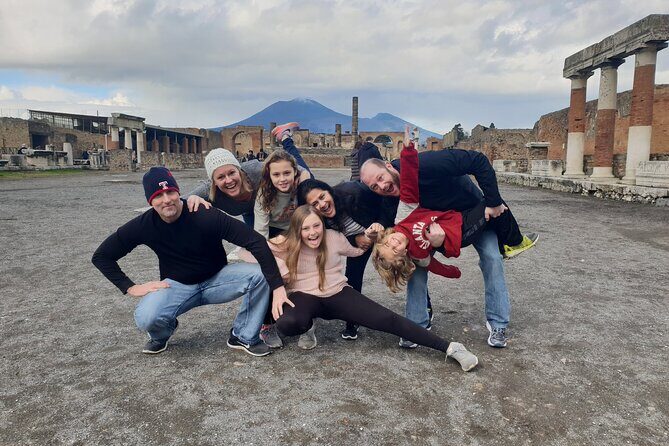
- Family-friendly Pompeii options can include games and kid-focused activities (great for ages 6–11)
What You’ll Actually Get: Priority Pompeii + Private Van + Two Coast Towns
This is built as a full-day “greatest hits” tour without turning it into a running race. You start in Pompeii with tickets handled for you, then you move by private minivan to the Amalfi side of the Bay of Naples, finishing with independent time in Sorrento and Positano.
The price is $486.47 per person for an 8 to 9 hour day. That sounds steep until you break down what’s included: Pompeii Express skip-the-line tickets, Pompeii admission, a private Mercedes Minivan with A/C, and onboard live commentary. If you were to arrange transportation plus timed entry plus a guide yourself, it usually stops being cheaper fast—especially for a day that also includes Amalfi Coast driving and time in two towns.
Your group stays private. That means you’re not stuck watching someone else’s pace. It also means your driver can adjust timing where possible, which matters on roads around the coast.
Who it’s best for: history lovers who also want scenery, couples doing a one-day sprint, and families who need structure but still want freedom to roam.
You can also read our reviews of more tours and experiences in Pompeii


Pompeii Without the Headache: Priority Access and an Optional Guide
Pompeii is one of those places that punishes you for arriving unprepared. Lines eat time. Confusing routes waste time. This tour reduces both problems with Pompeii Express skip-the-line tickets and admission included.
You’ll begin with time at the Archaeological Park of Pompeii, where your private guide (optional) picks key highlights. This is the part where learning matters. The ruins are impressive on their own, but they become understandable when someone connects buildings to daily life—shopping, justice, worship, bathing, entertainment, and home routines.
Two practical perks:
- If you truly don’t want to walk through everything, there are cafés and gift shops right outside the entrance where you can regroup.
- The tour is structured in short segments—many stops are listed as 5 to 10 minutes—so you won’t spend the whole day stuck at only one monument.
For the emotional part of Pompeii, you’ll also encounter the Antiquarium di Pompei later, which is essentially your decoding tool. It puts artifacts and context in front of you before you move deeper into the open ruins.
Porta Marina to the Forum: The Route That Makes Pompeii Click
The Pompeii walk is arranged to move you through the city’s civic and social core, then outward to standout religious, residential, and entertainment areas. Here’s what you’ll get from the main anchor stops.
Porta Marina e cinta muraria: Arriving the way visitors did
You’ll see Porta Marina, one of Pompeii’s main gates, tied to access through the port area and the defensive wall system. This is quick—about 5 minutes—but it’s a powerful “how people entered the city” moment. You can walk along the original stone ramp, and you’ll get the sense that Pompeii wasn’t just open-air ruins. It was a functioning city with controlled entry for merchants, sailors, and travelers arriving from the Bay of Naples.
Basilica: The city’s public machine
Next comes the Basilica, built in the 2nd century BC. Think law, business, and politics under tall columns. It’s an open rectangular space where merchants negotiated and magistrates issued rulings. Even if you’re not a Roman-law fan, this stop helps you picture how “public life” worked in a city where forums weren’t just for speeches.
You can also read our reviews of more private tours in Pompeii





Temple of Apollo: Old religious rhythm near the Forum
The Temple of Apollo is one of Pompeii’s oldest religious sites. Dedicated to Apollo—sun, music, and prophecy—this space sits near the Forum area, in a large open courtyard where offerings were made and guidance sought. If you like the idea of Pompeii as a place where people met their gods in ordinary daily routines, this stop lands well.
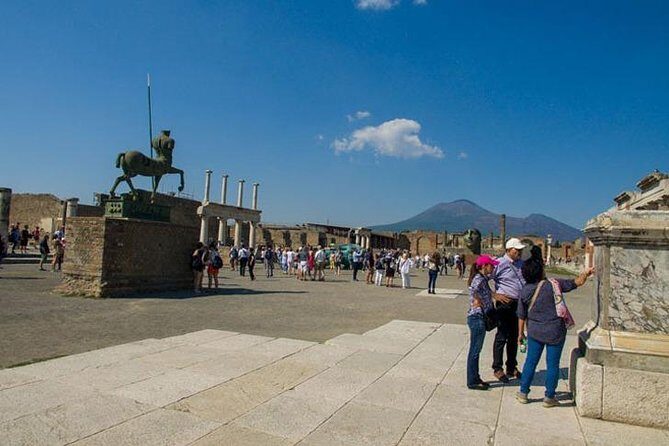
Forum of Pompeii: Civic heart, viewed from smart angles
The Forum is where the city’s roles overlap: religion, politics, and commerce. You’ll be able to observe the arrangement of temples and administrative buildings from terraces and modern walkways around the square. The advantage here is the viewpoint. Being a bit elevated makes it easier to understand how monumental buildings framed a bustling civic space, with Mount Vesuvius looming in the background.
You’ll also see key structures referenced in the Forum area: the Capitolium, Basilica, and Macellum all in view from these elevated perspectives.
Macellum: The food market that kept the city running
The Macellum was Pompeii’s main food market—a covered complex where vendors sold fish, meat, fruit, and imported items. This stop is about more than architecture. It’s about the organization of Roman commerce and, honestly, the importance of food supply in city life. The preserved counters and marble tables help you visualize the day-to-day bustle of shoppers and traders.
Terme del Foro: Baths as social life
The Forum Baths (Terme del Foro) are among Pompeii’s most elegant public bath complexes. You’ll learn how the layout separated men’s and women’s sections, with warm and hot bathing halls plus a cold plunge pool. A hypocaust system provided heating under the floors, and you’ll still see stucco reliefs and vaulted ceilings—details that make the bath stop feel like more than a ruin.
This is also a good “breather stop.” If you’re tired from walking, baths provide a calmer visual focus for a few minutes.
Elite Homes and City Streets: Casa dei Vettii and the People of Pompeii
After the civic and market core, the route shifts into elite residence and working neighborhood detail. This is where Pompeii stops being only public buildings and starts feeling human.
Casa dei Vettii: A wealthy merchant’s statement
The House of the Vettii is one of Pompeii’s finest aristocratic homes. Built around atria and a peristyle garden, it shows the lifestyle and aspirations of wealthy merchant owners in the 1st century AD. The standout is the frescoes—mythological paintings and ornamental motifs—plus the refined layout of domestic spaces.
This stop is about taste and daily life. Pompeii wasn’t only survival and disaster. It was also art, status, and home routines.
Insula dei Casti Amanti: A neighborhood seen from above
The Insula dei Casti Amanti is a residential and commercial block named after a famous fresco showing a couple sharing an affectionate moment. The big practical detail: you access the site via elevated ramps. That means you can view workshops, storerooms, and domestic rooms below without disturbing fragile surfaces.
From above, it’s easier to picture craftsmen at work and families moving between spaces—because Pompeii’s trade and home life were close together. You’ll also see preserved painted signs and signs of mid-renovation work, which adds a strange realism: it feels like the neighborhood was caught mid-routine right before AD 79.
Theater Time: Teatro Grande and the Sound of a City
The Teatro Grande is the Roman entertainment stop that helps Pompeii feel like a place with evenings, performances, and crowds. You’ll look down onto semicircular seating tiers and the stage building, including the orchestra area where musicians and dancers performed.
The site has excellent acoustics, and the views toward the city and Mount Vesuvius help explain why performances drew people in large numbers. Even with short time on the clock, this stop is worth it for the sense of scale and the “imagine the crowd” effect.
If you’re a photo person, the theater overlooks give you a natural framing line—ruins, seating curves, and that unmistakable Vesuvius silhouette in the distance.
Antiquarium di Pompei: The Emotional and Practical “Decoder Ring”
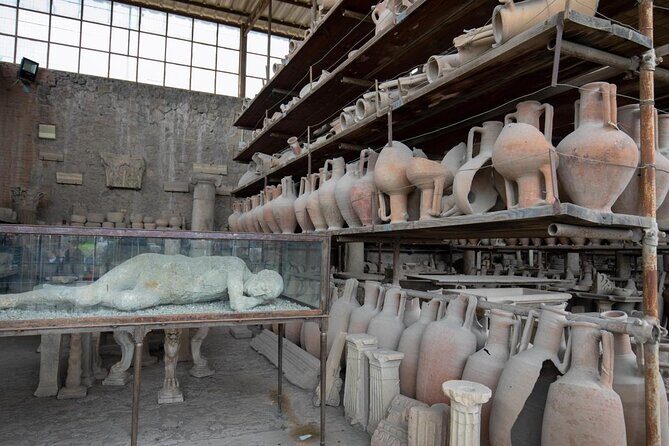
Before you leave the Pompeii learning zone, the Antiquarium di Pompei acts like a museum bridge. You’ll walk through well-organized galleries filled with statues, household objects, inscriptions, jewelry, and other excavation finds—things that can’t survive outside in the open air.
It’s useful because glass cases and interpretive panels help you connect objects to the city you just walked through. And the final rooms include plaster casts of victims and dramatic eruption material. It’s the part of the day that hits hardest, not because it’s sensational, but because it makes the story personal and real.
If you get emotionally affected easily, plan to take a slow pace here and don’t rush yourself.
The Cliff Road to Sorrento: SS145 Views You Can’t Get Anywhere Else

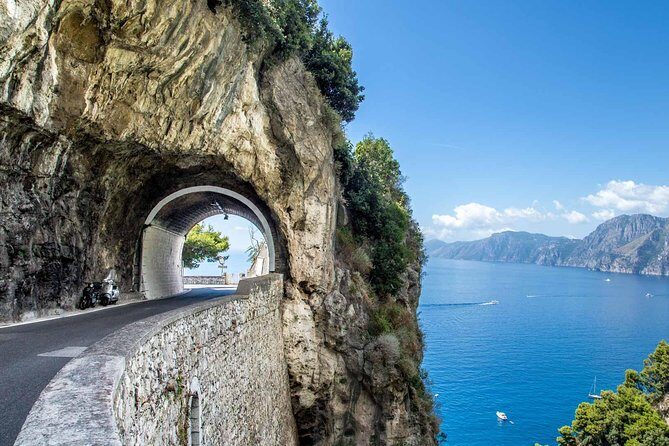
Once you leave Pompeii, the day pivots to scenery. You’ll travel along Strada Statale 145 (SS145), a cliff road approach into Sorrento that gives you sweeping views of the Bay of Naples. From the vehicle, you can spot terraced lemon groves, small ports, and fishing villages, with glimpses of Mount Vesuvius across the water.
This section matters because it resets your brain. Pompeii is heavy and focused. Then you get a wide horizon and a chance to catch your breath—plus the kind of “I get it now” coastal feeling that makes the day feel complete.
Sorrento in a Nutshell: Piazza Tasso, Corso Italia, and Quiet Cloister Time
You’ll get about an hour in Sorrento on your own. That’s not enough to see everything, but it’s enough to feel the town and hit the basics without panic.
As you enter the historic center, narrow lanes lead to cafés, boutique shops, and artisan spots. The atmosphere is lively but not chaotic, with a mix of medieval, baroque, and 19th-century architecture—and that distinctive citrus vibe you’ll smell long before you find the souvenir shops.
Here are the places you’ll naturally orbit:
- Piazza Tasso: Sorrento’s social square. It’s ideal for a coffee pause or gelato, while you watch scooters and day-trippers flow through.
- Corso Italia: the main promenade with shops and limoncello producers. Wide sidewalks make it easy to stroll and people-watch, especially later in the afternoon.
- Cloister of San Francesco: a calmer pocket with a portico and pointed arches. It’s a nice change of pace if you want a quiet moment before heading to Positano.
If you want one practical move: plan your hour around one drink and one viewpoint terrace. Don’t overstuff it.
Positano on Your Own: Spiaggia Grande and Santa Maria Assunta
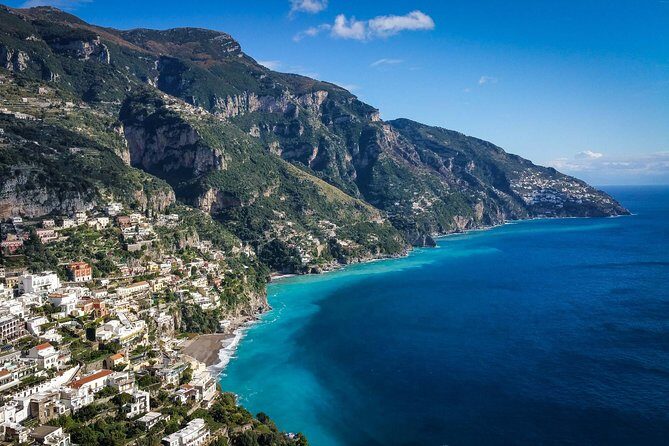
Positano is the “wow” town, and the approach along the Amalfi Coast road sets up the scene. You’ll see the town rising from the sea in layers of pastel houses, narrow stairways, and domed churches. The drive-in is what gives you that instantly recognizable postcard silhouette.
Then you get about an hour to explore, which is perfect for a focused loop:
- Spiaggia Grande: the main beach at the base of the cliff houses. It’s a lively visual center, and it also functions as a hub for ferries to nearby towns and seasonal coastal boat trips.
- Chiesa di Santa Maria Assunta: Positano’s iconic landmark with a colorful majolica-tiled dome. Inside, you’ll find a Baroque interior and the 13th-century Byzantine icon of the Black Madonna. Even if you don’t go deep into the art, stepping into the church is a real contrast from the street energy outside.
From the church steps, you’ll get one of the best “Positano in one frame” viewpoints looking back toward the beach and harbor.
How the Timing Works: Short Stops That Still Add Up
The itinerary is designed around momentum. Many Pompeii stops are 5 minutes, while others stretch to 10 minutes, and the main Pompeii exploration is around 2 hours. That means:
- You’ll see a lot of Pompeii in one day
- You won’t be stuck at only one section
- You’ll want comfortable shoes because the walking is continuous even if the “looks” are short
Also, the tour is described as customizable—so if your interest runs heavier toward architecture versus markets, you should be able to shape the pace within reason. Bring sun protection and keep water in mind. Amalfi towns can feel sunny even when the light changes fast.
Price and Value: Does $486.47 Make Sense for This Day?
Here’s how I’d judge the value, without hand-waving.
You’re paying for:
- Pompeii Express skip-the-line tickets
- Pompeii admission tickets included
- Private Mercedes transportation with A/C
- Live commentary on board
- Time in Sorrento and Positano that doesn’t require you to manage routes between towns
The main item not included is lunch (if you request it). That’s normal for tours like this, but it means you’ll want to plan your food either as a quick bite near Pompeii or as a café stop in Sorrento/Positano during your free hour.
If you compare alternatives, the price often starts to look fair when you factor in your time saved on Pompeii entry and the convenience of a private vehicle plus commentary. You also get independence at the last two towns, which you can’t always get when you’re locked into a strictly guided sightseeing schedule.
Who This Tour Fits Best
I’d point you toward this tour if:
- You want Pompeii highlights but don’t want to spend an entire day figuring out logistics
- You like a combo day: ruins in the morning, coastal strolling later
- You’re traveling with kids and want structure (including kid-focused Pompeii options recommended for ages 6–11)
- You want Sorrento and Positano without the stress of moving between them on your own
I’d think twice if:
- You have limited mobility and need very slow, flexible pacing inside Pompeii
- You dislike walking segments where stops are brief
- You’re hoping for long time in Amalfi villages beyond Sorrento and Positano (this is more about two towns plus road views)
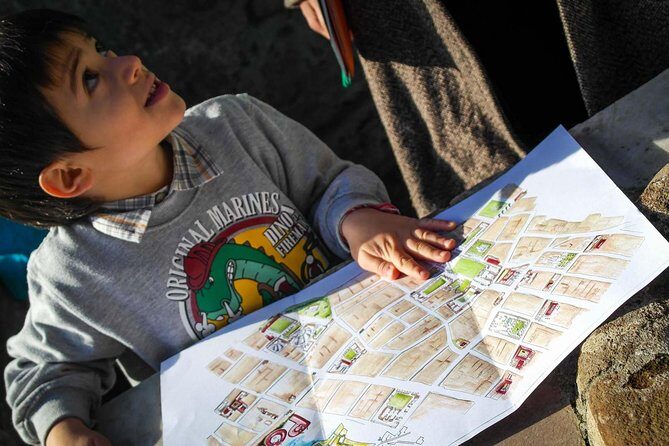
One more note from a family-friendly angle: in at least one Pompeii day experience, the guide approach included games and patient explanations for kids. That kind of energy can make Pompeii far less intimidating for younger visitors.
Final Call: Should You Book This Pompeii + Amalfi Day?
Yes, if you want a well-run day that covers Pompeii’s big civic highlights and then rewards you with the Bay of Naples coastline. It’s especially compelling if you value priority entry, private comfort, and the freedom to wander Sorrento and Positano on your own time.
Book it if your schedule fits and you’re okay with a full day. Skip it if you want a slower “only Pompeii” visit or you need very gentle walking. Otherwise, this is a strong choice for first-timers who want maximum payoff—ruins you can actually understand, plus coast views you’ll remember.
FAQ
How long is the Pompeii and Amalfi Coast tour?
It runs about 8 to 9 hours.
Is pickup included?
Yes. Pickup is offered from Naples, Sorrento, Pompeii, and other locations like hotels, vacation rentals, train station, airport, and cruise terminals/ports (you specify your pickup place when booking).
Is this tour offered in English?
Yes. It includes English-speaking driver and live commentary on board, and the tour is offered in English.
Are Pompeii tickets included?
Yes. Pompeii Express skip-the-line tickets and admission tickets for the listed stops are included.
Is lunch included?
Lunch is not included (you can request it).
What do I need to bring on the day of travel?
A current valid passport is required, or you can provide just a picture of it on the day of travel. Comfortable walking shoes and sun gear are recommended.
Can I cancel for a full refund?
Yes. You can cancel for a full refund up to 24 hours in advance of the experience start time.