REVIEW · POMPEII
Pompeii Skip-the-Line Tour – Private and limited group options
Book on Viator →Operated by Towns of Italy · Bookable on Viator
Pompeii hits you fast. This 2-hour guided visit is built for people who want real context while seeing major highlights, from the city streets to the theatres area. I like how the tour is run by a professional archaeologist, so you’re not just looking at stones—you’re hearing what archaeologists think you’re seeing.
I also like the limited-group feel, which helps the walk stay focused and easier to follow. One possible drawback is that even with skip-the-line entry, there’s still a compulsory security check and your start time can get delayed if the meeting group runs late.
In This Review
- Key Things I’d Prioritize
- Pompeii in Two Hours: What You Actually Get
- Meeting at Piazza Esedra: Start Easy, End Where You Began
- Entering the Site: Skip the Line, Not the Security
- Your Guide: Why an Archaeologist Changes Everything
- Walking Pompeii’s Core: Streets, Shops, Forums, and Sacred Spaces
- A quick note on the “Foro to Entertainment” pacing
- Entertainment District: Theatres and the Amphitheatre
- Houses, Workshops, Baths: The Everyday Stuff That Makes Pompeii Real
- The drawback to know
- Out of the City: Necropolises and the Villa dei Misteri
- Limited Groups: Why Private or Small Can Be Worth It
- What to Bring (and What to Leave Behind)
- Timing Reality: When the 2 Hours Feels Like 2 Hours
- Price and Value: Is $40.43 Worth It?
- Who Should Book This Pompeii Tour
- Should You Book It?
Key Things I’d Prioritize
- Archaeologist-led explanations tied to how the site was buried and preserved
- Skip-the-line access that still includes a security check
- Small groups and audio gear for clearer listening on a busy site
- A tight Pompeii route that hits streets, sacred spaces, public buildings, and entertainment zones
- Practical Pompeii rules (dress code, bag limits, ID) that affect your day at the gate
Pompeii in Two Hours: What You Actually Get
If you’ve ever felt overwhelmed by Pompeii’s size, this tour is a smart antidote. You’re not trying to “do it all.” You’re getting a focused walk through key parts of the ancient city—enough to understand how Pompeii worked day to day and why its preservation is so famous.
The big story here is the burial. Pompeii was covered by ashes and lapilli after the AD 79 earthquake—an overburden estimated at around 6 metres high. That kind of sudden, heavy sealing is why so many buildings survived with walls, floors, and everyday details still in place. When you walk among the ruins, you’re seeing the Roman city’s layout as a whole, not just a pile of temples.
The time window is short by design—about 2 hours—so the tour aims at the areas that best teach the city’s structure. You’ll cover ancient streets, a sweep through civic and sacred spaces, and then move into the entertainment side of town.
You can also read our reviews of more private tours in Pompeii


Meeting at Piazza Esedra: Start Easy, End Where You Began
The tour begins at Piazza Esedra, 80045 Pompei NA, Italy, and it ends back at the same meeting point. That matters more than it sounds. When a Pompeii tour finishes somewhere random, you often lose time figuring out transport or walking back through heat and crowds. Here, you can plan the rest of your day with less friction.
The site is close enough to public transportation that you can pair this with other stops in the region. You also don’t need a hotel pickup, which keeps the day simpler if you’re already in Pompeii.
Entering the Site: Skip the Line, Not the Security
The headline feature is expedited entry with skip-the-line access to the Pompeii ruins. That can save real time during peak hours, especially when entry lines snake back and forth.
But here’s the practical truth: there is still a compulsory security check, and that can create delays. So if you’re the type who hates uncertainty, plan to arrive a few minutes early and keep your expectations flexible. Once you’re in, though, the guidance helps you get moving fast and use your time well.
Also note the site rules that can affect your entry. There’s a required dress code: no shirtless entry and no discourteous clothing. If you don’t comply, your entry can be refused. Bring your best day-out-of-the-house attire that still works for walking.
Your Guide: Why an Archaeologist Changes Everything
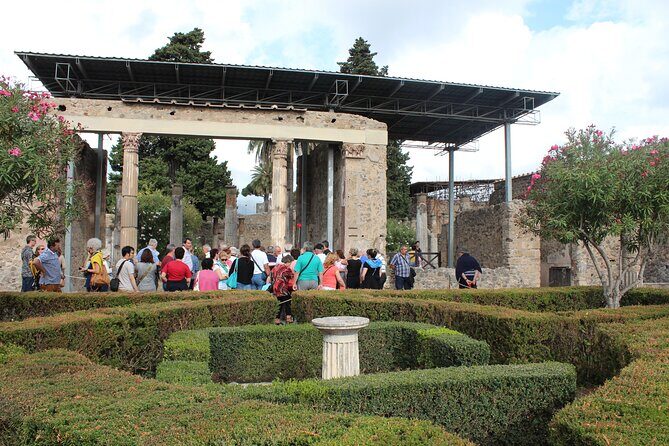
This experience is built around expert guidance from a professional archaeologist. That’s the difference between a “look at this” tour and a “why this matters” tour.
In a place like Pompeii, details are everything. A wall isn’t just a wall. A doorway isn’t just a doorway. With an archaeologist explaining what the excavation revealed and what evidence suggests, you start to connect the dots—how people lived, how the city functioned, and how the eruption preserved daily life.
The tour also tends to run in a language that stays consistent (it’s available exclusively in English or Spanish). That monolingual approach keeps explanations clear and avoids the half-translation problem that can happen on mixed-language tours.
And yes, guide names do pop up in real-world feedback. For example, Marina has been praised as very professional and clear, with agile pacing and strong explanations. Even if you don’t get her, the format you’re paying for is the same: structured, expert commentary that moves.
Walking Pompeii’s Core: Streets, Shops, Forums, and Sacred Spaces
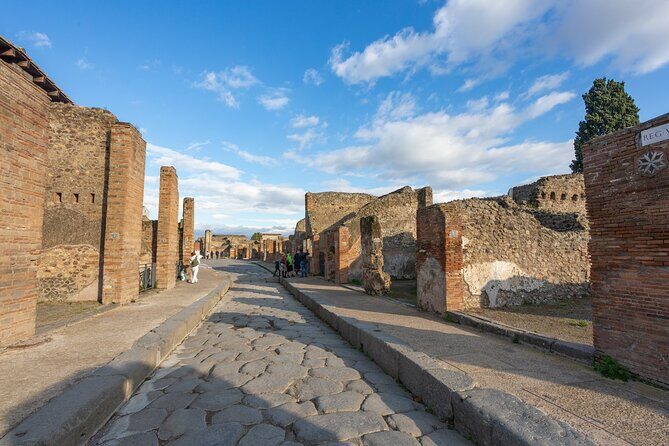
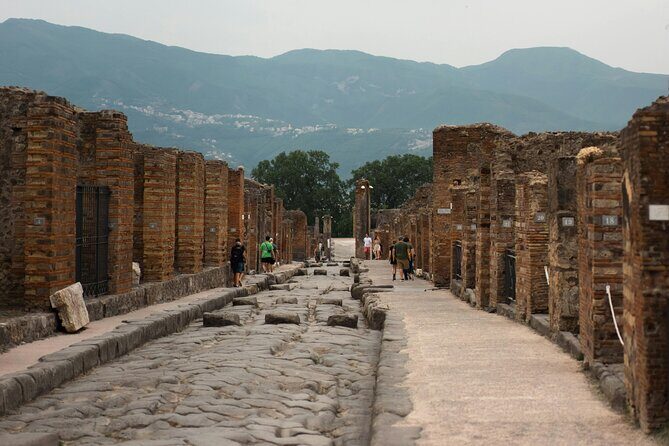
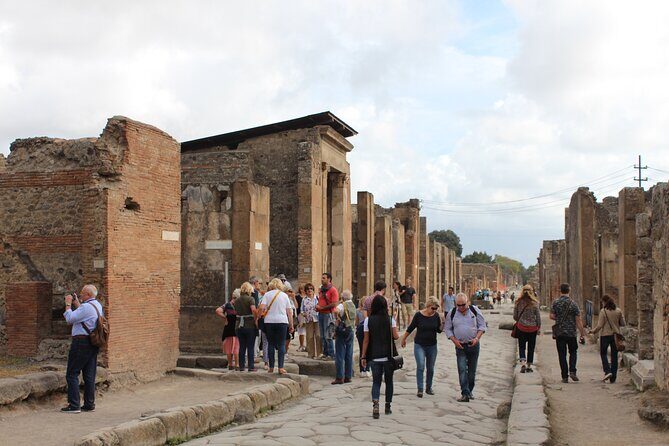
Your route centers on a broad sweep of the most instructive parts of town. You’ll walk through ancient streets and see how the built environment tells the story of a working Roman city.
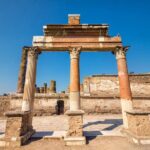
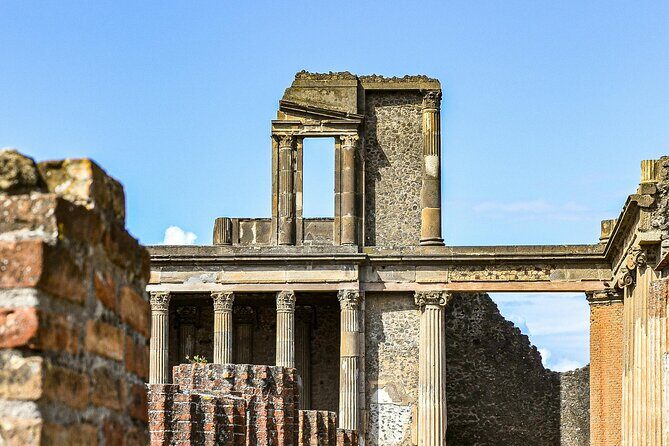
Early on, you’ll get into areas first revealed through excavation, including parts associated with the Ercolano Door, the Temple of Iside, and the theatres area. Seeing these clustered highlights helps you understand that Pompeii wasn’t just residential. It was civic, religious, and entertainment-driven too.
As you move along, you’ll encounter public and sacred sites and the bones of daily life: the Foro (forum area), public buildings, and spaces tied to religion. Pompeii’s charm isn’t only that it’s old. It’s that it preserves the relationship between the sacred, the civic, and the commercial.
You can also read our reviews of more tours and experiences in Pompeii




A quick note on the “Foro to Entertainment” pacing
Because you’re only here for about two hours, the tour uses a pace that keeps you from lingering too long in any single zone. That’s good for first-timers. It also means you’ll likely want to return on your own for deeper exploring afterward, armed with better context.
Entertainment District: Theatres and the Amphitheatre
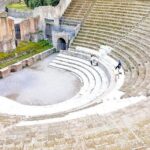
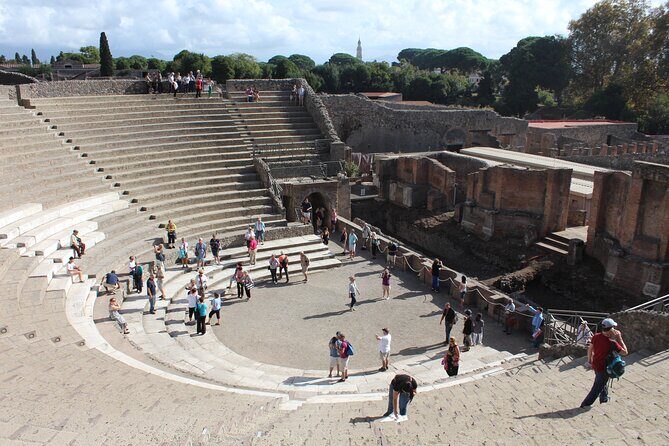
Pompeii’s entertainment spaces are some of the most memorable parts of the walk. You’ll spend time in the theatres area and see the city’s larger amphitheatre.
These zones help you picture the rhythm of Roman public life. In a city buried under ash, it’s easy to forget that it was once loud and crowded. The theatre and amphitheatre make it feel human again—people gathering, performances happening, and crowds moving through known routes.
If you’re short on time in Pompeii, this is a strong investment of that limited time. It’s also a great anchor for your mental map. After you’ve seen these spots, the rest of the city starts to feel like it belongs to a connected whole.
Houses, Workshops, Baths: The Everyday Stuff That Makes Pompeii Real
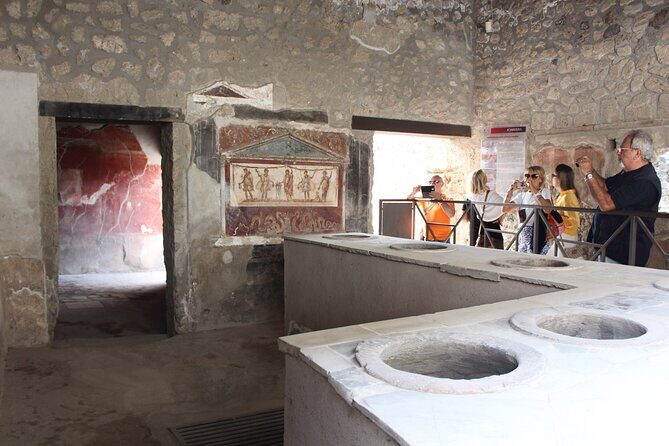
One of the most valuable parts of guided Pompeii is when it starts explaining what you’re standing next to. In the right order, you go from “wow, ruined buildings” to “this is how daily routines worked.”
During your walk, you can expect to see evidence of houses, workshops, baths, and other residential or mixed-use spaces. Pompeii is famous for preserved everyday objects—furnishings, mosaics, paintings, and statues—which are preserved and studied in museum collections like the Antiquarium of Boscoreale and the Archaeological Museum of Naples.
Even if what you’re looking at on the ground is a mix of original and reconstructed surfaces, the guide’s job is to help you interpret what’s in front of you. A professional archaeologist can point out how preservation conditions affect what survives, and what excavators can and can’t confidently say.
The drawback to know
Pompeii’s ruins are spread out and uneven. On a short 2-hour tour, you’ll do more walking per minute than you might on a longer visit. Wear proper shoes. I’d also pace yourself, because the sun plus stone surfaces can turn your legs into a bargaining chip.
Out of the City: Necropolises and the Villa dei Misteri
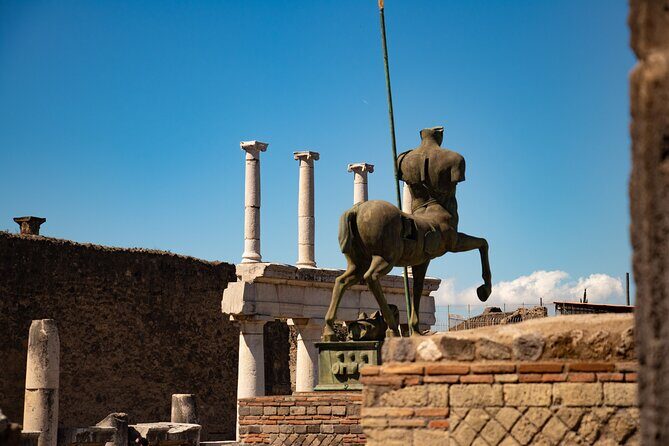
The tour doesn’t stop at the center. It also covers the city’s edge concepts—how Pompeii extended beyond urban blocks.
Outside the main excavated area, you can see four necropolises with monumental tombs. That’s an important contrast point: the living city inside, and the resting spaces outside. It’s a reminder that Roman planning and ritual shaped where people lived and where they were buried.
You may also cover the Villa dei Misteri, a well-known suburban residence. This area helps you understand Pompeii beyond its street grid—how wealth and lifestyle could look just outside the city center.
Limited Groups: Why Private or Small Can Be Worth It
The tour runs with a maximum group size (up to 30 travelers total for the activity), but it also offers options designed for a more personal experience.
- Private option: you get a private expert archaeologist when the private option is purchased.
- Limited group option: the experience can be kept intimate, with a maximum of 16 participants for a more personal feel.
- For very small groups (max 5 participants), audio devices are provided to make listening easier.
What this means for you: small group formats usually lead to a better Q&A rhythm. You can ask things and get answers that fit what you’re seeing right now. You also get a more controlled pace, which is a big deal on a site where people tend to slow down, stop, and get distracted.
If you hate herding and you like to move on your own mental schedule, the private or small group versions are often the best match.
What to Bring (and What to Leave Behind)
Pompeii is not hard technically, but it is hard physically. The rules and comfort tips here are simple and worth following.
- Wear good walking shoes (no flip-flops).
- Bring a hat and sunscreen.
- Bring water, since you’ll be outside on stone surfaces. (The tour is short, but the sun can still bully you.)
- Bring your ID card or passport. Entry depends on it.
- Dress to pass the site dress code. No shirtless entry, and avoid discourteous clothing.
Bag rules can also matter. There’s a limit on large bags: no backpack or big bags larger than 30x30x15. Anything that doesn’t fit needs to be deposited in the cloakroom. If you arrive with the wrong bag size, you can burn minutes sorting it out.
And a few things aren’t allowed: pets are not permitted, drone RPA isn’t allowed, and you shouldn’t show up with professional optical and audio equipment. The tour rules also prohibit introducing unauthorized transportation (including bicycles and scooters).
Timing Reality: When the 2 Hours Feels Like 2 Hours
With any skip-the-line tour, you’re buying time back—then you have to use it well. A couple of practical things affect your pace:
Even with expedited entry, the security check can add delay. If the group meets a bit late, your start might slip too. One example from real-world experience included waiting because not everyone was on time, which pushed the start back and made the schedule feel tighter.
So here’s my advice: arrive early, be ready to move, and treat Pompeii as a sprint with planned stops, not a museum stroll.
Price and Value: Is $40.43 Worth It?
At about $40.43 per person, this tour sits in the “serious value” zone for Pompeii. Why?
You’re paying for:
- Expedited entry (the skip-the-line part that reduces wasted time)
- Expert archaeological guidance
- Audio devices when group size is small enough to need them
- A structured route that’s designed to fit the site’s scale into a short timeframe
- Admission is listed as free with the experience, which matters because Pompeii tickets add up
Where you might question the value is if you’re the type who already knows Pompeii well and would rather explore at your own speed with audio guides alone. But even then, the archaeological explanation can help you read the ruins better, and that can make an independent visit much more rewarding later.
For first-timers, the math usually works in your favor. You’ll leave with a clear mental map, not just photos.
Who Should Book This Pompeii Tour
This is a strong fit if:
- you want a guided first visit without being overwhelmed
- you like learning from an archaeologist instead of general commentary
- you’re short on time and need the best Pompeii highlights in about 2 hours
- you prefer English (or Spanish) explanations with a consistent language format
- you value private or limited-group comfort and clearer listening
It’s probably not the right choice if:
- you have mobility limitations (the tour isn’t suitable for impaired mobility or heart patients)
- you want a long, unhurried tour with lots of time to wander
- you’d struggle with on-site rules like the dress code and bag size limits
Should You Book It?
I’d book this tour if you want Pompeii to make sense quickly. The combination of skip-the-line entry, archaeologist guidance, and a tight, high-value route is exactly what you want when you only have a couple hours.
Pick the private or smaller-group option if you dislike noise, want better listening, or like to ask questions as you go. If you’re flexible and okay with a group pace, the standard limited options still offer a lot of structure for the money. Just show up prepared for the site rules, expect a security check, and plan your day so you’re not rushing at the end.