REVIEW · POMPEII
Pompeii and Mount Vesuvius Small Group Tour
Book on Viator →Operated by Askos Tours · Bookable on Viator
Two icons of disaster, in one day. This Pompeii and Mount Vesuvius outing compresses two heavy-hitters into an 8-hour plan, with a minivan ride, an archaeologist on the ruins, and a licensed guide on the volcano.
I love the 2-hour Pompeii guidance because it helps you read the city quickly: where people met, ate, bathed, and relaxed. I also love that the volcano part is led with a steady pace, so the climb feels like a learning walk, not a race.
The only real drawback is effort and weather. The Vesuvius route includes step walking and a very steep last stretch, and when fog or wind hits, your views may be limited.
In This Review
- Key points to know before you go
- Pompeii and Vesuvius: A full-day plan that actually makes sense
- Porta Marina Superiore: start where the city begins
- The archaeologist-led Pompeii arc (2 hours that set the tone)
- The Forum area: where politics, commerce, and daily life met
- The main street walk: see the city as a system
- House of Menander: wealth you can measure
- Stabian Baths: the city’s social engine
- The stops that make Pompeii feel real: brothel, houses, and theaters
- Lupanar: Pompeii’s famous brothel
- House of the Faun: big private life
- Teatro Piccolo and Teatro Grande: entertainment in stone
- Getting to Vesuvius: minibus ease, then the climb begins
- At the crater edge: what the guide turns into a story
- What visibility can look like
- Herculaneum swap: a smart plan B when Vesuvius is closed
- Food, breaks, and how to keep energy up
- Price and value: is $119.77 worth it?
- Who this tour fits best (and who should rethink)
- Should you book this Pompeii and Vesuvius small group tour?
- FAQ
- How long is the Pompeii and Mount Vesuvius small group tour?
- What is the group size like?
- Is it offered in English?
- Where do we meet and where does the tour end?
- How much guidance do we get at Pompeii?
- Do I need to buy tickets for Pompeii and Vesuvius?
- How difficult is the hike at Mount Vesuvius?
- What should I wear?
- What happens if Vesuvius is closed?
- Is food included?
- Is there free cancellation?
Key points to know before you go
- Two guided halves: archaeologist-led Pompeii + a licensed hiking guide on Vesuvius
- Small-group feel: maximum 14 travelers on the minibus
- Clear must-wear footwear rule: steep uphill and loose, sometimes slippery ground
- Crater-edge payoff: a view over the Bay of Naples, Capri, Ischia, and the Sorrento coast when visibility cooperates
- Force-majeure backup: if Vesuvius isn’t accessible, the tour swaps in Herculaneum
- Admission and transfers handled: Pompeii guidance includes tickets and the day is tied together with modern minibus logistics
Pompeii and Vesuvius: A full-day plan that actually makes sense
Pompeii is one of those places where time can get weird. You’re looking at streets, homes, theaters, and bath complexes—but without context, it’s easy to walk through the site like you’re flipping pages without a storyline.
This tour is built to fix that. You get an archaeologist guide for a focused introduction to the city, then you head up Vesuvius with a dedicated hiking guide and crater-edge time. It’s not a quick photo sprint. It’s structured so you finish the day understanding what you saw—then you get the view that explains why it happened.
And yes, this is a long day. But it’s also a practical one: a minibus handles the back-and-forth, and the group stays small enough that you’re not lost in a crowd.
You can also read our reviews of more tours and experiences in Pompeii.
Porta Marina Superiore: start where the city begins
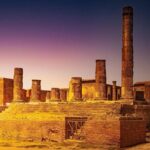
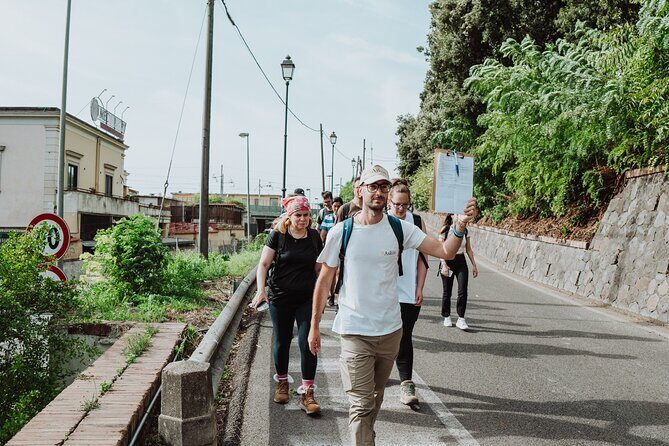
You meet at Via Villa dei Misteri, 2 in Pompei, and your Pompeii visit starts at the main entrance area called Porta Marina Superiore. Your guide will be holding a sign for Askos Tours.
Here’s why that matters: Pompeii is big, and its entrances and routes can feel confusing if you show up without a plan. Starting with the guide at the primary entrance helps you get your bearings fast, then you can follow the city layout instead of just walking wherever your feet decide to go.
The archaeologist-led Pompeii arc (2 hours that set the tone)
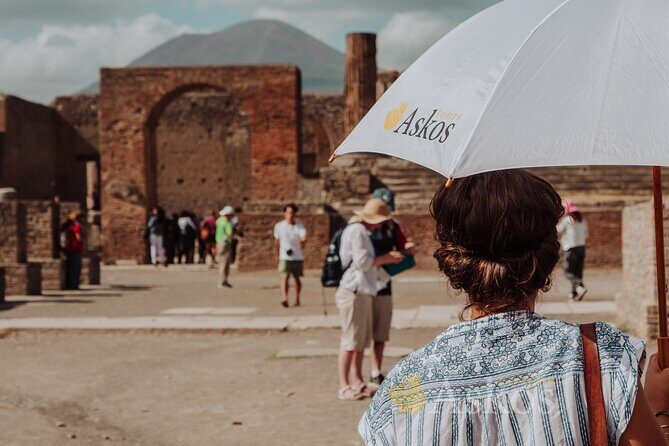
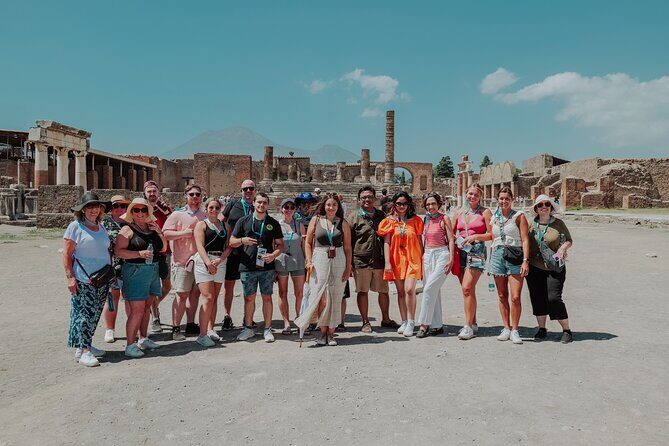
The heart of the Pompeii portion is a 2-hour guidance session with an archaeologist at the ruins. The site is essentially a frozen time capsule, but the value of a trained guide is that they turn stone and street layouts into daily life.
Your route includes quick but meaningful stops that build a mental map:
The Forum area: where politics, commerce, and daily life met
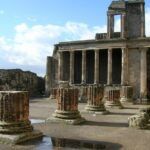
You’ll look at the Foro de Pompeya, the ancient main square. Ten minutes might sound short, but the point here is orientation—this is where you understand how the city organized itself around public space.
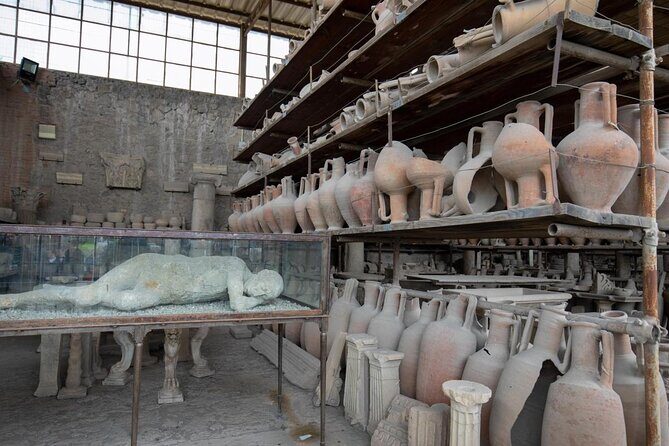
Then you’ll move into the Granaries of the Forum. This stop is especially memorable because it combines everyday function and the human record of the eruption. You’ll see marble tables and bath-like features used for fountains at house entrances, plus casts of victims of the eruption. There are also casts of a dog and a tree, which is a strange detail in the best way—it reminds you this wasn’t only a human tragedy.
The main street walk: see the city as a system
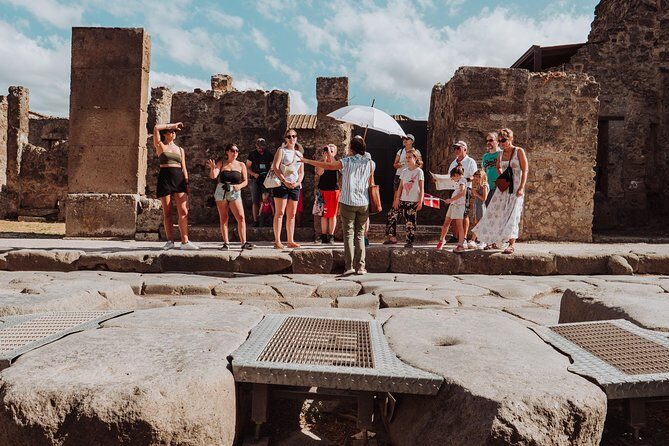
You’ll also walk through Pompeii’s main street. This kind of stop is less about one specific artifact and more about how everything connects. Streets, building fronts, and intersections stop being random when you’re guided through them with a reason.
House of Menander: wealth you can measure
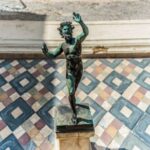
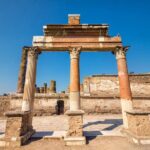
At the House of Menander, you get a peek at one of Pompeii’s richer private residences—especially for its architecture, decoration, and contents. This is where Pompeii starts feeling less like a ruin and more like a lifestyle. You can physically sense how people lived differently depending on wealth and status.
Stabian Baths: the city’s social engine
The Stabian Baths (Terme Stabiane) are a large complex and the oldest thermal complex in Pompeii. Even with a short stop, baths are powerful because they were social spaces. This is where you connect the city’s routine—bathing, meeting, lingering—with what you’re seeing in buildings around it.
The stops that make Pompeii feel real: brothel, houses, and theaters
After you understand the big public spaces, the tour shifts toward the places that shape daily rhythm and culture.
Lupanar: Pompeii’s famous brothel
The Lupanar is the city’s most famous brothel. It’s not a “gotcha” stop; it’s a reminder that Pompeii was a full city with all the gritty parts of life you’d expect to find anywhere in the Roman world.
If you have sensitive feelings about that theme, it’s better to know it’s part of the standard route rather than being surprised. The time here is also limited, so it doesn’t drag—just enough to understand what you’re looking at.
House of the Faun: big private life
The House of the Faun shows how large and impressive some residences were. This is another place where a guide helps, because the site layout can be confusing if you don’t know what to focus on.
Teatro Piccolo and Teatro Grande: entertainment in stone
You’ll get a look at the Teatro Piccolo, then the Teatro Grande, which is the most important theater in Pompeii. The jump from a smaller theater to the main one helps you understand scale—what “entertainment” meant in Pompeii and how performance space reflected civic life.
Getting to Vesuvius: minibus ease, then the climb begins
After Pompeii, you transfer by modern minibus to Vesuvius. A key value here is that you’re not left to self-navigate transport between two very different locations on your own.
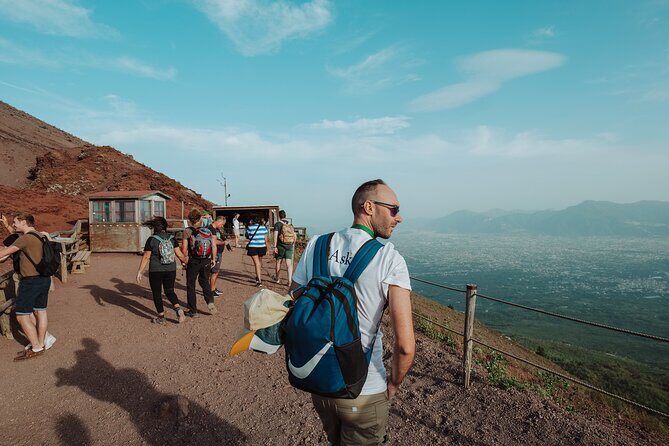
At the volcano, you’ll get on the top area to access the crater route. The tour notes two important walking reality checks:
- The first 30 minutes include step walking to reach the crater area.
- The last 500 meters are a very steep uphill walk.
Closed-in shoes are essential. If you wear sandals, you’re basically volunteering for a painful souvenir.
At the crater edge: what the guide turns into a story
On a clear day, you get the big payoff: the crater area, still smoking slightly, plus panoramic views over the Bay of Naples, with sights like Capri, Ischia, and the Sorrento coast.
But even when the views are limited by fog or rain, the guide-led part still has value. Guides on the volcano portion explain how the eruption affected Pompeii and Herculaneum, how the current volcano behaves, and what you should watch for on the ground and in the sky.
One detail I really like is how the group pace is handled. In multiple accounts, guides—especially Mario—are described as patient and encouraging, including when people struggle a bit on the climb. That matters. A volcano hike is one part fitness, one part nerves, and a steady guide helps you keep moving without feeling embarrassed.
What visibility can look like
Weather can change quickly up top. If fog rolls in, you might have only a few feet of visibility and still be standing right at the crater edge. That’s not anyone’s fault, but it is why I treat this tour as both history and a weather-dependent experience.
Bring a light layer if you run cold in wind. You’ll thank yourself the first time gusts hit your face.
Herculaneum swap: a smart plan B when Vesuvius is closed
Vesuvius accessibility depends on conditions. The tour states that if Vesuvius isn’t accessible due to force majeure, the day includes a visit to Herculaneum instead.
This is more than a consolation prize. Herculaneum tends to feel more intimate than Pompeii, and it can help you complete the picture of what life looked like before the eruption—especially when Vesuvius ends up being too foggy, rainy, or closed off for safe access.
The practical win: your day doesn’t just shrink. You still get a major site, a guide-led experience, and a coherent theme.
Food, breaks, and how to keep energy up
Food and drinks are not included. Plan for a meal stop you control.
On the Pompeii-to-Vesuvius rhythm, you’ll want to time your snack break so you’re not eating right before the steepest part of the climb. If you’re shopping for something quick, there are cafes down the hill where you can pick up a sandwich and a beverage. Keep it simple so you can focus on the walk.
Also: bring sun protection in summer. The tour guidance specifically suggests sunglasses and sunscreen for warmer months.
Price and value: is $119.77 worth it?
At $119.77 per person, you’re paying for a packed day that includes:
- 2-hour archaeologist guidance at Pompeii with admission included
- Mt. Vesuvius admission fees listed as part of the package
- Modern minibus transport from Pompeii and back
- Small group size (maximum 14 on the minibus)
- A licensed hiking guide for the volcano portion
You do not get food and drinks included. That’s the main extra cost you control.
Is it a great value? For me, the best reason is the structure. Pompeii without a trained guide can turn into aimless wandering. Vesuvius without guidance can turn into uncertainty on a steep, step-heavy route. Paying for both guided pieces in one day saves time and reduces stress.
One caution: Mount Vesuvius has an entry ticket listed at 11,00 euros. The package says admission fees are included, but that number is specifically provided. I’d treat it as a “confirm at booking” item so you’re not surprised.
Who this tour fits best (and who should rethink)
This is for you if you want a guided day that connects Pompeii’s ruins to the eruption that made them possible—and you don’t mind walking.
The tour says moderate physical fitness is required. If you have mobility concerns or walking impairments, it’s not recommended. And children under 6 aren’t allowed.
I’d also be honest: the climb is not a casual stroll. The steep last 500 meters and the step sections at the start of the crater route mean you should bring shoes with grip and expect to work a little.
Should you book this Pompeii and Vesuvius small group tour?
I’d book it if you want two iconic stops in one day and you value context. The archaeologist-led Pompeii portion gives you a framework, and the guided Vesuvius climb turns a hard walk into a clearer story about eruption, impact, and what’s still happening.
I’d think twice if you hate uncertainty with weather, or if you’re not comfortable with a steep uphill finish. If fog and rain arrive, the day can still be good—especially with the Herculaneum backup—but the crater views may not deliver the postcard version.
If you’re comfortable wearing closed-in, grippy shoes and you can handle a long day, this is one of the more efficient ways to experience both Pompeii and Vesuvius without feeling rushed or stranded.
FAQ
How long is the Pompeii and Mount Vesuvius small group tour?
It runs about 8 hours (approx.).
What is the group size like?
The tour is a small group. The minibus supports up to 14 people.
Is it offered in English?
Yes, the tour is offered in English.
Where do we meet and where does the tour end?
You start at Via Villa dei Misteri, 2, 80045 Pompei NA, Italy, and the tour ends back at the same meeting point.
How much guidance do we get at Pompeii?
You get about 2 hours of guidance at the Pompeii ruins with an archaeologist.
Do I need to buy tickets for Pompeii and Vesuvius?
Admission for Pompeii is included with the guidance portion. The Mount Vesuvius entry ticket is listed at 11,00 euros.
How difficult is the hike at Mount Vesuvius?
The tour requires moderate physical fitness. The crater route includes step walking for the first 30 minutes, and the last 500 meters are a very steep uphill walk.
What should I wear?
Wear comfortable closed-in shoes with good grip. Sunglasses and sunscreen are recommended in summer.
What happens if Vesuvius is closed?
If Vesuvius isn’t accessible due to force majeure, the tour will include Herculaneum instead of Vesuvius.
Is food included?
No. Food and drinks are not included.
Is there free cancellation?
Yes. You can cancel up to 24 hours in advance for a full refund. If you cancel less than 24 hours before the start time, the amount paid is not refunded.