REVIEW · HISTORICAL TOURS
Historical Walking Tour in Pantheon with Tickets
Book on Viator →Operated by Global Guiding · Bookable on Viator
The Pantheon still feels unreal.
This private, skip-the-line visit is built for people who want the big picture fast and the details explained clearly, right inside one of Rome’s most famous monuments. You’ll go from the Roman temple story to its Christian life, with a guide focused on what you’re actually looking at, including the oculus overhead.
I especially love two things. First, the skip-the-line ticket saves real time at a place where the queue can eat up your energy. Second, you get a professional guide who turns the Pantheon from a name on a map into a building you can read, from its architecture to the meaning behind its design.
One thing to consider: this experience requires good weather, and the tour is only about 1 hour. If you want extra time lingering in the nave and taking photos, you may want to plan what you’ll do after the guided portion ends.
In This Review
- Key highlights you’ll care about
- Why the Pantheon dome earns your attention
- Skip-the-line entry: what it really buys you
- Where the tour starts at Piazza della Minerva
- The Pantheon’s story: from Augustus to Hadrian to AD 609
- Entering the Pantheon: what to watch for during the walk
- The dome and oculus: why the unreinforced engineering still impresses
- A private guide who can answer your questions
- Timing, pace, and what happens after the tour
- Price and value: does $76.93 make sense?
- Who this Pantheon tour fits best
- Should you book this Pantheon walking tour?
- FAQ
- How long is the Pantheon walking tour?
- Is the tour private?
- What language is the tour offered in?
- How much does the tour cost?
- Where do I meet the guide?
- Where does the tour end?
- Is the Pantheon admission ticket included?
- Is a guide included?
- Are pickups and drop-off included?
- Does weather affect the tour?
Key highlights you’ll care about
- Skip-the-line entrance ticket for smoother access to the Pantheon
- World-famous unreinforced concrete dome plus the central opening to the sky
- Private English guide to connect architecture, religion, and politics across centuries
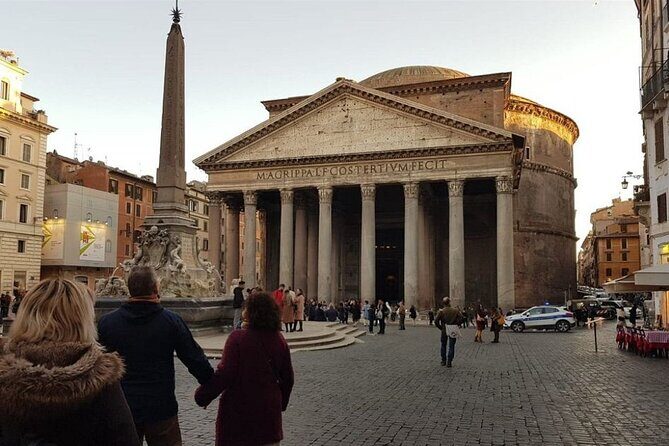
- Start at Piazza della Minerva near the elephant and monolith landmark
- Ends right in Piazza della Rotonda in front of the Pantheon, ready to keep exploring
Why the Pantheon dome earns your attention
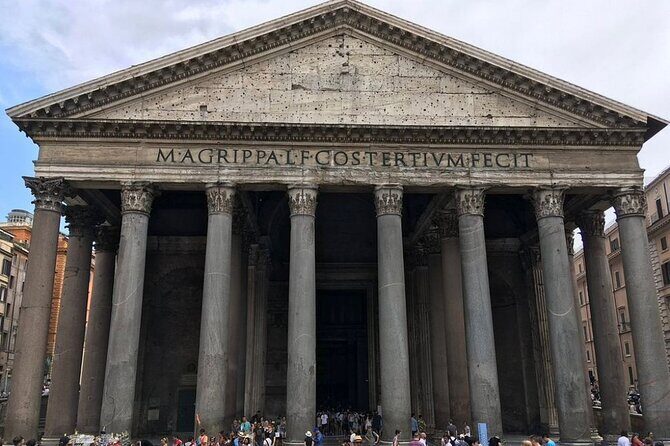
Even people who think they know Rome’s monuments often underestimate how striking the Pantheon feels in person. The building’s signature feature is the huge dome, and the main reason it still stops people is simple: it’s the world’s largest unreinforced concrete dome. Standing there, you get the sense that Roman builders were solving problems at a scale most of us can’t picture.
The second reason is the oculus. That central opening isn’t just a decorative touch. It’s the Pantheon’s built-in way of bringing the sky indoors, changing the light across the interior as the day moves on. A good guide helps you notice what that means for the space, not just what the dome is made of.
This tour focuses on getting you the right sights in the right order. You won’t just wander in circles. You’ll be shown the major architectural moves and the historical path that led to what you see today.
You can also read our reviews of more tours and experiences in Rome



Skip-the-line entry: what it really buys you
Skip-the-line access sounds like a convenience, but it’s really about time and calm. The Pantheon draws crowds, and when you’re standing waiting outside, you lose the moment. With the included skip-the-line entrance ticket, you start your visit on your feet, not stuck in a bottleneck.
It also changes how you experience the building. When you’re not rushing to beat the next group, you can actually look up at the dome and take in how the interior space is shaped. You’ll also have time to follow your guide’s explanation instead of reading it on the fly.
The tour runs about an hour, with the ticket portion lasting around 45 minutes inside. That’s a compact visit, which is great if you’re pairing it with other Rome stops, but you’ll want to plan your next steps if you want a slower, photo-heavy pace.
Where the tour starts at Piazza della Minerva
Your morning or afternoon begins at Piazza della Minerva (00186 Roma RM, Italy). It’s a handy starting point because it’s in the central historic area and near public transportation, so you’re not forced into complicated routing.
One detail that helps your orientation: guides often use the nearby elephant and monolith landmark as a visual reference before you head toward the Pantheon area. That kind of quick wayfinding matters in Rome, where streets and piazzas can blur together.
You’ll start the tour outdoors and move into the Pantheon with a clear sense of what you’ll be seeing next. By the time you reach the entrance, the guide’s setup helps you avoid the common problem of feeling like you entered a huge building but don’t know where to focus first.
The Pantheon’s story: from Augustus to Hadrian to AD 609
Inside, your guide will walk you through the building’s main timeline. The Pantheon you see today is built on the site of an earlier Roman temple commissioned by Marcus Vipsanius Agrippa during the reign of Augustus (27 BC – AD 14). That first structure later burned down, and the present building was ordered by Emperor Hadrian in AD 126.
That sequence is more than trivia. It explains why the Pantheon feels like both an ending and a beginning at the same time: it’s Roman power and Roman engineering, rebuilt and refined after loss. A guide will help you understand that the structure isn’t just ancient—it’s a deliberate achievement shaped by rulers and events.
Then there’s the religious shift that gives the Pantheon its layered identity. Since AD 609, it has been a Catholic church called Basilica Santa Maria ad Martyres (also known as Basilica of St Mary and the Martyrs). Seeing it today, you’re standing in a building that moved from worship of Roman gods to Christian use without losing its core physical character.
Entering the Pantheon: what to watch for during the walk
At the start of your visit, you’ll get a guided circuit around the space. The goal is to help you read the building’s design, not just admire it from one spot. You’ll be shown the architectural features and get explanations that connect what you see to what it meant in Roman times and later as a church.
The guide will put special attention on the central opening to the sky, the oculus. Don’t treat it like a photo spot only. Think of it as part of how the interior functions. Your guide’s job is to help you connect the dome, the opening, and the overall proportions so the space makes sense as you move.
You’ll also notice how Roman temple architecture can still feel surprisingly “modern” in its clarity. That’s one reason a guided experience can feel like cheating—in a good way. Without context, it’s easy to appreciate the wow factor and miss how the pieces work together.
You can also read our reviews of more walking tours in Rome





The dome and oculus: why the unreinforced engineering still impresses
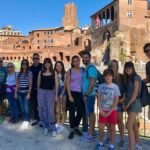
The tour highlights a key fact: almost two thousand years after it was built, the Pantheon’s dome remains the world’s largest unreinforced concrete dome. That’s an engineering headline, but the value for you is what it changes visually when you’re standing inside.
Your guide will help you look at the dome as a system, not a single object. The scale of the curve, the sense of height, and the way light falls through the opening all interact. The result is that you can feel the space as a design, not just a container.
If you’re the kind of person who likes to understand how old buildings work, you’ll likely enjoy this portion most. You’re not getting a lecture. You’re being guided to notice a few essential things and then letting the building do the rest.
A private guide who can answer your questions
This is a private experience, meaning only your group participates. That matters for two reasons. First, you can ask questions without worrying about slowing anyone else down. Second, a good guide can adjust what they emphasize based on your interests—architecture fans usually get extra value here.
The professional guides you may get—like Sabrina and Loussine—are praised for bringing more than surface-level facts. They’re especially good at pointing out extra details you’d likely miss on your own, and they help connect the monument’s parts into a coherent story.
One practical benefit: you’ll get explanations you can’t easily copy from a sign. The Pantheon has an information overload problem. A guide filters it into the few points that matter while you’re inside, so your memory sticks.
In at least one instance, the guide also offered extra help after the main walkthrough, including lunch restaurant suggestions and a mention of gelato from Fassi. That kind of local follow-through is small, but it’s genuinely useful when you’re trying to keep your day flowing smoothly.
Timing, pace, and what happens after the tour
The experience is listed at about 1 hour total. That’s a well-balanced length for the Pantheon, because it includes guided time at the monument without turning into a half-day commitment.
The pacing tends to work best if you like a focused walk and prefer your learning delivered as you go. You’re in and out with enough momentum to keep exploring, and you don’t feel stuck in one place for too long.
You’ll finish in Piazza della Rotonda right in front of the Pantheon. That end point is convenient because it puts you exactly where you’ll want to be if you plan to wander afterward, grab a coffee, or connect to other nearby sights. It’s an easy “depart the tour, continue Rome” setup.
Price and value: does $76.93 make sense?
At $76.93 per person, this isn’t a bargain-basement ticket, but it also isn’t overpriced for what you’re getting. The big value drivers are:
- a professional guide
- a skip-the-line entrance ticket
- all fees and taxes included
If you’ve done Rome monuments without a guide, you already know the problem: you can see the building, but you don’t automatically understand what you’re looking at. Paying for guidance can be worth it when you care about the difference between noticing something and actually comprehending it.
The skip-the-line part matters too. If your visit is one of your limited time windows in Rome, those minutes you don’t spend in line have direct value. You can reallocate that time to better photo angles, a longer look at the interior, or simply reducing stress.
Because this is a private format, the cost also reflects the guide’s attention staying on your group. For couples, small friend groups, or history lovers who prefer not to share attention with strangers, the price can feel more reasonable than it first appears.
Who this Pantheon tour fits best
This experience fits best if you’re visiting with curiosity and you want to understand what makes the Pantheon tick. I think it’s especially good for:
- history lovers who want the timeline made clear
- architecture fans who like concrete facts and visible design features
- people who want to avoid lines and still get meaningful context
- small groups who prefer a private pace and easier questions
If you’re the type who only wants a quick photo stop and you already know the main story, you might not need a guided hour. But if you want your visit to feel like more than a checkbox, this format is designed for that.
Should you book this Pantheon walking tour?
I’d book it if you care about getting the most out of a short visit and you want skip-the-line entry tied to an actual guide narrative. The Pantheon is one of those places where context changes everything—especially with the dome, the oculus, and the Roman-to-Christian timeline.
I’d think twice if you’re looking for a totally self-directed museum feel, or if you’re planning your day around uncertain weather. Since the experience requires good weather, it’s smart to have a little flexibility in your schedule.
If your priority is a smooth, focused, high-impact Pantheon visit, this one checks the right boxes.
FAQ
How long is the Pantheon walking tour?
It’s approximately 1 hour total, with about 45 minutes that include admission.
Is the tour private?
Yes. It’s a private experience, so only your group participates.
What language is the tour offered in?
The tour is offered in English.
How much does the tour cost?
The price is $76.93 per person.
Where do I meet the guide?
The meeting point is Piazza della Minerva, 00186 Roma RM, Italy.
Where does the tour end?
The tour ends at Pantheon in Piazza della Rotonda, 00186 Roma RM, right in front of the Pantheon.
Is the Pantheon admission ticket included?
Yes. Skip-the-line entrance ticket and admission are included.
Is a guide included?
Yes. You get a professional guide.
Are pickups and drop-off included?
No. Pickups and drop-off are not included.
Does weather affect the tour?
Yes. The experience requires good weather. If it’s canceled due to poor weather, you’ll be offered a different date or a full refund.