REVIEW · PRIVATE
World War II Sights in Rome Private Walking Tour with Guide
Book on GetYourGuide →Operated by Roso Travel · Bookable on GetYourGuide
Rome has layers, and WWII is one of them. This private walk connects Italian Fascism and the German occupation to real places you’ll recognize, from Via Rasella to the Jewish Ghetto. I like that you get a true history-expert private guide who explains the why behind the headlines, and I also like that the route ends at the Great Synagogue so the story doesn’t stop at politics. One drawback: the tour can feel less like a catalog of WWII bomb sites and more like a guided street story with a few key WWII moments plus broader context.
You’ll also have an option to add the Museum of the Liberation (free with the 4-hour option). If you’re the type who wants artifacts and prison-cell rooms to match what you learn outside, that extension is the smart move. If you only choose the 2-hour version, you’ll still cover the big turning points, but you’ll be moving briskly between major landmarks rather than spending long blocks at each one.
In This Review
- Key takeaways before you go
- Starting at Hotel Stendhal and getting oriented fast
- Via Rasella: walking the street where the Resistance struck back
- Trevi Fountain as a contrast point, not a WWII storybook prop
- Piazza Venezia: where Mussolini’s authority was displayed
- The Altar of the Fatherland connection: empire talk vs. national myth
- Ending in the former Jewish Ghetto and seeing the Great Synagogue
- The 4-hour option adds the Museum of the Liberation: prison cells and original rooms
- How the history expert guide makes it click (Massimo is a name to remember)
- Price and value: what $194.17 per person buys you
- Who this tour suits best (and who might want to adjust expectations)
- Should you book this WWII walking tour of Rome?
- FAQ
- FAQ
- How long is the World War II Sights in Rome private walking tour?
- Where does the tour meet?
- Does the 2-hour option include the Museum of the Liberation?
- What’s included in the 4-hour option?
- Which languages are available for the guide?
- Is this tour private?
- Can I cancel, and is there a reserve-and-pay-later option?
Key takeaways before you go
- Via Rasella in 1944: you walk the exact street tied to an ambush of Nazi SS troops and the Roman Resistance story
- Fosse Ardeatine massacre context: the guide ties retaliation to what happened to Italians in the aftermath
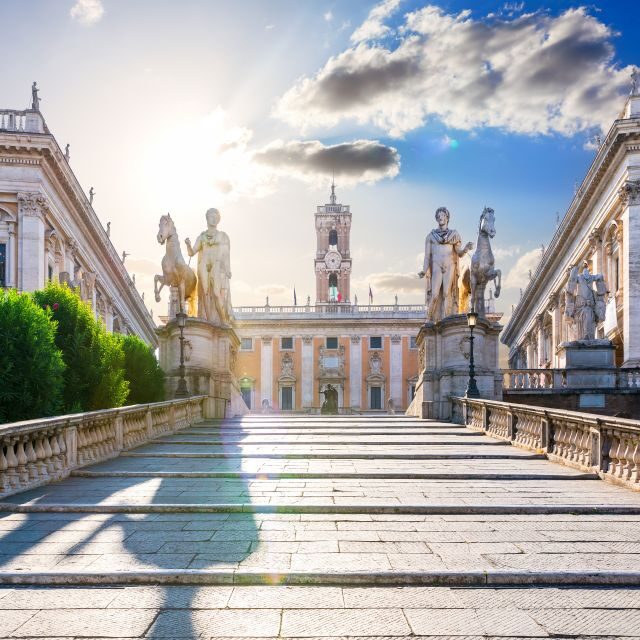
- Mussolini’s Rome, in plain sight: Piazza Venezia landmarks help you see how Fascist power staged itself
- Jewish Ghetto walk to the Great Synagogue: you learn what changed for Roman Jews under German occupation
- 4-hour option adds the Museum of the Liberation: former police headquarters and Nazi prison, with original rooms and cells
- Private Q&A: because it’s just your group, you can ask the awkward questions and get clear answers
Starting at Hotel Stendhal and getting oriented fast

The tour starts at Hotel Stendhal, on Via del Tritone. It’s not a tour inside the hotel; it’s simply the meeting point so the guide can grab you and head out together. From there, your walk funnels toward Piazza Barberini near Fontana del Tritone and Palazzo Barberini, which is a practical way to get your bearings before you start stitching WWII into the modern city.
This is a private group, which matters more than it sounds. In Rome, it’s easy to get lost in the scenery. A good guide keeps you from turning WWII into random trivia. You’ll have time to ask questions as you go, especially when the story gets uncomfortable or complicated.
One reason I like this setup: you begin in an area that’s visually easy to connect to Rome’s present. Then the guide shifts you into the parts of the city where the past is harder to look at, but also more important to understand.
You can also read our reviews of more walking tours in Rome

Via Rasella: walking the street where the Resistance struck back

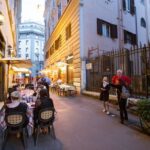
Your early stop is Via Rasella, and this is where the tour becomes very real, very quickly. The guide explains what happened in 1944 when a column of Nazi SS troops was attacked by an ambush of Italian Partisans. The number matters here: 28 SS policemen were killed.
What you’re really learning isn’t just the incident. Your guide uses the attack to introduce the Roman Resistance movement—how local networks operated, how risk spread, and how Rome was not simply a background stage for events happening elsewhere. In other words, you’re not only studying WWII. You’re studying how WWII lived inside the city.
The story then moves straight into what followed, and this is where the emotional weight lands. In retaliation, Nazi forces carried out the Fosse Ardeatine massacre, killing 335 Italians. Walking and hearing those figures together is tough, but it’s also one of the most important lessons of the tour: actions and consequences were tightly linked, and civilians paid a brutal price.
Practical note: because this segment is emotionally heavy, you’ll likely want a moment to pause and take it in as you walk. Don’t rush past it just because Rome’s streets are busy.
Trevi Fountain as a contrast point, not a WWII storybook prop
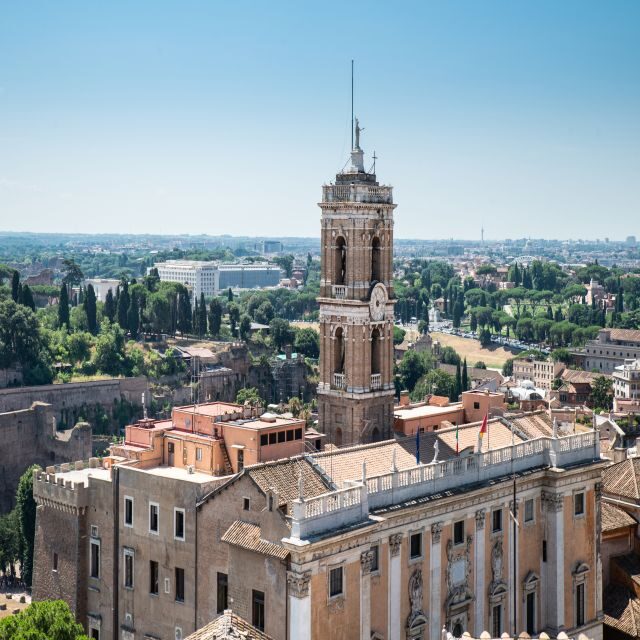
Next, you’ll pass the Trevi Fountain. Yes, it’s famous for other reasons, and no, it isn’t being treated as a WWII artifact. What I like about seeing it here is the contrast: this is a postcard Rome moment, but your brain is now trained on the city’s wartime layers.
Your guide uses these transitions to help you understand something important. In wartime, propaganda, power, and daily life overlap. Rome didn’t stop being Rome just because the war arrived. You’re watching how the physical city kept functioning while political reality became more violent.
So if you’re expecting a route where every stop is a signed WWII site, take a breath and reset. The value is in the connections your guide makes between locations that readers might think of as “just sights” and the history tied to power and occupation.
Piazza Venezia: where Mussolini’s authority was displayed
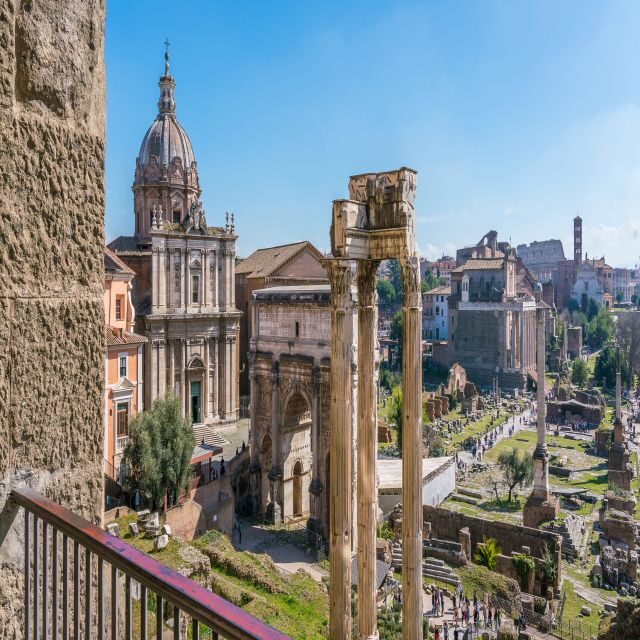
From Trevi, the walk heads toward Piazza Venezia, one of the best places in Rome to understand how Fascist leadership tried to look permanent. The guide points out the palace that served as Mussolini’s headquarters. It’s a strong moment because you’re not looking at history behind glass. You’re looking at a commanding setting that still communicates authority.
The tour also connects this location to the dictator’s public theater. You’ll hear about the balcony linked to the declaration of the creation of the new Italian empire in May 1936. The guide then points you toward how other monuments in the area sit in conversation with that mindset, especially the nearby Altar of the Fatherland.
What I found useful about this part is that the guide doesn’t treat Mussolini as a one-note villain. Instead, you get a clearer picture of how Fascism rose—and how it tried to align itself with a broader imperial fantasy. The tour covers the idea of Mussolini’s alliance with Adolf Hitler, framed in the context of how Italy moved from Fascist rise to German occupation.
This is where the tour is especially good if you’re more of a “why did it happen” traveler than a “what happened here” traveler.
The Altar of the Fatherland connection: empire talk vs. national myth
In this area, you’re surrounded by Italian identity symbols, including the Altar of the Fatherland (also known as Altare della Patria). The guide uses it to anchor what Fascism tried to sell to Italians: national greatness, continuity, and the idea of a restored or expanded empire.
Even if you’ve already visited the Altar of the Fatherland, this tour gives you a different lens. You’re not just admiring a large monument. You’re learning how the same kind of monumental style can help governments build emotional momentum.
That matters for WWII history because Fascism wasn’t just policy. It was persuasion. And persuasion is how regimes survive long enough to create disasters.
You can also read our reviews of more guided tours in Rome




Ending in the former Jewish Ghetto and seeing the Great Synagogue
The route ends in Rome’s former Jewish Ghetto, with a stop at the Great Synagogue. This is not a quick photo break. Your guide explains the story of Roman Jews and what happened when Germany occupied the city.
This segment is powerful because the tour has been building toward it. First you learn about the rise of Italian Fascism and the alliance ties. Then you hear about wartime violence and major turning points, including the raid of the Jewish Ghetto and the bombings of Rome, all framed through the experience of people in the city.
Reaching the Great Synagogue at the end helps the story land where it belongs: not only in political decisions, but in real communities and real fear. It also gives you a chance to ask questions while you’re standing somewhere that still feels connected to the people whose lives were changed.
If you’re sensitive to Holocaust-era topics, go slow here. Rome can be loud and beautiful, but this stop deserves respect.
The 4-hour option adds the Museum of the Liberation: prison cells and original rooms
If you choose the 4-hour tour, you add a visit to the Museum of the Liberation. This part can be a game-changer for people who want more than street-level context.
The museum is housed in former police headquarters and Nazi prison spaces. That detail matters. You’re not just looking at explanations; you’re walking through the kinds of rooms where repression happened.
On the private tour, you explore three floors of exhibitions, including:
- an original conference room
- a library
- prison cells
- and a hall commemorating victims of anti-Semitism in Italy and Rome
Your guide also brings the exhibits together by explaining WWII artifacts on display, and how they connect to different aspects of the war in Italy. The goal isn’t shock for shock’s sake. It’s understanding how occupation worked at the level of systems, documents, and imprisonment.
Transport detail: in the 4-hour option, you get one-way public transport tickets to reach the museum, because it’s a short walk from the heart of Old Rome. In practice, that keeps the experience smooth and prevents your day from turning into logistics.
If you’re deciding between the 2-hour and 4-hour options, here’s the honest tradeoff: the 2-hour version is a clean and focused walk through key WWII-relevant places; the 4-hour version adds an emotionally direct, artifact-heavy setting that makes the story harder to forget.
How the history expert guide makes it click (Massimo is a name to remember)
A big reason this tour works is the guide’s role. You’re not getting a monologue. You’re getting a licensed history expert who can explain the rise and fall of Italian Fascism, German occupation, bombings, liberation, and more—then answer your questions as you walk.
One name that came up as an especially strong example is Massimo. The praise wasn’t just about knowing dates. It was about being able to connect the history to how families lived within it. People also appreciated that he was eager to share practical Rome tips, which can be surprisingly helpful when your visit overlaps with heavy subject matter. You walk out feeling like you understand more than a timeline.
Even if your guide is someone else, look for that same skill set: clear explanations, comfort with tough topics, and the ability to turn a few streets into an intelligible narrative.
Price and value: what $194.17 per person buys you
The price is $194.17 per person, and it’s a private tour. That means you’re paying for more than movement through a city. You’re paying for a history guide you can interrogate, plus a tailored route through high-signal locations.
So is it worth it?
- For the 2-hour version: you’re paying for a focused street walk through key WWII-linked spots, ending with the Jewish Ghetto and the Great Synagogue. If you want a guided, coherent story in a short time, it can be good value—especially because private tours in central Rome aren’t cheap.
- For the 4-hour version: the value improves if you’re museum-inclined. You get free admission to the Museum of the Liberation plus the short transport help to get there. The museum spaces—police HQ and Nazi prison areas—aren’t the kind of thing you can fully replicate on your own in a half-day without a guide explaining what you’re looking at.
If your budget is tight, you can save money by choosing the 2-hour walk. If you have the time and want depth, the 4-hour option is the better “history per hour” deal.
Who this tour suits best (and who might want to adjust expectations)
This experience is ideal if you:
- want WWII history tied to specific Roman places
- like private guided Q&A rather than group pacing
- want the story to cover more than one angle, from Fascism to occupation and the fate of Roman Jews
- are considering the Museum of the Liberation and want it explained properly
It may be less ideal if you:
- want a long list of only narrowly defined WWII “action sites” (bombing details, ruins, and so on) with lots of time at each place
- only want military history and nothing else, because the tour also focuses on Fascism, ideology, and how regimes affected civilians
A good way to frame it: this tour is about how the war reshaped Rome’s society, not a scavenger hunt for the most visually dramatic wartime locations.
Should you book this WWII walking tour of Rome?
I’d book it if you want a guided narrative that connects Fascism, occupation, and the Jewish Ghetto to the Rome you’ll actually walk through. The route makes sense, the ending at the Great Synagogue gives the story a necessary moral center, and the option to add the Museum of the Liberation turns the tour from “informative” into “memory-making.”
If you’re on the fence, my practical suggestion is simple: choose the 4-hour option if your schedule allows it and you’re curious about prison cells and original rooms. Choose the 2-hour option if you want a tighter walk with strong context and don’t want to spend extra time in museums.
FAQ
FAQ
How long is the World War II Sights in Rome private walking tour?
The walking tour runs 2 to 3 hours, and there’s also a 4-hour option that includes the Museum of the Liberation.
Where does the tour meet?
Meet your guide at Hotel Stendhal, Via del Tritone, 113, 00187 Roma RM, Italy. Please do not enter the hotel; it’s only the meeting point.
Does the 2-hour option include the Museum of the Liberation?
No. The 2-hour option does not include free museum admission.
What’s included in the 4-hour option?
The 4-hour option includes a visit to the Museum of the Liberation with free admission, plus one-way public transport tickets to reach it.
Which languages are available for the guide?
The live guide is available in English, French, Italian, Russian, and Spanish.
Is this tour private?
Yes. It’s listed as a private group tour.
Can I cancel, and is there a reserve-and-pay-later option?
You can cancel up to 24 hours in advance for a full refund and you can reserve now & pay later to keep your plans flexible.