REVIEW · WALKING TOURS
Walking and Guided Tour of Rome at Dusk
Book on Viator →Operated by Gray Line I Love Rome by Carrani Tours · Bookable on Viator
Rome looks totally different after dark.
This walking tour strings together some of central Rome’s most famous sights with a slower pace and real evening atmosphere, from the Jewish Ghetto area up to the Pantheon and ending in Piazza di Spagna. You’ll move through classic landmarks with time to actually take them in, and you’ll even finish with creamy gelato on us.
I love two things most about it: the small group size (max 20) and the fact that you’re guided through the places with clear context, so the stones feel like stories instead of a checklist. The route also comes with fun extras, like the Trevi coin ritual and a stop at the Turtle Fountain in Piazza Mattei.
One thing to consider: this is a walking tour at night, so your comfort depends on the guide you get and your willingness to walk and navigate crowded streets after dark. If you’re the type who likes questions and interaction, lean into it early, and you’ll get more out of it.
In This Review
- Key highlights worth showing up for
- Why Rome at dusk feels like its own city
- The start near Teatro di Marcello: a great first step
- The Jewish Ghetto corridor: history you can actually feel
- Piazza Mattei and the Turtle Fountain’s story
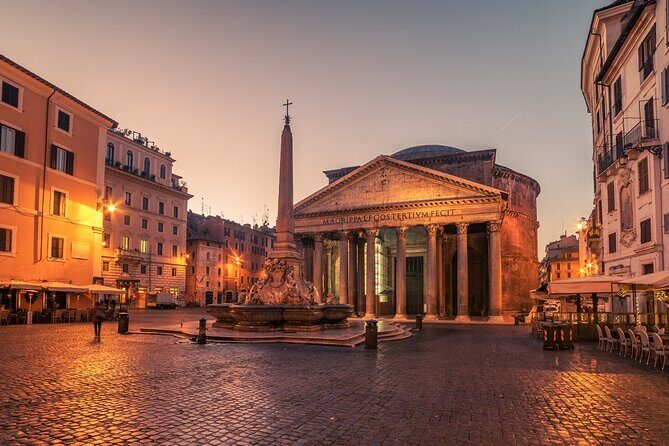
- Pantheon at dusk: more than a famous facade
- Trevi Fountain: the coin toss and the aqueduct link
- Piazza di Spagna: landing in a square that lives
- Gelato payoff: a simple ending that feels right
- What you’re really paying for (and where it’s good value)
- Who should book this dusk walk
- A note on guides: your experience depends on the person
- Should you book it?
- FAQ
- FAQ
- How long is the Walking and Guided Tour of Rome at Dusk?
- What time does the tour start?
- Where do I meet the guide?
- Where does the tour end?
- How much does it cost?
- Is the ticket mobile?
- What’s included besides the guide?
- Do I pay admission at the stops?
- How big is the group?
- Is free cancellation available?
Key highlights worth showing up for
- Pantheon at night: a powerful view when the light softens the facade
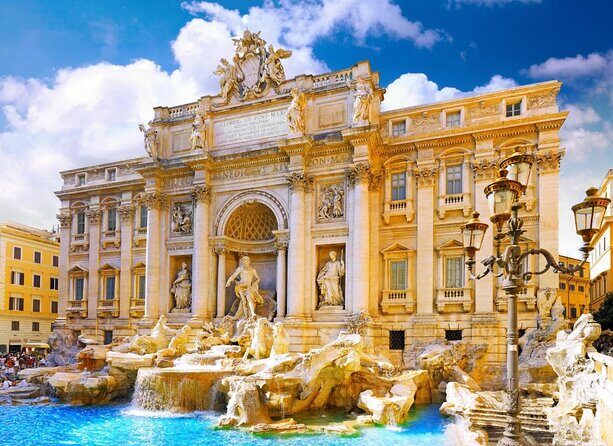
- Trevi Fountain moment: the Acqua Vergine story plus the right-shoulder coin toss
- Jewish Ghetto area vibes: a historic neighborhood feel, not just sightseeing
- Fontana delle Tartarughe in Piazza Mattei: turtles and an unusual Duke Mattei challenge origin
- Gelato included: a real, simple payoff after the walk
- Stops with free admission tickets: you’re not paying extra at each major site
Why Rome at dusk feels like its own city
Rome at night does two things that daytime often doesn’t. First, it slows you down. Second, it changes the mood of the buildings you thought you already knew. The sky, the softer streetlight, and the evening crowd flow make the route feel like a guided walk through Rome’s imagination.
This tour is built for that. You’re not trying to race between major sights. You’re walking a compact slice of central Rome with an expert guide, so you get the why behind what you’re seeing. The pace matters here because the stops are memorable, even when you’re only there for about 8 to 20 minutes at each one.
It also helps that the group stays small, up to 20 people. In a smaller group, questions don’t vanish into the back of the pack, and the guide can keep the story moving without losing people.
You can also read our reviews of more walking tours in Rome


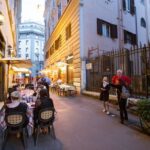
The start near Teatro di Marcello: a great first step
You meet at Via del Teatro di Marcello (00186 Roma RM) and the tour starts at 8:15 pm. Ending in Piazza di Spagna (00187 Roma RM) is smart too, because that area gives you options afterward: dining, strolling, and easy wandering toward other famous streets without feeling like you’re stuck.
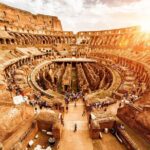
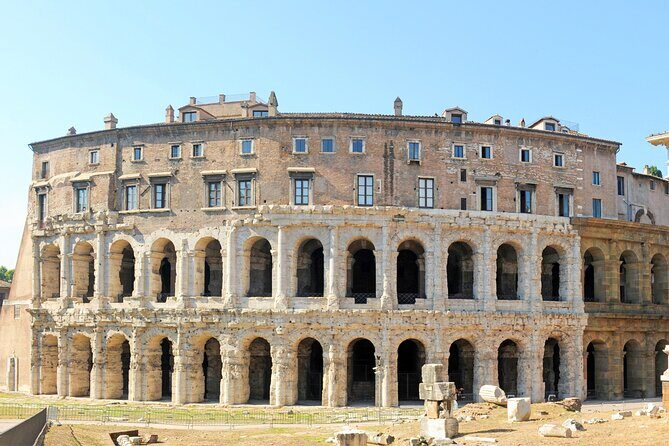
Teatro di Marcello is a fun way to begin because it looks instantly familiar. The tour frames it as a smaller cousin to the Colosseum—commissioned by Emperor Augustus—and that comparison helps you picture what you’re standing next to. Even if you’ve never studied Roman architecture, you’ll likely understand what makes it special right away: the semicircular design and the scale that feels big, even when it’s not the biggest.
And since stop time is short here (about 10 minutes), it’s a quick orientation moment. You get your bearings, then you’re off into more atmospheric streets.
The Jewish Ghetto corridor: history you can actually feel
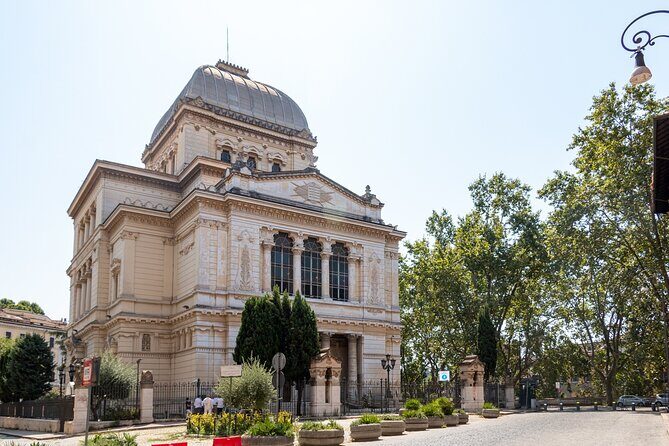
One of the best parts is that the walk threads through the Jewish Ghetto area, described as one of Rome’s most beautiful neighborhoods with a real Roman atmosphere. This isn’t just a marketing line. When you move through older parts of the city at night, you experience the contrast: grand monuments and smaller streets living side by side.
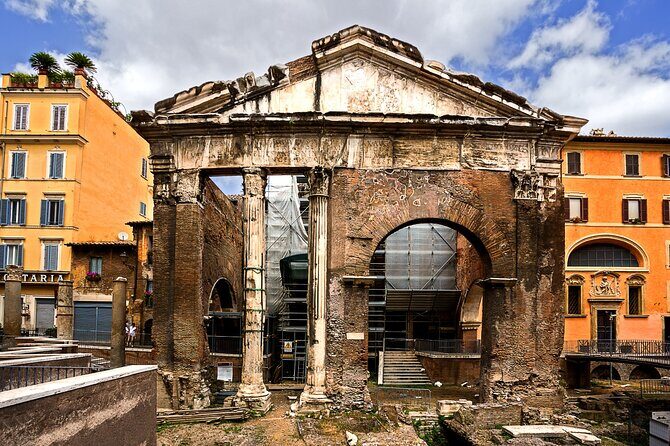
Two monuments anchor this portion of the walk: Portico d’Ottavia and the surrounding views. The Portico d’Ottavia stop focuses on what’s preserved—only the monumental entrances remain—and that matters because it changes how you read the place. Instead of being overwhelmed by a fully intact structure, you’re seeing a fragment that still shapes the view and the feel of the area.
If you like walking tours that teach you how cities were built and used, this is the right kind of segment. It’s also a good reminder that the most interesting Rome isn’t always the biggest building. Sometimes it’s the neighborhood geometry—alleys, entrances, and the way people move through space.
Piazza Mattei and the Turtle Fountain’s story
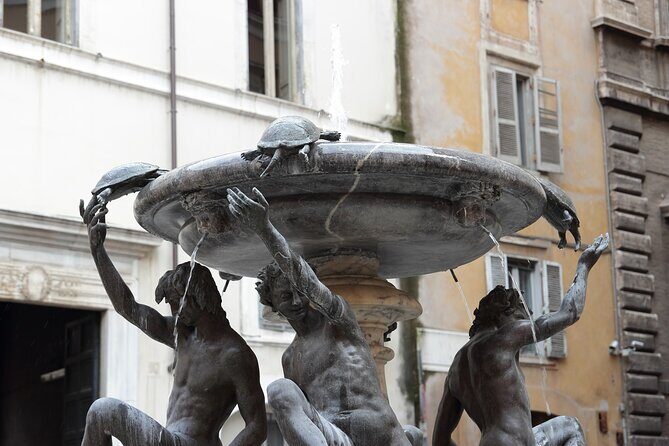
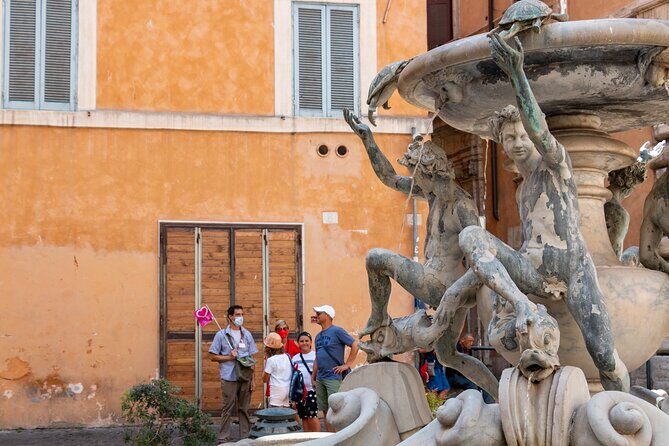
Next comes Fontana delle Tartarughe in Piazza Mattei, a stop that feels like a little break from the big-name monuments while still being deeply Roman. The fountain’s backstory is unusual, and that’s what makes it stick.
You’ll hear that Duke Mattei ordered the fountain toward the end of the 16th century as part of a challenge, built in a single day in front of the windows of his beloved’s father—basically a loud demonstration of status. Then there are the turtles, designed and placed by Bernini in 1658. That combination—an urgent personal drama plus the artistic touch of Bernini—turns a quick photo stop into something you can actually talk about later.
This is the kind of fountain that’s worth slowing down for. The group time is about 10 minutes, so it’s not a long detour, but you’ll have enough time to look closely and catch the details without feeling rushed.
Pantheon at dusk: more than a famous facade
At the Pantheon, you get one of the most satisfying stop types: the tour builds in a chance to look, not just pass by. The Pantheon is presented as a place of layers—built by Emperor Hadrian between 118 and 125 AD on earlier temple remains from 27 BC, then consecrated as a Christian church in 609 under the name Santa Maria ad Martyres.
Then there’s the political layer from later history: in 1870 it became the shrine of Italy’s kings, welcoming the remains of Vittorio Emanuele II, Umberto I, and Margherita di Savoia. That’s not trivia to ignore. It’s a big reason the Pantheon feels powerful even today. It’s not one era’s monument; it’s a long-running stage.
You’re scheduled for about 10 minutes at this stop, but because the Pantheon is such a magnet, 10 minutes at dusk can feel like plenty if you’re ready to look up and take in the facade and the atmosphere around it. Night lighting helps too, because you’re less distracted by the daytime crowds and more aware of the monument’s shape.
Practical note: the Pantheon area can be busy, so move with the group and don’t let yourself get stuck behind others trying to photograph the same spot. If you want photos, pick your angle fast, then enjoy the view.
You can also read our reviews of more guided tours in Rome




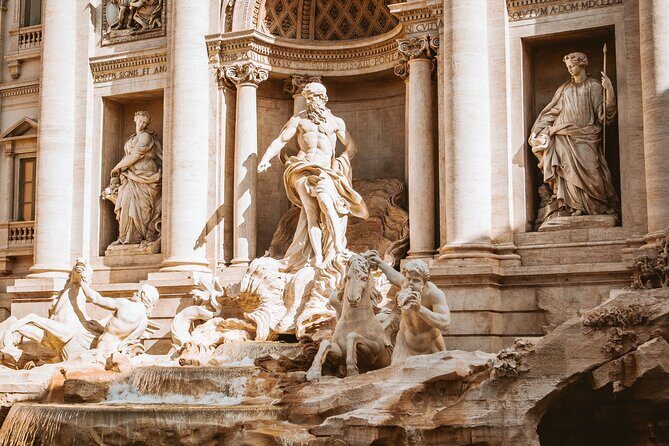
Trevi Fountain: the coin toss and the aqueduct link
No Rome night walk feels complete without the Trevi Fountain. Here, the tour doesn’t just point at it—it connects the Acqua Vergine aqueduct story to what you’re seeing.
You’ll learn that the aqueduct, led by Marco Vipsanio Agrippa to bring water to Rome in 19 BC, supplied the city with water that supported thermal baths. That background gives the fountain more meaning than a pretty landmark. It’s not magic water out of nowhere; it’s a system, and the fountain is a public expression of engineering and power.
The tour gives you about 20 minutes here, which is important. Trevi is one of those places where crowds can swallow time. Having extra minutes helps you do what you actually came for: take photos, watch the light on the stone, and do the ritual.
And yes, the tour includes the classic tradition: close your eyes and throw a coin over your right shoulder straight into the Trevi Fountain. Even if you don’t care about the superstition, it’s a fun shared moment in a very iconic setting.
Piazza di Spagna: landing in a square that lives
The tour finishes in Piazza di Spagna after a walk that also takes you through the Fontana della Barcaccia area. Piazza di Spagna is introduced as one of Rome’s most famous and visited piazze, and the center holds the Fontana della Barcaccia, designed in Baroque style by Pietro and Gian Lorenzo Bernini.
This is the kind of stop where the explanation helps you look better. The square is described with a distinctive butterfly-like shape made of two triangles crossing at the top. Once you see that layout, you stop thinking of the place as just a backdrop and start noticing how it pulls people through.
You’ll have about 20 minutes in this area, which is enough time to enjoy the fountain and settle into the end-of-tour vibe. It also matters that the tour ends here rather than somewhere random. Piazza di Spagna is a natural “after tour” hub.
Gelato payoff: a simple ending that feels right
At the end of your walk, you get an authentic Italian gelato. The idea is smart: you’ve been standing in history, looking up at stone, and walking between districts. A creamy finish isn’t just a treat. It’s also a practical reset that helps you keep your energy while you decide what to do next in Rome.
The guide keeps it light and social, too, which matches the tour’s overall style: not a museum lecture, more like a guided evening stroll with storytelling and breaks where you can breathe.
If you’re picky about dessert plans on travel days, this one is convenient. You don’t have to hunt for gelato right after you finish the main route—you’re already there, and it’s included.
What you’re really paying for (and where it’s good value)
The price is $20 for about 1 hour 30 minutes, with a mobile ticket and a maximum of 20 people. That’s a pretty strong deal when you compare what you get: a professional guide, multiple major sights, and the gelato included at the end.
It’s also notable that the major stops are described with free admission tickets. That doesn’t mean you’re skipping everything related to tickets, but it does mean you’re not paying for entry at each site during the walk. For a night tour, this matters because you want your time budget to be predictable.
You also get the kind of value that’s hard to price: a good guide connects the dots. Instead of seeing separate monuments, you see Rome as a place with recurring themes—power, religion, neighborhood identity, public water, and art.
Who should book this dusk walk
This tour is best for you if:
- you want an easy first-night introduction to central Rome
- you like walking at a relaxed pace with stops for photos and short looks
- you enjoy history when it’s told as stories tied to what you see
It’s also a good choice if you’re visiting for the first time and want a guided framework. Evening tours are especially handy because you get a “before you get lost” orientation without spending all day in transit.
If you prefer very long visits in one site, you might feel the time at each stop is short. But for a compact 90-minute evening highlight walk, it hits a sweet spot.
A note on guides: your experience depends on the person
The guides are central to the success of this tour. Multiple guides are named across experiences—Francesca, Fabio, Laura, David, and Davide—and the consistent theme is that the walk lands better when the guide brings the history to life.
There is one caution from past experiences: if you get an unprofessional guide, the tour can feel off and waiting time can stretch. You can’t control who you get, but you can control your side of the deal: arrive a bit early, be ready to ask questions, and pay attention to the first few minutes. If the group is clearly set up and the guide is engaged, the tour usually clicks fast.
Should you book it?
Yes, you should book this if you want a focused Rome night walk that mixes famous sights with less-overcrowded-feeling neighborhood context. The Pantheon and Trevi combo alone is a big draw, but what makes it worth the money is the pacing and the story glue from the guide, plus the included gelato.
Skip it only if you dislike night walking, or if you know you need long, slow time in a single site rather than quick, satisfying stops. For most people, this is a smart “first evening in Rome” choice.
FAQ
FAQ
How long is the Walking and Guided Tour of Rome at Dusk?
It lasts about 1 hour 30 minutes.
What time does the tour start?
The start time is 8:15 pm.
Where do I meet the guide?
You meet at Via del Teatro di Marcello, 00186 Roma RM, Italy.
Where does the tour end?
The tour ends in Piazza di Spagna, 00187 Roma RM, Italy.
How much does it cost?
The price is $20.
Is the ticket mobile?
Yes, the tour uses a mobile ticket.
What’s included besides the guide?
You get an authentic Italian gelato.
Do I pay admission at the stops?
The itinerary notes admission ticket details for each stop as free.
How big is the group?
The tour has a maximum of 20 travelers.
Is free cancellation available?
Yes. You can cancel up to 24 hours in advance for a full refund. Canceling within 24 hours isn’t refunded.