REVIEW · 1-DAY TOURS
Siena and San Gimignano 1 Day Trip from Rome – Semi Private Tour
Book on Viator →Operated by ROMAETRAVEL · Bookable on Viator
Towers, cathedrals, and wine without the hassle.
This semi-private day trip is built for maximum sightseeing with minimum stress: hotel pickup in central Rome, an air-conditioned minivan, and a small group (typically capped around 14–15). You’ll drive through the Chianti Hills, then get free time to explore two standout towns at your own pace—Siena and San Gimignano—plus a tasting of local wine and food.
Two parts I really like are the small-group feel and the built-in local tasting, so the day doesn’t turn into nonstop walking with no breaks. One thing to consider: the schedule is time-tight. With roughly a 3-hour drive each way, you should expect a long day (about 12 hours total), and you’ll still need to pay attention to dress rules for church stops.
From what I see in guide feedback, the experience can feel either very personal or more logistics-heavy depending on your guide’s style—names like Serena and Victoria come up as standouts when they’re on. So if you want lots of background while you’re walking, come with questions ready.
In This Review
- Key Points Worth Knowing Before You Go
- From Rome at 7:30am: the Chianti Hills drive you’ll actually enjoy
- Piazza del Campo: Siena’s medieval stage in one hour
- Centro Storico di Siena: UNESCO walking time and choosing your pace
- Torre del Mangia: the view ticket is optional, plan for it
- Duomo di Siena: cathedral time, plus the dress-code reality check
- San Gimignano 1300: why the hill town feels like a time machine
- Wine and local products tasting: included, but make it part of the day
- The full timing picture: long day, but it’s built to keep moving
- Price of $507.05: when it’s worth it, when to reconsider
- Who should book this Siena and San Gimignano day trip?
- Should you book ROMAETRAVEL’s 1-Day Siena and San Gimignano trip?
- FAQ
- How long is the Siena and San Gimignano day trip?
- What time does the tour start from Rome?
- Do you pick up from a hotel in Rome?
- How big is the group?
- What’s included in the price?
- Are entrance fees included for major sites like Piazza del Campo and the historic centre?
- Is Torre del Mangia admission included?
- Do I need special clothing for churches?
- Is food and drinks included all day?
Key Points Worth Knowing Before You Go
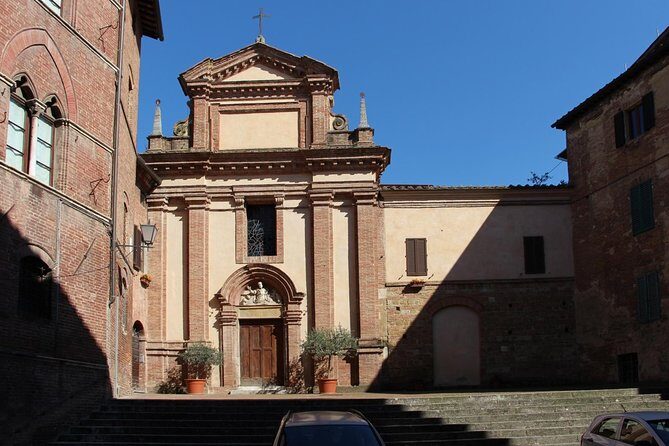
- Small-group cap helps keep the day from feeling like a cattle run (max around 14–15 people)
- Hotel pickup and drop-off saves you from figuring out trains, parking, or meeting points
- Chianti Hills driving time turns the long transfer into a scenic part of the trip
- Siena at major medieval sites includes Piazza del Campo and the historic centre (UNESCO-listed)
- Optional Torre del Mangia is a separate ticket, so plan for extra cost if you want the climb
- Wine and local food tasting is included, so you’re not hunting for lunch the whole time
From Rome at 7:30am: the Chianti Hills drive you’ll actually enjoy
This tour starts early—7:30am—from a central Rome meeting point (Piazza della Repubblica). The big win here is you don’t self-navigate. You’re picked up from your Rome hotel (the exact time arrives by mail the day before), then you settle into a minivan and let the driver handle the roads.
The ride to Tuscany is about a 3-hour stretch each way in real life, not a fantasy “quick hop.” I’d treat that time as part of the experience. The itinerary is designed around a scenic route through the Chianti Hills, so you get the sense you’re leaving Rome behind—not just riding out to the first city like it’s a chore.
Because it’s a shared vehicle, you’ll want to be practical: bring water, use the restroom before you leave (it’s a long day), and keep a layer handy. Morning air can feel cooler than you expect, and then the day warms up once you start walking.
This is also where guide style matters. Some guides focus on town history; others focus on timing and smooth flow. Either way, the drive sets the tone: you arrive ready to walk, eat, and look up at towers instead of thinking about directions.
You can also read our reviews of more private tours in Rome

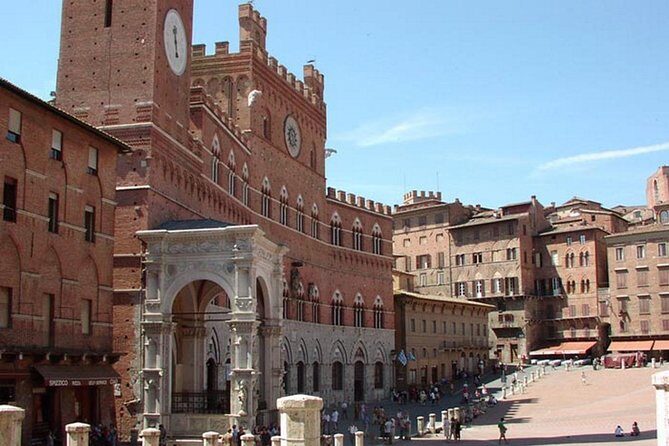
Piazza del Campo: Siena’s medieval stage in one hour
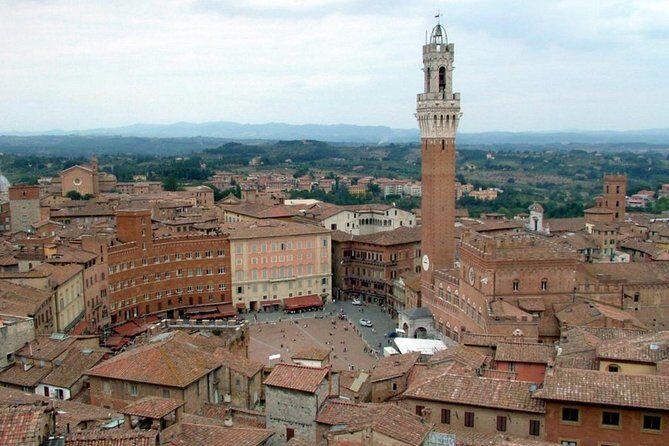
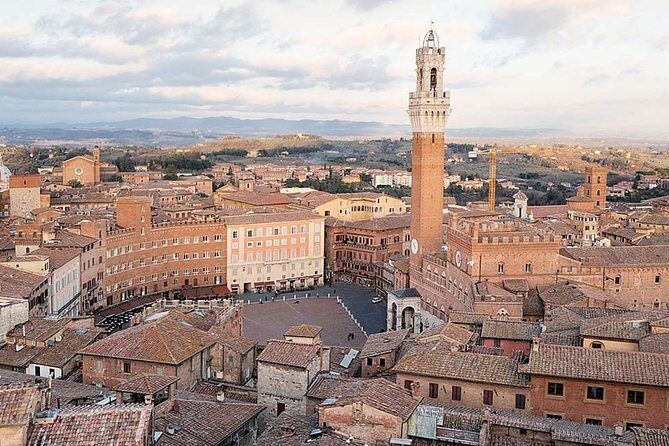
Siena’s Piazza del Campo is the first stop for a reason. It’s Siena’s main medieval square—shell-shaped—and it’s surrounded by the buildings that make the whole place feel like a carefully staged set.
What to watch for as you arrive:
- The way the space funnels your eyes toward the Palazzo Pubblico area (you’ll hear it mentioned because it anchors the square).
- The Torre del Mangia looming near the Palazzo Pubblico—this tower is basically the square’s vertical signature.
- Fonte Gaia at the northwestern edge, which adds a nice “pause and look” moment.
You’ll have about an hour here, and I like that it’s not rushed past. Piazza del Campo is one of those places where just standing still works. You can frame photos from different angles, try a slow loop around the edge, and get your bearings before the walking begins.
Also, the square links directly to Siena’s most famous horse-racing tradition, the Palio. Even if you’re not there for the race itself, you’ll feel how the space supports it—open, dramatic, and designed for crowds.
One small note: the best experience comes when you stop thinking of it as a photo spot and start treating it as Siena’s “living room.”
Centro Storico di Siena: UNESCO walking time and choosing your pace
After the big square, you shift into Siena’s historic centre. This is the part that’s UNESCO-listed, and it’s easy to see why. The city feels medieval in a way that’s more than just old stones. It’s compact, walkable, and visually consistent—so you’re not constantly figuring out where “the historic part” starts.
You’ll get about an hour here, which is enough time to do one good loop rather than trying to cover everything. Siena’s draw is the mix: medieval lanes, art and museums, and the broader sense that the city is built around traditions like the Palio (held twice a year).
Here’s how I’d use your time.
- Start by wandering without a checklist for the first 15–20 minutes. Let the streets pull you around.
- Then pick one anchor: a church area, a viewpoint, or a museum outside of the cathedral complex.
- If you like food, this is a great moment to keep your eyes open for local specialities—even if you don’t stop for a full meal.
This is also where dress and footwear start to matter in practice. You’ll be moving on uneven sidewalks and steps. Comfortable shoes are your best “included” item.
If you’re the type who hates feeling rushed, don’t worry—you have freedom here. Use it like a break, not like homework.
Torre del Mangia: the view ticket is optional, plan for it
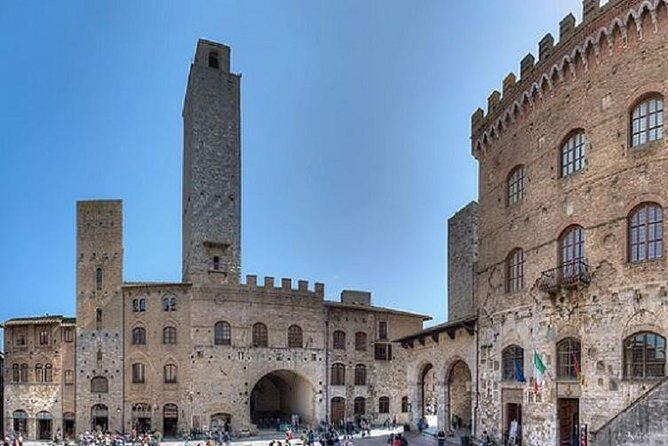
Right after Centro Storico, you’ll reach the area for Torre del Mangia. The tower sits next to the Palazzo Pubblico in the same square complex, and it’s a major medieval landmark.
Important practical detail: the Torre del Mangia admission is not included. So if you want the climb (and the views from up high), you’ll be paying extra on the day.
Why it’s worth considering: towers are what make San Gimignano famous too, so seeing Siena’s tower first helps you connect the theme. Also, Torre del Mangia’s height (it’s 102 meters) makes it a real presence in the skyline. Even if you skip the climb, you’ll appreciate it more once you’ve stood in the square and understood its scale.
If you do go up, I’d treat it as your “Siena moment” before moving on. One of the easiest ways to enjoy a busy day is to choose one paid add-on view and make it your reward for keeping your energy up.
If you skip it, you don’t lose the core experience. Siena’s streets and square are the main event.
Duomo di Siena: cathedral time, plus the dress-code reality check
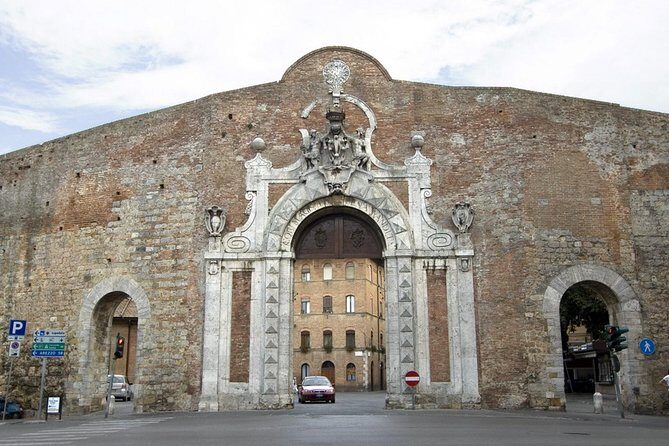
Siena Cathedral (Duomo di Siena) is next, with about an hour allotted. The cathedral is dedicated to the Assumption of Mary, and it’s been an important episcopal seat over centuries—so you’re not just stepping into a pretty church. You’re stepping into a place that has long been tied to Siena’s religious and civic life.
Here’s the practical catch: a dress code is required to enter places of worship and selected museums. That means knees and shoulders must be covered for both men and women. No shorts, no sleeveless tops. If you show up in summer gear without a plan, you may get refused entry.
I recommend packing a light layer even in warm months. It’s the easiest way to avoid turning your cathedral hour into a frantic clothing scramble.
Inside, focus on what you came for: the feel of the space, the architectural drama, and the sense of Siena’s importance in the broader region. The cathedral isn’t something you “power through.” One hour is just enough for a calm circuit—if you’re ready to slow down.
You can also read our reviews of more tours and experiences in Rome
San Gimignano 1300: why the hill town feels like a time machine
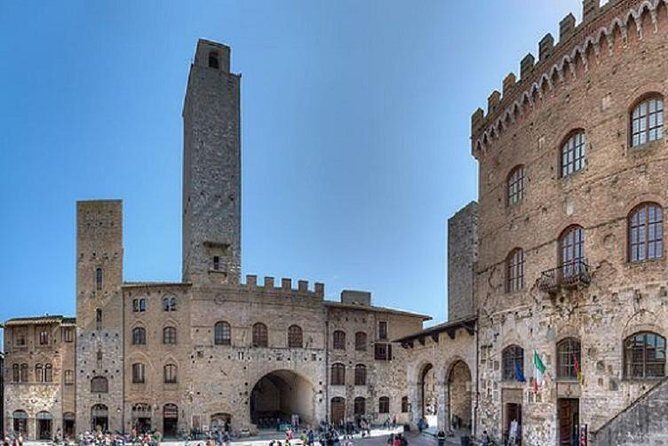
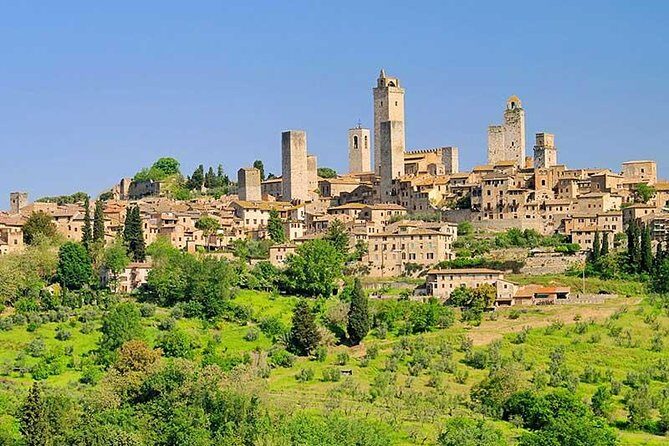
Then comes San Gimignano, the small walled medieval hill town that’s famous for its towers. You’ll get about two hours here—enough time to get the big tower views, wander through the historic centre, and still sit down if you want to regroup.
What makes San Gimignano special is how the town layout supports the effect. The walls and hill position make the skyline look intentional. As you walk, your view of the towers changes with every turn, so it never feels like you’re staring at one postcard angle.
Two hours sounds short, but it’s a realistic match for how this town works. You’re walking hills, moving between lanes, and stopping for views. The best strategy is to:
- Start with the main viewpoints early while your energy is high.
- Then switch into “street mode” once you’ve got the skyline shots.
This is also a great place to slow your pace. If you rush, you’ll miss the way the streets feel medieval without being staged. San Gimignano is compact, but it still rewards wandering.
From the pacing on this day, I’d call it a highlight that balances Siena’s large-square drama with smaller-town texture.
Wine and local products tasting: included, but make it part of the day

One of the most valuable inclusions is the tasting of local products—wine and food. You’re not relying on luck for lunch, and you’re not stuck spending time searching for a restaurant in between two major sightseeing blocks.
A couple of useful notes based on how people describe the day: the tasting often pairs wine with small local bites, including grilled items sometimes described as brochette-style. Even if you’re not a big wine person, this is still a good break. It gives your legs a rest and resets your brain for the next walking block.
How to get the most from it:
- Pace yourself with water, especially if you plan to keep walking afterward.
- If you’re curious about what you’re tasting, ask the guide or staff a simple question like what pairs best with your food. This is usually where you get a more personal, local answer than a generic explanation.
Because food and drinks are not broadly included beyond what’s specified, this tasting matters. It’s one of the few “no decisions required” moments in the day.
The full timing picture: long day, but it’s built to keep moving
This trip is about 12 hours total, with early pickup and a long drive. Some people love this structure because it gets them to two famous Tuscan towns in one day. Others feel the day is rushed because the schedule has to fit multiple stops.
Here’s my honest take on how it feels:
- Siena gives you the big medieval anchors (square + historic centre + cathedral).
- San Gimignano gives you the hill town wandering and tower views.
- You’ll also spend time tasting and traveling between places.
That means you won’t do “deep research mode” for hours in one museum. Instead, you’ll experience the big picture—medieval civic space, cathedral scale, tower-town atmosphere—then move on.
If you’re the type who likes to linger, you may need to adjust expectations. Use the free time intentionally: one slower loop in each town beats trying to cram everything into the gaps.
And one more practical point: footwear and weather. The tour says it’s not affected by adverse weather conditions, but you should still dress for comfort and bring a light rain layer if there’s a chance of drizzle. Slippery cobblestones can turn any sightseeing day into a test.
Price of $507.05: when it’s worth it, when to reconsider
At $507.05 per person, this isn’t a budget day trip. So you need to ask what you’re paying for.
You’re paying for:
- Pickup and drop-off in central Rome
- Air-conditioned minivan
- Small group (so less waiting and less crowd pressure)
- Driver/guide
- Wine and food tasting
That package can be great value if you want the hassle removed. If you’d rather not deal with parking, ticket planning, and figuring out inter-town timing, the price starts to make sense.
But there are also reasons it might feel overpriced for you. If you’re the type who wants lots of commentary while walking through each street, you may feel the experience is more about logistics than deep guiding. Also, when the day is tight, it can feel like you’re checking boxes instead of soaking in a place.
My advice: if you can handle a long day and you’ll actually use the tasting and guided transport, this works. If you’d rather travel slower or prefer to explore Siena and San Gimignano independently, you might get a more relaxed pace for less money. The cities are famous—there’s no shortage of ways to get there on your own.
Who should book this Siena and San Gimignano day trip?
I’d point this tour at people who want a smooth, structured day:
- You have limited time in Rome and want Tuscany highlights without planning.
- You like small groups and want the day to feel personal, not chaotic.
- You’re okay with a long driving day in exchange for two major towns.
It also works well if you’re a history and architecture fan who wants the big medieval anchors fast: Piazza del Campo, Siena cathedral, and the tower-town vibe in San Gimignano.
I’d think twice if:
- You hate early starts.
- You prefer slow travel and long museum time.
- You’re looking for heavy narration at every turn and you need deep storytelling to feel satisfied.
Guide quality can matter. When guides like Serena or Victoria are in the mix, the day can feel friendly and well explained. When narration is lighter, you’ll need to bring curiosity and ask questions.
Should you book ROMAETRAVEL’s 1-Day Siena and San Gimignano trip?
If your goal is Tuscany highlights in one shot, this is a strong option. The best parts are the small group, the Chianti Hills drive, and the included wine and food tasting that keeps the day from feeling like pure sprinting.
Before you book, check your own priorities. If you’re happy with a long day, respect the dress code for the cathedral, and you want to see two UNESCO-listed medieval-heavy towns without the planning headache, you’ll likely enjoy it.
If your dream trip is long, unhurried wandering with lots of museum time and deep guide-led storytelling, you may find better value elsewhere. But if you’re aiming for efficient, classic Tuscany with minimal logistics, this tour makes sense.
FAQ
How long is the Siena and San Gimignano day trip?
It runs for about 12 hours.
What time does the tour start from Rome?
The start time is 7:30am.
Do you pick up from a hotel in Rome?
Yes, pickup is offered, and the tour includes pickup and drop-off.
How big is the group?
It’s a small group with a maximum of 14 people mentioned, and up to about 15 travelers noted.
What’s included in the price?
Transport by air-conditioned minivan, pickup and drop-off, a driver/guide, a tasting of local products (wine and food).
Are entrance fees included for major sites like Piazza del Campo and the historic centre?
Admission is listed as free for Piazza del Campo and the historic centre of Siena.
Is Torre del Mangia admission included?
No. Torre del Mangia admission is not included.
Do I need special clothing for churches?
Yes. You must cover knees and shoulders. No shorts or sleeveless tops. If you don’t follow this, entry may be refused.
Is food and drinks included all day?
Food and drinks are not included unless specified. The included tasting is the main food component listed.