REVIEW · CITY TOURS
Private Rome City Bike Tour with quality Cannondale EBike
Book on Viator →Operated by TopBike Rental and Tours · Bookable on Viator
Rome looks faster from a bike.
You get a private ride through central sights without the usual walking grind, powered by a quality Cannondale E-bike with anti-puncture tires. I especially like that the route is planned to help you see major highlights in a few hours, and still feel unhurried with an actual guide riding right with you. One thing to keep in mind: you are riding a bike for about 4 hours, so if you hate being on two wheels for that long, this won’t feel relaxing.
The best part is how the tour handles Rome’s everyday problem: traffic. With limited-access traffic routes (and some stretches with no traffic at all), you can focus on the sights instead of white-knuckling your way through intersections. And yes, the distance is listed at about 8.5 miles/14 km at a leisure pace, but expect a bit of variation depending on stops, photo time, and the route conditions that day.
Key points worth knowing before you book
- Private guide, no sharing: only your group on the route, which makes questions and pacing way easier.
- Quality Cannondale electric bikes: anti-puncture tires plus a helmet you must wear.
- Traffic-smart routing: limited-access roads designed to keep the ride calm.
- Best early-morning timing: built to beat crowds and summer heat when possible.
- Stops that feel like a real city walk-through: from big icons to quieter neighborhoods like the Antico Quartiere Ebraico.
In This Review
- Why a Private Electric Bike Tour Works So Well in Rome
- Price and What You’re Really Paying For ($139.13 for 4 Hours)
- Cannondale E-Bikes, Helmets, and a Ride That Feels Built for Touring
- Morning Timing: Beating Crowds Without Missing the Best Light
- From Via Labicana to the Roman Forum: The Route-First Philosophy
- Piazza Venezia and the Monumental Triad (Trajan’s Column, Vittoriano, Palazzo Venezia)
- Trevi Fountain and Spanish Steps: Iconic Views with Less Foot Wear
- Piazza del Popolo and a Taste of Rome’s Arrival Routes
- Villa Borghese: Scenic Break Time in a Real Park Setting
- Piazza Navona and the Pantheon: Two Extremes in One Ride
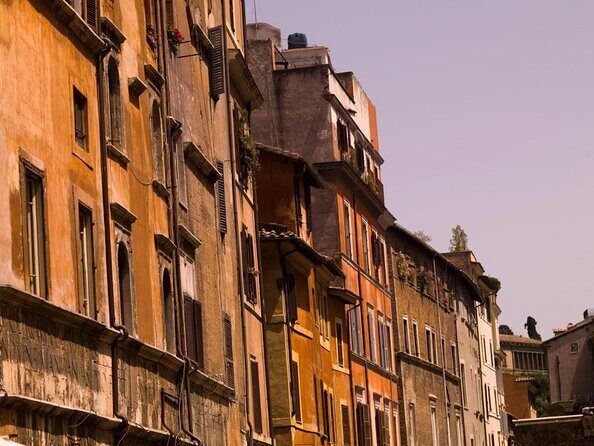
- Antico Quartiere Ebraico: A Short Stop That Feels Like a Different Rome
- Teatro di Marcello and the “Prototype” Feeling
- Piazza del Campidoglio: Capitol Hill Views and Michelangelo’s Piazza
- What the Best Guides Do (and Why It Shows Up in Reviews)
- Small Practicalities That Make a Big Difference
- Who Should Book This (and Who Should Skip It)
- Should You Book This Private Rome City Bike Tour?
- FAQ
- How long is the private Rome city bike tour?
- About how far do you ride during the tour?
- Is the helmet included and required?
- Is Villa Borghese admission included?
- Are children allowed on this tour?
- Can I get a full refund if I cancel?
Why a Private Electric Bike Tour Works So Well in Rome
Rome is one of those cities where your feet start bargaining with you by day two. This tour gives you a practical alternative: cover a big chunk of the center in a morning or early slot, while your guide steers you through the “how do we cross this” moments that can slow down even confident walkers.
The private format matters. When you’re not sharing the group, you’re less likely to feel rushed between monuments. It also means the guide can adjust pacing for your group’s comfort level—especially helpful if you’re bringing kids or mixing ages.
The electric assist is what makes this feel doable for more people. You’re still riding, but it takes the sting out of hills and longer stretches. So instead of the day turning into “walk, rest, walk, repeat,” you get steady movement with short stops that actually let you see things up close.
Price and What You’re Really Paying For ($139.13 for 4 Hours)
At $139.13 per person for about 4 hours, you’re paying for three things that add real value:
First, private guiding. This isn’t a crowded hop-on/hop-off style setup where you just follow along.
Second, electric bikes from a named brand (Cannondale) with anti-puncture tires. A basic rental bike can be fine, but you’re getting a more “tour-grade” setup.
Third, a route that tries to save you from Rome’s traffic headaches. That might sound intangible, but the difference shows up the moment you’re crossing big intersections or rolling near major sites.
If you’re short on time—or you want a solid first overview so you can decide what to revisit later—this price can feel fair fast. Walking the same loop at your own pace could take days of effort, especially if you factor in how long it takes to get around safely and efficiently.
You can also read our reviews of more cycling tours in Rome
Cannondale E-Bikes, Helmets, and a Ride That Feels Built for Touring
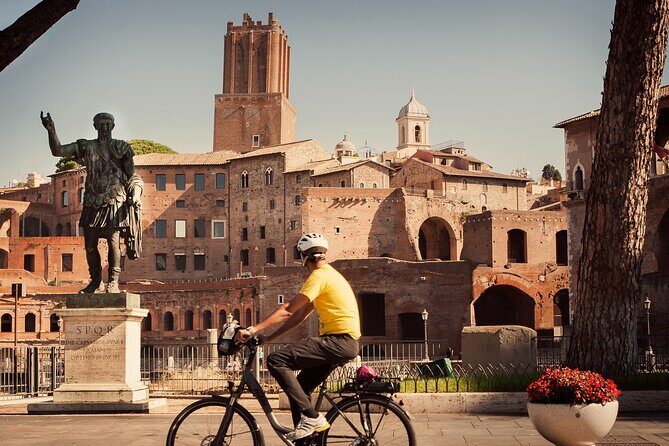
The bikes are quality Cannondale electric models with anti-puncture tires, which matters more than you’d think in Rome. Glass, grit, and road wear are real. Anti-puncture tires reduce the chance that your “perfect morning” turns into a flat-tire detour.
Helmets are mandatory, so plan to treat this like a guided ride, not a casual cruise. You’ll also get a handlebar bag and water in a biodegradable bottle. Small detail, big comfort—having water accessible without stopping your whole rhythm helps.
The tour also comes with a stated equipment weight limit of 300 lbs (136 kg). If you’re close to that, it’s worth confirming before you go, but it’s clearly part of how they run the experience.
And for safety: the route follows planned paths with limited traffic access, and sometimes no traffic at all. That’s the kind of detail you want to hear for a bike tour in a city like Rome.
Morning Timing: Beating Crowds Without Missing the Best Light
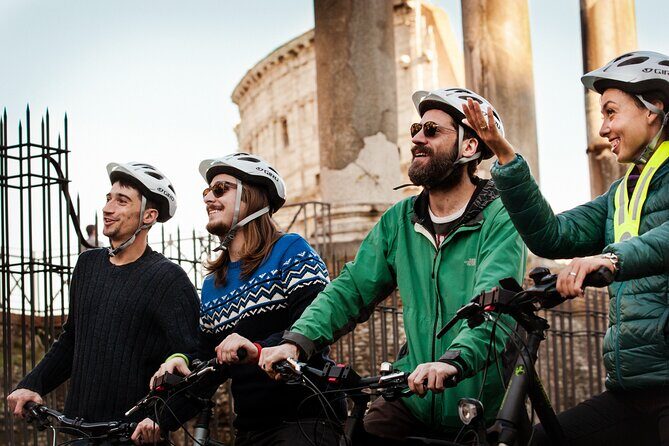
Rome’s big sites are busiest at predictable times. The tour is designed around morning slots so you can beat some crowds and often dodge the hottest part of the day.
That timing also fits how you’ll use the day after the ride. When you start early, you’re more likely to have energy left to go back for longer visits—like returning for museum hours, a relaxed lunch, or a second pass at a place you loved from the bike route.
If you’re the type who likes a “lay of the land” day, this is a strong way to do it. You’ll come away with mental map landmarks, so later it’s easier to navigate on foot.
From Via Labicana to the Roman Forum: The Route-First Philosophy
You meet at Via Labicana 49, 00184 Roma RM, right in Rome’s urban fabric. The end point returns you to the same meeting area, which keeps the logistics simple.
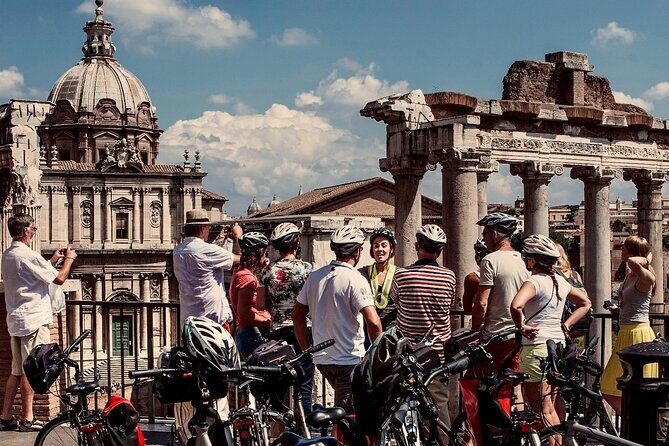
The itinerary includes a ride on a large road that cuts straight through the Roman Forum and the Imperial Fora area. That’s not just scenic—it’s efficient. Rome’s history is layered, and seeing it from the right angle, at the right speed, helps you connect what you’re looking at instead of treating it like disconnected postcard views.
You’re covering about 8.5 miles (14 km) at leisure pace. So this isn’t about “training.” It’s about moving smoothly between clusters of sights, with short breaks to actually look.
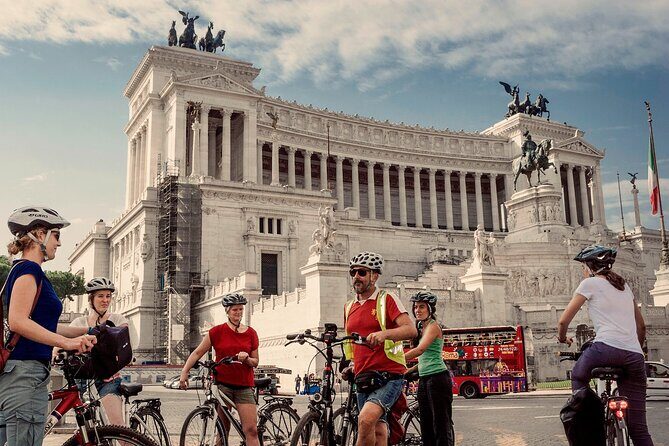
Piazza Venezia and the Monumental Triad (Trajan’s Column, Vittoriano, Palazzo Venezia)
Piazza Venezia is a natural anchor point for a reason. It’s one of those Rome squares where a lot of major landmarks sit close enough to make the area feel like a stage set for history.
Here you’ll get a quick stop for:
- Trajan’s Column
- the Vittoriano Monument
- Palazzo Venezia
This is a short visit (about 5 minutes), so you won’t spend time ticketing or museuming. Instead, you’re getting orientation and context—what each structure is, why it matters, and how they relate to the broader sweep of Rome’s eras.
A practical tip: if you want photos, this is one of the best spots to grab them. The scale is big, and it sets up what you’ll be seeing again and again as you move through the center.
You can also read our reviews of more city tours in Rome

Trevi Fountain and Spanish Steps: Iconic Views with Less Foot Wear
Trevi Fountain (about 10 minutes) is the kind of stop where being on a bike helps. You still pause to learn the story and take photos, but you’re not spending your entire time in line chaos.
Then you head to the Spanish Steps and Piazza di Spagna (about 5 minutes). This stop is quick but memorable because you get the staircase down from the church, framing the area in a way that’s hard to capture while walking quickly between crowds.
Even when you know these places from photos, Rome’s scale hits differently in person. A short stop from an easier vantage point can give you the “aha” moment without turning it into a full half-day.
Piazza del Popolo and a Taste of Rome’s Arrival Routes
Next up is Piazza del Popolo (about 5 minutes). The key idea here is that this square has long been treated as a first visual greeting to Rome—especially for people arriving from the north over the Via Flaminia.
So while it’s a smaller moment in time, it’s a smart historical stop. It helps you think about Rome like a city of entrances and journeys, not just monuments lined up for pictures.
If you like your travel with a little story, this is the kind of stop where a good guide makes a short moment feel like it has weight.
Villa Borghese: Scenic Break Time in a Real Park Setting
At Villa Borghese (about 10 minutes), you’ll have a chance to reset. This is where the tour gives you a break that doesn’t feel like an awkward pause between big stops.
The tour includes Villa Borghese admission ticket free, so you’re not stuck figuring out what requires payment versus what doesn’t. You’ll also get one of the classic Rome experiences: open-air views that make the city feel wide and layered rather than tightly packed.
This stop is practical too. When you’ve been riding and seeing monuments, the park atmosphere gives your eyes a rest.
Piazza Navona and the Pantheon: Two Extremes in One Ride
Piazza Navona (about 10 minutes) is an easy win: you cycle around the oblong square and get a first-row view of the central Baroque fountain. It’s the kind of place where even a quick stop gives you real “Rome energy”—activity, architecture, and atmosphere all at once.
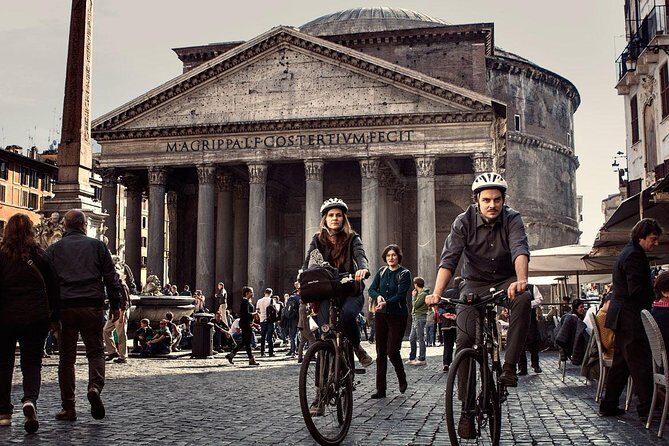
Then comes the Pantheon (about 10 minutes). You get a short break in front of one of the oldest and best-preserved buildings from Antiquity. If you’ve ever seen images of the Pantheon, seeing it in person is still a little shocking—because the scale and preservation make it feel more present than ancient.
One consideration: these are short stops, so don’t expect a full interior tour. The goal is overview and orientation—then you can decide what’s worth your time later.
Antico Quartiere Ebraico: A Short Stop That Feels Like a Different Rome
This is the kind of stop that can make the whole tour feel more personal. The itinerary includes a quick visit to the Antico Quartiere Ebraico (about 5 minutes), a smaller neighborhood with archaeological, cultural, and religious heritage.
You’re not going deep here. But you’re getting a glimpse beyond the “top five Rome hits.” For me, that’s where the value lives: the tour gives you more than a greatest-hits reel, so your second day choices feel more informed.
Teatro di Marcello and the “Prototype” Feeling
Teatro di Marcello (about 5 minutes) appears as a short stop with a ticket note listed as not included. The big idea is what it represents: an ancient theater used as a prototype for the Colosseum.
Even if you don’t go inside, seeing a structure that helps explain later Roman engineering gives the city more logic. It’s one of those “now I get it” moments that can make the history click.
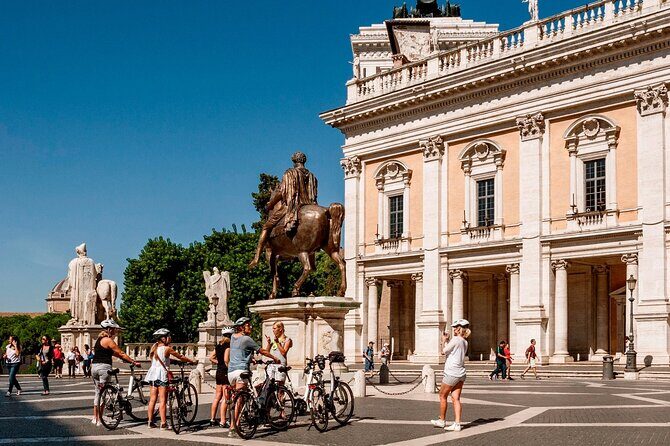
Piazza del Campidoglio: Capitol Hill Views and Michelangelo’s Piazza
Finally, you’ll reach Piazza del Campidoglio (about 10 minutes). This is where the tour often feels like it lands on a high note.
You’ll get:
- a breathtaking view over the Roman Forum from atop Capitoline Hill
- the 16th-century Piazza del Campidoglio, designed by Michelangelo
This stop works because it ties earlier sights together. The ride-through history becomes a bigger picture when you look down from a height.
If you only have limited time in Rome, this is a perfect “how the city connects” moment.
What the Best Guides Do (and Why It Shows Up in Reviews)
A theme that comes through strongly is how guides handle pace and safety, especially at crossings. People have highlighted guides like Francesca, Marco, Valerio, Elizabeta, and Bitsa/Bita—each praised for being family-friendly and keeping the ride calm.
Here’s what I’d pay attention to when your guide leads your group:
- Do they manage traffic crossings smoothly?
- Do they explain what you’re seeing in plain terms?
- Do they keep the group moving without feeling like a race?
One reason this tour scores so well is that it’s not just about getting you near sites. It’s about helping you understand what you’re seeing while keeping you comfortable on the bike.
Small Practicalities That Make a Big Difference
A few details can change your experience day-to-day:
- What’s included vs not included: Food isn’t included. Villa Borghese admission is free, and several stops list admission as free, while others note not included (like Piazza Venezia and Teatro di Marcello).
- What happens if events block the plan: In the case of official/public celebrations in the city center, the company may swap one or more included highlights for alternatives.
- Distance and pace reality: The tour states about 14 km at leisure difficulty, but at least one private ride report covered about 28 km in roughly 5 hours when factoring stops and photos. Translation: it’s flexible based on your group’s tempo.
Also, the difficulty is listed as leisure, and most travelers can participate—so long as you’re comfortable biking.
Who Should Book This (and Who Should Skip It)
This tour is a great fit if:
- you want a fast, high-quality overview of central Rome in a few hours
- you like history stories, but don’t want to spend the whole day walking
- you’re traveling with a family and want a safer, controlled way to cover sights
- you appreciate a private format so the guide can pace around your group
You may want to skip it if:
- you can’t or won’t ride a bike for most of a half day
- you want long museum time inside buildings (this is more of an overview ride)
- you’re visiting only for quiet, unstructured wandering, since the itinerary is guided and timed
For families: the tour notes a child extension for ages 5–8. Kids age 9 and above can ride on an appropriately sized e-bike.
Should You Book This Private Rome City Bike Tour?
If you’re asking me for a straight recommendation, I’d say book it if you want maximum Rome per hour with less fatigue and a route designed to avoid major traffic stress. The combo of private guide, quality electric bikes, and a sequence of iconic stops plus one or two more interesting neighborhoods makes this a smart first-Rome move.
I’d only hesitate if you’re uneasy on a bike, or if you’re hoping for long interior time at the biggest monuments. This works best as your orientation day—then you go back on foot for whatever captured you.
If you’re set on beating crowds, getting solid city context fast, and staying comfortable from start to finish, this is the kind of tour that tends to feel worth it.
FAQ
How long is the private Rome city bike tour?
It’s listed at approximately 4 hours.
About how far do you ride during the tour?
You’ll cover about 8.5 miles (14 km), described as leisure difficulty.
Is the helmet included and required?
Yes. A helmet is included and is mandatory.
Is Villa Borghese admission included?
Yes. Villa Borghese is included with admission ticket free. Other stops may be free or not included depending on the site.
Are children allowed on this tour?
Children ages 5–8 can have a child extension provided. Children ages 9 and above can ride autonomously on an appropriately sized e-bike.
Can I get a full refund if I cancel?
Yes, you can cancel for free up to 24 hours in advance for a full refund. If you cancel less than 24 hours before the start time, the amount paid is not refunded.