REVIEW · POMPEII
Pompeii Walking Tour: The Real History of the Ruins
Book on Viator →Operated by InStazione · Bookable on Viator
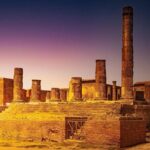
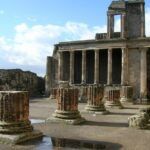
Pompeii feels personal in just two hours. This walking tour threads together the ruins behind the famous AD 79 disaster, turning scattered stones into daily life: entertainment, homes, baths, and public power. You’ll move through major areas like the Teatro Grande and the Forum with a guide who gives archaeological context instead of just pointing.
I particularly like how the route is built around contrast. One stop is the theater where comedies and pantomimes were staged; the next is the Stabian Baths with male and female areas preserved; after that comes the Lupanar, the red-light district that still shows its famous erotic wall art. The tour also includes your entrance ticket, so you’re paying for a guide plus access, not just a slideshow.
The main drawback to watch is timing. The tour is supposed to depart daily at 10:30 from the InStazione help desk, but actual start times can vary, so you’ll want to show up early and keep your day flexible.
In This Review
- Key takeaways
- How this 2-hour Pompeii walk makes AD 79 feel understandable
- Getting there: the 10:30 departure and why meeting early matters
- Teatro Grande: where comedies and mimes turned ruins into a story
- Via Stabiana: the cobblestones that make your brain switch modes
- Casa del Menandro: wealth, art, and a house you can read
- Stabian Baths (Terme Stabiane): the oldest baths in Pompeii
- The Lupanar: Roman tolerance, shown without modern euphemisms
- Forum de Pompeya: where power, law, and grain meet
- Temple of Jupiter (Capitolium energy in a single view)
- Basilica: justice indoors, with a safety feature
- Temple of Apollo and the granaries: religion plus money math
- The ponderary table: where trade got standardized
- Why the guide makes or breaks this tour
- Price and value: what $42.05 buys you
- Who should book, and who might want a different plan
- Should you book this Pompeii walking tour?
- FAQ
- What time does the Pompeii Walking Tour depart?
- How long is the tour?
- Is the Pompeii entrance ticket included?
- Where do I meet the guide?
- Is lunch included?
- What’s the group size limit?
- What happens if weather is bad?
Key takeaways
- 2-hour, admission-included circuit through major Pompeii sites, designed to fit a tight schedule
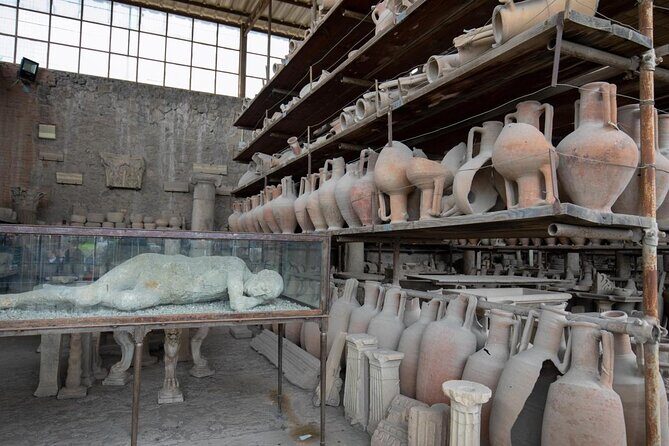
- Roman daily life in full color: theater, wealthy home, baths, brothel, and the Forum
- Via Stabiana’s cobblestone street is a standout moment that helps you picture movement through the city
- Stabian Baths are the city’s oldest bath complex, with distinct male and female sectors preserved
- Forum power meets everyday commerce at the Temple of Jupiter, Basilica, granaries, and a working ponderary table
- Guides often land the experience with humor (Grace, Frederica, Vincenzo, and Igor are names you may meet)
How this 2-hour Pompeii walk makes AD 79 feel understandable
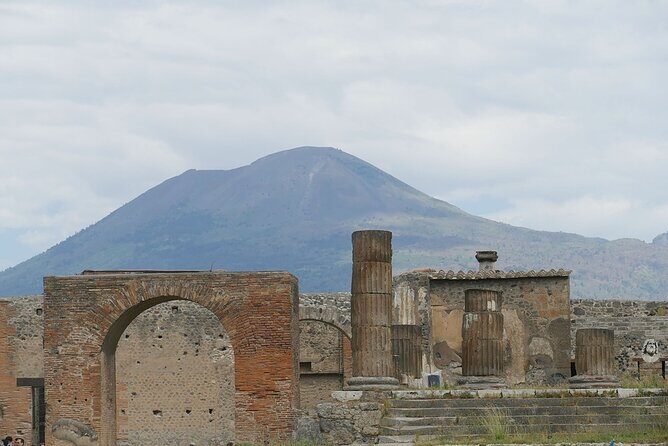
Pompeii is huge. Most people hit it like a checklist and still feel lost. This tour is a different approach: it gives you a short sequence, then explains what you’re seeing as you go. That’s what makes the time work.
You start at the InStazione help desk and then go together with your guide toward the entrance at Porta Anfiteatro. From there, the route hits high-impact spaces in a logical flow: first entertainment and street life, then a wealthy home, then the pleasures and habits Romans managed on ordinary days, and finally the public institutions that ran the city.
Group size is capped at 35 travelers, which matters because Pompeii can feel crowded fast. A smaller group helps you get answers without constantly craning your neck.
You can also read our reviews of more walking tours in Pompeii

Getting there: the 10:30 departure and why meeting early matters
The tour departs every day at 10:30 am from the InStazione help desk. After registering your details, you’ll head as a group toward Porta Anfiteatro with your guide.
Here’s the practical lesson: show up earlier than you think you need to. In the experience, start times can land later than the posted meeting plan. When that happens, it can throw off your whole schedule. If you’re connecting from Naples, it’s smart to leave breathing room.
The tour ends at Scavi di Pompei, Viale delle Ginestre, 80045 Pompei NA, Italy, so you’ll be dropped near the main area people use to explore more on your own afterward.
Teatro Grande: where comedies and mimes turned ruins into a story
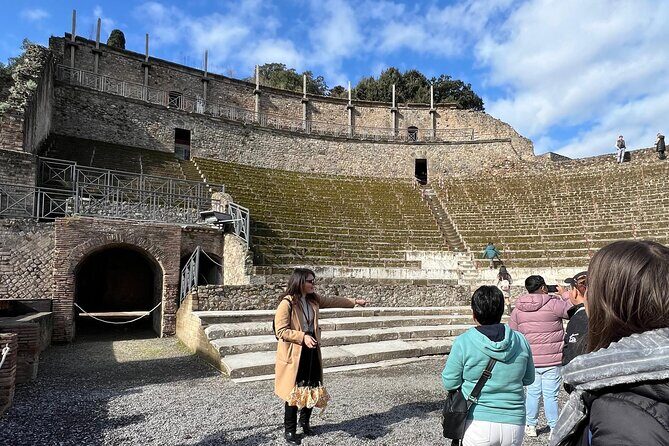
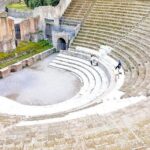
Stop #1 is the Archaeological Park of Pompeii, and one of the first real landmarks is the Teatro Grande. This is a Roman theater that ended up buried by Vesuvius in AD 79 and later uncovered through excavations.
What I like here is the specific range of performances you’ll hear about: comedies, mimes, pantomimes, and the atellane (street-style comedic drama). That list changes how you look at the space. You’re not just seeing seating tiers; you’re picturing what kinds of stories would have filled the air.
Why it’s valuable on a short tour: theaters are built for sightlines and timing. If a guide explains how the performances worked, you can understand the purpose of the architecture in minutes—exactly what you want when you only have two hours.
Via Stabiana: the cobblestones that make your brain switch modes
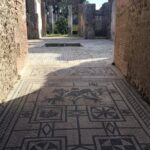
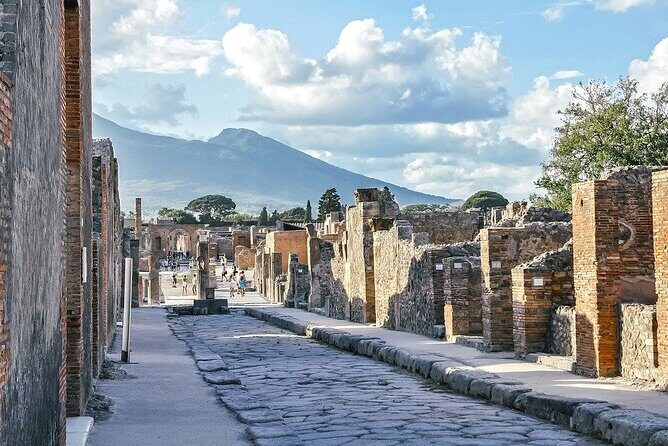
After Teatro Grande and the Odeon, the route goes along via Stabiana, described as a perfectly preserved cobbled street with sidewalks and pedestrian walkways. It’s dotted with the kinds of shops and houses that helped make Pompeii feel like a working city, not a frozen museum.
This is one of those moments where the “ruins” label stops being accurate. When you’re staring at a street you can imagine walking down, it’s easier to follow everything else later: the homes you’ll see, the public buildings, even the way people clustered around commerce and religion.
Also, it helps you understand that Pompeii’s layout wasn’t random. Roads connected neighborhoods, and major areas functioned like hubs.
Casa del Menandro: wealth, art, and a house you can read
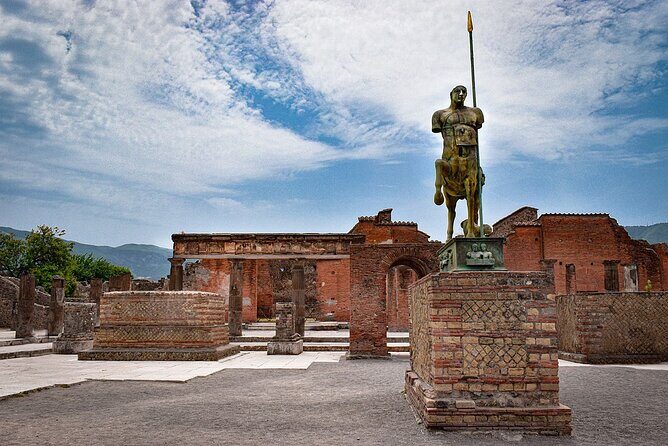
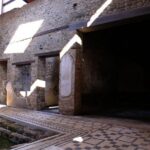
Next comes Casa del Menandro, a wealthy urban domus with almost 1,800 m². It was excavated in the years 1926 to 1932, and it’s a strong example of what affluent Pompeian life looked like.
The name comes from an image of the Greek poet Menander, not the owner’s identity. That detail matters because it signals how Pompeii can be interpreted through the art itself. If you look with that in mind, the house starts to feel like an authored space—decorated and designed to communicate status and taste.
On a 15-minute stop, you’re not trying to see every room. Instead, focus on the idea: this is what “home” meant for a wealthy family—layout, decoration, and how art and public identity blended.
You can also read our reviews of more historical tours in Pompeii
Stabian Baths (Terme Stabiane): the oldest baths in Pompeii
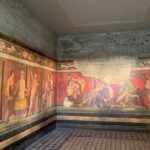
Stop #3 is the Stabian Baths, a Roman bath complex buried in AD 79 and later excavated. The big point here is that it’s the oldest bath building in the city.
You’ll spend about 15 minutes, and the guide ties it to Roman routines: bathing wasn’t just hygiene; it was a social and cultural habit. The male and female sectors are described as perfectly preserved, which gives you something tangible to observe rather than a vague “there were baths.”
The drawback of any bath stop is that you can get lost in fragments. A good guide keeps you anchored by explaining what each area likely served and how the design supported daily movement through the space.
The Lupanar: Roman tolerance, shown without modern euphemisms
Then comes the Lupanar, Pompeii’s best-known brothel area. The lupanari were places dedicated to mercenary sexual pleasure—essentially houses of tolerance—during the Roman era, and some of the structures are still visible.
The tour points out that the walls include famous erotic scenes. Even if you find the subject uncomfortable, I think this stop is important for historical honesty. Pompeii includes sex work, violence, humor, religion, and daily meals—because the city was real people, not cleaned-up propaganda.
If you’re sensitive to explicit imagery, mentally prepare for it. Also be aware that this isn’t a long stop, so you don’t have to linger if you’d rather keep moving.
Forum de Pompeya: where power, law, and grain meet
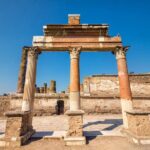
Stop #5 takes you to the Forum of Pompeii. It began around the 4th century BC in the Samnite era near a key road junction, with roads heading toward Neapolis, Nola, and Stabiae. After Roman conquest, the Forum was rebuilt and expanded—especially in the 2nd century BC—with shops and a perimeter wall near the Temple of Apollo removed as political and religious buildings took over.
On a guided route, the Forum works because you can connect three different functions:
1) public space,
2) commerce and exchange,
3) religious authority.
Temple of Jupiter (Capitolium energy in a single view)
You’ll see the Temple of Jupiter, which later became associated with the Capitolium idea in Rome and was dedicated to Jupiter, Juno, and Minerva. In the basement, the guide explains there was storage for sacred furnishings, votive offerings, and the public treasury called the erarium.
This is a moment where you can stop thinking only in terms of ruins and start thinking in terms of governance. A temple wasn’t only worship; it was also a place tied to civic wealth and authority.
Basilica: justice indoors, with a safety feature
Next is the Basilica, a major public building dating to the second century BC. The guide frames it as an indoor forum-like space for when weather pushed activities inside.
On one side, there’s the tribunal where the judge sat elevated above the parties. The guide also explains a detail about protection: the judge’s area was reachable by a mobile wooden staircase designed to prevent condemned people from attacking judges. That’s the kind of practical design element that makes ancient law feel less abstract.
Temple of Apollo and the granaries: religion plus money math
Stop #7 includes the Temple of Apollo. The guide connects Apollo’s cult to the Greek world and explains that, just before the eruption of 79, following shifts in favor, Apollo’s influence had declined as Jupiter and the Capitolium-style worship grew.
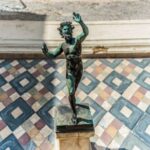
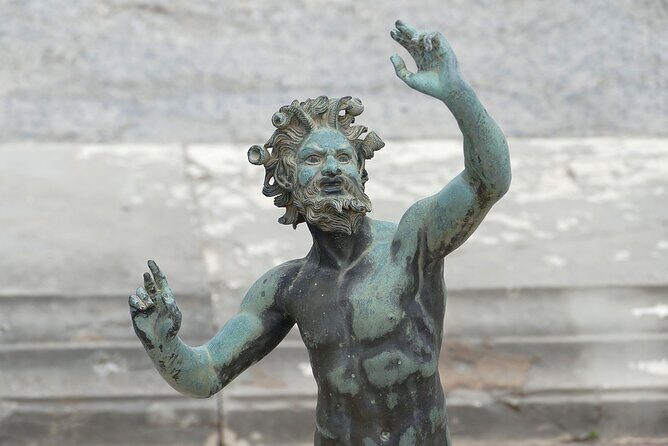
In the ruins, you can see the bronze statue of Apollo as an archer, and in front you can spot a statue of Diana.
Then you’ll reach the granaries area, which served as a market for cereals and legumes. A useful interpretation detail comes up here: there were no traces of plaster found there, so it was believed the structure wasn’t finished at the time of the eruption. That kind of “unfinished” evidence is what keeps Pompeii from feeling like a sealed-off snapshot.
The ponderary table: where trade got standardized
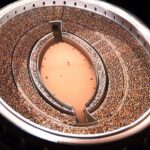
One of the most practical points is the ponderary table, described as a place where tools were kept to ensure correct exchanges and conversion of measurement units from across the empire into the units valid in Pompeii.
If you like history that connects to how people actually negotiated and traded, this is a strong payoff. It shows that everyday business depended on rules, tools, and agreed units—just like today.
Why the guide makes or breaks this tour
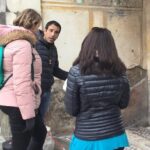
The experience lives and dies by the guide. The best versions of this tour are guided with humor, quick clarity, and a willingness to explain what you’re looking at in plain language.
You might meet guides such as:
- Grace, noted for brilliant explanations and for making the two hours go fast
- Frederica, praised for careful, funny explanations of what you’re seeing
- Vincenzo, singled out for engaging presentation and making sure everyone could see and understand
- Igor, described as well prepared and highly professional
You won’t control who you get, of course, but the lesson is useful: when a guide speaks clearly about the purpose of each building—what it did, who used it, and why it was placed there—the ruins stop being random. You’ll spend less time guessing.
Price and value: what $42.05 buys you
At $42.05 per person for about two hours, the value is mostly about two things: you get an entrance ticket plus a guided interpretation.
This is not a full-day Pompeii plan. It’s a focused hit list, which is exactly why the price works. If your goal is to see the biggest, most meaningful areas without getting tangled in a self-guided maze, this is the right pricing model for you.
If you’re the type who loves wandering and taking photos for hours, you might find the time tight. But if you want momentum and context, the structure is built for it.
Who should book, and who might want a different plan
This tour fits best if:
- you want a 2-hour overview of Pompeii’s core spaces
- you’d rather have someone explain Roman culture as you see it
- you like variety: theater, baths, a home, a brothel, and the Forum
It may be less ideal if:
- your schedule is rigid and you cannot handle possible start-time slippage
- you want long stays in just one area, like only the Forum or only the houses
Should you book this Pompeii walking tour?
I’d book it if you want a guided route that turns ruins into a coherent story. The stops are chosen for variety and purpose: entertainment at Teatro Grande, daily social life at the baths, the Forum’s civic power, and the granaries’ trade logic.
You should also book it if you’re traveling with limited time, because two hours can be enough to get your bearings fast when the guide connects the dots.
Before you go, pick a mindset: this is a “best-of” walk. If you expect to see everything slowly, it will feel short. If you want context and momentum, it’s a strong way to experience Pompeii without losing the plot.
FAQ
What time does the Pompeii Walking Tour depart?
It departs every day at 10:30 am from the InStazione help desk.
How long is the tour?
The tour is about 2 hours (approx.), with shorter timed visits at each major stop.
Is the Pompeii entrance ticket included?
Yes. The entrance ticket and guided tour are included, and admission tickets are listed as included for the stops.
Where do I meet the guide?
You meet at the InStazione help desk in 80045 Pompei, and the tour ends at Scavi di Pompei on Viale delle Ginestre.
Is lunch included?
No. Lunch is not included.
What’s the group size limit?
The tour has a maximum of 35 travelers.
What happens if weather is bad?
The experience requires good weather. If it’s canceled due to poor weather, you’ll be offered a different date or a full refund.