REVIEW · POMPEII
Pompeii: Skip-the-Line Entry Ticket with Digital Audio Guide
Book on Viator →Operated by Vox City International Ltd · Bookable on Viator
Pompeii hits you fast. This ticket gets you into the Pompeii Archaeological Park and pairs it with a 130+ stop digital audio guide in several languages, so you can wander temple streets and big landmarks without feeling lost. I especially like the way the audio anchors you to standout spots like the Pompeii Forum and the House of the Faun. One real drawback to plan around: you must bring your own smartphone and headphones, and the audio guide needs to be downloaded via the QR code before you arrive.
I also like that you’re not locked into a strict group route. You can take breaks, linger at mosaics or plaster-cast areas, and pace yourself across a huge site. Pompeii covers 44 square hectares, so having a self-guided plan is helpful when your legs start negotiating with your curiosity.
Logistics are straightforward. You exchange your voucher at Piazza Esedra, 1, in front of Hotel Vittoria, then walk into the park. Expect about 2 to 3 hours for the highlights, and plan a bit more if you want time to slow down at the eruption aftermath.
In This Review
- Key things to know before you go
- Skip-the-line entry and what that means at Pompeii
- Meeting point at Piazza Esedra: get your bearings quickly
- The offline audio guide setup that can make or break your day
- What you’ll see: temples, mosaics, and Pompeii’s main civic spine
- Pompeii Forum: where trade met power
- Amphitheatre stops and the idea of public spectacle
- House of the Faun and what “domestic Pompeii” feels like
- Temples to Venus, Apollo, and Jupiter: religion you can still map
- Ash-covered homes, plaster casts, and the Vesuvius backdrop
- Navigating without a set route: use maps and simple anchors
- Suburban Villas cost extra: what you’re skipping by default
- Price check: is $33 good value for Pompeii?
- Who should book this Pompeii audio ticket
- Should you book this Pompeii skip-the-line audio ticket?
- FAQ
- What’s included with the Pompeii skip-the-line entry ticket?
- How long should I plan for inside Pompeii?
- Which languages are available in the audio guide?
- Where do I redeem my voucher for this ticket?
- Do I need headphones or a smartphone?
- Do I get access to the suburban villas like the Villa of the Mysteries?
- How do I get the audio guide before I arrive?
- Is transportation included?
- Is this ticket refundable if I change my mind?
Key things to know before you go

- Skip-the-line entry can still be variable: a reserved ticket helps most when crowds stack up, but the line situation isn’t identical every day.
- 130+ audio stops make self-guided easier: the commentary is available in English, French, Spanish, German, and Italian.
- Download the audio before arrival: the app is meant to work without relying on mobile signal on site.
- You need headphones and a device: this is not an included guided tour headset setup.
- Suburban villas are extra: the ticket does not include access to the Villa of the Mysteries, Villa of Diomedes, or Villa Regina (listed as 8€).
- GPS can be hit or miss: it’s smart to have a map ready when the phone decides to be unhelpful.
Skip-the-line entry and what that means at Pompeii

This experience is built around convenience: you get a reserved entry ticket to Pompeii, plus an audio guide that you run on your smartphone. In plain terms, you’re paying to avoid the most annoying part—figuring out entry while people cluster around the gates.
That said, skip-the-line value depends on timing. If the day is calm, you might not feel a dramatic difference. If you’re arriving in a peak window, reserved entry usually pays off by keeping your energy for walking instead of waiting.
Also note that this is a self-guided experience inside the park. The ticket doesn’t turn you into a sheep in a human funnel; you’re free to follow the audio cues at your pace, and you can stop for photos, shade, or a longer look at plaster casts.
You can also read our reviews of more tours and experiences in Pompeii



Meeting point at Piazza Esedra: get your bearings quickly
Your voucher gets exchanged at a specific spot: Piazza Esedra, 1, 80045 Pompei NA, in front of Hotel Vittoria. It’s also described as near public transportation, which matters because Pompeii can be a little chaotic once you’re off the bus/train and moving on foot.
Here’s the practical move: when you arrive, don’t wander too long trying to find the park entrance. Redeem your ticket first, then get oriented with a map as you cross into the main area. Even with a phone audio guide, Pompeii is big, and your first 10–20 minutes shape the whole visit.
Duration-wise, you’re typically planning for 2–4 hours in the park overall. The experience estimate is about 2–3 hours, so if you want a slower stroll with extra stops, build in time before you commit to leaving.
The offline audio guide setup that can make or break your day
This is the part you can control the most. The audio guide is accessed through a QR code on your voucher. The important instruction is to download the audio using that QR code before you arrive. That way, you’re not depending on a patchy connection once you’re inside the ruins.
Why I think this matters: Pompeii is outdoors, and phone signals can be uneven among ancient stone, open courtyards, and busy walking lanes. If you try to rely on live connectivity, you might lose the audio track right when you hit the most interesting structures.
Headphones are also not included. Bring wired earbuds or Bluetooth headphones that you already know work well with your phone. If your headphones are temperamental at home, they’ll be even more annoying when you’re standing beside a mosaic and trying to match the audio to what you’re seeing.
What you’ll see: temples, mosaics, and Pompeii’s main civic spine
You’re covering a highlight set across the park, and the audio guide is designed around major points of interest. Expect stops tied to the Roman layout—public spaces, religious sites, and domestic neighborhoods—plus the eruption impact.
The audio is meant to take you past famous landmarks and smaller details too, like intricate mosaics and historic residences. You’ll also hear about temples dedicated to Venus, Apollo, and Jupiter, which is a great way to connect what you see (stone platforms, niches, columns) with why the Romans used these spaces.
One thing to know: the audio is not described as a single, strict walking order. That can be great if you like flexibility, but it also means you should be comfortable making small routing decisions yourself. When the map or GPS isn’t cooperating, your best friend is a park plan and simple landmarks like the Forum area and major public buildings.
Pompeii Forum: where trade met power

If you want one “center of gravity” for your visit, it’s the Pompeii Forum. The Forum is described as the city’s trading hub and political center, which helps you understand why it feels like the busy heart of daily life—this wasn’t just a pretty plaza.
Standing in this space, you can connect the dots between civic authority and commerce. The Romans didn’t separate politics from the economy; they shared the same public stage. Using the audio here is especially useful because it gives you context while you’re looking at what survives—stone layout, building edges, and the shape of the space.
Try not to rush the Forum. If you only speed through the biggest names, you miss the feeling of how a Roman town actually functioned. A slow couple of minutes here can make the rest of the walk click.
You can also read our reviews of more guided tours in Pompeii






Amphitheatre stops and the idea of public spectacle
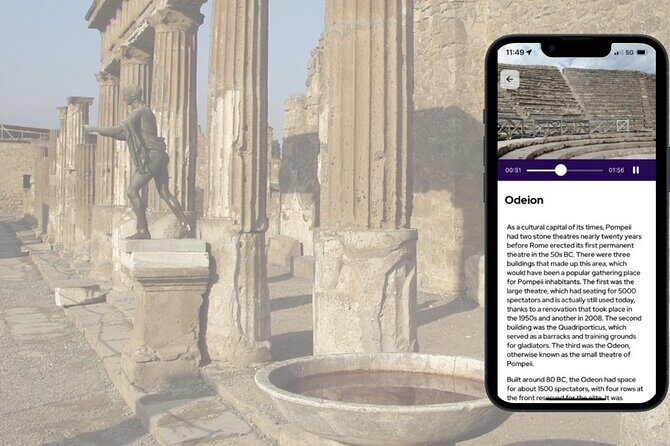
The route includes Pompeii’s Amphitheatre, which is one of those sights where the stone shapes do a lot of the storytelling. Even if you don’t go deep into architectural details, you can still “read” the idea: public entertainment for crowds, built into the city’s daily rhythm.
This is a good place for an audio moment because the guide can turn the seating and open space into a story you can picture. And because the Amphitheatre sits on the big, famous side of Pompeii, it’s also one of the easiest anchors for orienting yourself while you wander.
If you’re short on time, the Amphitheatre is one of the best ROI stops. It’s a major landmark, and it helps you understand that Pompeii wasn’t just private villas and household rooms—it was a full civic town.
House of the Faun and what “domestic Pompeii” feels like
One of the standout residences included in the audio highlights is the House of the Faun. Houses like this matter because they show you what everyday Roman wealth and taste looked like at ground level—courtyards, rooms, and decorative details that weren’t meant for public crowds.
The audio guide’s coverage of residences and mosaics can help you spot the difference between a random room and a room meant to impress. That’s a big deal when you’re looking at ruins where walls are worn down and ceilings are gone. With the audio running, you’re less likely to treat the site like a collection of unrelated stones.
Also, pace yourself here. Domestic areas can be visually dense—lots to look at in a small footprint. If you’re the kind of person who enjoys details, slow down. If you’re not, stick to the main audio cues and move on so you don’t burn your energy before the eruption aftermath areas.
Temples to Venus, Apollo, and Jupiter: religion you can still map
Temples in Pompeii aren’t just about religion—they’re about urban planning and community identity. The audio includes temples dedicated to Venus, Apollo, and Jupiter, and that’s useful because it gives you a framework for what you’re seeing.
When you hear the deity context while looking at the remaining temple structures, you get a clearer sense of how Romans organized belief in physical space. It turns the ruins into a mental map: civic life, religious life, and public entertainment all share the same street grid.
Practical tip: pick one or two temple stops to linger at. If you try to hit every single religious cue, you can end up mentally saturated. Pompeii rewards focused attention, especially when you’re walking outdoors for hours.
Ash-covered homes, plaster casts, and the Vesuvius backdrop
The emotional weight of Pompeii comes from the eruption aftermath. The experience includes haunting scenes like ash-covered homes and plaster casts of victims, set against the dramatic backdrop of Vesuvius.
This is the part where your audio guide can be more than entertainment. When you’re standing in a devastated space, context helps you avoid turning the moment into just another photo stop. Listening as you look gives you a steadier understanding of what these buildings represent: lives paused suddenly, then preserved in a terrible kind of snapshot.
If you want a gentler visit, schedule these areas earlier in the day before you get tired. If you want a deeper emotional impact, plan to take your time here and reduce your pace for a while. Either way, give yourself a few minutes of quiet, even if it’s just sitting on a step and letting the scale land.
Navigating without a set route: use maps and simple anchors
The audio guide is built around 130+ points of interest, but you should assume you’ll make micro-decisions as you walk. One practical issue that can pop up with phone-based navigation is that GPS mapping and on-screen guidance may not always behave the way you expect.
So don’t treat the phone as the only map. Bring a park plan, and use clear anchors like the Forum, major landmark buildings, and the areas you most care about. If the phone route stalls or your app feels awkward, switching to a simple plan prevents frustration from eating your time.
I also suggest you download and test your audio setup before you step into the densest entry zone. Sound quality, volume, and headphone Bluetooth pairing are easy to fix in advance, and annoying to fix while you’re trying not to lose your place.
Suburban Villas cost extra: what you’re skipping by default
This ticket does not include access to the suburban villas, specifically the Villa of the Mysteries, Villa of Diomedes, and Villa Regina. Those are listed as 8€ extra.
This matters because some visitors come specifically for the villas outside the main city grid. If that’s you, double-check how much time you want to allocate. With only 2–3 hours built into the experience estimate, squeezing in additional sites might require firm priorities.
If your goal is Pompeii’s core street life—the Forum, public buildings, major residences, and the eruption aftermath—this ticket covers the essentials. If your goal is the villas as a top priority, you’ll want to budget for the add-on separately.
Price check: is $33 good value for Pompeii?
$33 is a fair entry price for what you get here: a reserved ticket plus an audio guide covering 130+ points in multiple languages. The value is best when you use the audio for context, because it helps you understand what you’re seeing while you walk.
Where the value can drop is if you don’t plan for the audio tech needs. This experience doesn’t include a phone or headphones, and the guide depends on the QR-code download before arrival. If you show up without ready audio, you’ll still be in Pompeii—but you’ll lose a big part of the reason you paid for this format.
It’s also worth factoring in that suburban villas cost extra (8€). If you’re going to pay that anyway, consider whether you want to extend your day. If not, keep your plan focused on the main park highlights.
Overall, I’d call it good value if you want flexibility and context, and you’re comfortable managing your own pacing.
Who should book this Pompeii audio ticket
This is a strong match if you want to see Pompeii at your own tempo. You’ll like it if you’re the type who enjoys listening while walking, stopping for mosaics or plaster casts, and choosing what to linger on.
It’s also a decent fit for couples, solo travelers, and small groups who can handle independent navigation. Since languages are offered (English, French, Spanish, German, Italian), it works well when people don’t all speak the same language.
I’d be more cautious if you know your phone struggles with offline audio or if your headphones often cut out. This is still a self-guided experience, and your comfort with tech will affect the day more than with a fully staff-led tour.
Should you book this Pompeii skip-the-line audio ticket?
Book it if you want reserved entry plus a 130+ stop audio guide that helps you connect the ruins to daily life—Forum, temples, major houses, and the eruption aftermath. It’s a smart way to see Pompeii without feeling rushed, as long as you treat the QR-code download and headphones as non-negotiables.
Skip it or switch formats if you’re aiming for a fully guided, staff-led route or if you expect the audio to work reliably without downloading ahead. In Pompeii, the most expensive problem is waiting around with no sound while everyone else has the fun parts happening.
If you do book, show up ready: download the audio first, bring solid headphones, and get a map when you enter. Then you’ll spend your time where it counts—on the streets of an ancient city that still feels shockingly real.
FAQ
What’s included with the Pompeii skip-the-line entry ticket?
You get a reserved entry ticket to Pompeii and a digital audio guided tour with 130+ points of interest.
How long should I plan for inside Pompeii?
The experience estimate is about 2 to 3 hours, and many visitors spend 2 to 4 hours in the park.
Which languages are available in the audio guide?
The audio commentary is available in English, French, Spanish, German, and Italian.
Where do I redeem my voucher for this ticket?
You exchange your voucher at Piazza Esedra, 1, 80045 Pompei NA, in front of Hotel Vittoria.
Do I need headphones or a smartphone?
Yes. Headphones and your mobile device are not included.
Do I get access to the suburban villas like the Villa of the Mysteries?
No. This ticket does not include access to the suburban villas, including the Villa of the Mysteries, Villa of Diomedes, and Villa Regina. Access is listed as an additional 8€.
How do I get the audio guide before I arrive?
Scan the QR code on your voucher to download the audio guide prior to arrival.
Is transportation included?
No. Transportation is not included.
Is this ticket refundable if I change my mind?
Yes, free cancellation is available up to 24 hours before the experience start time for a full refund.