REVIEW · POMPEII
Pompeii & Herculaneum Family Adventure | Guide+Transport+Tickets
Book on Viator →Operated by Leisure Italy · Bookable on Viator
Two cities, one eruption, and real-life details. This day is built around Herculaneum’s shockingly preserved streets, then carries you into the bigger and busier Pompeii site with a guide who keeps the story clear for kids and adults. I especially like the practical flow: you start in Herculaneum first, then shift to Pompeii, so you’re not just collecting ruins. The other big win for me is the skip-the-line setup plus private family pacing. One thing to consider: this is a long, mostly outdoors day with real walking and sun, so you’ll want good shoes and a calm pace.
What makes it work for families is that the tour doesn’t treat archaeology like a museum exhibit. You move through real spaces—homes, baths, shops, courtyards—then learn what everyday life was like in 79 AD. Seeing how materials survived in Herculaneum (including wood and painted rooms) helps kids grasp the idea that people lived there, not just that stones sit there.
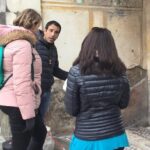
And when the guide is as thoughtful as Giuseppe D’Angelo—warm, precise, and tuned to the group—you get answers without the lecture vibe. Still, this is a private tour, so it’s best if your group can handle about a full workday’s worth of walking and attention.
In This Review
- Key highlights to look forward to
- Start in Herculaneum: where the eruption preserved daily life
- Boat Pavilion and the port feeling you can actually picture
- Elegant villas and baths: the daily routine side of Rome
- Pompeii route: from Porta Marina to the theater steps
- Skip-the-line, transport, and private guiding that saves your day
- Price and value: is $738.31 per person worth it?
- Practical tips so the day feels fun, not exhausting
- Should you book the Pompeii & Herculaneum Family Adventure?
- FAQ
- How long is the Pompeii and Herculaneum family adventure?
- Is pickup included, and where does it operate?
- Are skip-the-line tickets included?
- Is this tour private?
- What languages is the tour offered in?
- What family-friendly activities are included?
- Are meals included in the price?
- Is bottled water included?
- What kind of physical fitness level do we need?
- Are service animals allowed?
- What is the cancellation policy?
Key highlights to look forward to
- Herculaneum first: smaller site, easier for families to picture daily routines
- Wood and everyday objects survive: a hands-on feeling for how the eruption sealed homes
- Boat Pavilion and maritime gear: you’ll connect Herculaneum to real trade by sea
- Ancient shoreline story: the guide leads you through the human side at a pace families can handle
- Pompeii in a family-friendly route: bread-and-baths-and-bakeries energy, not just big monuments
Start in Herculaneum: where the eruption preserved daily life
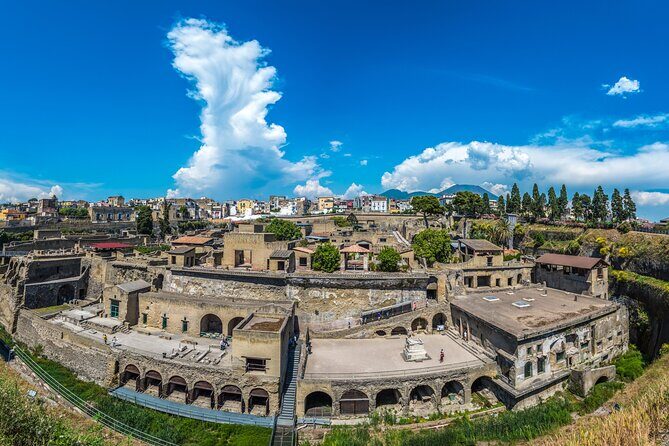
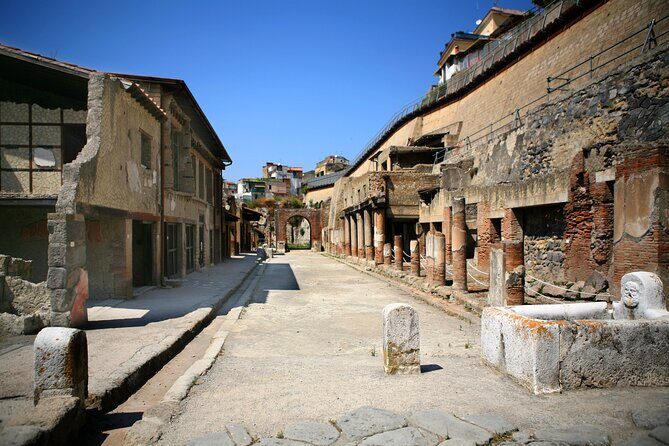
The day begins at Parco Acheologico Di Ercolano in Herculaneum, the smaller sister city at the base of Mt. Vesuvius. Pompeii often feels like a dramatic snapshot frozen in ash, but Herculaneum is different. It was hit by a superheated surge that sealed and protected many upper areas, so the archaeology tells a more intimate story. For families, that means you’re not just looking at walls—you’re seeing how rooms were used.
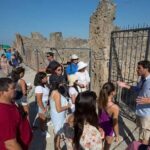
A private guide matters here. You can wander alone, sure, but the point of a guided family adventure is speed plus clarity. In Herculaneum, the guide helps you connect the dots between space and daily life: where people dined, how residents moved around town, and why certain details survived in a way that’s rare in archaeology.
You’ll also get an easy photography bonus. The tour notes you’ll see the volcano from the bottom—so you’re not driving up for overlooks—yet you still get great vantage points from both Herculaneum and Pompeii. That’s smart for families: less effort, more payoff.
Possible drawback: Herculaneum is compact, but it’s still an active archaeological site with uneven ground in places. If your group has very small kids or anyone who tires quickly, you’ll want to plan extra water breaks and take the shade when the guide suggests it.
You can also read our reviews of more tours and experiences in Pompeii
Boat Pavilion and the port feeling you can actually picture
One of the most memorable stretches is the Boat Pavilion. This stop focuses on a Roman vessel and maritime equipment discovered during the excavations. The value for kids is simple: boats make the story feel real fast. The value for adults is that it explains how Herculaneum worked as a trading port, not just as a pretty seaside backdrop.
Then comes the Antiquarium, where the guide highlights objects that survived in extraordinary condition—especially carbonized wood from furniture, doors, beams, and even shelves. This is the sort of detail that changes how you understand the entire eruption. Instead of only thinking of destruction, you start thinking about sealing and preservation. Kids often get it immediately: wood can survive for centuries when protected and sealed by volcanic conditions.
The tour also helps you connect artifacts to human decisions. That’s important because Herculaneum can feel emotional—quiet streets, preserved rooms, and a stronger sense of life happening up close. The guide leads you down toward the ancient shoreline to picture Herculaneum as a seaside town where goods arrived by water and boats were pulled ashore.
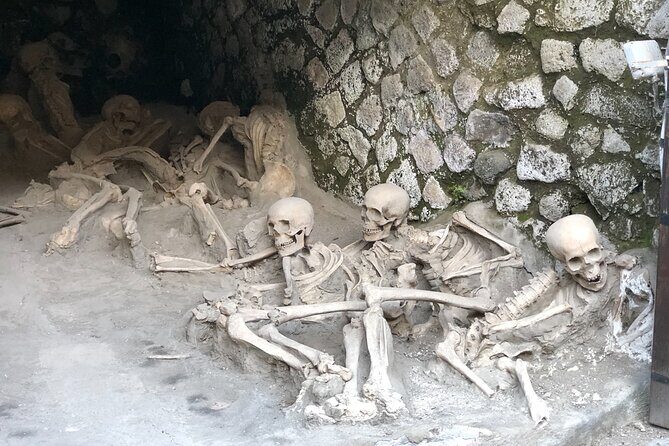
A sensitive highlight here is the discovery from the boathouses: archaeologists found over 300 skeletons, including men, women, and children, suggesting many tried to escape by sea. The guide’s role is key. Families don’t need a harsh script; you need a calm route through a hard story, with time to absorb and move on at your own pace.
Elegant villas and baths: the daily routine side of Rome
After the port story, Herculaneum shifts into luxury and routine. You’ll see the House of the Deer, an elegant seafront villa known for its marble deer sculptures attacked by dogs. Kids usually love the drama of the sculpture, and adults often appreciate how Roman luxury blended art with everyday views. The terraces over the ancient coastline are the kind of view that makes the stones feel less abstract.
Next is the exercise courtyard, used by young citizens for athletic training and social life. The guide helps you picture not just running drills, but also the broader civic role: youth education, discipline, and pride in preparing for public life. It’s a good stop if your kids like movement, because it feels like an open outdoor space rather than a cramped room.
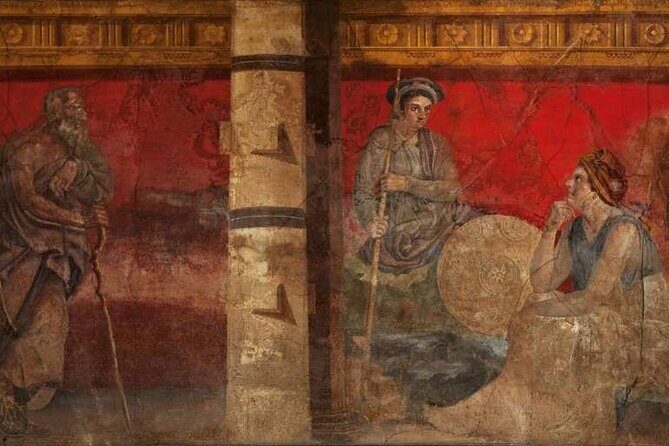
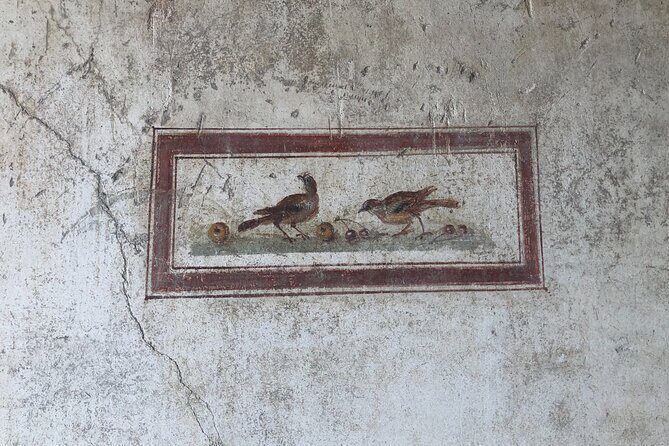
Then you’ll step into one of the celebrated residences reopened after restoration. This is where preserved wall paintings, wooden shutters, and the structure of upper floors help you understand domestic life across multiple levels. The guide highlights the décor and family rooms, and you get a rare sense of what it might have felt like inside, not just what was left behind.
The tour then follows with a shop-like stop recognizable by rows of terracotta jars (cucumae) set into a marble counter. Here the guide makes commerce feel tangible: this wasn’t a blank floor, it was a place where residents bought food and drinks. Surviving shelving and traces of storage show how everyday commerce worked.
You’ll also see a home known for a mosaic panel of Neptune and Amphitrite. The mosaic’s deep blues and golden glass tesserae help you picture how color and glass worked inside Roman spaces. For families, it becomes a quick visual lesson: Roman interiors were not gray and dusty. They were meant to impress.
Finally, you’ll visit the women’s section of the public baths, with benches, painted walls, and even wooden shelving surviving from the eruption. The guide explains how baths worked as hygiene and social time. You’ll go through the changing room and then the warm and hot spaces where steam would have filled the air. It can feel intimate—like you’re stepping into a daily habit, not just visiting a site.
A late Herculaneum stop covers a hall dedicated to the cult of the Emperor, with frescoes that mix myth scenes and imperial identity. The guide explains the Augustales, a prestigious local group of freedmen, and how civic life and politics blended with religion. It’s not just about what people believed—it’s about how belief shaped social standing.
Pompeii route: from Porta Marina to the theater steps
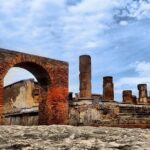
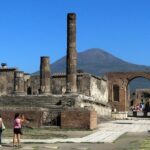
After Herculaneum, you head to Pompeii’s Archaeological Park, famous for its frozen city feeling. Pompeii is expansive, and without a guide it can turn into a long walk with gaps in understanding. With a private guide, it becomes a structured city story.
Timing matters too. The tour can adjust based on day and season, and the guide may suggest an afternoon visit when the site is often less crowded. That’s a family-friendly approach: fewer bottlenecks, more time to linger where your kids are curious.
You’ll start through Porta Marina, one of the main gateways. This is a good way to set the stage: merchants and sailors entered from the port, and your guide helps you picture the morning of the eruption—market chatter, goods arriving, and streets full of motion.
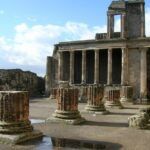
Next comes the Basilica, Pompeii’s key civic building. It’s where legal disputes were heard and contracts were agreed. Even with missing roof elements, the building shows how authority worked in stone. It’s a solid stop for adults because you learn why these spaces mattered, and it’s useful for kids because it clarifies that the city had systems and rules.
Then you’ll visit the Temple of Apollo. The guide explains why the religious spaces mattered for identity and politics. There’s also a practical payoff: from the temple terrace, you can admire a clear view toward Mt. Vesuvius. It’s history and geography in one frame.
The route continues into the Forum, the city’s civic heartbeat. This is where public life happened: business, speeches, ceremonies, and daily movement. Kids often do well here because your guide encourages imaginative storytelling—vendors, priests, crowds—while adults get the structure behind Roman city planning.
You’ll then go to the Macellum, the marketplace where citizens bought meat, fish, fruit, and imported items. This is one of the most kid-friendly parts because you can turn shopping into a game. Marble counters and storage vessels make it feel like a functioning place, not just a recovered set.
After that, the Forum Baths are a great contrast to Herculaneum. You’ll walk through changing rooms and heated bathing areas and see mosaics and stucco details that survived. Kids may compare it to a modern spa or sports club, while the guide explains how bathing tied together hygiene, exercise, and social life.
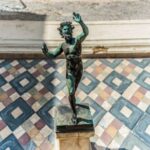
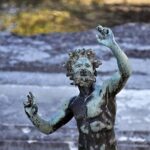
The itinerary includes aristocratic homes, including one with gardens and mosaics, famous for a small bronze statue of the dancing faun and a mosaic floor depicting Alexander the Great. Then you’ll visit the House of the Vettii, with vivid frescoes and a courtyard setting. The guide points out how wealthy families used art to show status. For families, this works well because it’s visual and story-driven.
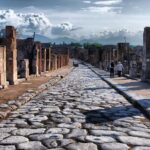
One of my favorite practical-feeling stops is Pompeii’s lively street lined with bakeries and bars. The pavement and storefront setting let your guide show how locals and travelers handled everyday errands. Stepping stones on the route help kids feel engaged instead of just waiting for adults to finish reading plaques.
There’s also a raised platform moment that offers a bird’s-eye view into a whole city block. The guide calls attention to the dollhouse effect—rooms without roofs, kitchens and workshops, dining areas, and the density of the city. Adults get a real sense of how archaeologists interpret space to reconstruct routines.
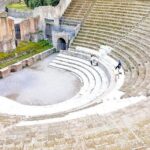
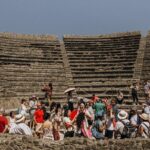
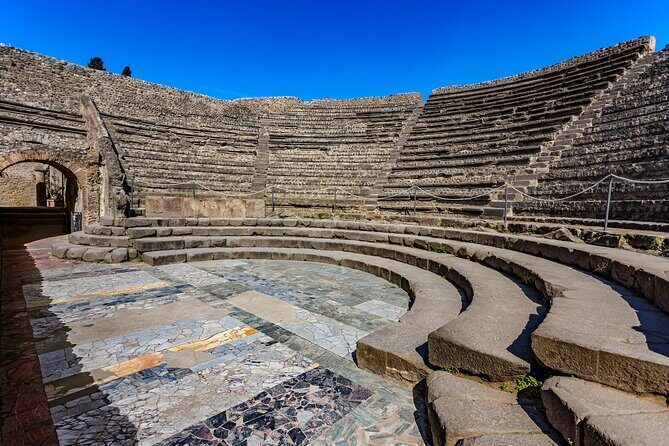
The day culminates at Pompeii’s main theater, built into the hillside to amplify sound. Kids can test the acoustics with the classic can-you-hear-me question, and adults learn why public entertainment was central to Roman culture. You sit on stone steps and get a feel for how audiences gathered in afternoon light.
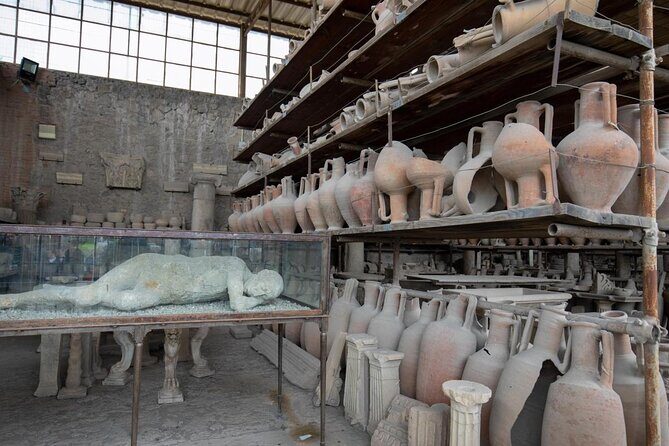
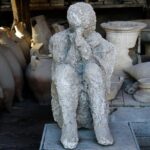
The tour finishes with time at the Antiquarium, where recovered artifacts and context help you connect ruins to people. Jewelry, coins, tools, and household objects bring the city down from giant monuments to real daily choices. Plaster casts of eruption victims may be introduced sensitively, so the human story is handled in a way families can process.
Skip-the-line, transport, and private guiding that saves your day
This tour combines transport by private vehicle with a Blue Badge private guide in both Pompeii and Herculaneum, plus skip-the-line tickets. That mix is what turns a two-site plan into a stress-reducing day.
For the money, you’re not just paying for access to ruins. You’re paying for:
- Someone guiding your route so you don’t lose time figuring out what matters
- Skip-the-line entry at each site so you’re not stuck at bottlenecks
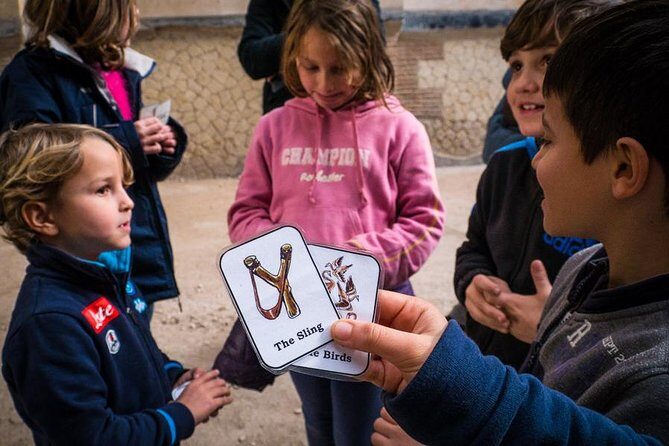
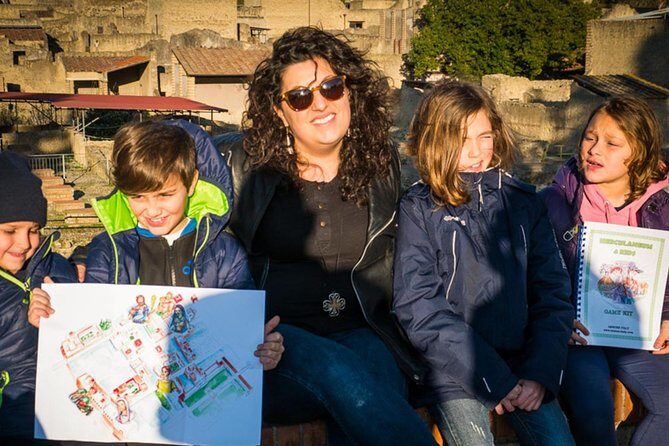
- Family-friendly activities like a booklet and map, plus game-style prompts your guide uses while walking
The guide is the glue. In the Pompeii and Herculaneum mix, there are a lot of rooms and labels. A good guide translates those labels into story, and story makes ruins stick in your mind instead of sliding past your eyes.
One more practical note: pickup is flexible. You can arrange pickup from places like Naples, Sorrento, Pompeii, vacation rentals, train stations, airports, and cruise terminals/ports. That saves you from the logistics puzzle of buses, taxis, and timed entry stress. You tell them your pickup spot when booking, and they handle the rest.
Also, the tour is offered in English, with mobile tickets included. That’s handy if you’re traveling light.
You can also read our reviews of more guided tours in Pompeii


Price and value: is $738.31 per person worth it?
At $738.31 per person for an 8-hour private family adventure, this isn’t a budget day trip. It’s priced for a full-service experience: private transport, two sites, Blue Badge guidance at both, and skip-the-line tickets. You’re also getting family-targeted materials and guided pacing.
Where the value shows up for many families is in time and energy. Pompeii and Herculaneum both demand walking, planning, and interpretation. If you’re going with kids, the cost of getting it wrong is high. If you arrive late, start in the wrong order, or spend time at the wrong spots, the day can feel like a long endurance test. This plan reduces that risk.
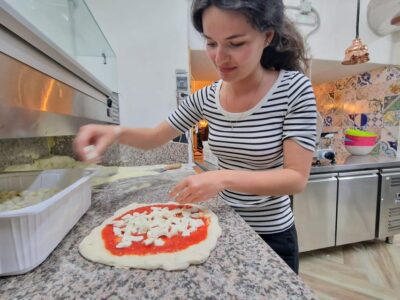
There’s also a possible extra for meals: meals are only included if you select the pizza lunch option. Bottled water isn’t listed as included, so you’ll want to bring your own (or plan to buy on site).
One small consideration for your decision: because it’s private and your group stays together, you’ll need to match the day’s rhythm to your family. If someone in your group wants lots of downtime, this itinerary may feel like it has a built-in pace. The guide can adjust, but it’s still an active day.
Practical tips so the day feels fun, not exhausting
A few simple things will make this kind of day work better for kids and adults.
First, start thinking in terms of heat and footwear. The tour recommends comfortable walking shoes and sunblock. That’s not just generic advice—Pompeii involves walking across uneven stone and across broad areas, and Herculaneum has its own ground challenges.
Second, use the day’s structure. The order is Herculaneum first, then Pompeii. That order helps you compare preservation. Wood and painted rooms in Herculaneum make Pompeii’s more dramatic ash layer feel more meaningful, not less.
Third, lean into the volcano photo strategy. The plan is to view Vesuvius from the bottom, with good photo chances from both cities. So you won’t be burning time traveling to a higher viewpoint. Take photos when the guide points out them, because sometimes a “small” angle makes the scene work better.
Fourth, be ready for a human story moment. The boathouse discoveries and the eruption’s impact are handled sensitively, but it’s still heavy material. If you’re bringing younger kids, it helps to tell them ahead of time that some parts of the tour talk about people and what happened.
Finally, if your guide is someone like Giuseppe D’Angelo, let the guide set the tempo. A good guide can turn facts into a walkable story, and that’s what makes a big archaeological day feel like a real family adventure instead of a checklist.
Should you book the Pompeii & Herculaneum Family Adventure?
I’d book this when you want a well-paced, family-focused day that covers both cities without wasting time. It’s a strong fit if you care about guides translating ruins into everyday life—especially the Herculaneum preservation details that make the past feel touchable. The private setup, skip-the-line entry, and hotel/port pickup are also a big deal if logistics would otherwise eat your day.
I’d think twice if your group struggles with long outdoor walking or if you want total freedom to wander at your own speed with no structure. Pompeii alone can feel huge. This tour manages that size with a route, but it still takes effort.
If you’re aiming for a day where the eruption becomes understandable instead of overwhelming, this is the kind of tour that makes Pompeii and Herculaneum click.
FAQ
How long is the Pompeii and Herculaneum family adventure?
It runs about 8 hours total, with roughly 2 hours 30 minutes at Herculaneum and about 2 hours 30 minutes at Pompeii.
Is pickup included, and where does it operate?
Pickup is offered and is flexible. It can operate from Naples, Sorrento, Pompeii, hotels, vacation rentals, train station, airport, and cruise terminal/port. You specify your pickup place when booking.
Are skip-the-line tickets included?
Yes. The tour includes Herculaneum and Pompeii Express skip-the-line tickets.
Is this tour private?
Yes. It’s a private tour/activity, and only your group participates.
What languages is the tour offered in?
The tour is offered in English.
What family-friendly activities are included?
The tour includes family-friendly activities, plus a booklet and map.
Are meals included in the price?
Meals are only included if you select the Pizza Lunch Option. Otherwise, meals are not included.
Is bottled water included?
No. Bottled water is not included.
What kind of physical fitness level do we need?
Moderate physical fitness is recommended, since the tour includes substantial walking.
Are service animals allowed?
Yes, service animals are allowed.
What is the cancellation policy?
You can cancel for a full refund up to 24 hours in advance of the experience start time. If you cancel less than 24 hours before, the amount you paid won’t be refunded.