REVIEW · POMPEII
Pompeii and Herculaneum small group tour – skip the line
Book on Viator →Operated by PompeiIn · Bookable on Viator
Pompeii and Herculaneum feel like time travel. This small-group tour strings together two UNESCO sites, with guided stops that focus on how Romans actually lived—houses, public buildings, and everyday spots like the forum and baths. I like that Pompeii is skip-the-line, and I like the small group size because you can ask questions instead of yelling over the crowd. The main drawback: it’s a long day with a lot of walking on uneven ancient surfaces.
You’ll start at Porta Marina Superiore in Pompeii, then move through the city’s key public areas and major houses. Later, you take the Circumvesuviana train to Herculaneum for a second set of ruins, with a shorter lunch break if you need one. The tour runs about 5 hours 30 minutes on the schedule, but the pace still feels like a full outing once you factor in transfers and walking.
Quality is a big part of why this tour is consistently booked. The rating is 4.7 with 93% recommended, and the guides named in past departures—like Amadeau, Vince, Sergio, Paulo, and Diego—show up as the reason people feel they learned a lot without feeling rushed. If you’re hoping for something stroller-friendly or low-walking, this probably won’t be your best match.
In This Review
- Quick hits: what makes this tour work
- Pompeii and Herculaneum in one day: what you actually get
- Meeting in Pompeii: starting at Porta Marina Superiore
- Pompeii rhythm: from the Basilica portico to the main square
- Basilica: the portico where everyday trade happened
- Foro de Pompeya: the main square viewpoint
- Main street walk: time to orient
- Pompeii houses you’ll actually remember
- Casa del Menandro: architecture and decoration
- Granai del Foro: marble tables, water features, and casts
- Terme del Foro: the oldest thermal complex noted
- A famous brothel stop
- Casa del Fauno: a large, impressive private residence
- Teatro Piccolo and Teatro Grande: Pompeii’s entertainment side
- Switching to Herculaneum: train transfer and the new pace
- Herculaneum entry meeting point: ticket office focus
- Herculaneum houses and thermal rooms: details that change your view of the city
- Casa dei Cervi: deer statues and peristyle clues
- La Terrazza di M. Nonio Balbo: another peristyle-based naming
- College of the Augustales: decorative identity markers
- Casa del Rilievo di Telefo: unusual private access
- Partem Domus lignea: the wooden partition importance
- House of the Skeleton: the story behind the name
- Central Thermae: men’s and women’s separate entrances
- Casa del Salone Nero: carbonized door remnants
- Casa Sannitica and Casa del Bel Cortile: layout differences
- House of the Grand Portal and other remaining areas
- The walking reality: what to plan so the day stays fun
- Price and logistics: is $119.85 worth it for you?
- Should you book this Pompeii and Herculaneum small-group tour?
- FAQ
- How long is the Pompeii and Herculaneum small-group tour?
- Is skip-the-line included?
- Are the train tickets included for getting to Herculaneum?
- What’s included in the tour price?
- What is not included?
- Where do we meet and where do we end?
Quick hits: what makes this tour work
- Skip-the-line in Pompeii saves real time at the busiest entrance.
- Max 20 travelers keeps the group manageable for questions and pacing.
- Circumvesuviana one-way tickets handle the Pompeii to Herculaneum transfer.
- Pompeii stops cover forum life, houses, baths, and the theater zones.
- Herculaneum stops focus on domus details like peristyles, fresco rooms, and thermal areas.
- You get Roman-day-life context, not just stone-by-stone sightseeing.
Pompeii and Herculaneum in one day: what you actually get
Buying a single ticket that covers both Pompeii and Herculaneum is the whole point. Pompeii is huge, and Herculaneum is smaller but still packed with standout houses and thermal areas. Doing both with one guide cuts down on planning stress and gets you two different Roman neighborhoods under one umbrella.
At $119.85 per person, the value mostly comes from three things you’re not having to arrange: skip-the-line entry, guidance through both sites, and the one-way train from Pompeii to Herculaneum. You do still need to plan for meals and transportation to/from Naples/Sorrento area on your own, because those aren’t included.
The tour is offered in English and uses a mobile ticket. Expect a guided experience that’s structured around short, timed visits—great if you want a clear route and hate wandering aimlessly. If you want to linger for photos for an hour in one spot, this format might feel a bit fast.
You can also read our reviews of more tours and experiences in Pompeii
Meeting in Pompeii: starting at Porta Marina Superiore
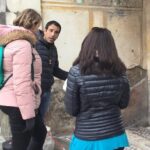
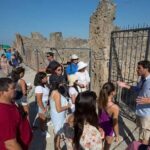
Your day starts at Piazza Esedra, 4, 80045 Pompei NA, then you meet the guide at the Pompeii entrance area called Porta Marina Superiore. The guide holds an Askos Tours sign at the main entrance, so it’s usually easy to spot the group when you arrive.
This matters because Pompeii’s entrances can be a maze, and the whole day is easier if you start with less confusion. If it’s busy when you arrive, skip-the-line access helps you move into the ruins with less waiting and more daylight time.
Pompeii rhythm: from the Basilica portico to the main square
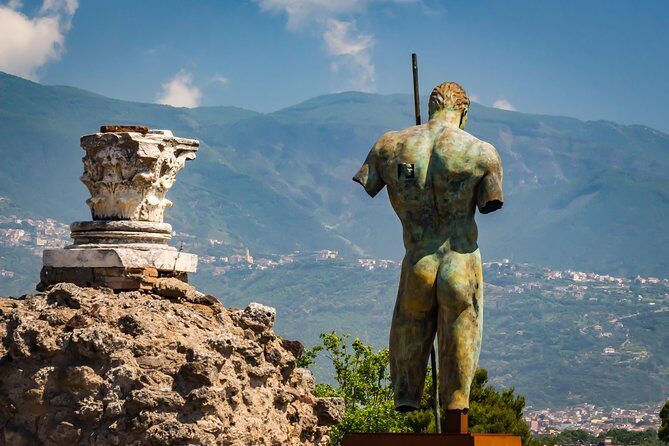
Pompeii’s guided route is built like a walking story: public shelter, commerce, civic space, then high-status homes. The first stops you make are meant to set the scene quickly.
Basilica: the portico where everyday trade happened
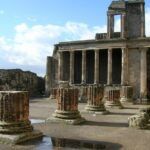
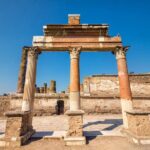
You’ll step into the Basilica, described as an open portico that gave shelter to merchants and other activities. Even if you only spend about 10 minutes there, this stop is key. It tells you Pompeii wasn’t just monuments—it was street-level life, where work and errands happened in public spaces.
Foro de Pompeya: the main square viewpoint
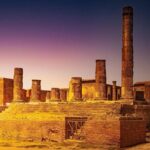
Next is the Foro de Pompeya, Pompeii’s main square. This is where you get a sense of how people moved through civic life—standing, gathering, watching, and conducting business. It’s also one of the easiest places to mentally organize the city, because the forum acts like a hub.
Main street walk: time to orient
The tour then includes a walk through the main street of Pompeii. That short transfer moment becomes useful. You’re building a mental map so the later houses and baths make more sense than if you only saw them as separate “stops.”
Pompeii houses you’ll actually remember
Pompeii is full of houses, but not all are equally memorable. This tour keeps the house stops focused on the big names and the design features that tell you what life was like.
Casa del Menandro: architecture and decoration
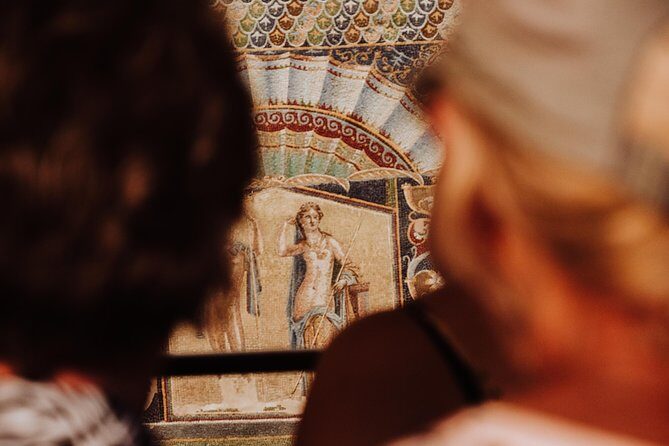
You’ll visit Casa del Menandro, one of the richest residences in Pompeii. The focus here is on what mattered to wealthy households: architecture, decoration, and contents. Expect to see how the home layout creates private and public-like spaces, with decoration used to signal status.
Granai del Foro: marble tables, water features, and casts
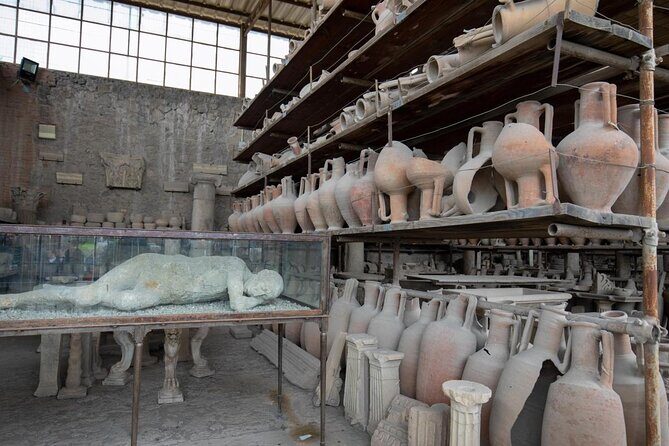
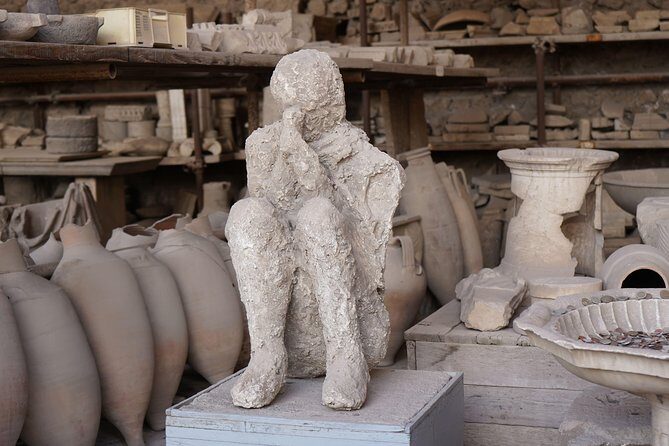
The Granai del Foro is one of those stops that sticks with people. You’ll be shown the granary space with marble tables and baths for fountains around entrances, plus casts of victims of the eruption. The stop also notes a dog and a tree among the casts, which makes it feel uncomfortably real instead of abstract.
This is also where you want to stay mentally steady. The subject matter is heavy, but a good guide helps you understand why the ruins are preserved the way they are and what you’re looking at when you see those forms.
Terme del Foro: the oldest thermal complex noted
Then come the Terme del Foro, described as the oldest thermal complex in Pompeii. Thermal areas are where Roman daily life turns physical: routines, comfort, and social patterns. Even in 10 minutes, you can get a sense of scale because the tour is showing you the area and the function of the complex rather than treating it like a single photo spot.
A famous brothel stop
The route also includes a look at the most famous brothel area in Pompeii. It’s timed like the other quick stops, so don’t expect a long, emotional lecture. The value here is context: how places for adult life were integrated into the city’s fabric and how the Romans organized their built environment.
Casa del Fauno: a large, impressive private residence
You’ll move on to Casa del Fauno, described as one of Pompeii’s largest and most impressive private residences. If you’ve ever wondered what “big house” meant in a Roman city, this is the kind of stop that gives you a clearer answer. The tour frames it as size and impressiveness, so you’ll likely notice scale and layout as much as ornament.
Teatro Piccolo and Teatro Grande: Pompeii’s entertainment side
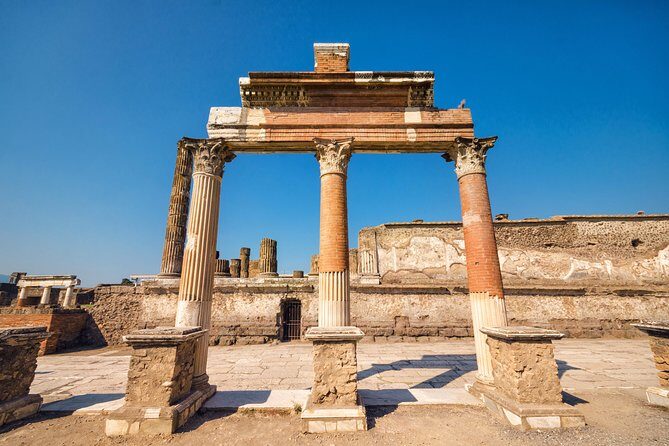
Pompeii wasn’t only work and housing. There was performance culture too.
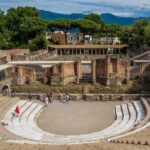
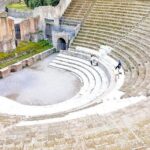
You’ll have time to see the Teatro Piccolo first, then visit Teatro Grande, described as the most important theater in Pompeii. Even with the relatively short time listed, theaters are worth it because they show Roman public life in a different way than temples or forums do. They also help you picture crowds—where people sat, gathered, and watched.
Switching to Herculaneum: train transfer and the new pace
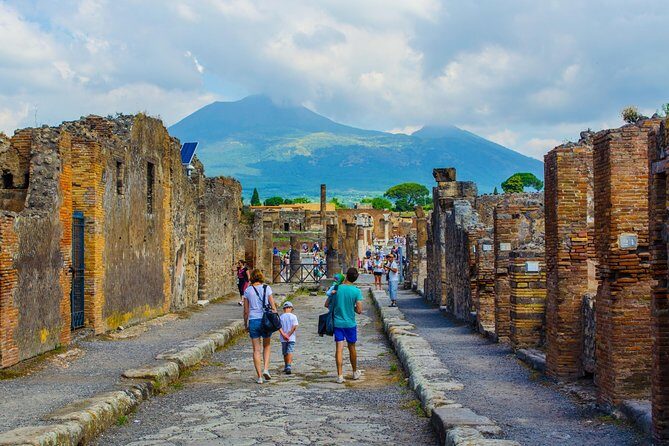
After your Pompeii block, you transfer to Herculaneum by train, using Circumvesuviana one-way tickets included. The schedule notes a 30-minute train ride plus a 10-minute walk.
In practical terms, this transfer is why the tour works for many people: you’re not standing around coordinating buses or trying to figure out routes with tired feet. The “walk to the ruins” portion is real, though, and it’s not designed for slow mobility.
You’ll do a quick lunch break if required. Meals are not included, so you should bring cash/card for whatever you choose to eat. A short break is better than no break, but it also means you don’t get a sit-down day off from ruins.
Herculaneum entry meeting point: ticket office focus
In Herculaneum, you meet at the Ticket Office of the Herculaneum ruins at Corso Resina, 187, 80056 Ercolano NA (and your end point is listed as the Archaeological Park of Herculaneum, Corso Resina, 187).
If you’re driving, there’s mention of not guarded parking close to the meeting place in via Pignalver. If you’re taking transit, the Circumvesuviana station is listed as 10 minutes’ walk away.
One practical note from real-world experience: the station walk is described as uphill by some guides’ followers, and renovations can make signage extra important. Bring your best “follow the signs” mindset and give yourself a few minutes of wiggle room.
Herculaneum houses and thermal rooms: details that change your view of the city
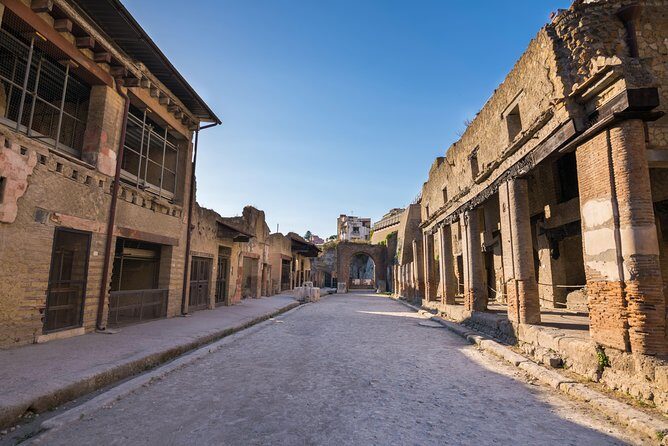
Herculaneum is often described as a surprise because it feels different from Pompeii—more compact, more intimate, and packed with well-preserved domestic spaces. This tour’s Herculaneum stops emphasize domus features like peristyles, fresco rooms, and carved stone details.
Casa dei Cervi: deer statues and peristyle clues
Casa dei Cervi gets its name from marble statues of stags/deer found in the peristyle. This is the kind of detail you can only appreciate if someone points it out. The tour’s short framing works because you’re learning what to look for, not just walking by empty walls.
La Terrazza di M. Nonio Balbo: another peristyle-based naming
The tour then moves to La Terrazza di M. Nonio Balbo. The naming in the itinerary repeats the stags/deer theme in the peristyle, which is actually useful: it tells you these houses were branded by visible stone features, not just location.
College of the Augustales: decorative identity markers
Next is the College of the Augustales. The itinerary lists this stop as another place where marble statues (again referenced with the stags/deer naming text) connect to identity and decoration. Even when the descriptions overlap, the experience is still practical: a guide is helping you decode what the labels mean on-site.
Casa del Rilievo di Telefo: unusual private access
Casa del Rilievo di Telefo is described as unusual because it has private access to the adjoining Suburban Thermae to the south. That’s a big deal. It suggests a household advantage: control over bathing space and the ability to connect private life to a related public function.
Partem Domus lignea: the wooden partition importance
You’ll also see Partem Domus lignea – Casa del Tramezzo di Legno, described as an important house for an elegant wooden partition that remains. Pompeii and Herculaneum are famous for preservation, but this kind of mention tells you the tour is specifically hunting for examples of materials you might not expect to survive.
House of the Skeleton: the story behind the name
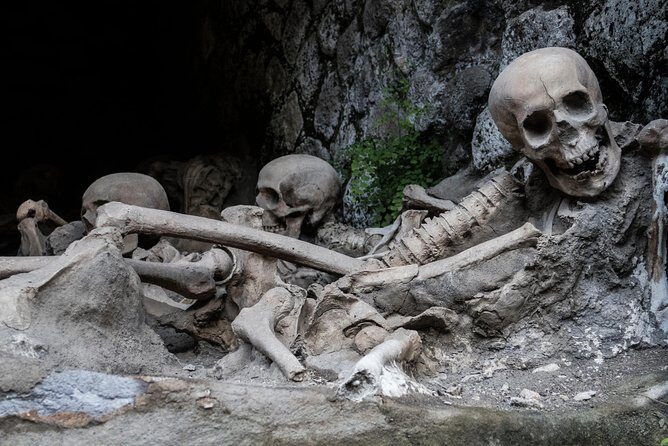
The House of the Skeleton is named from human remains found in a second floor room in 1831. This stop is brief, but it has emotional weight. A guide’s job here is to help you understand how the house got its name and why those remains matter to understanding the eruption’s impact.
Central Thermae: men’s and women’s separate entrances
Then you’ll hit Central Thermae, described as dating to around the beginning of the 1st century AD. The tour notes the baths were divided with separate entrances for men’s and women’s baths. Even in limited time, that detail helps you imagine routine life: separate spaces weren’t unusual—they were built into the system.
Casa del Salone Nero: carbonized door remnants
Casa del Salone Nero (House of the Black Hall) is described as a more luxurious mansion. The itinerary highlights a monumental entrance retaining the carbonised remains of doorposts and lintel. That’s one of those preservation details that makes Herculaneum feel less like ruins and more like a frozen moment.
Casa Sannitica and Casa del Bel Cortile: layout differences
You’ll also see Casa Sannitica, described as typical of the Samnites, with an atrium and a gallery with Ionic columns, plus rooms decorated with frescoes. Then Casa del Bel Cortile is described as original for its courtyard with a stairway and stone balcony instead of an atrium.
These two stops together are helpful because they show how domus design wasn’t one-size-fits-all. You start seeing how culture and preference show up in building layout.
House of the Grand Portal and other remaining areas
Finally, you’ll visit House of the Grand Portal, described as a beautiful domus with environments, collonnati, fresco everywhere at Herculaneum, and charred remains of wooden parts. This last segment is about scale and the feeling of domestic luxury—or at least domestic aspiration—set against what the eruption destroyed.
The walking reality: what to plan so the day stays fun
If you do this tour, plan around walking and uneven ground. The tour is built from short 10–15 minute bursts in multiple areas, and that means you’re constantly repositioning.
Practical tips that help:
- Bring water. You’ll cover a lot of ground, and the stops aren’t long enough for water breaks to feel optional.
- Use the restroom before you start. Pompeii in particular can make mid-route bathroom stops harder once you’re inside the flow.
- Skip the stroller. One review warned it’s not stroller-friendly and you’ll still end up carrying a baby. Better to travel light.
- Wear shoes with grip. Uneven ruins are part of the deal.
Weather is a factor too. One past departure noted rain didn’t derail the experience because the guide handled it thoughtfully. Still, pack accordingly—Pompeii’s stones can be slippery, and you don’t want soggy shoes the whole day.
Price and logistics: is $119.85 worth it for you?
For $119.85, you’re paying for organization: guided time at two major sites, skip-the-line tickets, and the train ticket one-way. If you tried to do this yourself, you’d still face the big friction points: lines, entry timing, and figuring out how to connect Pompeii to Herculaneum efficiently.
That said, the tour is best if you like structure. You’re not getting a leisurely day. You’re getting a route designed to cover a lot of ground, with short stop times and clear “look here” guidance.
This is also a good fit if you want Roman context fast: commerce in the Basilica, civic life at the forum, domestic patterns in houses, and bathing culture in the thermal complexes.
If you prefer total freedom—no time pressure, no train schedule—then consider a slower plan like one site per day with extra time to roam. But if your goal is to hit both UNESCO sites without turning your trip into a logistics project, this is a strong match.
Should you book this Pompeii and Herculaneum small-group tour?
I’d book it if:
- You want Pompeii + Herculaneum without spending your vacation figuring out transportation.
- You like guided context and don’t mind a packed schedule.
- You want skip-the-line convenience and a small group.
I’d hesitate if:
- You need low-walking routes or stroller-friendly logistics.
- You want to linger for long periods in one house or one theater area.
- You’re sensitive to the emotional weight of eruption-related remains.
If you’re flexible and ready for a full day, this tour is one of the more practical ways to see the highlights of both ancient cities with less hassle.
FAQ
How long is the Pompeii and Herculaneum small-group tour?
The tour duration is listed as about 5 hours 30 minutes.
Is skip-the-line included?
Yes. Skip-the-line tickets are included for Pompeii and Herculaneum.
Are the train tickets included for getting to Herculaneum?
Yes. One-way Circumvesuviana train tickets from Pompeii to Herculaneum are included.
What’s included in the tour price?
Guidance in Pompeii and Herculaneum ruins for the duration of the tour, skip-the-line tickets in both sites, and the one-way Circumvesuviana train tickets.
What is not included?
Meals and personal expenses are not included, and transportation to Pompeii and your accommodation at the end of the tour is not included.
Where do we meet and where do we end?
You start at Piazza Esedra, 4, 80045 Pompei NA, Italy. You end at the Archaeological Park of Herculaneum, Corso Resina, 187, 80056 Ercolano NA, Italy.