REVIEW · WALKING TOURS
Moonlight Walking Tour in the Heart of the Imperial & Baroque Rome
Book on Viator →Bookable on Viator
Late-night Rome hits different.
This Moonlight Walking Tour strings together the Baroque highlights and the big Imperial sights when daytime crowds thin out. I especially like how the route blends beauty (Piazza Navona and Trevi) with story time (Roman Forum legends), and how your guide helps you read the buildings instead of just sightseeing past them. Guides connected to this tour have included Rina and Lascarina, and the reviews point to a knack for details and real back-and-forth questions.
You’ll also enjoy the practical format: it’s a small group (max 15), it runs about 2 hours 30 minutes, and the stops are paced so you’re not just sprinting from one photo spot to the next. One thing to consider: it depends on good weather, and you should be ready for night walking—Rome’s streets are charming, but they’re not always smooth.
In This Review
- Key things to know before you go
- Why this moonlight route works so well in Rome
- Piazza Navona after dark: Four Rivers and Sant’ Agnese in Agone
- The Pantheon viewpoint: a fast look at a building with a wild past
- Trevi Fountain at night: Nicola Salvi’s showpiece, minus the worst crowds
- Piazza Venezia and Vittoriano: connecting Italy’s modern story to Rome’s past
- Trajan’s Column: the “why” behind the stone
- Roman Forum by night: legends and secrets under the lights
- Price and value: what you get for $82.80
- Who should book this moonlight walk?
- Tips to make your night smoother (and more photo-friendly)
- Should you book this tour?
- FAQ
- What’s the duration of the Moonlight Walking Tour in the Heart of the Imperial & Baroque Rome?
- How much does the tour cost?
- What language is the tour offered in?
- What time does the tour start?
- Where do I meet the guide?
- Where does the tour end?
- What’s included in the price?
- Is transportation included?
- Are there admission tickets required?
- Is the tour affected by weather?
Key things to know before you go
- Moonlit pacing: a slower-feeling evening route designed to dodge daytime crowds and traffic
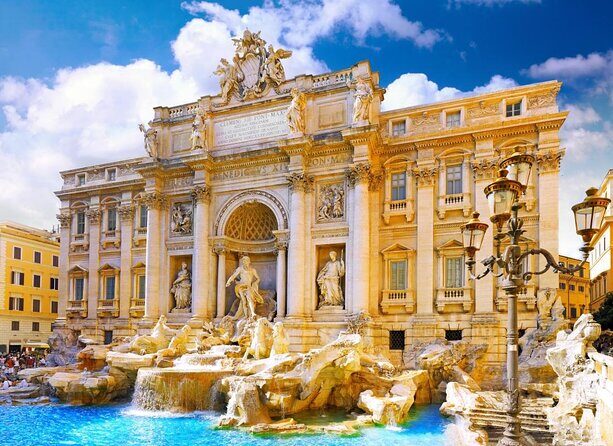
- Baroque on display: four rivers at Piazza Navona, plus Trevi Fountain’s iconic drama
- Imperial Rome at night: the Roman Forum is the star when it’s lit up and calmer
- Short, focused stops: about 10–20 minutes each, so you get highlights without overload
- Small group energy: under 15 people, with a guide who answers questions and helps with photos
- All admission free at each stop: you’re paying for the guide and the experience, not entry fees
Why this moonlight route works so well in Rome
Rome looks great in daylight. But at night, it gets cinematic. Street noise softens, traffic thins, and key monuments feel more human—like you’re stumbling into the city’s secret side, not queuing for it.
This tour is built around that idea: Baroque Rome up front, then Imperial Rome as the evening unfolds. You start near Piazza Navona, then move through a line of landmark after landmark, finishing in the Colosseum area. That “step-by-step” layout matters, because it lets you actually absorb details at each stop instead of rushing.
Another plus is the guide factor. The reviews attached to this experience highlight guides like Rina and Lascarina for being friendly, interactive, and quick to answer questions. That can be the difference between a photo walk and a walk that actually teaches you what you’re looking at. If you’re the type who likes to ask why something was built a certain way, this style fits.
You can also read our reviews of more walking tours in Rome

Piazza Navona after dark: Four Rivers and Sant’ Agnese in Agone
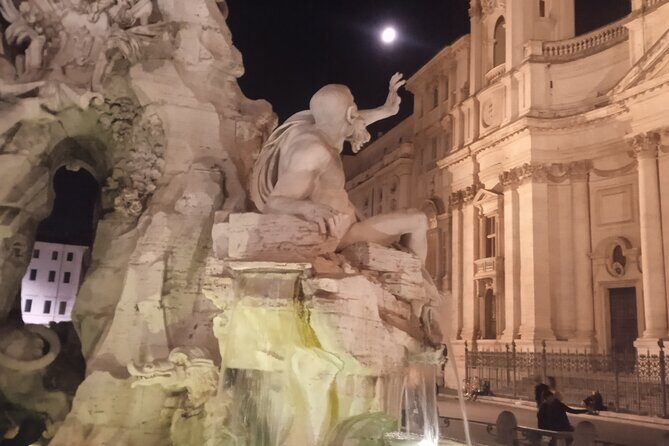
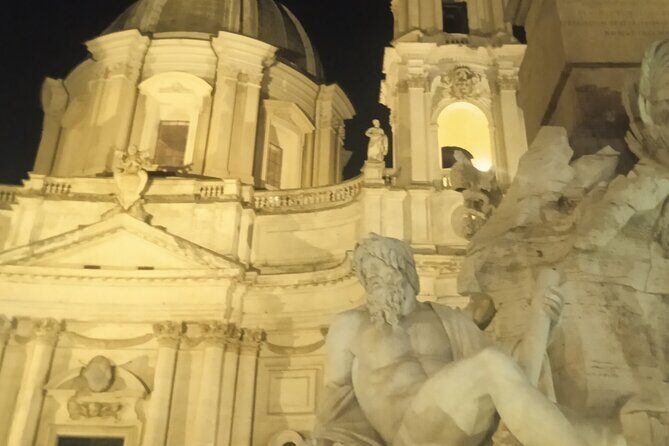
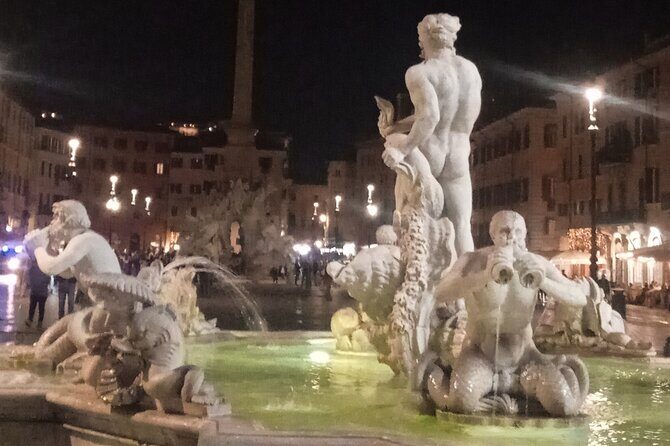
Piazza Navona is already famous. At night it feels less like a postcard and more like a living stage. You’ll arrive at the Fontana dei Quattro Fiumi, the Baroque fountain that’s central to the square’s drama, plus you’ll see the church Sant’ Agnese in Agone.
What makes this stop worth your time is the way the guide frames the art. You’re not just looking at the fountain; you’re hearing legends tied to the Baroque artists associated with the era and the way their work shaped Rome’s visual identity. Even if you know Baroque already, hearing the connections between art, power, and symbolism adds texture.
Practical note: this is a “stop and look” moment. Plan to linger, but don’t expect time to roam the whole square. You’re there to learn and then move on.
The Pantheon viewpoint: a fast look at a building with a wild past
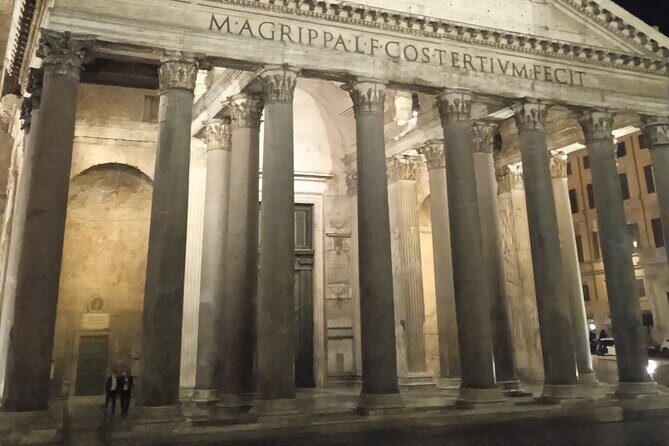
Next comes the Pantheon, but in a smart way: you admire it from the exterior. That’s useful for two reasons. First, you get the impact without turning the night into a queue mission. Second, the guide can point out what matters visually, so the Pantheon hits faster.
Here’s a detail worth catching: the Pantheon was built three times and destroyed twice. Knowing that before you look at the façade makes the whole monument feel more like an ongoing story than a single “finished” building.
Drawback to keep in mind: since you’re not entering, you won’t get the full interior experience. If you want a deep look inside, you’d pair this with another daytime plan later. For a night tour, though, this exterior stop is efficient and satisfying.
Trevi Fountain at night: Nicola Salvi’s showpiece, minus the worst crowds
Trevi Fountain is famous enough to almost be a cliché. Still, it’s a special cliché. Watching the fountain at night changes the vibe: the water looks louder, the stone looks warmer, and the whole scene feels more theatrical.
This stop is also where the guide’s focus on Baroque symbolism pays off. You’ll hear about the fountain’s creator, architect Nicola Salvi, and about how Trevi became a backdrop for movies, including Dolce Vita. That link to pop culture isn’t just fun trivia—it helps you understand why Trevi became a Roman shorthand for beauty and spectacle.
The practical reality: Trevi is popular even at night. Your best move is to stand where you can see the guide while still getting a clean view of the fountain. If you’re serious about photos, come ready for crowds and work quickly—moonlight won’t stop people from wanting the same shot.
Piazza Venezia and Vittoriano: connecting Italy’s modern story to Rome’s past
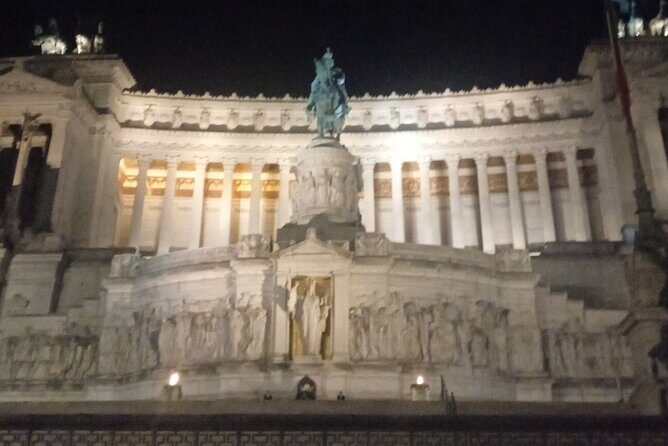
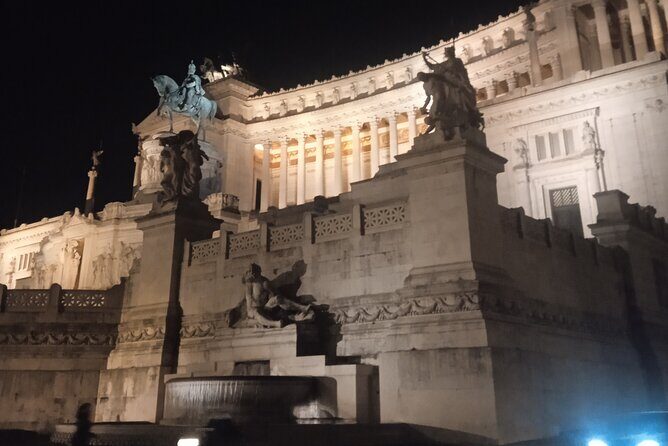
From Trevi, you shift toward a different kind of monument: Piazza Venezia and the Vittoriano (the Altar of the Fatherland). This is where modern Rome shows through, centered on Italian unification and designed by architect Giuseppe Sacconi.
At night, Vittoriano’s illuminated presence can feel almost like a spotlight. It’s big and formal in a way the older ruins don’t always match, so it’s a helpful contrast in your mental map of the city. The guide also uses this stop to point out curiosities from modern Roman history—so you’re not only living in antiquity for the whole evening.
Why it helps for the rest of the tour: it reminds you that Rome is layered. The Forum might be ancient, but the city’s identity keeps getting rewritten—and those rewrites shape what you see today.






Trajan’s Column: the “why” behind the stone
As you enter Imperial Rome, the mood shifts again. You get Colonna Traiana, the majestic Trajan Column, and the guide connects it to legends and stories tied to Rome’s origins.
This stop is less about “look at this wall” and more about “what is this doing here?” The column is a kind of visual record, and the guide’s job is to translate what you see into meaning. If you’ve ever wondered how Romans communicated power and narrative through art, this is a great moment to get oriented.
A consideration: this is still a city street experience. Plan to stay alert and watch your footing in the dark.
Roman Forum by night: legends and secrets under the lights
The Roman Forum is the emotional payoff of the tour. At night, you get the same scale you’d expect in daylight, but the lighting changes everything. The ruins feel more dramatic, and there’s a sense of quiet that helps the stories land.
This stop centers on legends and secrets tied to Roman life. The guide explains how the area reflects three crucial Roman periods, walking you through the idea of Roman history as a sequence of changing power and personalities. The tour description also hints at scandal and drama—again, it’s not just ruins, it’s people.
What I think you’ll value most here is the pacing. You’re not meant to crowd your mind with every fact. Instead, you get enough structure to leave with a stronger sense of what mattered and why. When you can connect the visual to the narrative, the Forum stops being a bunch of separated stones and becomes a place where events feel possible.
Price and value: what you get for $82.80
At $82.80 per person, you’re paying for a guided route through major landmarks at a time of day when it can be harder to organize your own plan. You get a local guide in English and a mobile ticket, plus the route is paced around short stops.
Also, the admission side matters. Each stop is listed as free admission, so your money goes to the experience and interpretation rather than entry fees. That’s good value if you’d rather spend time learning than budgeting for multiple tickets during one night.
The group size (max 15) is the other value lever. Smaller groups tend to mean you can ask questions and get answers without feeling like you’re shouting into a wall. If you like a more personal pace, this setup helps.
Who should book this moonlight walk?
This tour is a smart match if you:
- want major Rome landmarks without spending your night figuring logistics
- enjoy storytelling that links art and architecture to what Romans actually cared about
- prefer evening sightseeing when roads feel calmer and lighting is softer
- want a small group format (max 15) rather than a large crowd scrum
It might be less ideal if you:
- want a long, slow, in-depth interior tour at every stop (this is mostly exterior viewing and guided stops)
- dislike night walking or rougher street surfaces
- are traveling with someone who needs flexible timing—this is a guided run with set stop lengths
Tips to make your night smoother (and more photo-friendly)
A few small choices can make a big difference:
- Wear shoes you trust on cobblestones. At night, traction matters.
- Bring a light layer. Even in months when Rome feels warm, evenings can cool down.
- If you care about photos at Trevi, plan to arrive ready to stand your ground briefly and shoot fast.
- Ask your guide questions early. If you want Baroque and Imperial connections explained, the first half of the night is when you’ll get the most momentum.
- If you’re fading from a busy day, don’t worry. The stops are short enough that you can reset between them.
Should you book this tour?
I’d book it if you’re aiming for a high-impact Rome night that mixes Baroque beauty with Imperial storytelling, without committing to a full-day museum schedule. The price makes sense when you focus on what’s included: a guided evening route, free admission at the stops, and a small group size that keeps the experience human.
Skip it if you’re searching for a strictly academic lecture style or for lots of interior time. This is a walk that trades breadth and pacing for easy engagement—perfect when you want Rome to feel magical and understandable at the same time.
FAQ
What’s the duration of the Moonlight Walking Tour in the Heart of the Imperial & Baroque Rome?
It lasts about 2 hours 30 minutes.
How much does the tour cost?
The price is $82.80 per person.
What language is the tour offered in?
The tour is offered in English.
What time does the tour start?
The start time is 8:00 pm.
Where do I meet the guide?
The tour starts at Fontana del Moro, Piazza Navona, 00186 Roma RM, Italy.
Where does the tour end?
The tour ends at the Colosseum area, Piazza del Colosseo, 1, 00184 Roma RM, Italy.
What’s included in the price?
A local guide is included, and you’ll receive a mobile ticket.
Is transportation included?
No private transportation is included.
Are there admission tickets required?
Admission at the listed stops is free.
Is the tour affected by weather?
Yes. It requires good weather, and if canceled due to poor weather, you’ll be offered a different date or a full refund.