REVIEW · ROME
Rome:Palatine Hill Roman Forum Experience & Multimedia Video
Book on GetYourGuide →Operated by TICKETSTATION SRL · Bookable on GetYourGuide
Rome hits differently here.
You start with a 30-minute Ancient Rome multimedia video at the Touristation Aracoeli office, then head in to the Roman Forum and Palatine Hill on your own, with a staff escort to the entrance. It is a simple setup: get your bearings fast, then wander the ruins where you want and stop when you want.
I love how the video’s overlays help you picture what you are actually looking at. I also love the practical flow: ticket pickup is set up so you can get inside and spend real time walking the sites.
One consideration: finding the meeting spot can be a little tricky, so plan extra time for the fountain under restoration and the orange flags.
In This Review
- Key things to know before you go
- Your first Rome win: the 30-minute Ancient Rome video
- Getting in smoothly at Touristation Aracoeli (and why it matters)
- Roman Forum: where power, everyday life, and religion collided
- Palatine Hill: the royal origin story with real views
- The ticket includes Palatine Museums and specific “SUPER sites”
- House of Augustus (watch the day)
- House of Livia
- Domus Tiberiana and the Neronian cryptoporticus
- Aula Isiaca / Loggia Mattei
- Santa Maria Antiqua, Ramp of Domitian, and the Oratory of the Forty Martyrs
- Curia Julia: limited days only
- How long should you plan for? Use time like a local
- The added English walking tour: Navona, Pantheon, Trevi at 10:00
- What I’d watch for: meeting point friction and choosing your pace
- Value check: is $32 worth it?
- Who this fits best (and who might want something else)
- Should you book this Palatine Hill and Roman Forum experience?
- FAQ
- Where do I meet for the experience?
- When does the experience start?
- Is there a multimedia video included?
- Do I get a guided tour inside the Roman Forum and Palatine Hill?
- Which sites are included on the Palatine Hill ticket?
- Is House of Augustus always open?
- When is Curia Julia open?
- What is included in the English city walking tour?
- What documents and items do I need or should avoid?
Key things to know before you go
- A 30-minute multimedia intro that translates ruins into places, streets, and power centers
- Self-paced Roman Forum + Palatine Hill access after an escort to the entrance
- Palatine “SUPER sites” included beyond the main hill viewpoints
- Day-dependent openings like House of Augustus (closed Mondays) and Curia Julia (limited days)
- Panoramic Palatine views that let you spot Rome landmarks such as the Colosseum
- An added English city walk (Navona, Pantheon, Trevi Fountain) every day at 10:00
Your first Rome win: the 30-minute Ancient Rome video

This experience starts in a smart way: before you step into the ruins, you watch a 30-minute Ancient Rome multimedia video. That time matters. The Forum and Palatine Hill can feel like piles of stone until you know who built what, where the political action happened, and how the layout fits together.
The best part is that the video works like a map plus a time machine. The visual overlays help you connect the geography of the ruins with what those buildings were used for in daily Roman life, Roman religion, and Roman politics.
You do not need to sit through a long lecture either. The video is short enough that it still feels like part of the day, not a separate event you have to endure.
You can also read our reviews of more tours and experiences in Rome.



Getting in smoothly at Touristation Aracoeli (and why it matters)
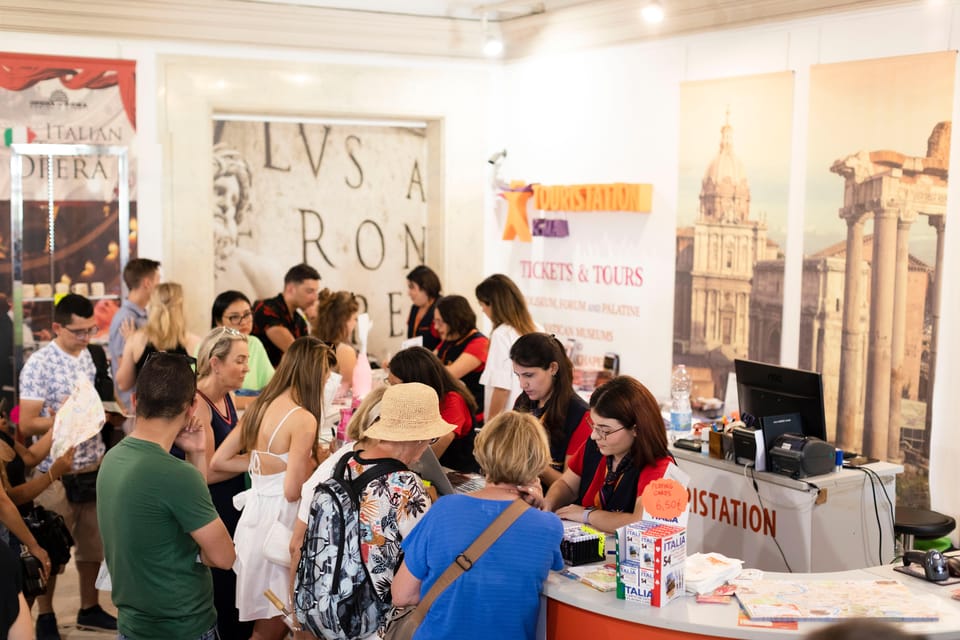
You exchange your voucher at the Touristation Aracoeli office: Piazza d’Aracoeli, 16. Do not show up at the Roman Forum entrance. Instead, look for a fountain under restoration and orange flags outside, then redeem your voucher there.
The time you pick when booking is the time at the office, not the time you start walking inside. In other words, you want to arrive a few minutes early so you do not waste your Forum time standing around.
A practical bonus: the ticket setup can route you through an alternate entrance (some people report an entry behind the Capitoline Museum with fewer line headaches). That can make a real difference in Rome, where waiting can eat hours.
Roman Forum: where power, everyday life, and religion collided
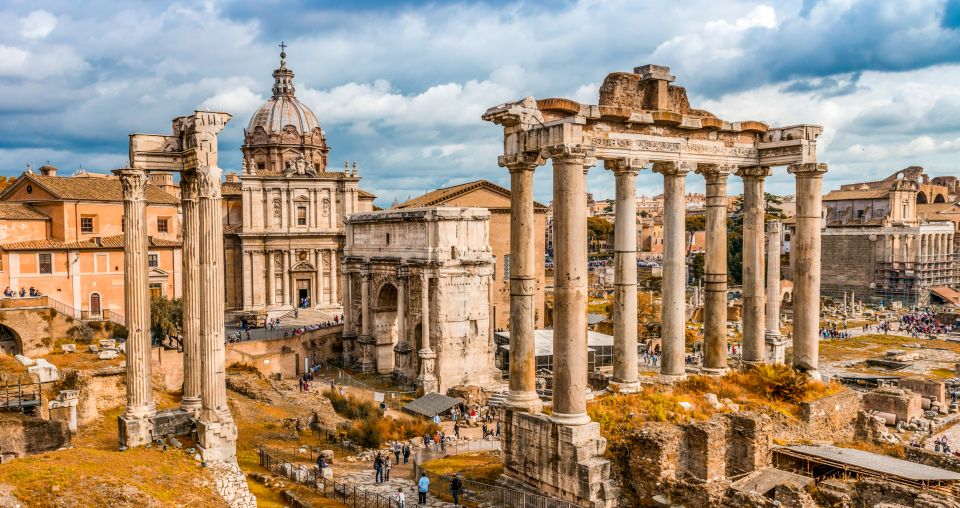
Once you are escorted to the entrance, the Roman Forum is yours to explore independently. This is the heart of the city’s public life: the place where ordinary Roman citizens would mix with officials, where religious moments and political decisions shared the same ground.
Here is what you should aim to do in the Forum. Slow down enough to read the space, not just look at individual ruins. Think about flow: where people would enter, gather, and move between important buildings. When you do that, the Forum stops being a checklist and starts feeling like a working city square.
You will also see the tomb of Julius Caesar. Even if you already know his name, the Forum context is what clicks. It is not just a figure in a textbook; it is a monument sitting inside the same civic world that raised him and watched him change Rome.
If you have time, make a point to look for Caesar’s pyre area as well. It is one of those Forum moments that helps the history feel more physical. A quick stop there can turn your visit from sightseeing into understanding.
Palatine Hill: the royal origin story with real views
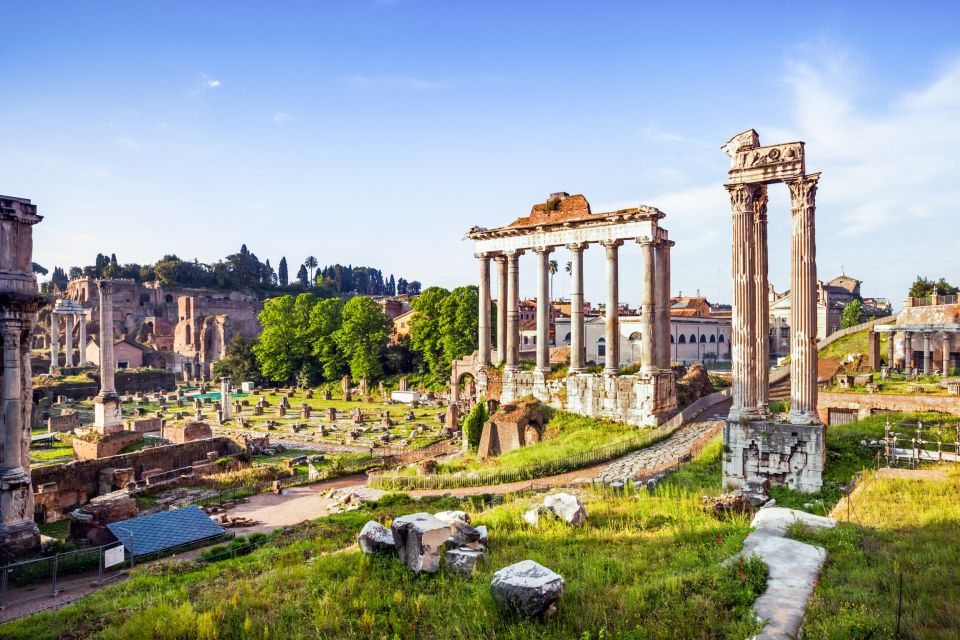
After the Forum, you move to Palatine Hill, the site tied to the foundation of Rome. Palatine is also where you see the “who lived here” side of history: it was the setting for the most important houses of emperors and kings.
The ruins here are different from the Forum. The Forum is about gatherings and civic space. Palatine is about status—how power expressed itself through architecture, gardens, and residence.
One of the big reasons people like Palatine is the viewpoint potential. Expect panoramic views over the city, including the possibility of spotting the Colosseum. Even if you have seen pictures before, seeing the hills and sightlines in person helps you understand why this area mattered.
Don’t rush. Palatine has angles that reward pausing, especially when the light is good and you can line up the terrain with the landmarks you recognize.
The ticket includes Palatine Museums and specific “SUPER sites”
Your access is not just to one area of Palatine. Your ticket includes Palatine Museums and a long list of specific sites and rooms, which is where the visit becomes more than a quick walk.
Here are the major ones you will want to look for, with what they add to your understanding:



House of Augustus (watch the day)
This is a key stop for getting a feel for imperial residence life. Your entry includes it, but there is one catch: House of Augustus is closed on Mondays. If your day falls on Monday, you might want to spend more time on the other Palatine areas instead.
House of Livia
House of Livia is included, and it is the kind of place where you can see how imperial power showed up in domestic space. Even when you are looking at ruins, it is easier to imagine daily routines when you can connect the architecture to a person, not just an empire.
Domus Tiberiana and the Neronian cryptoporticus
You also get access to Domus Tiberiana (the exhibition rooms) and the Neronian cryptoporticus. These are excellent for people who like spaces that feel both functional and atmospheric. The cryptoporticus, in particular, is the sort of setting that makes you think about movement, storage, and how the living and the working parts of the palace complex fit together.
Aula Isiaca / Loggia Mattei
This stop is included too, and it adds variety to the visit. It helps break up the day so you are not staring at the same kind of ruins for hours without a change in perspective.
Santa Maria Antiqua, Ramp of Domitian, and the Oratory of the Forty Martyrs
This trio gives you a religious and ceremonial thread to balance the imperial-story part of Palatine. You can also expect the visit to feel more layered: palace spaces on one side, sacred spaces on the other.
Curia Julia: limited days only
Curia Julia is one of those places that makes the Forum and Palatine feel even more connected to governance. But openings are limited: Curia Julia is open only on Mondays, Saturdays, and Sundays. If you arrive on a day it is closed, you will still enjoy the rest of the site, but you should not build your whole plan around that one room.
How long should you plan for? Use time like a local
If you only have a short window, you can rush Palatine and the Forum and still see highlights. But this is one of those Rome days where you really benefit from giving yourself enough time to slow down and look twice.
A good rule: plan on at least a few hours. People often find that they cannot cover everything at a comfortable pace in less time, especially because your ticket includes multiple Palatine stops beyond the obvious viewpoints.
Also bring water. There are not many places to refill during a long walk, and summer heat (or just a hot Roman afternoon) turns a “short visit” into a miserable one fast.
The added English walking tour: Navona, Pantheon, Trevi at 10:00
This package includes an English city walking tour covering Navona Square, the Pantheon, and the Trevi Fountain. It runs every day at 10:00.
This is a nice pairing because it adds what the ruins day does not give you as directly: a guided thread through central Rome’s showpieces. You get architecture you can still use today, plus a context boost for what you see in the old city center afterward.
If you are the type who likes to connect dots (ancient politics → today’s streets), this part can make the day feel more complete.
What I’d watch for: meeting point friction and choosing your pace
This experience is built to be easy, but you still need to manage two real-world factors.
First, the office location. You need to exchange your voucher at Touristation Aracoeli, not the Forum entrance. If your timing is tight, you can lose minutes searching for the fountain under restoration and orange flags. That is fixable—just give yourself a little cushion.
Second, pace. The Forum and Palatine are spread out and uneven. Since you visit independently, it is on you to decide when to linger and when to move. If you love photos and reading, you’ll naturally take longer. If you only want the key highlights, you can cut it down.
Either way, you can make the visit feel “yours,” not like a race.
Value check: is $32 worth it?
The headline price is $32 per person, and the ticket includes an 18€ entry ticket with reservation plus ancillary services. Translation: you are paying for reserved access and the extras that make it easier to get your bearings.
In real terms, the value comes from three places:
- Fast, structured entry through the Touristation office setup
- The 30-minute multimedia video that improves what you see once you are inside
- Access to Palatine areas that many shorter tickets skip, plus the English city walk at 10:00
If you were going to buy separate tickets and try to figure out your timing, this package saves effort. If you do not care about the video or the city walk, you might feel like you are paying for more than you need.
Who this fits best (and who might want something else)
You’ll likely enjoy this most if you want:
- A strong ancient Rome overview without a full guided walk through every ruin
- Independent time on site, so you can linger at the tomb areas or viewpoints
- An English day plan that still includes a guided segment elsewhere (Navona, Pantheon, Trevi)
You might want a different option if:
- You are expecting Colosseum entry. Your package specifically does not include it.
- You only want a quick 60–90 minute look and are not interested in multiple Palatine stops.
Also note a planning tip: accessibility is listed as wheelchair accessible, but people with disabilities have the right of free entry, so booking may not be the best cost move for everyone.
Should you book this Palatine Hill and Roman Forum experience?
Yes—if you want an efficient, structured start plus lots of self-paced ruins time. The 30-minute multimedia video is the right kind of prep for a complex site, and the included Palatine stops go beyond the basic viewpoints. Add the 10:00 English walk through Navona, Pantheon, and Trevi, and you get a full Rome day that does not require constant re-planning.
Book it with this mindset: you are buying smooth entry and helpful context, then spending the day walking and thinking at your own speed.
FAQ
Where do I meet for the experience?
Meet at the Touristation Aracoeli office at Piazza d’Aracoeli, 16. Exchange your voucher there and look for a fountain under restoration and orange flags outside. Do not report at the Roman Forum entrance.
When does the experience start?
The time you select for booking refers to the timing at the Touristation Office. You visit the Roman Forum and Palatine Hill independently after pickup and an escort to the entrance.
Is there a multimedia video included?
Yes. Your package includes a 30-minute Ancient Rome multimedia video.
Do I get a guided tour inside the Roman Forum and Palatine Hill?
No. You are escorted to the entrance, then you explore the Roman Forum and Palatine Hill independently at your own pace.
Which sites are included on the Palatine Hill ticket?
Included sites are Palatine Museums; House of Augustus; House of Livia; Domus Tiberiana (exhibition rooms); Neronian cryptoporticus; Aula Isiaca/Loggia Mattei; Santa Maria Antiqua; Ramp of Domitian; Oratory of the Forty Martyrs; and Curia Julia (when open).
Is House of Augustus always open?
No. The House of Augustus is closed on Mondays.
When is Curia Julia open?
Curia Julia is opened only on Mondays, Saturdays, and Sundays.
What is included in the English city walking tour?
An English guided walking tour of Navona Square, the Pantheon, and Trevi Fountain, everyday at 10:00.
What documents and items do I need or should avoid?
Bring a valid passport or ID card for all participants. Pets are not allowed, and luggage or large bags are not allowed. Alcohol and drugs are not allowed, and glass objects are not allowed.