REVIEW · HISTORICAL TOURS
Rome: History and Flavors of the Jewish Ghetto, Semi-Private Tour
Book on Viator →Operated by Welcome Italy · Bookable on Viator
Rome gets personal in three hours. This walk ties Trastevere, the Tiber, and the old Roman Jewish quarter into one clear route, led by a professional guide so you can focus on the places instead of getting twisted up in streets.
I especially like the morning timing. You wrap up after about three hours and still have your afternoon for museums, lunch, or a slower second look at Rome.
One thing to consider: the main focus stays on the Jewish area, so if you want extra Trastevere commentary, you may not get as much as you hoped. Also, Rome traffic can affect punctuality, even when everything else is set.
In This Review
- Key points worth knowing before you go
- A three-hour route that keeps Rome from feeling chaotic
- Price and what $175.07 buys you in real terms
- Meeting at Teatro di Marcello, then stepping into Trastevere
- Piazza Trilussa and Acqua Paola: Trastevere’s “start here” square
- Santa Maria in Trastevere: mosaics you’ll know how to read
- Isola Tiberina: the Tiber Island stop that links stories fast
- Turtle Fountain (Fontana delle Tartarughe): a legend with a punchline
- Sant’Andrea della Valle: a “minor basilica” with a big dome
- Il Portico di Ottavia: ancient boundaries where the Ghetto took shape
- The Antico Quartiere Ebraico and the synagogue visit
- Finishing at Campo de’ Fiori: your afternoon starts right after
- Who this tour suits best (and who should rethink it)
- Quick checklist before you book
- Should you book this Rome Jewish Ghetto and Flavors tour?
- FAQ
- What time does the tour start and how long is it?
- Where do we meet the guide?
- What is the end point?
- Is the tour in English?
- What’s included in the price?
- Do I need to pay for tickets during the tour?
- Is there a dress code?
- Is pickup from my hotel included?
- Can I cancel and get a full refund?
Key points worth knowing before you go
- A small group (max 12) makes it easier to keep track of where you are and what you should be looking for
- Synagogue entry is included, plus you also get an included ticket stop at Santa Maria in Trastevere
- Two distinct neighborhoods (Trastevere and the historic Ghetto area) are connected in a way that keeps you oriented
- Morning schedule means you finish early and still have time for your own plans
- Dress code applies for places of worship, so plan clothing before you leave the hotel
- Guides can be story-first and weather-smart, which helps even when Rome is throwing rain at you
A three-hour route that keeps Rome from feeling chaotic
Rome can feel like constant motion and constant detours. This tour helps you turn that chaos into a simple walk with a beginning, middle, and end—so you can enjoy the city instead of negotiating it.
What you’re really buying here is direction and context. Yes, you’ll see famous sites, but the value comes from connecting details—why a fountain was built, why a basilica looks the way it does, why a certain street area matters—to the actual stone in front of you.
You can also read our reviews of more private tours in Rome



Price and what $175.07 buys you in real terms
At $175.07 per person for about three hours, this isn’t the cheapest way to do Rome. But it’s built for value in a few key ways:
- You get a professional guide for the full walk
- Entrance to the synagogue is included
- Multiple stops have tickets covered on-site (including Santa Maria in Trastevere)
- The group stays small, with a max of 12 travelers, which matters in a walking tour
If you’re the kind of traveler who wants more than photos and quick facts, this price starts making sense. If you just want scenery and you’re comfortable guiding yourself through religious sites and the Ghetto, you might prefer a self-guided plan.
Meeting at Teatro di Marcello, then stepping into Trastevere
The tour starts at Antico caffè del teatro di Marcello, on Via del Teatro di Marcello 42, at 9:00 am. That early start is practical: it helps you move through Rome before the day fully heats up and before crowds build at major crossroads.
From there, the route leads you toward Trastevere’s social heart, and the pace is friendly enough for a moderate fitness level. There’s walking, but it’s not the kind of pounding marathon where you arrive tired and cranky.
Piazza Trilussa and Acqua Paola: Trastevere’s “start here” square
Stop one is Piazza Trilussa, in Trastevere, near Ponte Sisto. This little square matters because it’s not just pretty—it’s a living meeting place for locals and visitors, with an easy sense of arrival.
Right in the middle of the action sits the Acqua Paola fountain, commissioned by Pope Paul V in 1613 to bring water to districts across the Tiber. Look for the mix of architecture and symbolism: it’s designed like a monumental arch with a central niche, Ionic columns, and the Borghese family coat of arms above, featuring an eagle and dragon.
Ticket note: the fountain stop is listed as free admission and runs about 30 minutes here. This is a good moment to reset your bearings before the tour moves into churches and historical layers.
Santa Maria in Trastevere: mosaics you’ll know how to read
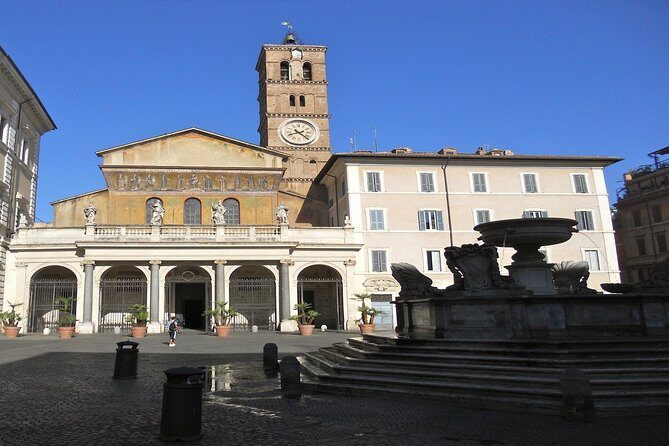
Next you head to Basilica di Santa Maria in Trastevere. This is the kind of church that rewards you for slowing down, and the guide’s job is to help you see what you might otherwise skim over.
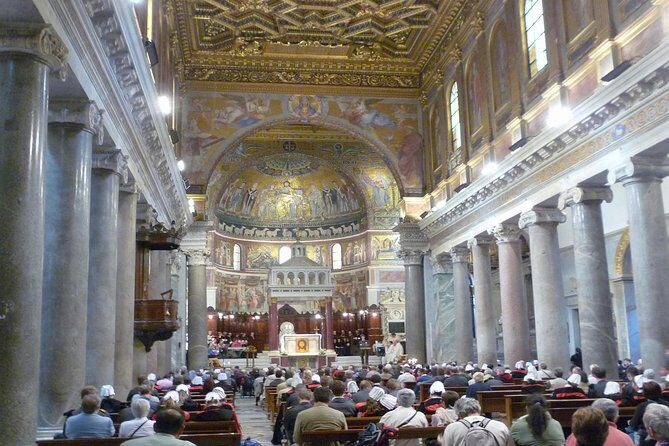
You’ll hear how the basilica became a major early Christian worship site in Rome (built in the 3rd century according to legend, completed in the 4th). You’ll also get the practical architectural timeline: rebuilding work under Pope Innocent II, later decorations and restorations under Popes Clement XI and Pius IX, and the fact that it retained a lot of older fabric—especially dating elements and mosaics.
Here’s what to focus on once you’re inside:
- The facade mosaics and the mosaics in the apse, including the Life of the Virgin scenes
- The 12th-century bell tower with its square base
- The portico remodeled in 1702 by Carlo Fontana, where you can spot fragments and epigraphs
The stop is about 30 minutes, and the ticket is marked as included. One quick reality check: the dress code for worship places means you should arrive with covered shoulders and knees (or plan to adjust on-site if that’s allowed).
You can also read our reviews of more historical tours in Rome




Isola Tiberina: the Tiber Island stop that links stories fast
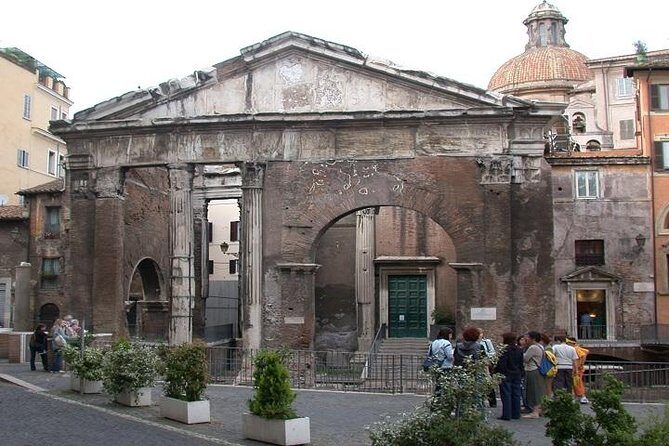
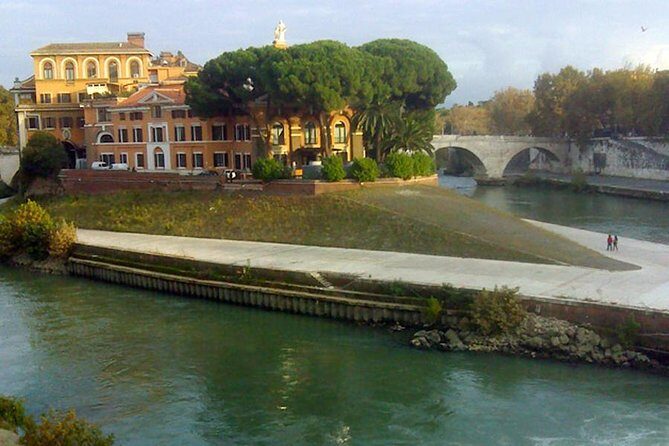
Then you cross the river zone to Isola Tiberina, the only urban island on the Tiber. It’s compact—about 300 meters long and 90 meters wide—so it feels like a “pause” in the middle of Rome rather than a full destination.
You’ll walk up to it through the context of the two bridges:
- The Cestio Bridge on the Trastevere side, dating to 46 BC
- The Fabricio Bridge toward the Ghetto, built in 62 BC and also called the Quattro Capi bridge for the herms on the parapets
There’s also the legend about the island’s origin after the last Roman king was overthrown and grain thrown into the Tiber supposedly formed the island. The tour also frames the more grounded explanation: the island sits on a tuff base, with sand settling over time.
This stop runs about 15 minutes and is free. It’s short, but it’s a smart breather before the tour moves deeper into the ghetto-area streets.
Turtle Fountain (Fontana delle Tartarughe): a legend with a punchline
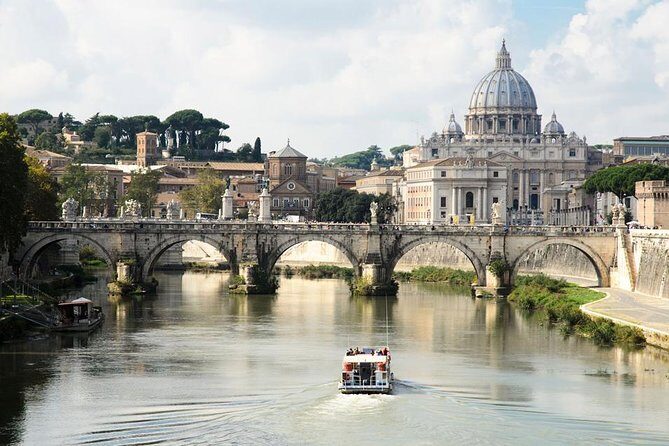
After the river island, you’ll reach Fontana delle Tartarughe, known as the Turtle Fountain. It was built between 1581 and 1588 based on a design attributed to Giacomo della Porta.
This is the kind of stop where the story makes the stone better. The legend says Duke Mattei lost his family fortune gambling, and the bride’s father refused the match. So the duke allegedly had the fountain built in one night to prove what he could create—even as a penniless Mattei.
Whether you treat it as literal or just a good Rome myth, it gives you a lens for why locals keep returning to these corners. The stop is about 15 minutes and listed as free.
Sant’Andrea della Valle: a “minor basilica” with a big dome
Next is Basilica di Sant’Andrea della Valle, a church with a quieter reputation than the giants of Rome—yet it has serious architectural weight.
You’ll learn its timeline: built at the end of the 16th century on a site that included an older San Sebastiano church and the Palazzo Piccolomini. It’s also tied to the Theatine regular clerics as their mother house.
Construction credits you can keep an eye out for:
- Giacomo della Porta, Pier Paolo Olivieri, and Carlo Maderno
- Maderno widened the transept and designed the dome
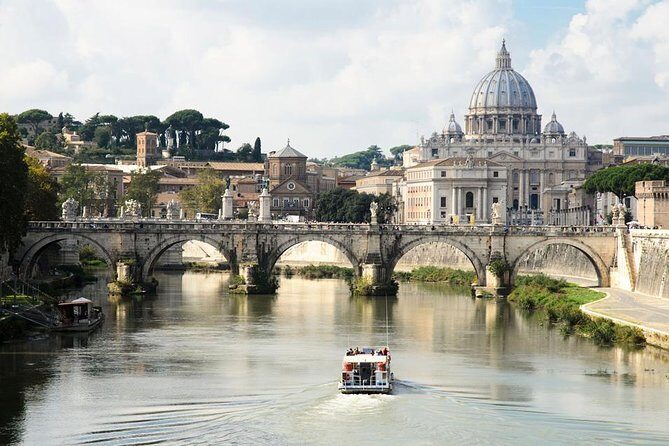
- The dome is the second highest in Rome after St. Peter’s
The stop is about 30 minutes, and admission is marked free. Like the Santa Maria stop, you’ll want to follow the worship-area dress code.
Il Portico di Ottavia: ancient boundaries where the Ghetto took shape
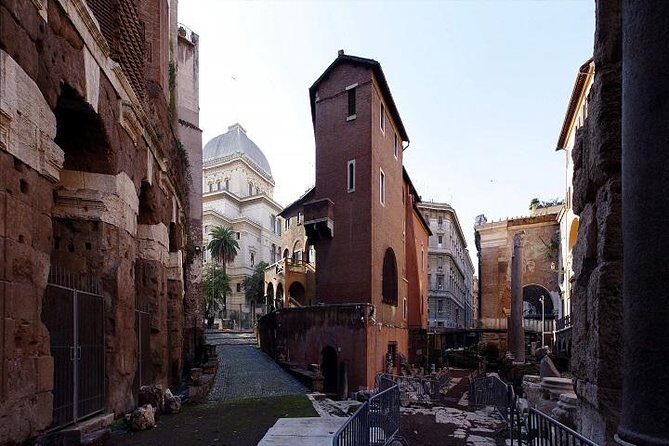
Now you arrive at Il Portico di Ottavia, a major reason this tour feels “connected,” not scattered. The portico complex is the only preserved part of a larger system of porticoes that once lined the square area connected to the ancient Circo Flaminio—and that corresponds to the area known as the old Ghetto.
This site is packed with layered history:
- It was rebuilt by Augustus between 27 and 23 BC, replacing an older Portico of Metello
- Septimius Severus restored and partially rebuilt it in 203 after a fire in 191
- Today, many visible remains date to that period
The complex is a quadriportico sized 119 x 132 meters. The guide gives you a mental map of what once sat here, including the Temple of Juno Regina, later joined by the Temple of Jupiter Stator (described as the first entirely marble-made temple in Rome), plus Greek and Latin libraries and the Curia Octaviae for public meetings.
Stop length is about 15 minutes and admission is free. It’s short, but it helps you understand why the ghetto-area story isn’t floating in the air—it’s anchored in Roman civic space.
The Antico Quartiere Ebraico and the synagogue visit
This is the heart of the experience: Antico Quartiere Ebraico, the old Jewish quarter. This neighborhood sits in the rione that heavily influenced traditional Roman cuisine, which is a useful angle because it reminds you this is not just a museum story—it’s also a living cultural thread.
Key facts you’ll hear:
- The Roman Ghetto was founded in 1555 by order of Pope Paul IV
- Jews were required to live there and carry a distinctive sign
- People were prohibited from trading and from owning real estate
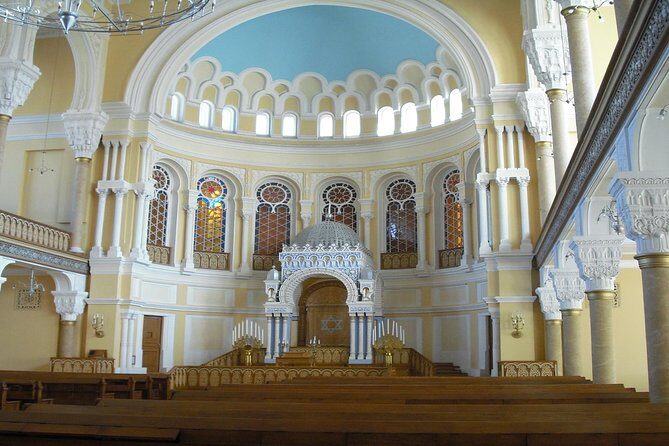
- In 1904, the Tempio Maggiore (the large synagogue) was inaugurated, serving as a cultural reference point
- A Jewish Museum is housed inside the synagogue complex area
Tour inclusion: entrance to the synagogue is included. In practical terms, that’s what makes this tour different from a quick street walk—you get to step into a major institution rather than only passing by outside walls.
Time at this stop is about 15 minutes and admission is listed as free at the neighborhood level, but the synagogue entry is covered by the tour package.
Finishing at Campo de’ Fiori: your afternoon starts right after
The tour ends at Piazza Campo de’ Fiori. That location is useful because it sits in a lively area where you can keep momentum without committing to another long plan.
With the tour lasting around three hours and starting at 9:00 am, you’re set up well for an afternoon of your choice. Maybe it’s a museum. Maybe it’s lunch. Maybe it’s simply returning to a spot you liked and looking again with less pressure.
Who this tour suits best (and who should rethink it)
This works best if you want:
- A small-group walking experience
- Clear guidance through major historical nodes across Trastevere and the Jewish quarter
- Synagogue time with a guide who can connect stories to what you see in front of you
- An early start that doesn’t steal your whole day
It may be less ideal if:
- You mainly want wandering time and zero structure
- You’re hoping for a heavy emphasis on Trastevere details beyond what’s needed to connect the route
- You’re not comfortable with places of worship requiring a dress code
Quick checklist before you book
- Bring clothing that follows worship-site rules (shoulders and knees covered)
- Wear shoes that handle uneven Rome stone
- Plan for weather: you’ll be outside for long stretches
- Go in expecting a focused Jewish-quarter experience, not a general Trastevere deep dive
- Aim to arrive a few minutes early at the meeting point near Teatro di Marcello
Should you book this Rome Jewish Ghetto and Flavors tour?
I’d book it if you like your Rome with context and you want a guided walk that connects Trastevere to the old Jewish quarter without you playing map roulette. The small group size, the synagogue entrance, and the blend of streets plus major religious architecture make it a solid value for a 3-hour morning.
Skip it if your priority is pure Trastevere wandering or if you’re allergic to any religious-site dress requirements. Also consider that Rome traffic can affect punctuality, so give yourself a calm start and you’ll be fine.
FAQ
What time does the tour start and how long is it?
It starts at 9:00 am and lasts about 3 hours.
Where do we meet the guide?
You meet at Antico caffè del teatro di Marcello, Via del Teatro di Marcello, 42, 00186 Roma RM, Italy.
What is the end point?
The tour ends at Piazza Campo de’ Fiori, 00186 Roma RM, Italy.
Is the tour in English?
Yes, it’s offered in English.
What’s included in the price?
The price includes 3 hours with a professional guide, and entrance to the synagogue. The Santa Maria in Trastevere basilica stop is also listed with admission included.
Do I need to pay for tickets during the tour?
Some stops are listed as free admission (like Piazza Trilussa fountain and Il Portico d’Ottavia), while others have admission included. Synagogue entrance is included.
Is there a dress code?
Yes. A dress code is required to enter places of worship and selected museums.
Is pickup from my hotel included?
No. Pickup and drop-off aren’t included.
Can I cancel and get a full refund?
Yes. You can cancel for free up to 24 hours in advance for a full refund.