REVIEW · WALKING TOURS
Rome Art Walking Tour Who Killed Caravaggio
Book on Viator →Operated by What About Tours · Bookable on Viator
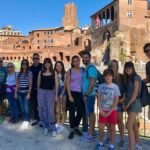
A murder mystery with paintings as clues. This Rome Baroque art walking tour turns Caravaggio’s life into an on-street case file, with a licensed local guide and a simple route through churches and palaces where you can still see the works tied to his story. I especially like the story-first format and the way the tour keeps you focused on paintings you can view in person rather than just names on a page. One thing to keep in mind: the stops are short, so you’ll need to pay attention and keep moving.
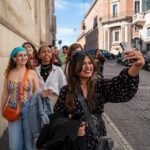
What really makes this work is the human touch of the guide. In past groups, guides like Simone, Ivan, and Jacopo have been praised for pacing, respectful answers, and enthusiasm that doesn’t feel scripted. You’ll also get that slightly interactive feel that stays friendly and low-pressure, so you’re not just staring at stone walls and hoping for the best.
The main trade-off is pace. With multiple stops at around 5 to 15 minutes each, it’s easy to miss a detail if you drift even a little during walking time, especially when questions come up on the move. If you love lingering in art spaces for long stretches, you may want to plan extra self-guided time after the tour.
In This Review
- Key highlights worth showing up for
- Why this Caravaggio walk feels different at 5:00 pm
- Piazza della Minerva: the first “clue” near the Pantheon
- The Pantheon and Raphael’s presence in the same breath
- Palazzo Madama: seeing power in Baroque form
- San Luigi dei Francesi: Caravaggio’s St. Matthew chapters
- Sant’Agostino: Madonna di Loreto plus Raphael’s Isaiah
- Via di Pallacorda: the murder-scene clue you can almost picture
- Vicolo del Divino Amore: Lena and Caravaggio’s house connections
- Palazzo Borghese and Il Circolo della Caccia: art, elites, and exclusivity
- Price and value: what $4.83 really buys you
- Logistics that matter: group size, English, and how to not miss the story
- Who this tour suits best
- Should you book Who Killed Caravaggio?
- FAQ
- Where does the tour start?
- Where does the tour end?
- What time does the tour begin?
- How long is the tour?
- What is the price per person?
- Is it offered in English?
- Do I get a mobile ticket?
- How big is the group?
- Is tipping required?
- Can I cancel and get a full refund?
- Are service animals allowed?
Key highlights worth showing up for
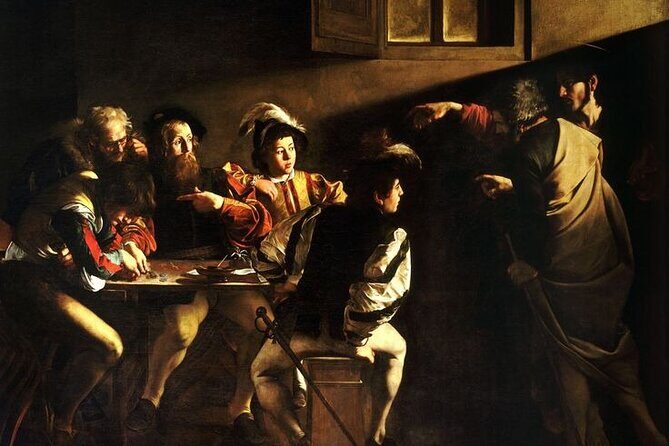
- Licensed local storytelling that connects the art to the mystery instead of treating paintings like museum labels
- Church stops with Caravaggio works still on the walls, so the case feels real
- A route that traces clues from a murder scene to the homes linked to Caravaggio’s life and models
- Raphael and Pantheon context to show you what this era looked like beyond one artist
- Small group size (max 25), which helps the guide actually respond to what you ask
Why this Caravaggio walk feels different at 5:00 pm
This is a late-afternoon to early-evening tour, starting at 5:00 pm and running about two hours. That timing matters in Rome: you get to see big landmarks while the light is kinder, and you’re not spending your whole day waiting in lines for the next stop. The vibe is also more “story walk” than “museum march,” which helps Caravaggio’s complicated reputation make sense.
You also get a practical setup: it’s in English, you get a mobile ticket, and the tour keeps the group tight at up to 25 people. For me, that’s a sweet spot. Large enough to feel social, small enough that you can hear the guide when things get dramatic.
And because it’s a tip-based model, the guide’s job is essentially to make the experience worth your extra support. You’re not buying a bundle of entertainment tricks; you’re paying for a licensed local with a clear point of view, plus access to a story you’ll remember when you walk away.
You can also read our reviews of more walking tours in Rome

Piazza della Minerva: the first “clue” near the Pantheon
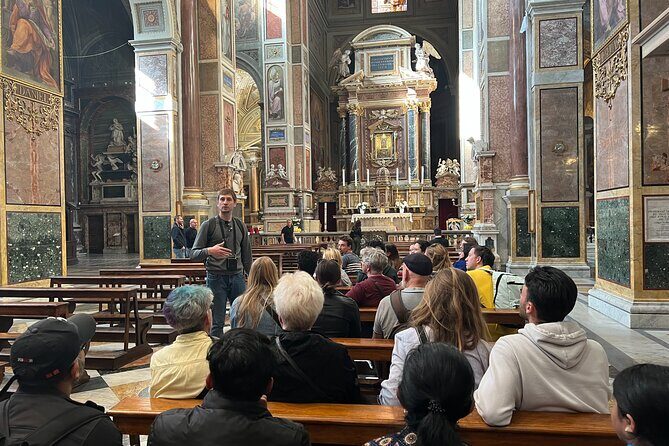
You start at Piazza della Minerva, near the Pantheon area. The location is handy because it drops you into the middle of Rome’s art-and-history density fast, without wasting time. Here, the tour sets a foundation: you’ll see Bernini’s Elephant and Obelisk and the Gothic Basilica of Santa Maria sopra Minerva, which sits on top of an ancient temple dedicated to the goddess Minerva.
This stop works well because it teaches you how Rome reuses space. You’re not just seeing Baroque decorations; you’re watching different eras stack on top of each other. Even if Baroque art is new to you, that “layers” idea is the key that makes the rest of the tour click.
The schedule keeps this segment to about 15 minutes, with admission listed as free for this stop. That’s enough time to get oriented, but not enough time to go deep on your own. If you’re the kind of person who likes photos from every angle, I’d suggest a couple quick shots and then keep pace.
The Pantheon and Raphael’s presence in the same breath
From there, the route moves toward the Pantheon, one of Rome’s most recognizable buildings. You’ll see what it’s famous for: a huge domed roof and a central oculus that lights the interior. It’s also where the tour connects this broader Renaissance thread to the era surrounding Caravaggio, including the fact that Raphael is resting here.
Why does the Pantheon belong on a Caravaggio tour? Because it anchors you in what people wanted from art and space during that big artistic shift. You get a sense of the “big picture” scale: monumental architecture, carefully engineered light, and famous artists tied to physical places.
One practical note: this is a high-traffic site, so you’ll want to be mentally ready to share space. The tour’s value isn’t “exclusive access” here; it’s what the guide helps you notice while you’re all standing in the same crowd.
Palazzo Madama: seeing power in Baroque form
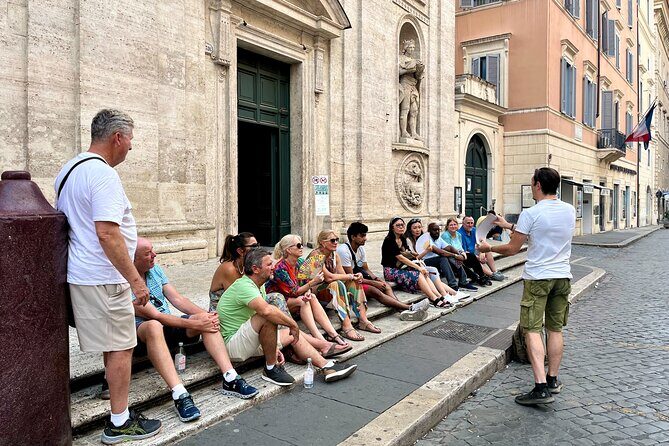
Next comes Palazzo Madama, a historic palace originally built in the 16th century and known for its Baroque character. Today it houses the Italian Senate, so it’s not just an aesthetic stop. You’re looking at how aristocratic and political power played out through architecture and grand public presence.
This isn’t the stop where you’ll stare at a single famous painting. Instead, it helps you understand patronage and status: who had the influence, who funded what, and why art and politics kept bumping into each other.
If you’re a fan of how buildings tell social stories, this segment will click. If you’re only interested in one artist and his works, you might find this stop more context than payoff. Still, it adds useful framing so the Caravaggio story doesn’t feel like it fell out of nowhere.
San Luigi dei Francesi: Caravaggio’s St. Matthew chapters
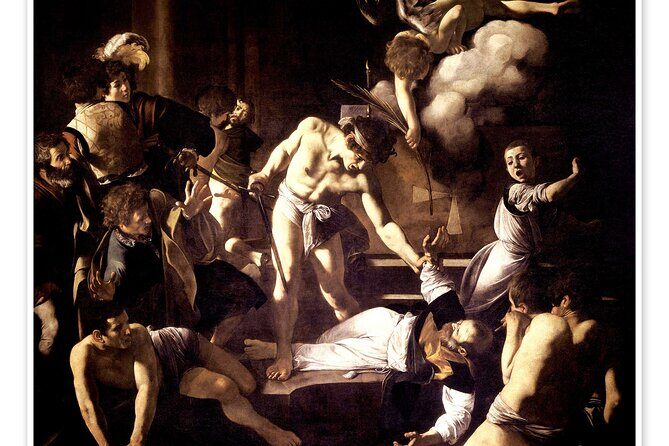
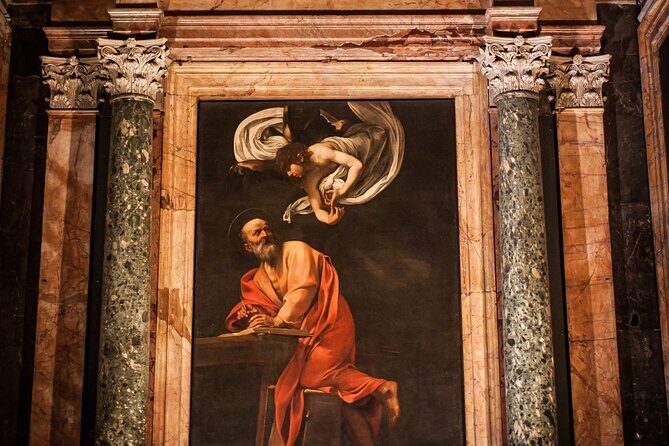
The tour’s art centerpiece arrives at San Luigi dei Francesi (Church of St. Louis of the French), near Piazza Navona. This is where you get one of the most famous Caravaggio connections on the route: the Contarelli Chapel, holding three Caravaggio masterpieces tied to the life of St. Matthew.
This stop is special for a simple reason: you’re standing in a church space built for devotion, and the art is doing storytelling in a way that feels immediate and dramatic. The guide’s job here is to translate what you’re looking at into a coherent narrative so the works don’t blur together.
The stop is about 15 minutes, with admission listed as free in the tour notes. That’s quick, but workable if the guide is keeping you on-track. Come ready to look more than you photograph. If you try to do both at maximum speed, you’ll lose the story thread the tour is built on.






Sant’Agostino: Madonna di Loreto plus Raphael’s Isaiah
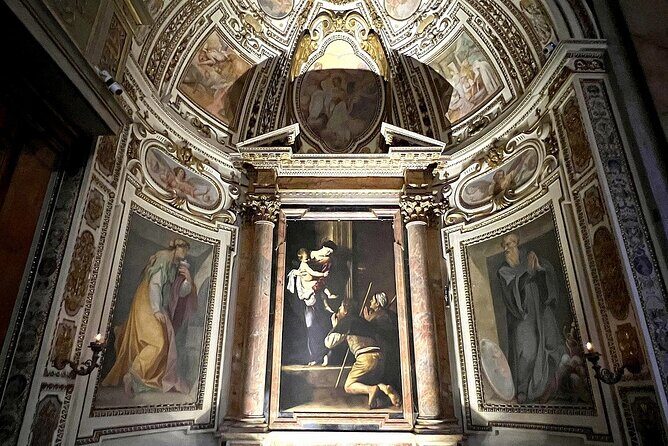
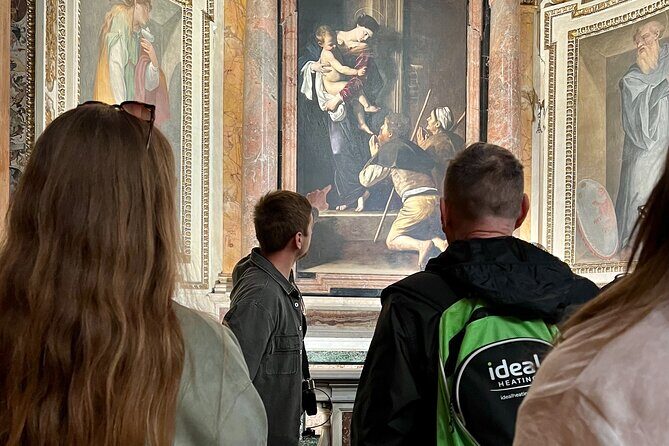
Right after Piazza Navona’s busy energy, the route shifts to Sant’Agostino. Here you’ll see Caravaggio’s Madonna di Loreto and, importantly, a Raphael fresco of Isaiah in the same space.
That pairing is a smart choice for your understanding of the period. You’re not just watching one artist’s worldview; you’re seeing how different schools and styles share the same Roman walls. It’s also a good reminder that “Caravaggio” is part of a wider art conversation, not an isolated brand.
This is another 15-minute stop, with admission listed as free. Again, the short time is by design: it keeps momentum for the mystery storyline that continues into the streets.
Via di Pallacorda: the murder-scene clue you can almost picture
After the churches, the tour leans into the detective work: Via di Pallacorda, described as the murder scene of Tomassoni, Caravaggio’s victim. This is where the experience stops feeling like “art tour” and starts feeling like “Rome noir, but in daylight.”
The value here isn’t whether you already know the full backstory. The tour’s structure helps you grasp why a single event could ripple through an artist’s reputation, relationships, and the way people talked about him.
This stop lasts around 10 minutes and is listed with free admission. It’s also a helpful palate cleanser: you go from interior art to an outdoor space tied to the story’s darker turn.
Vicolo del Divino Amore: Lena and Caravaggio’s house connections
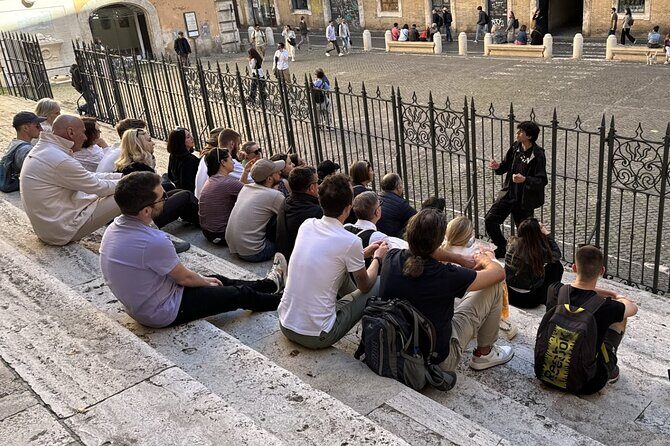
The last street-clue segments focus on two nearby alleyways tied to the people in the Caravaggio story.
First: Vicolo del Divino Amore, described as the house of Lena, Caravaggio’s “most scandalous model.” Then you move to the related spot also described as the house of Caravaggio.
These are quick stops at about 5 minutes each, both listed as free. That brevity is probably the only way they can keep the whole mystery arc moving while still giving you enough orientation to connect the locations.
If you like walking through the physical spaces behind a story, these two moments are fun. If you’re the type who needs context repeated slowly, stay close when the guide is talking because you’ll have limited time to rewind mentally.
Palazzo Borghese and Il Circolo della Caccia: art, elites, and exclusivity
Your tour ends at Palazzo Borghese near the Spanish Steps. This is a proper Baroque palace stop, tied to the influential Borghese family. The highlight here is the story angle: Il Circolo della Caccia (The Hunting Club), described as a secretive elite club established in the 17th century by the Borghese family.
The tour frames it as a private gathering space for noblemen and intellectuals, with art exhibitions and discussions alongside private hunting activities. The key takeaway is how exclusive circles shaped culture. In a city like Rome, the “who knew who” part of art history is never far behind the finished masterpiece.
This segment is about 15 minutes. It’s also marked as free admission in the route notes. Ending here feels right: you finish with power, patronage, and social control, which helps explain why artistic stories get preserved (and mythologized) over centuries.
Price and value: what $4.83 really buys you
At $4.83 per person, this price is eye-catching. The big reason it can be so low is that the tour is tip-based, and it’s focused on guide-led storytelling rather than paid entrances at every stop. On the route notes, several stops are marked with admission ticket free, which also keeps your out-of-pocket costs stable.
So here’s how I’d think about value: you’re paying for (1) a licensed local guide, (2) a story-driven route, and (3) the structure that ties together multiple locations into one mystery you can follow end to end. You’re not buying a long list of museums or a packaged “show.” The payoff is your understanding, and your ability to look at Caravaggio-related scenes with a story in your head.
One practical check before you book: because the guide works for tips, you should plan accordingly. If you budget like you would for a normal walking tour, you’ll be fine.
Logistics that matter: group size, English, and how to not miss the story
This tour is offered in English and has a maximum group size of 25. That matters because the story depends on hearing the guide. If you’re far back, you’ll miss details, especially during walking sections when questions pop up.
Also: the meeting point is Piazza della Minerva and the tour finishes at Palazzo Borghese / Piazza Borghese. Build that into your evening plans so you’re not scrambling for a ride or a dinner reservation right after.
You’ll get a mobile ticket, and the start is described as near public transportation, which is useful for getting back into Rome’s grid without burning time.
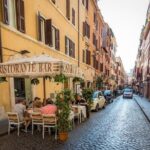
One last tip: wear comfortable shoes. The route includes churches plus short alley/street stops, and Rome doesn’t do smooth sidewalks everywhere. You’ll want your feet to keep up so your brain stays on the plot.
Who this tour suits best
This is a great match if you:
- Want a story-first art experience where you learn by following a mystery trail
- Like Baroque art but don’t want to feel overwhelmed by dates and labels
- Enjoy churches as “real rooms,” not just photo backdrops
- Want a smaller-group feel, with space for questions
It’s also ideal if you’re mixing art interest with curiosity about the darker side of history. The route from a murder scene to locations tied to models and private elite circles gives you a sense of the full ecosystem around an artist.
The only group I’d caution is the slow-pace art lover who wants 30+ minutes in one chapel. This tour is built for motion and momentum.
Should you book Who Killed Caravaggio?
Book it if you want a high-impact Caravaggio story set in real Roman locations, with a licensed local guide and a route that connects the paintings to the people and events behind them. At this price point, the value is mostly in your understanding, not in paid extras.
Skip it only if short stops and tight pacing will drive you crazy. If you’re happy to follow a guide, look quickly but meaningfully, and then return on your own to linger later, this is an easy yes for an art night in Rome.
FAQ
Where does the tour start?
The tour starts at Piazza della Minerva, 00186 Roma RM, Italy.
Where does the tour end?
The tour ends at Palazzo Borghese, Piazza Borghese, 00186 Roma RM, Italy.
What time does the tour begin?
The start time listed is 5:00 pm.
How long is the tour?
The duration is approximately 2 hours.
What is the price per person?
The price is $4.83 per person.
Is it offered in English?
Yes, the tour is offered in English.
Do I get a mobile ticket?
Yes, you receive a mobile ticket.
How big is the group?
The tour has a maximum of 25 travelers.
Is tipping required?
It’s a tip-based tour. Tips are the stated way guides are compensated.
Can I cancel and get a full refund?
You can cancel for a full refund if you cancel up to 24 hours in advance of the experience start time.
Are service animals allowed?
Yes, service animals are allowed.