REVIEW · MUSEUMS
Private & Small Group Vatican Museum, Sistine Chapel& St. Peter’s
Book on Viator →Operated by Gaudium travel · Bookable on Viator
The Vatican hits hard even if you’ve read the headlines. This tour packs the Vatican Museums, the Sistine Chapel, and a fast path into St. Peter’s Basilica into about two hours, with an expert guide steering you through the must-sees without you getting stuck in line chaos.
I particularly love the small-group feel and how the guide keeps the route focused. I also like that admission is included for the key sites, and you get priority-style access so you spend more time looking and less time shuffling.
One thing to keep in mind: St. Peter’s Basilica can be restricted for Vatican events, and if that happens on short notice, the plan can end at the Sistine Chapel with no refund.
In This Review
- Quick hits before you go
- How this Vatican tour works in plain terms
- Meeting point at Via Germanico 67 and what to expect
- Vatican Museums: the route that actually makes sense
- Pinecone Courtyard view of St. Peter’s
- Octagonal Courtyard stops: Apollo and Laocoön
- Room of the Muses and the Belvedere Torso
- The Round Room: a smaller Pantheon and Nero’s bathtub
- Greek Cross Room and rare porphyry tombs
- Tapestries and the big finish: Maps Gallery
- Sistine Chapel: how to look beyond the famous ceiling
- Why the short timing still works
- A reality check about crowding
- St. Peter’s Basilica: priority access, flexible timing, and the key spots
- If the basilica is open
- If the basilica is restricted
- Dome tickets are not included
- Skip-the-line tickets: what they save (and what they can’t)
- Headsets: helpful, but not perfect for everyone
- Guides and pacing: why the “small group” matters
- A good pace beats a long pace
- Dress code, comfort, and what to bring
- Price and value: is $102.12 a good deal?
- Who should book this tour
- Final take: should you book it
- FAQ
- How long is the tour?
- Does the price include admission tickets?
- Are dome tickets included for St. Peter’s?
- Is this tour only in English?
- What happens if St. Peter’s Basilica is closed?
- What’s the group size?
Quick hits before you go
- Skip-the-line entry helps you get moving fast through major bottlenecks
- Small group (about a dozen) makes it easier to ask questions and keep pace
- Headsets are provided for groups of 6+, but sound can vary in crowds
- You get a guided route through highlight rooms instead of wandering the wrong corridors
- St. Peter’s can close due to events, so have a flexible mindset
- Dome tickets are not included, so plan that separately if you want the view
How this Vatican tour works in plain terms
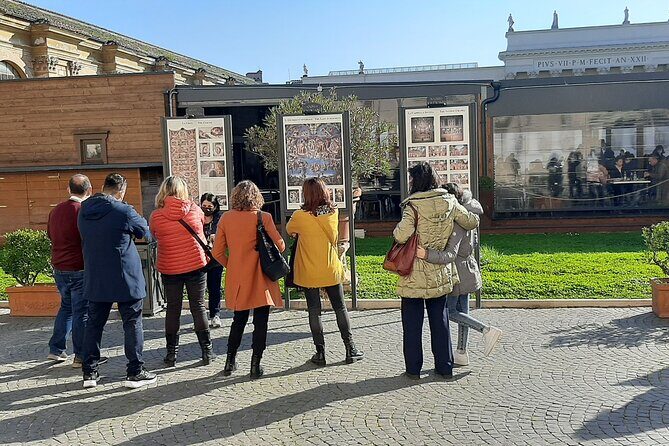
This is a fast, tightly managed Vatican day. In roughly two hours, you’ll move from the Vatican Museums into the Sistine Chapel, then finish with priority time at St. Peter’s Basilica to explore at your own pace.
The value here is the combination: a licensed English guide + skip-the-line tickets + a route that hits the standout rooms in a logical order. If you’re short on vacation time, it’s one of the most efficient ways to make the “big three” actually feel manageable.
You can also read our reviews of more private tours in Rome

Meeting point at Via Germanico 67 and what to expect
You’ll start at Via Germanico, 67, 00192 Roma and end at St. Peter’s Basilica, Piazza San Pietro, 00120 Città del Vaticano. Plan to arrive a bit early because the Vatican area is busy, and you want to start moving before the crowd wave settles in.
This is also a walk-heavy experience. The pace is designed for people with moderate physical fitness, meaning you should be comfortable moving through galleries and stairs without constant breaks.
Vatican Museums: the route that actually makes sense
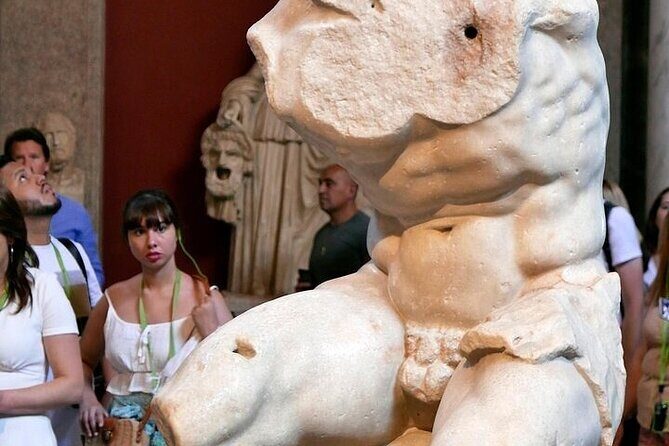
The Vatican Museums can be overwhelming if you go in “free-roam mode.” The galleries are huge, the signage can be confusing, and you can easily spend energy finding things instead of seeing them. Here, the guide keeps you on a tight highlight route so you check off real masterpieces without wasting time.
Pinecone Courtyard view of St. Peter’s
You’ll begin with a breezy look at the Pinecone Courtyard, including a view toward St. Peter’s Basilica. It’s a great warm-up moment because it sets the stage: you start with the payoff, not with paperwork.
Octagonal Courtyard stops: Apollo and Laocoön
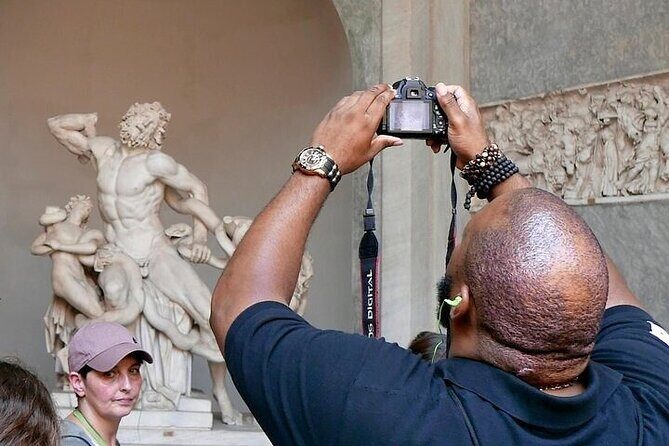
Next comes the Octagonal Courtyard, where you’ll see famous sculptures like Apollo and the Laocoön. These are the kinds of works that feel more “real” once you’re standing close enough to notice details.
You can also read our reviews of more museum experiences in Rome



Room of the Muses and the Belvedere Torso
Then you move toward the Room of the Muses, including the Belvedere Torso. The torso gets cited often for a reason—it’s one of those pieces that gives you an instant lesson in how classical sculpture was built to teach anatomy through form.
The Round Room: a smaller Pantheon and Nero’s bathtub
One of the most fun stops is the Round Room, described as a smaller replica of the Pantheon. The centerpiece includes Nero’s bathtub, which sounds odd until you’re there and realize how much storytelling the Vatican builds into everything, even the strange bits.
Greek Cross Room and rare porphyry tombs
In the Greek Cross Room, you’ll see two tombs made from extremely rare porphyry marble. This is the kind of detail you’ll be glad you have a guide for, because “rare marble” is one thing—seeing the scale and craftsmanship is another.
Tapestries and the big finish: Maps Gallery
You’ll also pass through the Gallery of Tapestries. After that, you end at the Gallery of Geographical Maps, which is often treated like a “must” inside the museums.
I like how this route finishes with something that feels both artistic and informational. It’s not just pretty walls—it’s a way of understanding how early modern people pictured the world.
Sistine Chapel: how to look beyond the famous ceiling
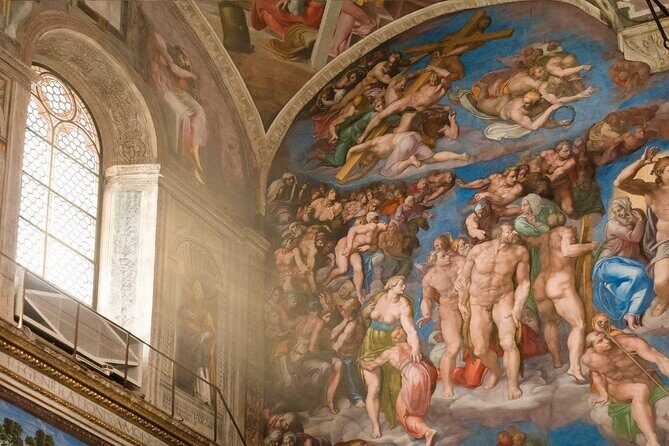
Then you step into the Sistine Chapel, where the ceiling frescoes by Michelangelo (including Creation and the Last Judgment) do their usual job: they stop you in your tracks.
This stop is also about the chapel’s role in politics and tradition. You’ll learn how the papal election process, called the conclave, is tied to this space. It’s a fun mental game to try to deduce where the stove and chimney would be, and where the newly elected pope would switch from cardinal attire into papal garments.
Why the short timing still works
This part of the tour is brief on purpose—about 15 minutes. In a place this crowded, a long session can turn into standing and staring without any guidance. You’re there long enough to see the key moments and get the context that makes your brain connect what you’re seeing.
A reality check about crowding
Even with skip-the-line entry earlier, the chapel itself can still be busy. Expect the room to feel tight, and expect you’ll have to share your space with other groups. That’s normal for the Sistine Chapel, and the guide’s job is to keep your group moving so you don’t miss the key areas.
St. Peter’s Basilica: priority access, flexible timing, and the key spots
St. Peter’s Basilica is a different kind of experience. It’s not a museum room—you feel like you’re inside a living landmark with layers of meaning.
The tour includes what’s described as priority access so you can explore on your own afterward. You’ll also get specific pointers before you go in, including the idea of the place where St. Peter was crucified and the fact that the Pope holds the Wednesday audience here.
If the basilica is open
If St. Peter’s Basilica is accessible, your guided time acts like a starter kit. Then you move through the space at your own pace, which is ideal because this basilica is the kind of place where you want freedom to stop when something catches your eye.
If the basilica is restricted
Here’s the biggest consideration: access can be restricted due to Vatican events. If that happens, the tour can end in the Sistine Chapel instead, and there’s no refund.
That doesn’t mean you’ll have a bad experience. The Museums + Sistine Chapel are still the core, and they’re a huge chunk of what most people came for. It just means you should keep your expectations flexible, especially if your date overlaps with known Vatican events.
Dome tickets are not included
Also note: dome tickets are excluded. If your plan includes climbing for views, you’ll need a separate arrangement.
Skip-the-line tickets: what they save (and what they can’t)
The phrase skip-the-line can sound like magic. In reality, it mostly helps you bypass the biggest queue points at the entry gates where time disappears.
You’ll still deal with crowds once you’re inside. One review noted how packed it could be outside and how getting into St. Peter’s took time despite priority access. That’s the Vatican in peak season: even when you’re efficient, you’re still sharing the space with thousands of other people.
Headsets: helpful, but not perfect for everyone
For groups of 6 or more, audio headsets are provided. One person found it hard to hear the guide through the ear pieces, and they compared it to a different headset style used on other tours.
My practical take: if you know you struggle with audio in noisy settings, mentally budget for moments where you’ll rely more on visual cues and your own reading. The guide route still matters, even when sound quality isn’t ideal.
Guides and pacing: why the “small group” matters
This tour keeps the group tight—up to about 12 people. That changes everything. You don’t feel like a number in a moving cattle line, and the guide can manage pacing without leaving half the group behind.
The guide factor is huge here. You’ll see names like Luigi, Alex, Ava, and Jeanette showing up in strong feedback for clear English, a friendly tone, and keeping everyone on track. In real terms, that means fewer tangents and more time spent where it counts.
A good pace beats a long pace
At the Vatican, a “slow” tour can actually be a rushed one if it’s wandering off-route. The best part of this format is that you get a guided route that doesn’t waste your energy finding things that are already hard to find.
Dress code, comfort, and what to bring
You’ll be walking and moving between sites, so dress for comfort. The guidance here says 10-inch shorts are fine since they reach the knees, and flip flops and sandals are fine. You’ll still want to be respectful—when in doubt, bring a light layer for crowds and temperature swings.
Bring a bottle of water. The Vatican complex can feel warm inside, and you may spend some time waiting in any outdoor queue sections before entrance.
Also, plan for closed-space moments. The Sistine Chapel is not airy, and it’s not a place for heavy bags or anything that makes you feel awkward in tight quarters.
Price and value: is $102.12 a good deal?
At about $102.12 per person, this tour isn’t cheap—no Vatican tour is. But you’re paying for three things that add up fast if you try to piece it together yourself: a guide, skip-the-line entry, and included admission across the main stops.
If you only go to one or two sites on your own, you might save money. But you usually lose time—and at the Vatican, time is the currency you run out of first. With a guide-built route, you spend less of your day trying to figure out where to go next.
Where I think you’re getting the most value is in the Museums section. That’s where most people wander, get tired, and miss key rooms. Here, you’re led through the standout areas like the Courtyards, Room of the Muses, the Round Room, the Greek Cross Room, and the Maps Gallery without a “where do we go now?” headache.
The only real dent in value is the St. Peter’s closure risk. If your date triggers restrictions, you could lose the basilica portion. Still, you would likely end with the chapel and museums, which are the big artistic core of the experience.
Who should book this tour
Book this if:
- You want the Vatican Museums + Sistine Chapel without getting lost
- You have limited time and want a tight two-hour plan
- You prefer a small group where you can keep up and ask questions
- You’d rather pay for fewer hassles than spend extra hours managing tickets and lines
Consider something else if:
- You strongly need St. Peter’s Basilica dome access (not included here)
- You cannot handle crowds or audio limitations
- You want a very long, slow museum day with lots of free time to roam
Final take: should you book it
I’d book this if your goal is simple: see the Vatican’s biggest hits with a guide and save time on lines. The route covers the Rooms and Galleries that most people feel are the point of the Museums, then takes you to the Sistine Chapel with the right context so you know what you’re looking at.
Just go in with your eyes open about St. Peter’s Basilica being the variable. If your date is a calm day, you’ll enjoy that priority access and your own pace inside. If it’s restricted, you’ll still come away with a strong artistic experience.
If you want the Vatican to feel like a plan, not a scramble, this one fits.
FAQ
How long is the tour?
It’s listed at about 2 hours total.
Does the price include admission tickets?
Yes. Admission fees are included for the Vatican Museums, the Sistine Chapel, and St. Peter’s Basilica.
Are dome tickets included for St. Peter’s?
No. Dome tickets are excluded.
Is this tour only in English?
Yes, it’s offered in English.
What happens if St. Peter’s Basilica is closed?
Access can be restricted due to Vatican events. If this occurs, the tour ends in the Sistine Chapel and there are no refunds.
What’s the group size?
This experience is kept small, with a maximum of 12 travelers.