REVIEW · 1-DAY TOURS
Private Pompeii Day Trip from Rome
Book on Viator →Operated by Driverinrome · Bookable on Viator
Pompeii is waiting, and you don’t have to hassle. This private day trip gets you out of Rome fast, with a comfortable ride plus live commentary en route, then time in Pompeii at a UNESCO site where the city feels frozen in 79 AD. I especially like the door-to-door hotel pickup and the chance to choose your style inside Pompeii—independent walk or an on-site licensed guide for deeper explanations.
Second, I like that you’re not stuck planning trains, transfers, or rental car headaches. You ride with an English-speaking driver who shares context from the vehicle, and you also get a set visit time at Pompeii (about 2.5 hours) so the day stays on track. One possible drawback: the Pompeii entrance ticket and food are not included, so you’ll want to budget extra and plan around limited time on site.
In This Review
- Key things to know before you go
- Why a private Pompeii day trip feels easier than doing it on your own
- The Rome-to-Campania drive: what you’re seeing (and why it matters)
- Castelli Romani and Lake Albano area
- Abbey of Montecassino from the road
- Bay of Naples and Vesuvius profile
- Arriving at Pompeii: entry fee, timing, and how to make the 2.5 hours work
- The big decision: self-guided ruins or hiring an on-site guide
- Why a guide changes the experience
- When self-guided works
- The Pompeii stops that usually land best: Forum, baths, theater, and the Lupanar
- The Forum (the city’s social and civic center)
- Thermal baths (why daily life becomes vivid)
- Teatro Grande (a theater for thousands)
- The Lupanar (a brothel with fresco decoration)
- The human side: what the drivers and guides do that actually helps
- Lunch and the return to Rome: plan for a real break, not just a snack
- Cost and value: is $420.31 per person worth it?
- Who this Pompeii day trip suits best (and who should rethink it)
- Should you book this Pompeii day trip?
- FAQ
- What time does the tour start?
- How long is the Pompeii day trip?
- Is the Pompeii entrance fee included?
- Do I get pickup and drop-off from my Rome hotel?
- Is this a private tour for just my group?
- Can I hire a guide once I’m in Pompeii?
- What language is the commentary?
- What is the cancellation window for a full refund?
Key things to know before you go
- Hotel pickup and drop-off mean less stress in Rome, especially on an early start.
- Private minivan just for your group keeps the day flexible and comfortable.
- English commentary from the driver helps you connect the drive-through sights to Pompeii once you arrive.
- On-site guide is optional and costs extra, but it’s often the difference between seeing ruins and understanding them.
- Entrance fee is separate (about 18 euros), so check how that fits your budget.
- A long day starts at 7:30 am, so bring water and expect a lot of walking in Pompeii.
Why a private Pompeii day trip feels easier than doing it on your own
Pompeii rewards slow looking. The problem is getting there from Rome can eat your day—trains, connections, schedules, and then figuring out how to get from the station to the ruins. This is built for people who want to maximize time without the logistics.
You’ll be picked up from your Rome hotel in the morning (the start time is listed as 7:30 am). From there, you head south in a private, air-conditioned minivan or sedan for your group only. That alone changes the tone of the day: less rushing, fewer “where are we supposed to meet?” moments, and more time to just focus on the destination.
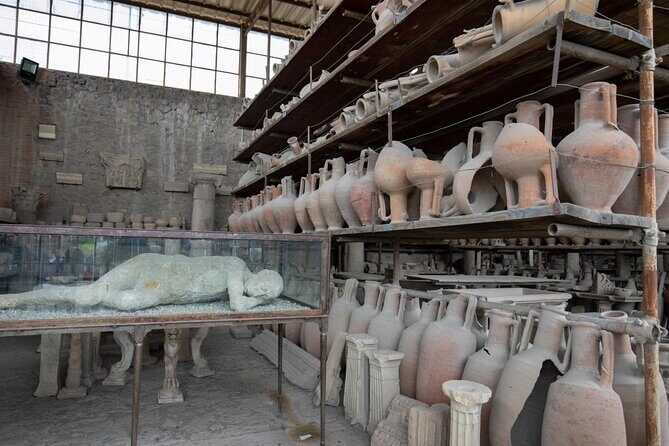
And yes, Pompeii is worth your attention. The ruins show you Roman daily life—streets, homes, public spaces—and they do it with a level of preservation that’s hard to match anywhere else.
You can also read our reviews of more private tours in Rome



The Rome-to-Campania drive: what you’re seeing (and why it matters)
The drive isn’t just dead time. You get little windows into the region, and they help you understand where Pompeii fits into the wider geography.
Castelli Romani and Lake Albano area
As you head south, you’ll pass through the Castelli Romani area—villages around Lake Albano in the Alban Hills region. It’s not the main event, but it gives you that classic in-between feeling of leaving a big city and moving into older countryside.
Abbey of Montecassino from the road
One of the most memorable stops is simply a drive-by view of the Abbey of Montecassino. This monastery is tied to the Battle of Monte Cassino in World War II, when the fight caused huge casualties and the near-total destruction of the town. The complex you see now has been rebuilt, and it looks dramatic from the road.
Even if you don’t step out here, it frames your day: you’re going to a site that carries disaster, loss, and rebuilding—just on a different timeline.
Bay of Naples and Vesuvius profile
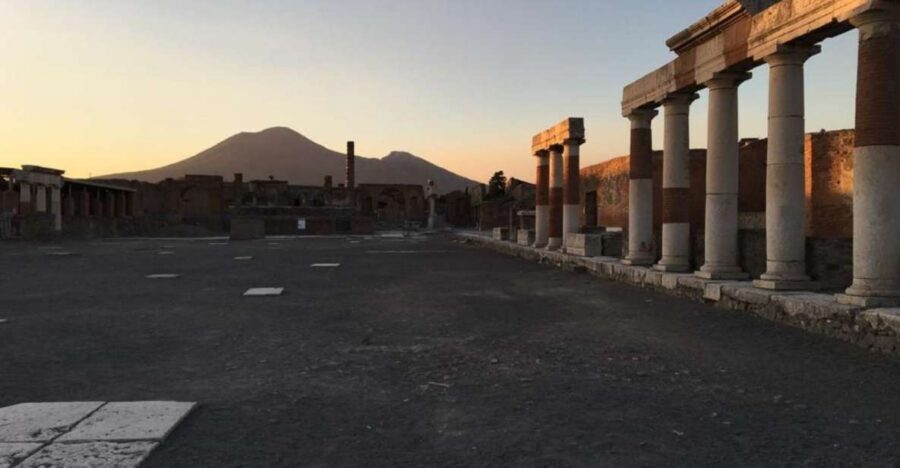
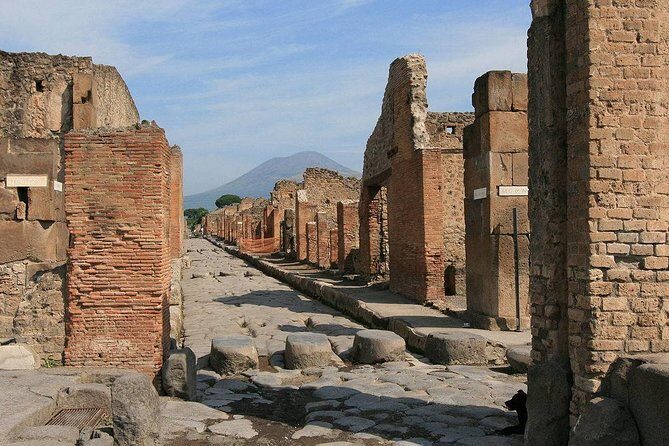
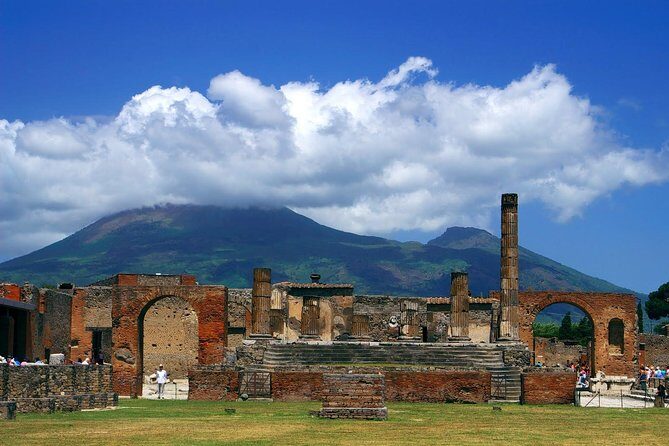
As you get closer, the Bay of Naples opens up and then Mount Vesuvius looms over the landscape. The volcano is the reason Pompeii exists in the form you’ll see it today. Seeing its profile before you arrive helps your brain connect the dots while you walk through streets and courtyards later.
You can also read our reviews of more tours and experiences in Rome






Arriving at Pompeii: entry fee, timing, and how to make the 2.5 hours work
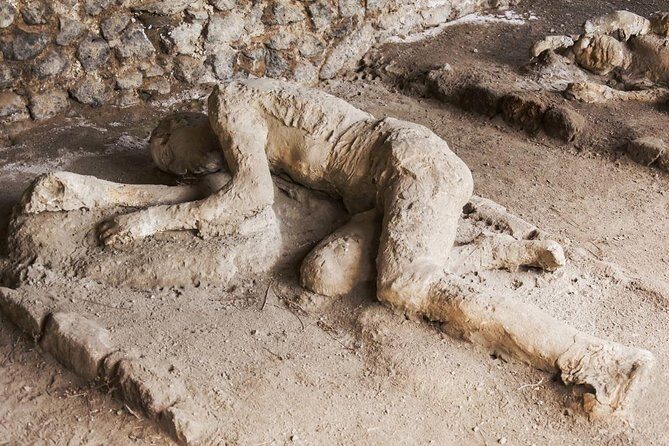
You’ll pay your own Pompeii entrance fee on arrival (listed as about 18 euros). After that, you move inside and begin exploring the archaeological park.
A typical visit window is around 2 hours 30 minutes, so you’ll want a game plan. Pompeii can overwhelm you if you try to see everything. Instead, I suggest you prioritize the “structures that explain the city,” then fill in with favorites—like a theater, baths, or a neighborhood street.
In this service, you can explore independently or you can add an on-site guide (at your own expense). This choice really matters for how satisfying your visit feels.
The big decision: self-guided ruins or hiring an on-site guide
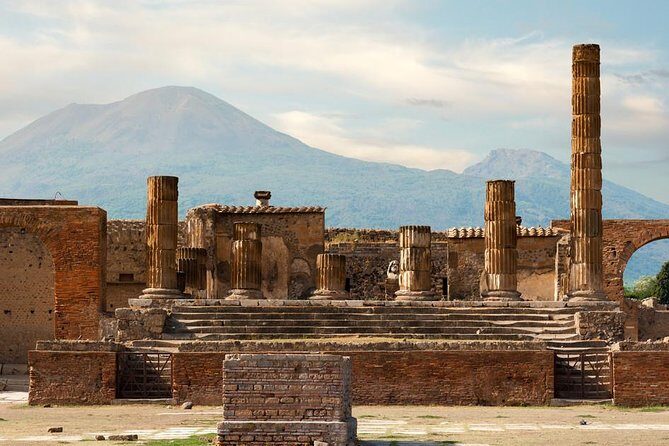
Pompeii is not hard to walk through—but it can be hard to interpret without help. That’s why adding a guide often pays off fast.
Why a guide changes the experience
An on-site guide can help you understand what you’re looking at and how to read the clues: where people ate and socialized, how the baths worked, what certain buildings likely were used for, and how the eruption reshaped the city’s story.
In the experience reports tied to this tour, people singled out guides like Barbara and Santiago for making the ruins click. One guide experience even highlighted keeping things practical on a hot day, with shade-conscious pacing.
When self-guided works
If you’re the type who likes to wander and read signs at your own pace, you can absolutely go it alone. Just don’t underestimate navigation. Pompeii is large, and it’s easy to end up spending time “finding your way” instead of “seeing what you came for.”
If you choose self-guided, I’d plan to:
- Arrive ready to pick up any available English support material on site (audio options exist, though you may need to ask).
- Use one or two must-see stops as anchors so the day doesn’t drift.
Also note a practical legal detail: your driver is not a licensed tour guide. They can provide explanations while you’re in the vehicle, but they can’t do extended guiding outside the vehicle due to Italian regulations. So the deeper Pompeii talk is really the on-site guide’s job.
The Pompeii stops that usually land best: Forum, baths, theater, and the Lupanar
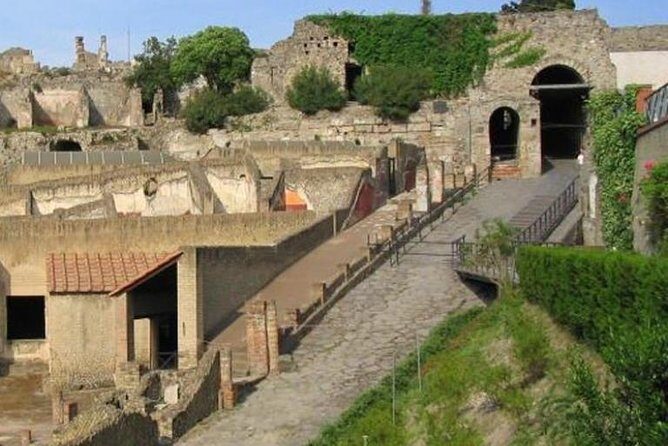
You’ll see major highlights that make Pompeii feel like a real city, not a collection of rocks.
The Forum (the city’s social and civic center)
The Forum area is where Roman public life concentrated. It’s a powerful place to start with because it gives context: this is where people gathered, discussed, and conducted public business.
One of the reasons the Forum hits hard is that it’s limestone and exposed—less “built spectacle,” more clear structure and layout. You can often grasp the city’s rhythm here in a way that’s tougher in more fragmentary zones.
Thermal baths (why daily life becomes vivid)
Pompeii’s baths are more than interesting ruins. They make daily routines feel real: changing spaces, social zones, and areas for bathing. Even if you’ve never cared about Roman bathing culture, the layout usually makes you understand why it mattered.
Teatro Grande (a theater for thousands)
The Teatro Grande once held about 5,000 people. That size helps you picture Pompeii as a busy, populated city—not a sleepy town.
Standing in a theater space and thinking about how many voices once filled it is a simple trick, but it works. It turns ruins into lived experience.
The Lupanar (a brothel with fresco decoration)
The Lupanar is a standout stop because it’s specific. It’s not just “a building”—it’s tied to the city’s private, practical side. The fresco decoration is often mentioned because it’s one of the most striking ways Pompeii shows social life beyond public monuments.
If you’re sensitive to adult themes, you might want to mentally brace for what this site represents before you go inside.
The human side: what the drivers and guides do that actually helps
The difference between a good and great day trip isn’t only the destination. It’s the handoff: how smoothly you’re picked up, where you meet the guide, and whether you feel cared for on a long drive.
In the experience feedback connected to this tour, drivers were often praised for punctuality and comfort, with names like Fabio, Ricardo/Riccardo, Alessandro, and Davide showing up repeatedly. People also liked that drivers kept the drive informative—pointing out things along the route and making sure you had what you needed.
Some examples that matter for your planning:
- One party reported a lead driver changing the meeting place to accommodate a walker user. If you have mobility needs, it’s worth contacting the provider ahead of time so they can plan the handoff.
- Families mentioned the ride being in roomy, clean vans and the day staying comfortable even with group size (one report mentioned eight people).
- People who chose the on-site guide felt it reduced stress and confusion once inside Pompeii, which is a big deal when the site is crowded and the ruins are spread out.
If you want a calm, well-managed day, this is the kind of structure that supports that.
Lunch and the return to Rome: plan for a real break, not just a snack
Your day trip includes a private ride back to Rome after your Pompeii time ends, with a stop for a meal on the return (food is not included). This matters because Pompeii is tiring, and arriving back in Rome without a planned meal can turn the evening sour.
In the experience notes tied to this tour, some people mentioned lunch recommendations or even a reservation arranged through the driver. You shouldn’t assume that every time, but it’s a good sign of how the service can be flexible.
My practical advice: eat near the end of your Pompeii visit window or right after, not after you’re already tired and stressed about meeting the van.
Cost and value: is $420.31 per person worth it?
At $420.31 per person, this is not the cheapest way to visit Pompeii. So the real question is: what are you paying for?
You’re paying for:
- Private, air-conditioned round-trip transport from Rome hotels
- Live onboard English commentary
- A driver who manages the day so you don’t lose time to transit logistics
- Flexibility in how your Pompeii time is handled (independent or guide option)
- A day that runs on a predictable schedule (start at 7:30 am, about 8 hours total)
Then you still pay separately for:
- Pompeii entrance (about 18 euros)
- Food and drinks
- Optional on-site guide, if you choose it
Here’s how I’d judge the value for you:
- If you hate commuting and want a smoother, lower-stress day, the private vehicle usually pays for itself in time and energy.
- If you’re traveling solo or as a couple, the price can feel steep compared to cheaper group tours—but you still get hotel pickup and a private ride experience.
- If you’re traveling as a group, it often starts looking much more reasonable because the vehicle cost is shared and you stay together.
In short: it’s best value when you value time, comfort, and not fighting Roman transport systems.
Who this Pompeii day trip suits best (and who should rethink it)
This tour style fits best if you:
- Want a low-hassle day with hotel pickup and drop-off
- Prefer comfort on the drive and an English explanation en route
- Plan to either (a) spend real time in Pompeii with a guide or (b) have a clear plan for what you’ll see independently
- Are traveling with family or a small group and want everyone on the same schedule
It might be less ideal if you:
- Are on a super tight budget and willing to handle trains and transfers
- Don’t want to walk much (Pompeii still requires steady walking)
- Expect your driver to serve as a full tour guide once you’re outside the vehicle—Italian rules limit what they can do, so you’ll need the on-site guide for deeper narration
Should you book this Pompeii day trip?
If your goal is a smooth, managed day where you trade Rome logistics for real time among the ruins, I’d book it. Pompeii is intense, and starting with a private pickup plus a guided-enough approach (either via onboard commentary or an on-site guide) helps you get more out of fewer hours.
I’d particularly consider it if you:
- Want help keeping the day organized at an early start
- Like the idea of seeing major stops like the Forum, baths, the Teatro Grande, and the Lupanar without spending your time guessing where to go next
- Appreciate having proven, responsive drivers and guides in the mix, including names like Barbara, Santiago, Alberto, and Davide that keep showing up in the experience details tied to this service
Just budget for the Pompeii entrance and food, and pick your on-site guide decision thoughtfully. That choice is the fastest path to turning a walk through ruins into a day that actually sticks.
FAQ
What time does the tour start?
The meeting time is listed as 7:30 am.
How long is the Pompeii day trip?
The duration is listed as about 8 hours.
Is the Pompeii entrance fee included?
No. The entrance ticket is not included, and it’s listed as approximately 18 euros.
Do I get pickup and drop-off from my Rome hotel?
Yes. The tour includes hotel pickup and drop-off from Rome.
Is this a private tour for just my group?
Yes. It’s described as private, with only your group participating.
Can I hire a guide once I’m in Pompeii?
Yes. You can explore independently or hire an on-site guide at your own expense.
What language is the commentary?
The vehicle includes live commentary in English from the driver.
What is the cancellation window for a full refund?
Free cancellation is available up to 24 hours in advance for a full refund.