REVIEW · CITY TOURS
Private Golf Cart Tour of the Eternal City
Book on Viator →Operated by Rome Tours · Bookable on Viator
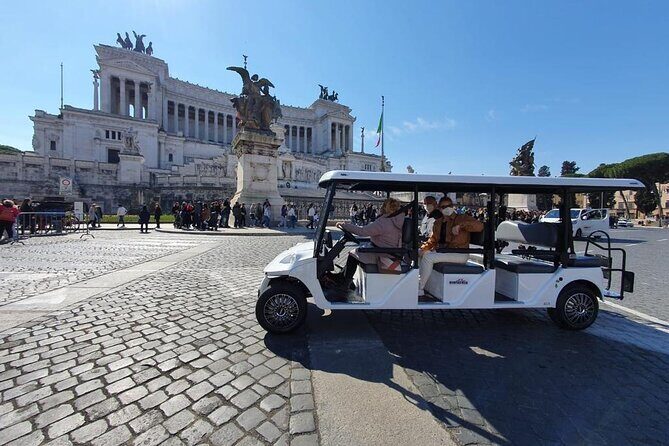
Skip the gridlock and see Rome’s classics. This private golf cart tour is built for comfort and smart timing, so you spend less energy walking and more time actually looking at the sights. I especially like that it’s a private ride with a guide who can adjust the flow, and that you get to glide along alleys and backstreets where a big bus can’t go.
One thing to keep in mind: several stops list admission tickets as not included, so you may want to budget for entry if you plan to go inside the sites you stop at.
The guide names people get tend to repeat for a reason. I’ve seen Andrea, Vino, and Elaine mentioned alongside drivers like Alex for doing two key things well: sharing real context, and handling the route safely while keeping the pace comfortable for the group.
In This Review
- Key highlights worth planning around
- A private golf cart tour is a different way to do Rome
- The ride: timing, pace, and why 2–3 hours can feel perfect
- Where you start and where you finish (useful for your day plan)
- Stop: Arch of Constantine (Arco di Costantino) and what to look for
- Piazza della Bocca della Verità: the myth, the setting, and the stone disc
- Tempio di Ercole Vincitore (Temple of Portunus area): columns with context
- Teatro di Marcello: Julius Caesar’s theater footprint in the modern city
- Piazza Venezia and Largo di Torre Argentina: monuments, power, and cats
- Piazza di Spagna to Trevi Fountain: a smooth route through the busiest zones
- Pantheon and Piazza Navona: two big names, two very different feels
- Price and value: $930.85 per group can make sense
- Who should book this private golf cart tour?
- Should you book this private golf cart tour of the Eternal City?
- FAQ
- How much does the private golf cart tour cost?
- How long is the tour?
- Is this a private tour?
- What’s included in the price?
- Are tickets for Rome sites included?
- Where does the tour start?
- Where does the tour end?
- Do I need to print anything?
- Is the tour suitable for families with small children?
- Can I cancel and get a refund?
Key highlights worth planning around
- Private group of up to 6: one price for your crew, not per-person tickets stacked on top of each other
- Golf cart route choice: designed to avoid traffic and keep you moving through narrower streets
- Guide-led storytelling at each stop: history and explanations tied to what you’re seeing right then
- Short, targeted time blocks: roughly 10 minutes at many photo-and-look stops so you cover more ground in 2–3 hours
- A mix of famous and Roman street-level sites: arches, theaters, squares, and the Pantheon area
- Easy finishing point near Trevi: the tour ends right by Piazza di Trevi, handy for what comes next
A private golf cart tour is a different way to do Rome
Rome is beautiful, but it can also be a logistics test. Big crowds. Slow crossings. Streets that funnel walkers into bottlenecks. This tour is built as a “control the chaos” option: you sit, you roll, and your guide handles the movement between places so you can focus on the sights.
The big advantage of the golf cart isn’t just comfort. It’s access and pacing. You’ll get routed along smaller streets and side lanes where traffic is calmer and your time isn’t eaten up by gridlock. That matters because most of Rome’s must-sees cluster in a walkable radius but don’t always feel walkable for hours.
This is also a good setup if you want the guide’s take instead of trying to piece together six different monuments on your own. The tour’s best moments tend to be when someone points out the details you’d likely miss at street speed—what the monument celebrates, why it was built where it was, or how later buildings absorbed earlier Roman structures.
You can also read our reviews of more city tours in Rome

The ride: timing, pace, and why 2–3 hours can feel perfect
The tour runs about 2 to 3 hours. That time window is meaningful. It’s long enough to hit multiple iconic stops, but short enough to stay relaxed and not turn into an all-day slog.
Here’s how to think about the pace: many stops are around 10 minutes. That’s not “park and chill” time. It’s “arrive, look up, take a few photos, get the key story, then move on” time. If you’re the type who likes to linger for 45 minutes, you might find yourself wishing for more time at the places you like best. The upside is that you’ll leave with a clean sweep of highlights without needing a full day.
Also note the tour is private. Only your group rides together, and you don’t share the cart with strangers. With a group of up to six, that’s a real perk: you can keep the conversation moving, and your guide can tailor what you prioritize.
Where you start and where you finish (useful for your day plan)
The meeting point is Via del Cardello, 31, 00184 Roma RM. The tour ends at Trevi Fountain, Piazza di Trevi, 00187 Roma RM.
That end point is a smart gift to your schedule. Trevi is near enough to many other central sights that you can keep going on foot if you want. Or you can stop your day there and switch to an easy meal and people-watching without backtracking across Rome.
If you’re arranging a packed day, build in some breathing room afterward. The tour is guided and fast-moving in a good way, but you’ll still want time to wander for a bit after you disembark.
Stop: Arch of Constantine (Arco di Costantino) and what to look for
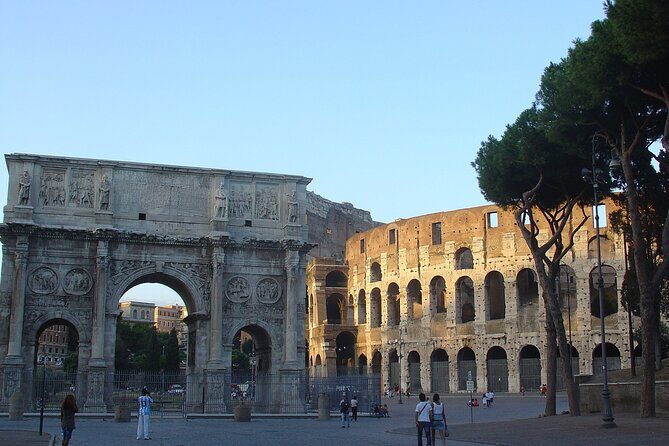
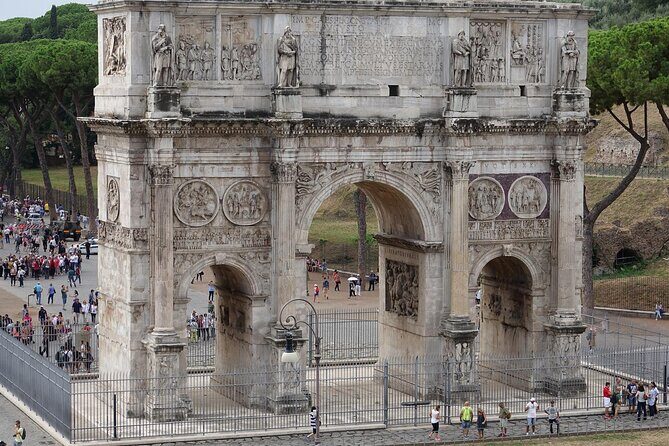
You’ll start with one of Rome’s most story-loaded monuments: the Arch of Constantine. This triumphal arch commemorates Emperor Constantine the Great and his victory over Maxentius at the Battle of the Milvian Bridge in AD 312.
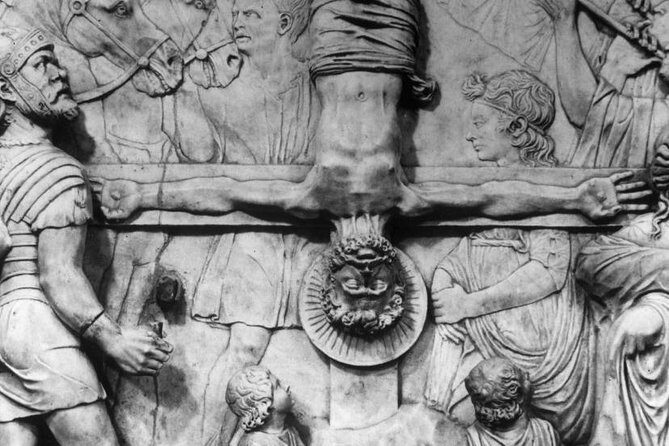
What makes this stop worth more than a quick photo is the design clue tucked into the stone. Some reliefs and inscriptions reuse elements from earlier monuments. That recycling isn’t random. It signals a shift in power and messaging—an especially relevant theme in a city where you can literally see layers of Rome changing over time.
If you’re the type who enjoys “spot the details,” this is a great opener. Look for the intricate carvings and the way the arch presents authority through sculpture and text. Your guide can also help you connect it to the bigger arc of Roman rule and the era when Christianity under Constantine gained momentum.
Piazza della Bocca della Verità: the myth, the setting, and the stone disc
Next up is Piazza della Bocca della Verità, home to the famous Mouth of Truth (Bocca della Verità) at the Basilica di Santa Maria in Cosmedin.
This is one of those Rome stops where the object gets more famous than the context. The Mouth of Truth is a large carved stone face with hollow eyes and an open mouth. People love the legend that it bites liars, but the more interesting part for me is that its original purpose is debated. Theories include it serving as a ceremonial well cover, a decorative element, or even a manhole cover.
So here’s what to do with the visit: don’t just line up for the myth photo. Use the guide’s explanation to understand why an object like this can get reinterpreted in different eras. It’s a reminder that Rome’s stories often live in the details and in what people later chose to believe.
Plan for about 10 minutes here. Also, admission tickets are not included for this stop, so if you want to go in fully and not just look around, budget time and money accordingly.
You can also read our reviews of more private tours in Rome



Tempio di Ercole Vincitore (Temple of Portunus area): columns with context
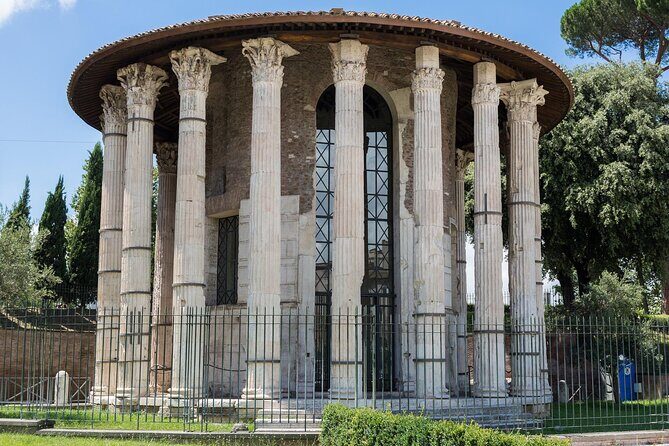
Right nearby is the Tempio di Ercole Vincitore area, which ties into the adjacent small rectangular temple often associated with Portunus, also known as the Temple of Fortuna Virilis.
This temple dates back to the 4th century BCE and shows a mix of architectural styles, including Ionic elements. It’s known for being well preserved, with Corinthian columns and a placement that feels slightly unusual—an important reason it’s still interesting even when you’re not doing a full museum-style stop.
What I like about pairing this with the Mouth of Truth is contrast. You go from a big myth object to a more subtle architectural artifact. It keeps your brain engaged. And it gives you a sense of how Roman sacred spaces could sit close to everyday city life.
This stop also runs around 10 minutes, and admission tickets are listed as not included, so treat it as a “see it and learn it” moment rather than a deep entry experience.
Teatro di Marcello: Julius Caesar’s theater footprint in the modern city
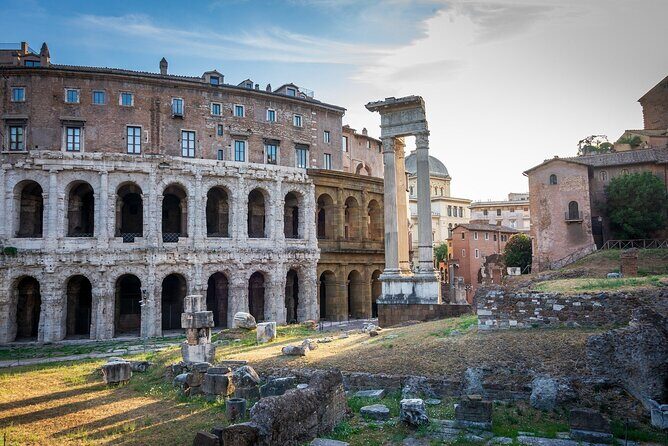
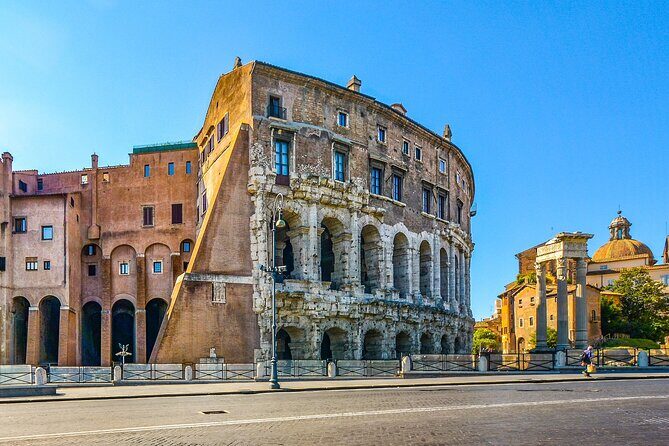
Then you roll to Teatro di Marcello, the Theater of Marcellus. This ancient Roman theater was inaugurated in 13 BCE under Julius Caesar’s commission and completed by Emperor Augustus in honor of his nephew Marcellus. It could hold around 20,000 spectators.
Here’s the practical value: Rome’s theater culture is hard to feel if you only look at museums. This stop gives you a sense of scale and design in a real urban setting. The theater’s semi-circular form is a strong example of Roman architectural innovation, and you can see how later buildings incorporated parts of it.
If you’re with teens or anyone who likes “show me how it worked,” this is a good one. The layered ruins help you understand how Rome grew without resetting everything from scratch.
Plan for around 10 minutes again. If you’re hoping for a full interior visit, admission isn’t included for this stop, so you’d need to plan separately.
Piazza Venezia and Largo di Torre Argentina: monuments, power, and cats
Two major stops follow: Piazza Venezia and Largo di Torre Argentina.
Piazza Venezia is anchored at Capitoline Hill’s base and tied to the Palazzo Venezia, a 15th-century residence that served as home for Venetian ambassadors. The square is also known for the monumental Altare della Patria, dedicated to Victor Emmanuel II, a symbol of unified Italy.
Why this matters on a golf cart tour: it shows you Rome beyond the “ancient-only” story. Even when you focus on Roman ruins, the city’s modern national identity is right here in the streetscape.
Next is Largo di Torre Argentina, an archaeological site with four Republican Roman temples from the 3rd and 2nd centuries BCE and remnants of Pompey’s Theatre built in 55 BCE by Gnaeus Pompeius Magnus. This square is famous for its association with the assassination of Julius Caesar, believed to be where it happened.
Then there’s the detail that makes this stop feel human: it’s also known for a cat sanctuary where stray cats are cared for. That adds a modern, grounded layer to a site loaded with political drama.
Expect about 10 minutes, with a lot of your time spent looking across the square and taking in the mixed signals of ancient and everyday life.
Piazza di Spagna to Trevi Fountain: a smooth route through the busiest zones
After the archaeological stop, the tour shifts to classic Roman postcard territory.
Piazza Di Spagna is famous for the Spanish Steps connecting to Trinità dei Monti. The area around the square is a shopping and cafe zone with historic landmarks nearby. The square is named after the Palazzo di Spagna, which served as the Spanish Embassy to the Vatican starting in the 17th century.
A key practical point: admission is listed as free for this stop. You can enjoy it as an exterior hangout and focus on the scale of the steps, not on entry requirements.
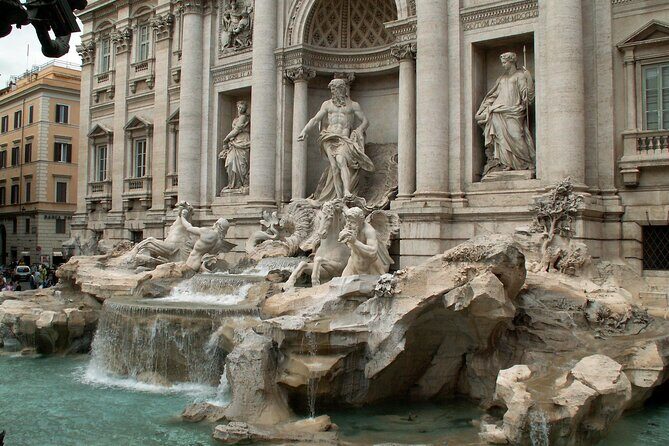
Then you head to Fontana di Trevi, one of Rome’s best-known fountains. Completed in 1762, it was designed by Nicola Salvi and features Neptune in the central figure, plus allegorical statues representing Abundance and Health. The legend says tossing a coin into the fountain ensures you’ll return to Rome.
This is a big attraction, and the golf cart approach helps because it keeps you from spending all your time fighting slow foot traffic. That said, admission tickets are listed as not included here, so if you plan to go inside any related structure, check what’s actually included versus optional.
At Trevi, plan for about 10 minutes. Use that window strategically: take your classic photos, then look for the sculptural details around the edges.
Pantheon and Piazza Navona: two big names, two very different feels
Your next major stop is the Pantheon, one of the best-preserved Roman buildings. It’s made primarily from brick and concrete, and it’s famous for the huge domed rotunda with the oculus at the top.
One reason I think this belongs on a golf cart itinerary: the Pantheon isn’t just a landmark. It’s a design lesson. The portico’s 16 granite columns lead you straight into a massive interior space, and the opening at the top is the dramatic focal point. Your guide can also help you connect the symmetry and transitions—from the rectangular portico area into the domed rotunda—to why this building influenced architecture for centuries.
Admission isn’t included for the Pantheon stop, so if going inside is part of your plan, budget for tickets separately.
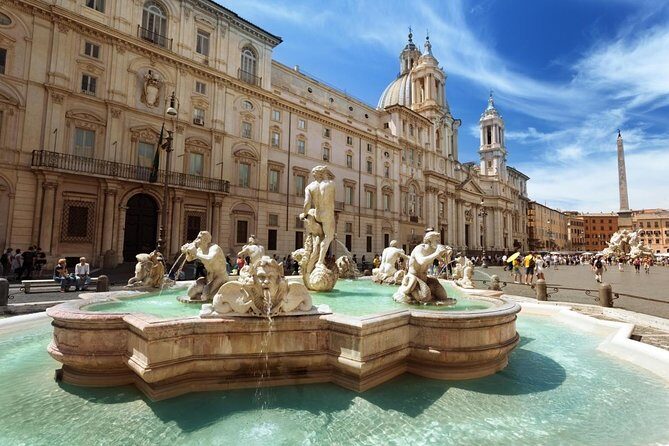
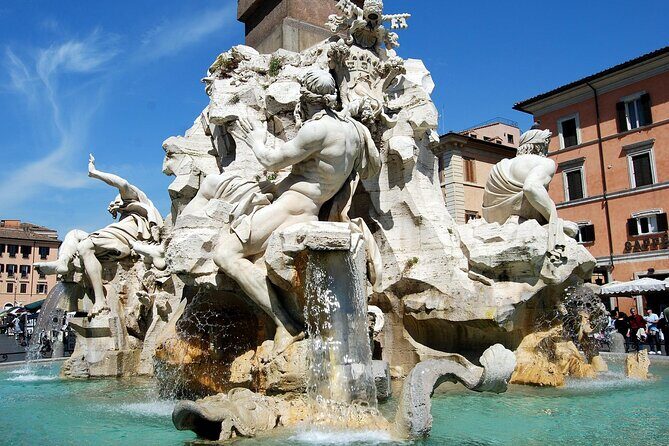
Finally, you wrap at Piazza Navona, known for Baroque architecture and three major fountains. The centerpiece is Fontana dei Quattro Fiumi with an obelisk and allegorical figures representing four world rivers. Sant’Agnese in Agone by Francesco Borromini provides an impressive church backdrop.
Admission is listed as free for Piazza Navona, making it a nice ending. It’s also a good moment to breathe. You can sit, watch people, and let the stories from the earlier stops settle in.
Price and value: $930.85 per group can make sense
The price is $930.85 per group, up to 6 people, for about 2 to 3 hours. If you fill the cart with the full six, you’re looking at roughly $155 per person before any outside costs like entry fees.
That math matters because your biggest added expense on a Rome day is often time and effort, not only tickets. This tour bundles transport by golf-cart and a professional guide. It also reduces the strain of long walks between scattered sights and helps you avoid traffic delays.
Where it may not be the best value is if you travel as only 2 people. Then the per-person cost jumps, and you might ask yourself whether you’d rather do a few sights with public transit or taxis. The tour can still be enjoyable at smaller group sizes, but it’s more clearly value-forward when you can spread the cost across a full group.
Also factor in that food and drinks are not included, and several stops have admission tickets not included. If you’re adding those costs, your final total won’t match the listed tour price.
Who should book this private golf cart tour?
This is a strong fit if you want a guided highlight run without turning your day into nonstop walking. It’s especially useful if your group includes teens or anyone who benefits from clear explanations rather than wandering and guessing. The guide approach is a recurring theme in the feedback tied to routes and story focus, and that tailoring can make the experience feel less like a checklist.
It’s also a practical choice if your group wants to avoid traffic and move through alleys and backstreets. If your energy level is limited, the golf cart does a lot of work for you.
One clear limitation: it’s not suitable for babies or children. If you’re traveling with young kids, you’ll need to look for a family-friendly alternative.
Should you book this private golf cart tour of the Eternal City?
Book it if you want a private, guide-led route that covers major Roman stops in a short time and minimizes the physical grind. The ending at Piazza di Trevi is a bonus, and the guide-led explanations at each stop are the difference between seeing sights and understanding them.
Skip or reconsider if your group is only two or three people and you hate paying for transport that you could replace with a short hop of transit and walking. Also reconsider if you’re the type who wants long, slow time inside major attractions, because this tour’s structure is built for quick, high-impact visits.
If you match the tour’s pace and plan to budget for any entries you want to make, it’s a very satisfying way to get the Rome highlights with less stress.
FAQ
How much does the private golf cart tour cost?
It costs $930.85 per group, up to 6 people.
How long is the tour?
The tour lasts about 2 to 3 hours.
Is this a private tour?
Yes. It’s a private experience, and only your group participates.
What’s included in the price?
Transport by golf-cart and a professional guide are included.
Are tickets for Rome sites included?
Admission tickets are not included for some stops, including the Mouth of Truth area, Tempio di Ercole Vincitore area, Teatro di Marcello, Fontana di Trevi, and the Pantheon. Piazza di Spagna and Piazza Navona are listed as free.
Where does the tour start?
The meeting point is Via del Cardello, 31, 00184 Roma RM, Italy.
Where does the tour end?
The tour ends at Trevi Fountain, Piazza di Trevi, 00187 Roma RM, Italy.
Do I need to print anything?
No. The tour uses a mobile ticket.
Is the tour suitable for families with small children?
It is not suitable for babies or children.
Can I cancel and get a refund?
Yes. You can cancel for a full refund if you cancel at least 24 hours in advance. If you cancel less than 24 hours before the experience start time, the amount paid is not refunded.