REVIEW · BORGHESE GALLERY TOURS
Borghese Gallery Guided Tour with Skip-the-Line Entry
Book on Viator →Operated by Doooing Experience · Bookable on Viator
The Borghese Gallery hits fast. In a couple hours, you get guided access to one of Rome’s most tightly packed treasure houses, with skip-the-line entry that helps you use your timed ticket wisely. I especially like the small group setup (max 15), and how the guide helps you spot what matters in each room, not just what’s on the wall.
Two things I’m glad about: the tour includes admission fees, and you’re given headsets if you need them, so you don’t strain to hear the story behind the art. One consideration: timing is strict. Late arrivals aren’t accommodated, and some rooms can be affected by refurbishment work, so your route may shift a bit inside.
In This Review
- Key things to know before you go
- Why the Borghese Gallery feels different from other Rome museums
- Meeting at Piazzale Scipione Borghese and getting in on time
- Skip-the-line access: what it’s really worth for a timed-entry museum
- Apollo e Daphne: the Baroque drama that grabs you immediately
- Pauline Bonaparte as Venus Victrix: beauty with a political edge
- Bernini busts and Truth Unveiled by Time: sculpture as performance
- David in marble: when speed, scale, and emotion all hit at once
- How the small-group pace and headsets change your viewing
- What to expect if rooms are closed or routes shift
- Is it good value at $91.95 per person?
- Who should book this Borghese Gallery tour
- Should you book this skip-the-line Borghese Gallery tour?
- FAQ
- How long is the Borghese Gallery guided tour?
- What language is the tour offered in?
- Does the price include admission tickets?
- Is there a mobile ticket?
- How large is the group?
- Are headsets provided?
- What happens if I cancel or need to change plans?
Key things to know before you go
- Skip-the-line access saves your best hours when timed entry controls the flow
- Headsets help you hear every detail without craning your neck
- A small group (15 max) keeps the pace human
- You cover major highlights across many rooms, not just one star artwork
- Refurbishment and Jubilee-related changes may affect access routes
- Your guide sets the context so Bernini and Canova feel alive, not distant
Why the Borghese Gallery feels different from other Rome museums
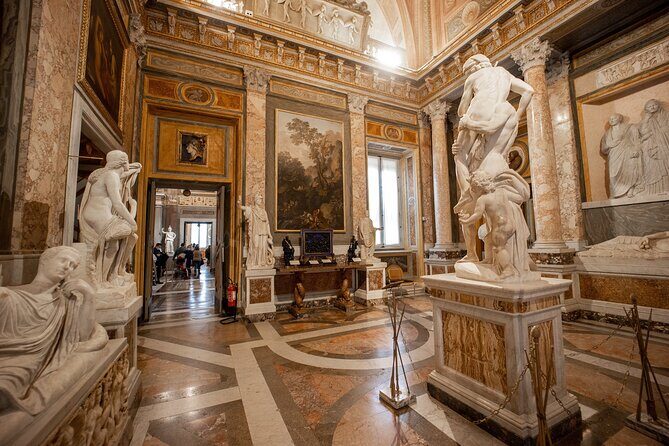
The Borghese Gallery isn’t a big, walk-all-day museum. It’s more like a series of dramatic room-sized “acts,” where sculpture takes center stage and the lighting and space are part of the experience. If you’ve ever stood in front of a famous statue thinking, So what am I supposed to notice, a good guide changes everything.
This tour is built for exactly that. The point isn’t to rush past masterpieces. It’s to help you read them: the emotion, the symbolism, the myth, and the political meaning. You’ll move through key stops that anchor the collection, then you’ll also get the sense of why people call this one of the best places in Rome for Bernini.
You can also read our reviews of more guided tours in Rome



Meeting at Piazzale Scipione Borghese and getting in on time
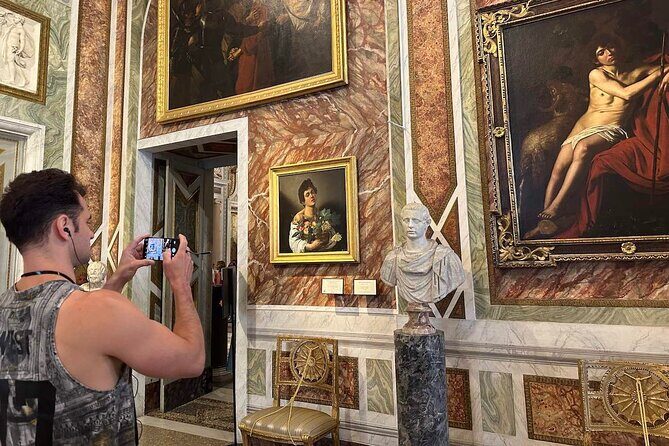
You meet at Piazzale Scipione Borghese, 5 (near public transportation). That location matters because the museum access is timed, and the group enters together with the guide.
Here’s the practical take: show up early. The tour requires you to arrive at least 15 minutes before departure time, and late arrivals won’t be accommodated or refunded. Rome traffic and street conditions are real, so I treat that 15 minutes as a minimum, not a target.
Also keep an eye on your messages. Due to the Jubilee, some monuments may be under restoration and access routes could change. If there’s an update, it can affect how you reach the meeting area and how you approach the museum.
Skip-the-line access: what it’s really worth for a timed-entry museum
“Skip-the-line” can sound like marketing until you deal with a museum that runs on strict entry windows. At Borghese, timed entry limits the number of people inside, and everyone has to follow the same rules.
What the skip-the-line feature buys you is time and momentum. Instead of spending your arrival window sorting out lines and slowdowns, you get to start the art experience sooner. And since the tour is about 2 hours, getting the clock moving early makes a real difference.
You also get headsets if needed. In a gallery setting, sound carries in odd ways—some corners feel loud, others feel muffled. The headsets keep the narration clear so you can focus on looking.
Apollo e Daphne: the Baroque drama that grabs you immediately
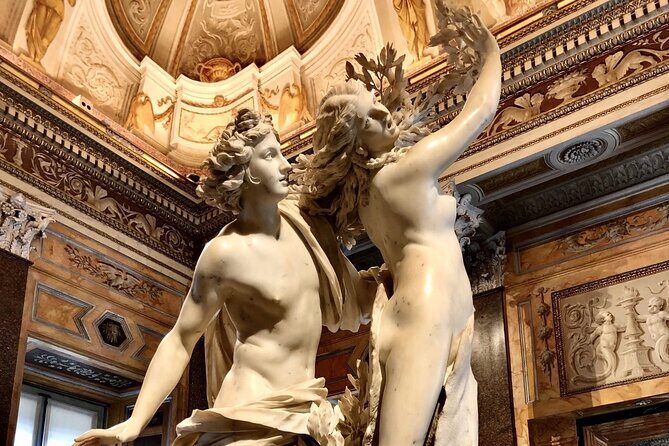
Your first major stop is Apollo e Daphne, a marble sculpture by Gian Lorenzo Bernini (1622–1625), in natural size. This is one of those works where you can feel the story before you even fully process it.
The subject comes from Ovid’s Metamorphoses: the climax of Apollo and Daphne’s history—myth, pursuit, transformation, and that moment where motion becomes emotion. Bernini’s Baroque style is all about making marble look like it’s alive and reacting in real time. When you stand close, you’ll notice how the pose and surfaces do the storytelling for him.
Why this stop works as a start: it sets your “viewing lens.” After Apollo and Daphne, you’ll be more alert to the same strengths across other pieces—expression, narrative, and dramatic staging.
Pauline Bonaparte as Venus Victrix: beauty with a political edge
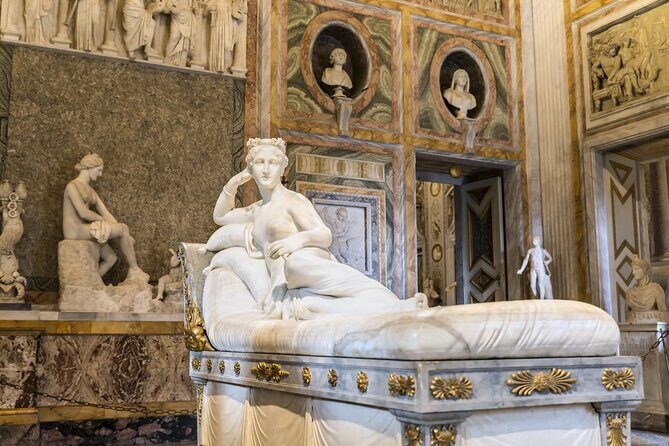
Next up is Pauline Bonaparte as Venus Victrix (also called Venus Victorious), a life-size neo-Classical sculpture by Antonio Canova (executed in Rome from 1805 to 1808). The story here isn’t just artistic. It’s personal and political.
You’re looking at Pauline Bonaparte portrayed as Venus—the goddess of love—but in this case the commission comes from Camillo Borghese after her marriage into the Borghese family. The sculpture’s journey also matters: it moved from Camillo’s home in Turin to Genoa, only arriving at the Galleria Borghese around 1838.
That background helps you see Canova’s style in a sharper way. Neo-Classicism aims for clarity and ideal form. When you know the subject and the patron story, the statue stops being only “pretty” and becomes a statement.
You can also read our reviews of more museum experiences in Rome




Bernini busts and Truth Unveiled by Time: sculpture as performance
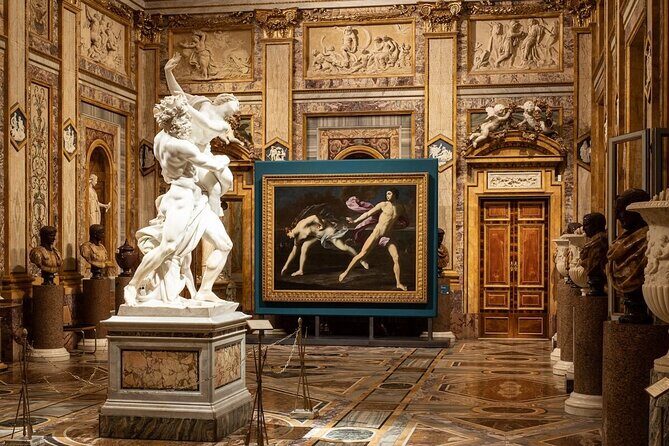
Then you move into portraiture with Two Busts of Cardinal Scipione Borghese (1632), again by Gian Lorenzo Bernini. Busts are often treated like “filler” compared to full statues, but Bernini’s portraits are the opposite. They’re tight, persuasive, and meant to convince you that personality can live in stone.
Right after that is Truth Unveiled by Time, a marble work Bernini executed between 1646 and 1652. The concept is theatrical: Truth is shown allegorically as a naked young woman being unveiled by a figure representing Time above her. There’s a fascinating production twist here—the Time figure was not originally executed as planned, then added later in 1665. The result is a work that feels both composed and slightly human in how the final “stage design” came together.
If you take only one idea from these two stops, take this: in the Borghese, sculpture isn’t static decoration. It’s drama you walk around.
David in marble: when speed, scale, and emotion all hit at once
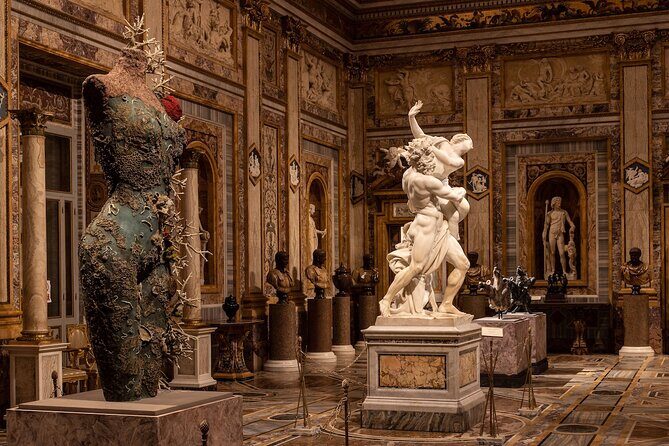
Your final big stop is David, another Bernini masterpiece, commissioned by Cardinal Scipione Borghese to decorate the gallery. It took seven months to complete, from 1623 to 1624, which is astonishing when you consider how finished it looks.
The subject is biblical: David about to throw the stone that will bring down Goliath. The emotional timing is the key. This isn’t a statue of calm heroism. It’s the instant before action—the split second where attention, tension, and decision all live together.
What I like about ending here is that it gives you a payoff that sticks. After David, you’ll likely notice how many galleries use a similar trick: starting big and ending big. Here, the end feels earned.
How the small-group pace and headsets change your viewing

This is a semi-private tour with a maximum of 15 people. That small size shows up in the experience. You’re not lost in a crowd, and the guide can keep things moving without turning it into a silent stamp-through.
Also, the tour includes headsets if needed. It’s a small detail until you’re inside and realize how easy it is to miss key points just because your guide is a few steps away or the room acoustics feel odd.
The tour is designed to move through multiple rooms and highlights across the gallery, with enough structure that you don’t feel like you’re wandering. At the same time, some people may want a bit more quiet time afterward to look longer on their own. If you’re the type who likes to linger, plan for some extra viewing time after the tour if your schedule allows.
What to expect if rooms are closed or routes shift
Two things can affect your day: refurbishment closures and access-route changes tied to the Jubilee. The tour notes that some rooms of the gallery might be closed to visitors, so don’t build your entire visit around one specific room.
This is also why a guided route helps. If the museum rearranges access in any way, you’ll still get a coherent story and a sensible sequence through major works.
Is it good value at $91.95 per person?
For $91.95, you’re paying for three main things: a guided explanation, timed skip-the-line entry, and admission fees included. You’re also getting headsets if needed, which is not always included on lower-cost museum tours.
Two-hour tours aren’t cheap, but Borghese is the kind of place where your time inside is precious. Timed entry limits how long you can browse, so getting a guide who helps you focus can feel like the best use of your ticket.
If you already know exactly what you want to see and you love silent wandering, you might decide to go unguided. But if your goal is to understand what you’re looking at while you’re there—especially for Bernini and Canova—this price starts to make sense.
Who should book this Borghese Gallery tour
Book it if:
- You want a smart path through major highlights without wasting time figuring out what to prioritize
- You like art history explained in clear, human terms
- You enjoy sculpture and myth subjects (Apollo and Daphne, David, allegories like Truth)
- You want a smaller group experience rather than a big bus of people
Consider another approach if:
- You hate tight timing and standing for most of a two-hour visit
- You strongly prefer long solo viewing time in every room
- You’re traveling with someone who gets stressed by strict arrival rules
The good news: the overall experience seems built for first-time Borghese visitors who want to leave feeling like they actually understood what they saw, not just that they survived the crowds.
Should you book this skip-the-line Borghese Gallery tour?
I think it’s a strong choice for most visitors. The combination of skip-the-line entry, a small group size, and headsets means you can focus on the art while someone else handles the structure. The stops are well chosen, and the mix of Bernini’s drama with Canova’s neo-Classical presence gives you a real feel for what the gallery does best.
My simple advice: if you care about meaning as much as beauty, book it. If you’re more of a quiet wanderer, plan extra time after the tour so you can slow down and look again.
FAQ
How long is the Borghese Gallery guided tour?
It’s about 2 hours.
What language is the tour offered in?
The tour is offered in English.
Does the price include admission tickets?
Yes. Entrance fees are included.
Is there a mobile ticket?
Yes, the tour uses a mobile ticket.
How large is the group?
It’s a small-group, semi-private tour with a maximum of 15 travelers.
Are headsets provided?
Headsets are included if needed, so you can hear the guide more clearly.
What happens if I cancel or need to change plans?
You can cancel for a full refund up to 24 hours before the experience starts. Changes within 24 hours aren’t accepted, and late arrivals aren’t accommodated or refunded.