REVIEW · EVENING EXPERIENCES
Ancient Rome’s Ultimate Night Walk
Book on Viator →Operated by Rome's Ultimate Free Walking Tours · Bookable on Viator
Rome’s night lights make history feel close. This guided walk connects Antiquity to modern Rome in a very watchable route: big public squares, famous viewpoints, and the long stretch toward the Roman Forum. You’ll also hear a clear storyline instead of random facts, with your guide, Nick, turning locations into a timeline you can actually follow.
Two things I especially like: you hit major landmarks without wasting time on ticket lines, and you end the tour with a complimentary nightcap in the city center. The sights you stop at are listed as admission-ticket free too, so what you’re really paying for is the pacing and the narration.
One consideration: it’s a good-weather-dependent walking tour. If rain is heavy, you’ll want to have the right outer layer ready, and also keep in mind that date changes may not be accepted when you’re close to the start time.
In This Review
- Key things to know before you go
- Why a 7:00 pm Rome Walk Feels Different
- Meeting at Via dei Serpenti (and what your route really is)
- Piazza Venezia: Italian unification in one unforgettable view
- Piazza del Quirinale: presidential seat and royal-papal history
- Piazza del Campidoglio and Michelangelo’s design
- Via dei Fori Imperiali: Roman Forum energy without a museum day
- Piazza di Pietra: Temple of Hadrian’s original columns
- Piazza Colonna: government seats, church power, and a final viewpoint
- The complimentary nightcap: small ritual, real value
- What makes the guide and pacing worth it
- Who this tour suits best
- Who might want a backup plan
- Should you book Ancient Rome’s Ultimate Night Walk?
- FAQ
- How long is the Rome night walk?
- What does it cost?
- Where do I meet the tour, and what time does it start?
- Is the tour in English?
- Are there admission tickets needed for the stops?
- What happens if the weather is bad?
Key things to know before you go
- Small-group feel: maximum of 15 travelers, so questions stay practical
- A tight 2.5-hour loop: designed to keep momentum from Piazza Venezia toward Piazza Colonna
- Free-entry stops: each listed viewpoint is admission-ticket free
- Nightcap finish: a built-in moment to decompress at the end
- English guide: tour is offered in English
- Lots of seats of power: from papal-era history to today’s government locations
Why a 7:00 pm Rome Walk Feels Different
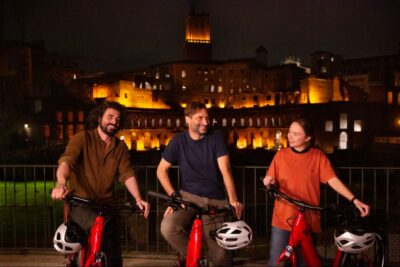
At night, Rome changes its tempo. Daytime crowds and tour buses are still around, but the mood shifts toward drama: you get softer light on stone, and many of the big squares feel more like they’re telling a story than just serving as photo backdrops.
This tour starts at 7:00 pm and runs about 2 hours 30 minutes. That timing matters. You’re not trying to do heavy “museum energy.” Instead, you’re doing city-walking energy: stop, look, listen, move on. It’s a smart way to get a first narrative of Rome, especially if it’s not your first visit but you want your bearings quickly.
Also, you’re walking between some of the most important “stage sets” of Rome. You’ll go past areas tied to Italian unification, papal and royal history, and Rome’s ancient civic world. The route is basically a guided map of who held power and how the city reinvented itself.
You can also read our reviews of more walking tours in Rome

Meeting at Via dei Serpenti (and what your route really is)
The meet-up point is Via dei Serpenti, 89, 00184 Roma RM. The tour ends at Piazza Colonna. That means you’re not circling back to the same exact block. You’re getting Rome’s layout as you go, which is part of the value: you learn the geography while you’re learning the history.
You’ll receive a mobile ticket, which is convenient if you don’t want to mess with paper. And because the maximum group size is 15, the pace stays under control. In places like Rome’s famous squares, crowding can make even a short stop annoying. A smaller group helps the guide keep everyone together and get your attention back on the next landmark.
Practical note: you’ll be on foot for the full length of the walk. Good shoes are not optional. Night in Rome also means you should dress for cool air and bring a layer you can tolerate if the breeze picks up.
Piazza Venezia: Italian unification in one unforgettable view
Your first stop is Piazza Venezia. This square is where big national identity stories show up in stone. Here, the focus is the story of Italian unification and the monument that symbolizes it.
I like starting here because it sets the “modern storyline.” You’re getting the idea of Italy as a country and then seeing how that modern identity grew out of older layers. If you’ve ever felt Rome is too many eras at once, this first stop helps you sort the timeline quickly.
You’ll have about 15 minutes at this stop. That’s enough time to understand the theme and orient yourself visually, without dragging. The only real drawback is that Piazza Venezia can be busy, so keep your attention on the guide’s explanation while you’re still taking in the architecture.
Piazza del Quirinale: presidential seat and royal-papal history
Next is Piazza del Quirinale. The big focus here is the current seat of the Italian president—and the earlier role of the area as a main papal residence before it was inhabited by the Italian royal family.
This is where the “Rome changes its rulers, then keeps the buildings” idea becomes real. You’re not only learning names. You’re learning how power shifts over time and how the same physical place can represent different eras.
Again, you’ll get about 15 minutes. That’s a useful length for this kind of stop: you can look, listen, and take in the vibe without it turning into a lecture that makes you tired before the walk even reaches the ancient parts.
Piazza del Campidoglio and Michelangelo’s design
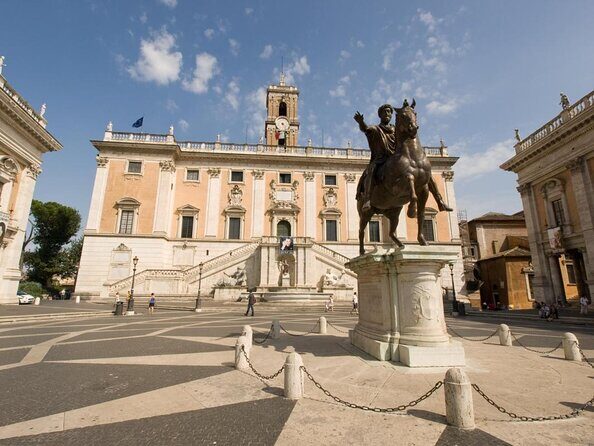
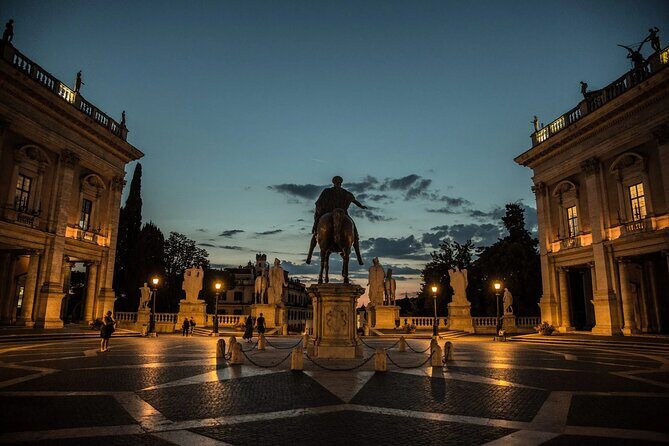
Then comes Piazza del Campidoglio. This is one of the stops where you can’t really fake your reaction. You’ll see the breathtaking piazza designed by Michelangelo, tied to the seat of the Roman mayor.
I love how the tour pairs a major art figure with a modern civic function. It’s not just art appreciation. It’s an example of how Rome repeatedly repurposes its own grand spaces. Michelangelo’s design isn’t sitting there as a museum exhibit; it still shapes how people move and how the city feels.
You get about 15 minutes here. The timing is tight enough to keep your group together, but long enough that you can look around the space and not just stand in one spot. If you’re the type who likes to understand why a place feels dramatic, this stop is a highlight.
You can also read our reviews of more evening experiences in Rome

Via dei Fori Imperiali: Roman Forum energy without a museum day
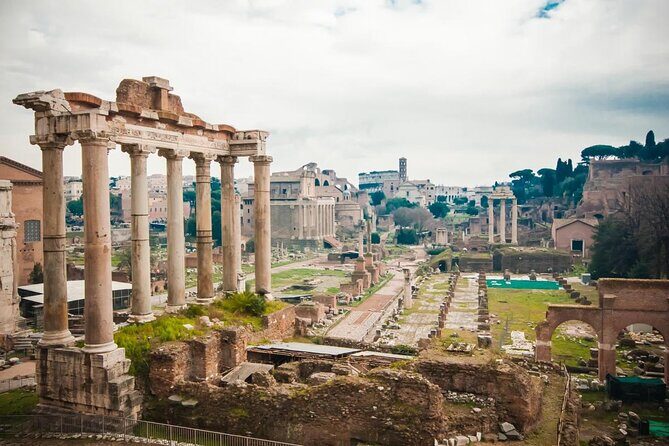
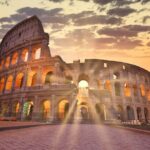
After Campidoglio, you move toward Via dei Fori Imperiali, where you intersect the route and view the Ancient Roman Forum—the ancient civic center that people describe with the phrase caput mundi, or center of the world.
This segment is valuable because it connects the “big squares” world with the ancient street world. Rome’s forums are easy to romanticize. At night, though, the scale can feel even more intense. You’re not buying a ticket to a single interior experience. You’re getting the sense of how public life was organized in antiquity.
You’ll have around 15 minutes for this stop. That works well because forums can turn into wandering if the group is loose. A guided view keeps it focused: you learn what you’re looking at, and then you’re on to the next square.
Piazza di Pietra: Temple of Hadrian’s original columns
Next is Piazza Di Pietra. Here, the key detail is the facade of the seat of the local Camera di Commercio, where you can still see the original columns of the Temple of Hadrian.
This is a short stop—about 5 minutes—but it’s the kind of detail that makes the walk worth doing even if you’re not a hardcore history person. It’s proof that Rome doesn’t just preserve ruins. It builds new structures around old elements, and you can literally see the leftovers.
If you’re trying to pack Rome into limited time, these quick “spot the evidence” moments add up. You’re not only going to famous places; you’re also learning how to read the city.
Piazza Colonna: government seats, church power, and a final viewpoint
Your final “big theme” stop is Piazza Colonna. The focus is the history of the Roman families who used to run the Catholic Church, and how this area is also tied to the seat of the Italian Prime Minister.
This ending makes sense because it ties the whole tour together. You started with unification and national symbolism. You passed papal-era influence and royal shifts. Now you land in a place that connects religious power historically with modern government.
You get about 15 minutes here. It’s a good length for tying together what you learned while the group is still fresh and the guide’s narrative has momentum.
The complimentary nightcap: small ritual, real value
After the walking and looking, the tour ends with a complimentary nightcap in the city center. This matters more than it sounds.
First, it gives you a decompression break without turning the day into a separate dinner plan. Second, it’s an informal moment to ask your guide follow-up questions when you’re not constantly moving. I find that’s when the history stops being a list and becomes something you can connect to the rest of your Rome plans.
If you drink little or want something mild, you can simply take it as a social reset. The key point is that the tour doesn’t just end when you stop walking—it ends with a human pause.
What makes the guide and pacing worth it
This walk is led by a guide named Nick, and the way he tells the story is a big part of why the tour earns such strong recommendations. He doesn’t just point. He narrates so Rome’s changes feel logical.
That’s not a small detail. Many night walks can become a series of “and that’s where…” moments. Here, the stops are arranged like chapters. You’ll feel the evolution from antiquity to modern life as you move through squares and along the ancient corridor toward the Forum.
The pacing is also practical: short stops at major squares (about 15 minutes), one quick clue stop (about 5 minutes), and then a clear ending. It keeps your energy steady for a night walk.
Who this tour suits best
This is a good fit if you want:
- A timeline of Rome without a long museum day
- A guided walk that focuses on power, civic spaces, and continuity
- An English-speaking guide with a narrative approach
- A small group (maximum 15) rather than a large crowd crush
It’s also a solid choice if you’re short on time and you still want Rome’s landmarks explained in a way that helps you connect where you are. If you’re already deep into Rome on your own, you might still like it as a night “editor’s cut” that pulls eras together.
Who might want a backup plan
You should think twice if you’re not comfortable walking for roughly 2.5 hours in one go. Also, because the experience is weather dependent, plan for rain. If the tour is canceled due to poor weather, you’ll need to have flexibility in your schedule.
And one more practical note: it’s a fixed 7:00 pm start. If you’re the type who often runs late because of travel delays, build a buffer before the meetup time so you don’t end up stressed at the start.
Should you book Ancient Rome’s Ultimate Night Walk?
I’d book it if you want a guided Rome overview that focuses on how the city evolved, from ancient civic life to modern government and major public spaces. The price is $84.33 per person for a 2.5-hour experience, and you’re paying for the guide story, the nighttime timing, and the fact that you’re not stuck with ticket-based site add-ons at each stop.
If you hate walking at night or you’re traveling without rain flexibility, consider saving your energy for daytime. But if you can handle a long-ish stroll and you want your first or next Rome narrative to make sense fast, this one is an easy yes.
FAQ
How long is the Rome night walk?
It lasts about 2 hours 30 minutes (approx.).
What does it cost?
The price is $84.33 per person.
Where do I meet the tour, and what time does it start?
You meet at Via dei Serpenti, 89, 00184 Roma RM, Italy, and the start time is 7:00 pm. The tour ends at Piazza Colonna.
Is the tour in English?
Yes, it’s offered in English.
Are there admission tickets needed for the stops?
The stops listed on the route are marked as admission ticket free.
What happens if the weather is bad?
The tour requires good weather. If it’s canceled due to poor weather, you’ll be offered a different date or a full refund.