REVIEW · CITY TOURS
Rome Self-Guided City Experience
Book on Viator →Operated by Vox City International Ltd · Bookable on Viator
Rome can be a lot. This makes it simple.
I like the geo-tagged map that helps you stay oriented, and I like the recorded narration that gives you context as you move. The main drawback to consider is tech hiccups: I’ve seen real cases where the app either didn’t load the map or wouldn’t recognize a prior purchase, turning a sightseeing plan into troubleshooting.
What makes this Rome self-guided experience feel useful (not just another scrolling list) is that you choose the pace. You can walk or link stops with nearby public transportation, and you can do it offline so you’re not chasing service in Rome’s streets.
If you want a laid-back day with quick hits, this works. Just plan to supply your own listening setup—earphones aren’t included—and remember the route is timed tightly (about 3 minutes per stop).
In This Review
- Key things to know before you start
- Price and value for a 2–3 hour Rome highlights route
- The setup that makes or breaks the day (offline, map, and your phone)
- Your 2–3 hour Rome route: all 20 stops, what to expect
- Stop 1: Pantheon
- Stop 2: Vatican Museums (admission not included)
- Stop 3: St. Peter’s Basilica
- Stop 4: Piazza Navona
- Stop 5: Piazza Di Spagna
- Stop 6: Fontana di Trevi
- Stop 7: Piazza Cavour
- Stop 8: Piazza del Popolo
- Stop 9: Via Della Conciliazione
- Stop 10: Museo Nazionale di Castel Sant’Angelo
- Stop 11: Villa Borghese
- Stop 12: Piazza della Repubblica
- Stop 13: Via Nazionale
- Stop 14: Abbazia di San Paolo Fuori Le Mura
- Stop 15: Piazza Venezia
- Stop 16: Via dei Fori Imperiali
- Stop 17: Via Del Corso
- Stop 18: Circo Massimo
- Stop 19: Bocca della Verita
- Stop 20: Insula dell’Ara Coeli
- Free stops versus ticketed reality: Vatican Museums is the one to plan for
- Navigation you don’t have to fight: geo-tagging and map confidence
- Earphones, Wi-Fi, and offline use: small items that matter
- Who this Rome self-guided app is perfect for
- Who should be cautious
- Should you book this Rome self-guided city experience?
- FAQ
- How long is the Rome self-guided experience?
- Is the app usable offline?
- What’s included in the price?
- Do I need to buy attraction tickets separately?
- Are earphones included?
- Do I need public transportation tickets?
- Where does the tour start and end?
- Can I use this on my phone?
- How many people is the group limited to?
- What if I need to cancel?
Key things to know before you start

- Offline-ready navigation helps you avoid expensive roaming and keeps the route usable without data
- 130+ points of interest means you’re not stuck with only the headline stops
- A short timed rhythm (about 2–3 hours total) is great for orientation, less great for slow wandering
- Entry isn’t always included, with Vatican Museums called out as not included
- Mobile ticket format keeps everything in your phone, which is convenient but also means battery matters
- Phone-direction quirks can happen, so be ready to slow down and re-check your bearings if the map view freezes
Price and value for a 2–3 hour Rome highlights route
At about $11.58 per person, you’re paying for three things: the app, the narration, and the “don’t-get-lost” guidance. You’re not paying for guided small-group leadership in the traditional sense, and you’re not paying for attraction tickets.
That’s why the value math here is pretty specific:
- If you already know Rome basics and you just want smart commentary while you roam, the low price can feel like a bargain.
- If you need tickets included everywhere, you’ll want to know the Vatican Museums stop is not included (even though many other stops are listed as free admission).
Also, this is booked around 13 days in advance on average, so it’s easy to plan. But because it’s app-based, your “moment of truth” happens on your phone in Rome. You’ll want your setup done before you roll out of your hotel.
You can also read our reviews of more guided tours in Rome



The setup that makes or breaks the day (offline, map, and your phone)

This is built around an easy idea: download once, then let the app guide you. The experience can operate offline, and it includes free Wi-Fi spots, so you can usually get what you need without burning roaming charges.
Here’s how to make that work in real life:
- Install the app ahead of time (don’t wait until you’re outside).
- Keep your phone charged. A self-guided app is only as good as the battery you bring.
- Bring earphones if you don’t want to blast narration to the street. Earphones are listed as not included.
- Make sure you can access your mobile ticket on your device when you start.
One practical caution: there are documented issues where the app either prompts you to repurchase service after you already bought it, or it fails to load the map. So if you run into a purchase-recognition problem, you’ll waste time. Your best move is to test the app functionality at home on Wi-Fi and confirm it behaves how it should.
Your 2–3 hour Rome route: all 20 stops, what to expect

The itinerary is designed like quick orientation stops. Each stop is listed as about 3 minutes, with a total experience duration of 2 to 3 hours. That means the goal isn’t “thorough museum mode.” It’s more like: see the big names, get the stories, and keep moving.
Also, the route includes both free-admission stops and the one major ticket exception: Vatican Museums.
Stop 1: Pantheon
This is your opening “Rome classic” moment. With the app’s narration running as you arrive, you’ll get a quick storyline so you’re not just taking pictures—you’re also understanding what you’re looking at. Since the stop is short, keep your wandering tight if you want to stay on schedule.
Stop 2: Vatican Museums (admission not included)
This is the only stop clearly flagged as admission not included. In practice, that means your experience here depends on having your own entry plan. The upside is that the app still helps you connect the dots before you go in, so you can use your time efficiently once you’re inside (assuming you have access).
You can also read our reviews of more city tours in Rome






Stop 3: St. Peter’s Basilica
Another marquee stop with free admission listed in the itinerary. The big benefit of the self-guided format is that you control how long you linger. If you want a slower look, you can extend your own time beyond the 3-minute block—just don’t expect the full list to stay realistic.
Stop 4: Piazza Navona
This one works well for a quick pacing reset. Squares and public spaces are ideal for an app-guided narration because you can stop, listen, and watch people move around you. The 3-minute format keeps it from turning into a time sink.
Stop 5: Piazza Di Spagna
You’ll get narration context right where you’re standing, which helps when a place is famous but vague in your memory. It’s a good stop for photos and short listening, not a long “sit and stare” session.
Stop 6: Fontana di Trevi
This is a major stop in the route and listed as free admission. Since the app time block is short, treat it as a “reach, listen, view” moment rather than a full photo project. If crowds swell, you’ll still get the story portion without losing the whole itinerary.
Stop 7: Piazza Cavour
This stop adds a change of scenery compared with the most central postcard sights. The app’s navigation keeps it from feeling like guesswork—use it to get the timing and direction right, then spend your minutes on the visual highlights.
Stop 8: Piazza del Popolo
Another square stop with free admission listed. Narration in open public spaces is handy because you can orient yourself while you decide whether you want to keep moving or linger for a better view.
Stop 9: Via Della Conciliazione
This is more of a walking corridor stop than a “big interior moment.” It’s useful because it gives you structure between major sights. If you like museum-quality routes but hate museum-time constraints, these connector stops help.
Stop 10: Museo Nazionale di Castel Sant’Angelo
This is a named museum stop with free admission listed. Even if you don’t go deep into exhibits, you can still use the app’s narration to make the place feel less random—especially helpful if you’ve visited Rome once before and want fresh details.
Stop 11: Villa Borghese
Villa Borghese gives you a breather in the overall itinerary flow. Because this is self-guided, you can pause when the path looks good for photos or simply for shade and people-watching. The 3-minute block is perfect for “listen while you stroll.”
Stop 12: Piazza della Repubblica
This stop works as a mid-route checkpoint. The app helps you keep the momentum going so you don’t accidentally wander off-route and lose time. It’s also a good spot to decide whether you’re going to finish all 20 stops or shift to fewer.
Stop 13: Via Nazionale
Another route-connector stop. These are underrated in city apps because they reduce the cognitive load—less map anxiety, more walking. With navigation built in and geo-tagging, you should feel confident moving through Rome’s street grid.
Stop 14: Abbazia di San Paolo Fuori Le Mura
A change of tone from the most central, fast-moving sights. The short narration format can be especially useful here since it keeps you grounded in what you’re seeing instead of treating it like just another landmark on a list.
Stop 15: Piazza Venezia
Back to a classic public space stop. Piazza stops tend to be easier to manage on a self-guided route because you can adjust your time without needing tickets or timed entry. Use the app to learn what matters so you don’t just glance and move on.
Stop 16: Via dei Fori Imperiali
This is a long, “walk-the-lines” kind of stop. It’s ideal when you want the feeling of Roman scale without committing to a full guided tour format. If you’re moving at a quick pace, stick close to the app’s rhythm; it’s built for that.
Stop 17: Via Del Corso
This stop helps stitch the route together with a recognizable Rome street experience. Since the itinerary times each stop tightly, it’s best to treat this as a “pass through with purpose” moment—hear the story, note what’s around you, then continue.
Stop 18: Circo Massimo
Another major-name stop with free admission listed. This is one of those places where it helps to have narration because the surroundings can feel wide and open. Even in a short stop, the app gives you a reason to look.
Stop 19: Bocca della Verita
A fun named attraction stop. Because the itinerary is short, you’ll get the experience more from the narrative framing than from extended time. If you want a longer visit, you’ll likely want to drop a couple other stops to give this one more minutes.
Stop 20: Insula dell’Ara Coeli
Your final stop wraps up the route with another named point of interest. By the end, the app’s real value shows: you’re not just walking from one famous name to the next—you’re collecting the stories that connect them.
Free stops versus ticketed reality: Vatican Museums is the one to plan for
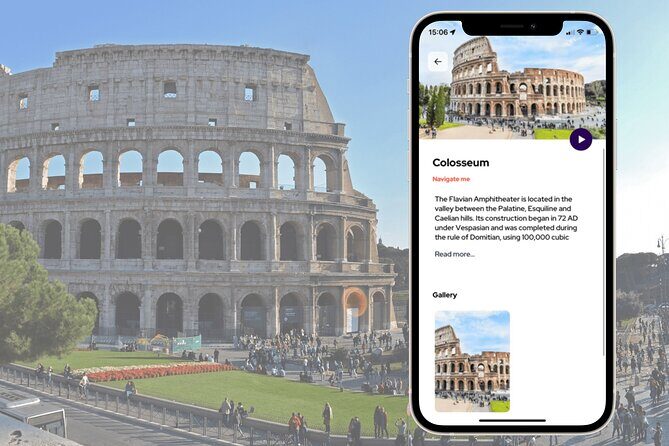
The itinerary is heavy on free-admission stops, with the notable exception of Vatican Museums, where admission is explicitly marked as not included. That one detail changes your day.
If you want this app to feel smooth:
- Treat Vatican Museums as a separate planning task where tickets/entry are handled by you.
- Keep the rest of the route flexible. Since many stops are listed as free, you can adjust your pacing without your whole schedule depending on admission lines.
It’s a great setup for people who like structure but don’t want to pay for a guided ticket package.
Navigation you don’t have to fight: geo-tagging and map confidence
This experience leans hard on usability. You’re geo-tagged, so you shouldn’t feel totally lost mid-walk. There’s also built-in map guidance and itineraries that work on foot or via public transportation.
That said, phones can act weird. There are reports of the app freezing and a missing walking-direction arrow, which can cause brief wrong turns. So keep a simple strategy:
- If your phone locks up or the direction indicator isn’t clear, stop for a minute and re-orient using street signs.
- Don’t try to sprint through Rome while troubleshooting.
This is exactly the kind of day where a calm pause beats forcing progress.
Earphones, Wi-Fi, and offline use: small items that matter
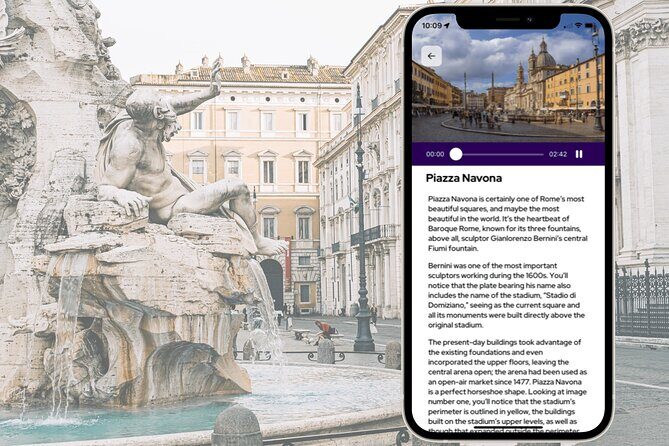
This is one of those tours where the “details” aren’t details. Earphones aren’t included, but narration is a core feature—so bring earbuds. If you forget, you can still listen on your phone, but it will feel awkward fast.
Offline capability is a huge plus. You can avoid roaming surprises, and you won’t be stuck if data is spotty. The app also lists free Wi-Fi spots, which is helpful for pre-downloading or refreshing your plan.
Finally, the experience can be used on Android or Apple devices, which makes it easier to test before you travel.
Who this Rome self-guided app is perfect for
This is best if you want:
- Independence: you choose when to start, stop, and linger
- Guided-style context: narrated stories help you make sense of monuments
- A route that feels doable in a short window (2–3 hours)
It’s also a smart choice if you’ve visited Rome before and you mainly want new facts while you re-walk familiar streets. The price makes it easy to try without overcommitting.
Who should be cautious

Be a little careful if:
- You rely on your phone for everything and can’t tolerate app quirks
- You want museum-style deep time at major ticket attractions
- You hate charging your phone or switching between apps
If your biggest priority is total reliability with zero tech involvement, you might prefer a traditional tour. Here, the app is the guide.
Should you book this Rome self-guided city experience?
I’d book it if you’re comfortable using a phone as your tour brain and you want a lightweight way to get stories while you see Rome fast. At $11.58, it can be a strong value, especially because it supports offline use and packs a lot of major names into one route.
But I wouldn’t treat it like a set-it-and-forget-it guarantee. Do a quick test beforehand, download what you can, and charge your phone. If you do those two things, this app-based Rome day can be a fun, practical way to get both movement and meaning.
FAQ
How long is the Rome self-guided experience?
It’s listed as approximately 2 to 3 hours.
Is the app usable offline?
Yes. The experience notes that the app can operate offline, so you can use navigation without internet access.
What’s included in the price?
The experience includes the mobile app, 130+ points of interest, walking itineraries, and free Wi-Fi spots.
Do I need to buy attraction tickets separately?
Yes. Vatican Museums is marked as admission not included. Other listed stops show admission ticket free in the itinerary.
Are earphones included?
No. Earphones are not included.
Do I need public transportation tickets?
Yes. Public transportation tickets are not included.
Where does the tour start and end?
It starts and ends back at the meeting point, which is listed as Province of Rome, Province of Rome, Lazio.
Can I use this on my phone?
Yes. It can be used on Android or Apple mobile devices.
How many people is the group limited to?
The maximum is listed as 30 travelers.
What if I need to cancel?
This experience is non-refundable and cannot be changed for any reason.