REVIEW · HISTORICAL TOURS
Rome Highlights Tour Squares and Fountains Stroll Through History
Book on Viator →Operated by Tour In Rome by Tour in the City · Bookable on Viator
Rome can be a lot at first.
This walking tour strings together some of Rome’s most famous squares and fountains with clear explanations, so the city feels less like a blur. You’ll move from the Spanish Steps area through Trevi and the Pantheon zone, then end with Tiber views near Castel Sant’Angelo.
I especially like two things here. First, you get headsets for easier listening with small groups, plus a professional art historian guide for the full walk. Second, the route is designed for impact: major sights in a short time, ending at a great “Rome at eye level” finish near the bridge.
One possible drawback: it is still a walking tour with an urban pace, and it’s not recommended for walker users or serious motor difficulties. If you have knee issues or need slower breaks, you’ll want to plan ahead.
In This Review
- Key things I think you’ll enjoy most
- A Fast Route Through Rome: Spanish Steps to Castel Sant’Angelo
- Start at Piazza della Trinità dei Monti: Easy Meeting, Big Neighborhood Energy
- Trinità dei Monti and the Spanish Steps: The Bourbon- French Connection
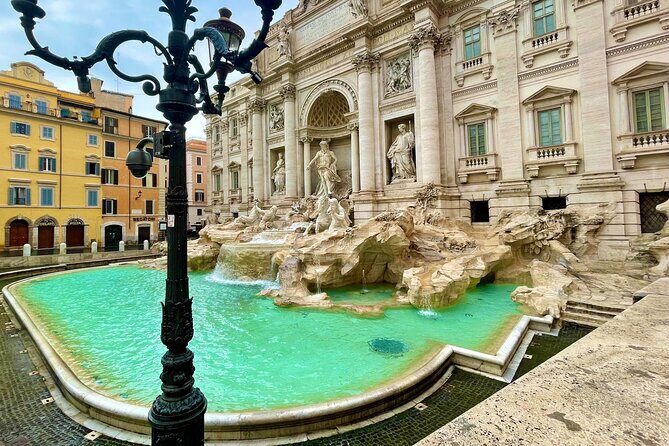
- Trevi Fountain (Fontana di Trevi): Baroque Drama in Real Life
- Pantheon Outside: Ancient Temple to Church in One View
- Piazza Navona and Fontana dei Quattro Fiumi: Games to Baroque Showpieces
- St. Angelo Bridge and Castel Sant’Angelo Views: The Tiber Finale
- St. Peter’s Basilica Moment: Quick Visual, Big Significance
- Price and Value: Why $69.84 Can Be a Smart Day-One Move
- Who This Tour Suits Best (and Who Should Rethink)
- Should You Book This Rome Squares and Fountains Stroll?
- FAQ
- How long is the Rome Highlights tour?
- What’s the meeting point and where does the tour end?
- Is the tour in English?
- Are headsets included?
- Are tickets for attractions included?
- Is food included?
- What should I wear?
- Can I cancel for a refund?
Key things I think you’ll enjoy most
- Headsets included so you can actually hear your guide without craning your neck
- Art-historian storytelling that connects squares, churches, and fountains to what came before
- Trevi Fountain timing with a classic first-time view of the Baroque masterpiece
- A tight Rome highlights route that saves you from figuring out logistics on day one
- A scenic finish at Ponte Sant’Angelo with Castel Sant’Angelo looming nearby
- Smart choice for first-timers who want orientation fast, not weeks later
A Fast Route Through Rome: Spanish Steps to Castel Sant’Angelo
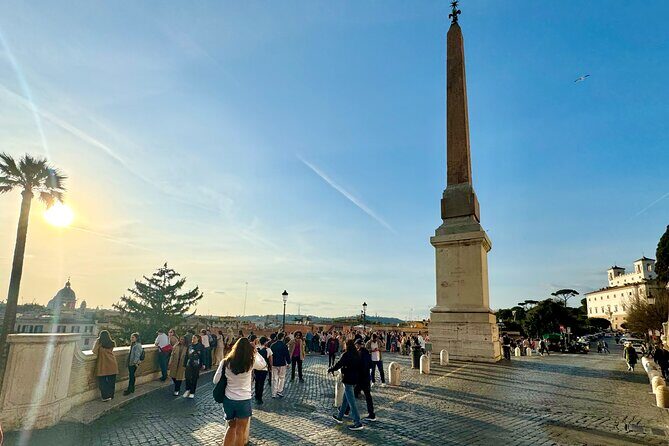
If you want Rome’s “greatest hits” without spending half a day stuck in transit, this tour fits the bill. In about 2 to 2.5 hours, you hit a run of iconic stops that normally take multiple days to plan well on your own. It’s compact, efficient, and designed to keep momentum.
The smart part is how the walk builds a sense of Rome as a layered city. You start at the Spanish Steps area, then you pivot into Rome’s fountain spectacle, move to ancient-to-early-Christian icon landmarks, and end with the river approach to Castel Sant’Angelo. That arc makes the city easier to understand when you’re still learning the geography.
Also, the group size stays reasonable (maximum 50), and the experience includes headsets when the group is larger than about 8 people. That matters in Rome, where streets get noisy fast.
You can also read our reviews of more historical tours in Rome


Start at Piazza della Trinità dei Monti: Easy Meeting, Big Neighborhood Energy
Your walk begins at Piazza della Trinità dei Monti (380, 00187 Roma RM). That’s a convenient starting area because you’re right by one of the most photographed parts of central Rome. You’re not meeting somewhere random in a maze of backstreets.
There’s a mandatory meeting time 15 minutes before departure. This is worth respecting because the group needs to assemble before you start moving. If you’re late, you can miss the briefing and lose time on the route.
The finish is Piazza di Ponte Sant’Angelo, right in front of the bridge area by Castel Sant’Angelo. It’s a satisfying ending because you leave with a clear visual marker for how Rome’s riverfront and monumental architecture connect.
Trinità dei Monti and the Spanish Steps: The Bourbon- French Connection
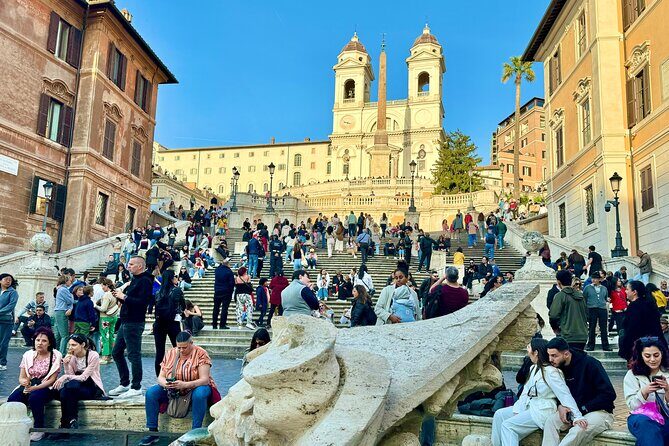
The first major stop is the Church of Santissima Trinità dei Monti, sometimes called Trinità dei Monti, set above the Spanish Steps. This church is tied to the top of that famous stairway, and it sits near a French State property area, including Villa Medici. That detail adds a surprising political and cultural layer to what looks like a simple viewpoint.
Then you step into the Spanish Steps themselves: 135 steps climbing between Piazza di Spagna and Piazza Trinità dei Monti. The design credit includes Francesco de Sanctis and Alessandro Specchi, and the stairway was under the patronage of the Bourbon kings of France.
Why you’ll like this stop: it gives you a quick way to read Rome’s monuments as more than postcard scenes. The steps are a stage for diplomacy, church influence, and the way foreign power visibly shaped Rome’s appearance.
A small consideration: it’s a steep climb and a classic congestion point. The stop is short (about 10 minutes), and admission is not included. Also, you’ll want comfortable shoes since the ground and crowds can slow your stride.
Trevi Fountain (Fontana di Trevi): Baroque Drama in Real Life
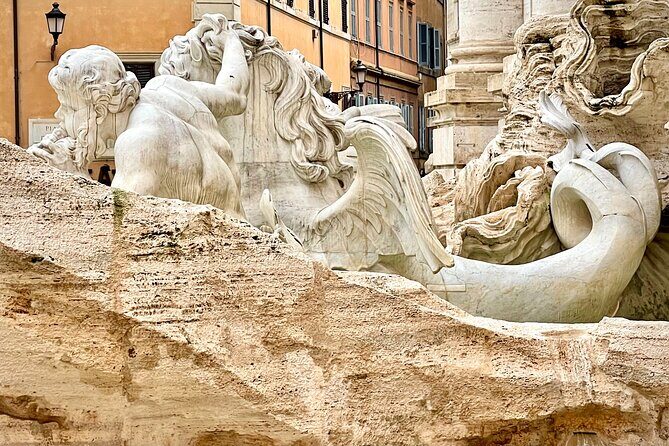
Next comes Fontana di Trevi, the largest Baroque fountain in Rome and one of the most famous fountains on the planet. It’s enormous in scale: about 49.15 meters wide and 26.3 meters high, designed by Nicola Salvi and completed around 1762 (with Giuseppe Pannini and others involved).
Your stop here is timed at about 10 minutes, and this one includes admission (meaning your ticket cost is covered for the included fountain experience). Even if you’ve seen photos a hundred times, it hits differently in person because the composition is built to pull your eyes across the whole façade.
Practical tip for enjoying it: don’t treat Trevi like a quick photo booth. Spend a little time looking at how the different sculpted figures and levels create depth, then re-check from different angles. That’s where a guide really helps, because you’ll understand what you’re seeing instead of only admiring the surface.
The main drawback is crowd pressure. Trevi is always crowded, and your time window is short—so you’ll want to stay close to the group and focus on the big visual read your guide explains.
Pantheon Outside: Ancient Temple to Church in One View
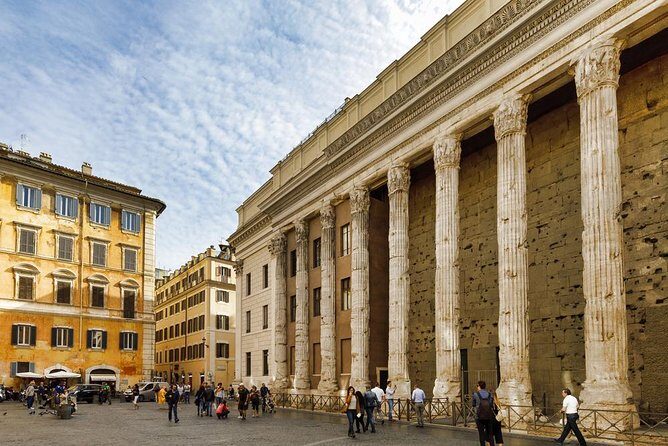
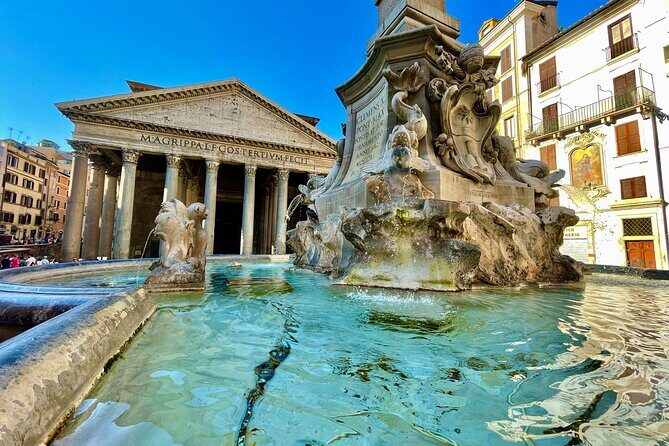
After Trevi, the route moves you toward the Pantheon. Even though this stop is listed as an outside visit, it’s still one of the best “orientation anchors” in Rome. You’ll be looking at a building that started life as a Roman temple and then became a church in AD 609.
The Pantheon’s story is big, and the details make it feel real: an earlier temple was commissioned by Marcus Agrippa under Augustus, it burned down, and Emperor Hadrian ordered the current version. Construction is often placed around c. AD 126, and the building keeps inscriptions from the older temple rather than marking the new one.
What makes this stop valuable on a walking highlights tour is the compression. You go from fountain spectacle to a structure that’s basically a timeline in stone. It’s the kind of shift that helps you understand why Rome feels so continuous rather than split into “ancient” and “modern.”
Admission is listed as not included, which makes sense since you’re viewing from outside. So you’re not forced into extra paid entry to enjoy the context and take in the proportions.






Piazza Navona and Fontana dei Quattro Fiumi: Games to Baroque Showpieces
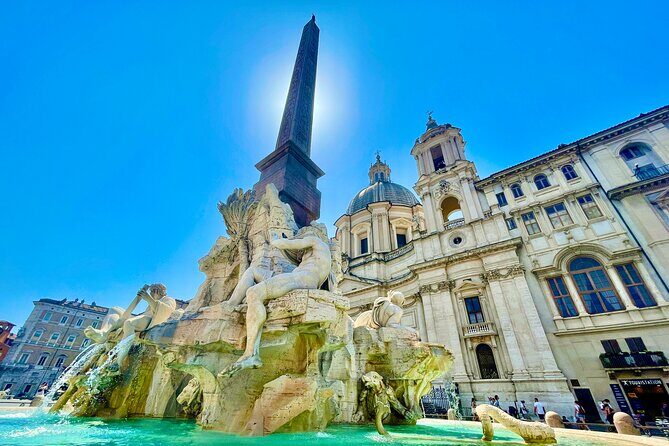
Then you land at Piazza Navona, built on the site of the old Stadium of Domitian (a Roman arena). This is one of those places where the urban shape itself is a clue: Piazza Navona follows the elongated oval footprint of the ancient stadium.
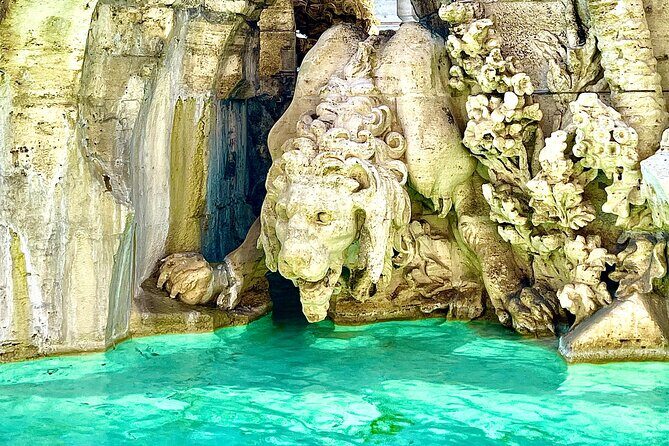
Your guide’s context matters here because Piazza Navona isn’t just a pretty square. It’s a history lesson you can walk around. It also became a Baroque stage in the 17th century, with work linked to major artists like Bernini and Borromini. The Fountain of the Four Rivers sits in front of the Church of Sant’Agnese in Agone, which is exactly the kind of pairing Roman architecture loves: civic square plus religious symbolism plus sculpted drama.
The Fontana dei Quattro Fiumi stop is short (about 10 minutes), and admission is not included. That’s fine because the fountain is designed for viewing from the open space, not for entry.
If you want to get the most from this section: use your time to look for how the fountain and the surrounding churches frame each other. The guide’s explanations are helpful because they translate art symbols into something you can actually notice while standing there.
St. Angelo Bridge and Castel Sant’Angelo Views: The Tiber Finale
After the central sights, the tour pushes you toward the river with St. Angelo Bridge (Ponte Sant’Angelo), a Roman bridge finished in 134 AD under Hadrian. It spans the Tiber and once connected the city center to Hadrian’s mausoleum, which later became Castel Sant’Angelo.
This bridge is now pedestrian-only and is a perfect scenic break. You get those classic views of Castel Sant’Angelo from the walkway, and the bridge’s five arches and travertine facing give it a sturdy, ancient feel even while it’s modern-life busy.
This segment is listed as 10 minutes and admission is free. That’s great value because you’re getting a meaningful Rome moment without adding ticket costs.
Also, the end point is right by the bridge area, so you can stay a little longer for photos if your timing works.
St. Peter’s Basilica Moment: Quick Visual, Big Significance
The tour includes St. Peter’s Basilica in Vatican City as a brief scenic stop (about 1 minute), and admission is free. This is not a full inside visit on this tour. It’s more like a quick visual check—an instant reminder that Rome’s Christian center matters just as much as its ancient monuments.
Even in a short moment, it’s worth paying attention to the scale and the way the basilica dominates the space. If you’re curious, this tour can also help you decide if you want a deeper Vatican visit later with timed entry.
Because it’s brief, don’t expect detailed commentary inside the basilica. The value here is that you get the location connection and orientation before you choose your next move.
Price and Value: Why $69.84 Can Be a Smart Day-One Move
The listed price is $69.84 per person for about 2 to 2.5 hours. That sounds like a lot until you compare what it buys you:
- You’re paying for a professional art historian guide, not just a map with walking directions
- You’re getting headsets, which you’d otherwise avoid paying for but lose out on clarity
- You’re packing in major landmarks across multiple neighborhoods in one organized sweep
- You’re not spending your mental energy piecing together route logic on day one
Where you should pay attention is admissions and what’s included. Trevi is indicated as ticket included, while several other stops list ticket not included. The Pantheon stop is outside, so you’re not forced into paid entry to enjoy the main visual. Still, if you plan to go inside later, treat this tour as the framework, then pick which paid experiences you want to add.
At this price, the tour feels most worthwhile if you’re a first-timer or if you want someone to connect the dots between squares, churches, and fountains in plain language.
Who This Tour Suits Best (and Who Should Rethink)
This works well for:
- First-time visitors who want fast orientation and a handful of must-sees
- People who enjoy art and architecture context more than just seeing a list of landmarks
- Anyone who likes a guided pace with a short, focused route
It’s less ideal if:
- You use a walker or have serious mobility limits, since the tour is not recommended for motor difficulties
- You need lots of frequent breaks due to pain, because the walk is continuous even though the stops are short
One useful detail from real-world experience: guides can sometimes adjust walking pace for guests with knee issues. Still, don’t assume that will work for every person on every day, so manage expectations and consider travel day timing.
Should You Book This Rome Squares and Fountains Stroll?
I’d book it if you want a smooth first look at Rome with clear, art-focused explanations and less guesswork. The combination of Spanish Steps, Trevi, Pantheon area views, Piazza Navona, and the Tiber finish hits a lot of top landmarks in a time window that doesn’t drain your whole day.
I wouldn’t book it if you have significant walking constraints or need a very slow, step-free route. For everyone else, it’s a strong value way to get oriented, understand what you’re looking at, and set yourself up for the Rome you want to explore after the tour.
If you’re the type who likes learning why a monument exists—not just where it is—this one is a good fit.
FAQ
How long is the Rome Highlights tour?
It runs about 2 hours to 2 hours 30 minutes.
What’s the meeting point and where does the tour end?
You start at Piazza della Trinità dei Monti, 380, 00187 Roma RM, Italy and end at Piazza di Ponte Sant’Angelo in front of Castel Sant’Angelo Bridge.
Is the tour in English?
Yes, it is offered in English.
Are headsets included?
Yes. Headsets are included to help you hear the guide clearly (especially with groups over about 8 people).
Are tickets for attractions included?
Not all of them. Trevi Fountain is listed as ticket included, while Spanish Steps, Pantheon, Piazza Navona, and Fontana dei Quattro Fiumi are listed as ticket not included. St. Angelo Bridge and St. Peter’s Basilica are listed as free.
Is food included?
No. Food and drinks are not included unless specified.
What should I wear?
The dress code is smart casual.
Can I cancel for a refund?
Yes. You can cancel up to 24 hours in advance for a full refund.