REVIEW · CITY TOURS
Rome: Golf Cart Tour of the Eternal City
Book on Viator →Operated by Facile Tours · Bookable on Viator
Rome is a lot more fun at golf cart speed. This private, open-air tour strings together big-name classics and quieter backstreet moments so you can see the city’s shape without getting stuck in traffic or burning your legs on hills. You ride, you stop often enough for photos, and you get an English-speaking guide to explain what you’re actually looking at.
What I like most is the mix of major monuments and viewpoint moments (Orange Gardens keyhole, Marcus Aurelius column views, and the Pantheon’s dome) and the human factor—guides such as Hadi, Francesco, and Marco are often praised for connecting dots and keeping the energy friendly and easy. One thing to consider: the cart experience depends on the setup and pace. A small number of guests reported trouble hearing the guide or feeling the route got rushed, so it’s smart to ask about audio/speakers when you arrive.
In This Review
- Key highlights worth knowing
- How the golf cart changes Rome (for the better)
- Pickup in central Rome: easy, with one important catch
- The 3-hour route: what you’re really seeing
- Villa Borghese Gardens: green Rome break and photo time
- Piazza del Popolo: a dramatic square and an easy panorama idea
- Mausoleo di Augusto: a quieter ancient moment
- Via del Corso: shop-and-stroll Rome between landmarks
- Column of Marcus Aurelius: ancient art you can climb to see better
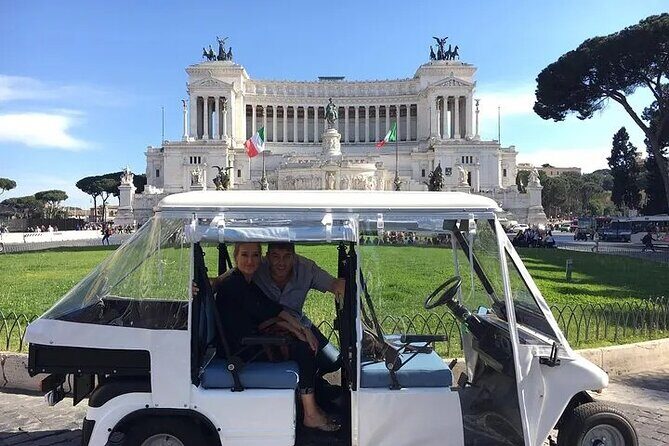
- Piazza Venezia and the Vittoriano: the big white monument in the middle
- Mercati di Traiano and the Imperial Fora: a walk through ancient commerce
- Circus Maximus: scale that still impresses
- Giardino degli Aranci: the keyhole view and the best kind of pause
- Bocca della Verità: silly fun with a real old legend
- Piazza del Campidoglio: Michelangelo’s square and the lone star statue
- Piazza Navona: fountains, people-watching, and easy evening vibes
- Pantheon: the dome that makes you stop talking
- Chiesa di Sant’Ignazio di Loyola: the false dome trick
- Trevi Fountain: iconic, yes—still worth the stop
- Piazza di Spagna and the Spanish Steps: the classic sit-and-stare moment
- Guides make or break it: what you can learn from the best
- Cost and value: is $160.91 per person worth it?
- Who this tour fits best
- Should you book this Rome golf cart tour?
- FAQ
- What’s the duration of the Rome golf cart tour?
- Is pickup included?
- Is the tour private or shared?
- What language is the guide?
- Are there admission tickets included for the stops?
- Where does the tour start?
- What type of stops are included?
- What’s the cancellation policy?
Key highlights worth knowing
- Private group ride through narrow streets so you waste less time inching through traffic.
- Photo-friendly stops at iconic places like Trevi Fountain, Piazza Navona, and the Spanish Steps.
- City views without the steep climbs thanks to the golf cart format and strategically placed photo stops.
- English guide with real context, with examples from guides like Hadi, Francesco, and Sahar.
- Mobility-friendly touring that works well for families and older visitors who still want the full Rome hit.
- A few “hear-and-pace” variables, so plan for the possibility of not catching every word.
How the golf cart changes Rome (for the better)
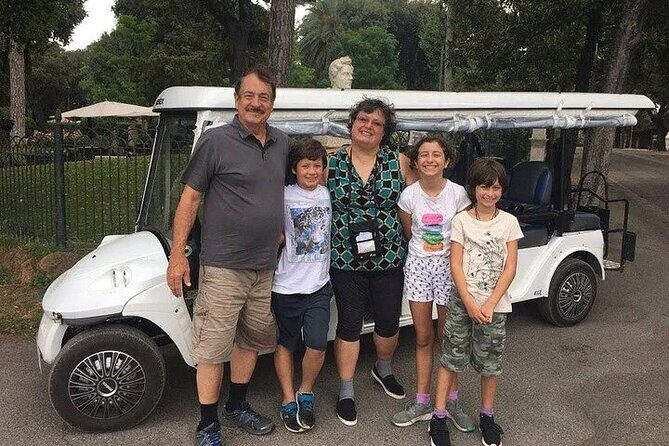
Rome can feel like a puzzle made of cobblestones, scooters, buses, and sudden turns. A golf cart tour doesn’t just move you faster—it helps you move smarter. Instead of fighting for position on foot, you’re often able to glide through smaller streets and reach viewpoints and landmark areas with less backtracking.
The tour is private, meaning it’s limited to your group rather than a large mixed crowd. That matters in Rome. When you’re in a small group, it’s easier to keep a steady pace, get questions answered, and adjust if your group wants extra time at a viewpoint or prefers a slower photo rhythm.
You’re also in an open-air vehicle. That sounds simple, but it’s a big deal for photos and comfort. Fresh air cuts the heat, and you can spot facades and street details without craning your neck the whole time.
You can also read our reviews of more city tours in Rome

Pickup in central Rome: easy, with one important catch
This experience offers pickup from your central hotel in Rome. The driver guide waits at the main entrance. If your hotel is outside the central area, you’ll need to meet at a designated central meeting point instead (or another central location arranged for your pickup).
This is the main practical thing to get right. If you’re not in the pickup radius, double-check that you know exactly where to meet and what name or instructions the driver will use. A few unhappy moments in this kind of tour often come from last-minute confusion when pickup details don’t match what someone expected.
You’ll also receive a confirmation at booking time, and you’ll have a mobile ticket ready.
The 3-hour route: what you’re really seeing
The tour runs about 3 hours, with short stops designed to keep you flowing. Think of it as a guided greatest-hits loop with enough time to look up, walk a bit, and get photos. You won’t feel like you’re stuck in one place forever—yet you won’t just pass by everything from behind a windshield.
Here’s the logic of the itinerary and what each stop adds.
Villa Borghese Gardens: green Rome break and photo time
You start at Villa Borghese Gardens, a large park area with lakes, fountains, sculptures, and museum/galleries nearby. Even if you’re not going into a gallery, the gardens help you reset. Rome has a way of crowding your senses. Villa Borghese gives you space and scale.
This is also a smart first stop because it sets expectations for the day. You get a sense of Rome’s layered city life: grand monuments, then sudden quiet greenery, then back to the historic core.
If you like gardens, this stop is a win. If you want only “must-see buildings,” it still works because it’s a break from stone.
Piazza del Popolo: a dramatic square and an easy panorama idea
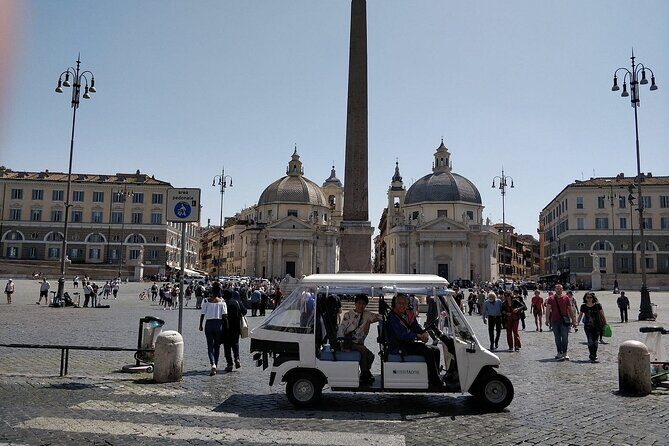
Next is Piazza del Popolo, one of the grand public squares in central Rome. It’s ringed by historic buildings, anchored by an Egyptian obelisk, and it’s the kind of place where people naturally gather.
There’s also a practical tip in the experience: the terrace of the Pincio offers panoramic views over the city. You may not have long here, but it’s the kind of “bookmark” place you can revisit later if you want a wider skyline shot.






Mausoleo di Augusto: a quieter ancient moment
The Mausoleum of Augustus is a peaceful stop in a park-like setting. Even though only part of the original structure remains, it still feels monumental. This is one of those locations that helps you understand Rome beyond the big postcard hits.
It’s a short stop, but that makes sense. The goal here is context: you’re looking at the tomb built to commemorate Augustus, and you get a sense of how early imperial Rome wanted permanence.
Via del Corso: shop-and-stroll Rome between landmarks
Then you pass through Via del Corso, a major shopping street stretching between Piazza del Popolo and Piazza Venezia. For many first-timers, this is useful because it’s a spine you can recognize later.
It’s not just retail. The street also helps you visually connect neighborhoods and landmark zones so you’ll navigate your next day more confidently.
Column of Marcus Aurelius: ancient art you can climb to see better
In Piazza Colonna, you’ll reach the Column of Marcus Aurelius. This is not a random statue—this is a towering column about 38 meters high, carved with a continuous spiral relief of military campaigns.
The standout detail is that you can climb inside the column for panoramic views. Even if you’re not climbing, you’ll appreciate it more after your guide points out how unusual the relief storytelling is.
It’s a quick stop, but it’s one of the most visually “Roman” moments: art, politics, and propaganda all stitched together in stone.
Piazza Venezia and the Vittoriano: the big white monument in the middle
At Piazza Venezia, the Vittoriano dominates the scene. This massive white marble monument celebrates King Victor Emmanuel II and became one of the most recognizable symbols of a united Italy.
If you want views, you can climb to the top. If you’d rather stay on the ground, you still get a strong sense of where the city’s civic heart sits—this is one of those plazas that makes directions easier later.
Mercati di Traiano and the Imperial Fora: a walk through ancient commerce
Next up is Mercati di Traiano – Museo dei Fori Imperiali (Trajan Market within the Imperial Fora museum setting). This space was built under Trajan as a commercial hub. Today, you’ll see restored ruins and interconnected spaces.
What I like here is that it breaks the “everything was temples” stereotype. This is Rome as an engine: trade, architecture, and infrastructure working together.
The time is short, so you’ll get more orientation than a slow museum experience—but that’s exactly what a 3-hour overview tour is for.
Circus Maximus: scale that still impresses
You then visit Circus Maximus, the ancient chariot-racing stadium that once held an enormous crowd (up to about 250,000 spectators). Much of the stadium is gone, but you can still walk along the ancient track area and feel the scale.
This stop gives you a different kind of Roman wow: not domes or churches, but public entertainment on a massive scale—right in the middle of the city.
Giardino degli Aranci: the keyhole view and the best kind of pause
On Aventine Hill, you’ll stop at Giardino degli Aranci (Orange Gardens). The name comes from citrus trees, and the garden is known for greenery plus sweeping city views.
The famous detail is a small keyhole in the wall that frames a view toward St. Peter’s Basilica in the Vatican when viewed from the right angle. It’s a quick “do it now” photo moment, and it’s also one of those things that feels magical without needing tickets or long lines.
Bocca della Verità: silly fun with a real old legend
At Bocca della Verità, you’ll see the Mouth of Truth stone disk in the portico of Santa Maria in Cosmedin. The legend says if you put your hand in and tell a lie, your hand gets bitten off.
Even if you don’t believe the myth, it’s fun in the way only Rome can manage: a real ancient object plus a pop-culture story (it’s been featured in films like Roman Holiday).
Expect a little waiting for photos if it’s crowded, but the stop time is short enough to keep the day on track.
Piazza del Campidoglio: Michelangelo’s square and the lone star statue
Next is Piazza del Campidoglio, on Capitoline Hill. This is a civic and religious power center from ancient Rome. Today, you also get a strong Renaissance layer, because the square was designed by Michelangelo, and the area includes important museums.
The plaza also features the statue of Marcus Aurelius, one of the few equestrian statues from ancient Rome that survived. It’s the kind of stop where the “wow” grows as your guide explains how the space was reshaped over time.
Piazza Navona: fountains, people-watching, and easy evening vibes
Then you reach Piazza Navona, known for its three fountains. The highlight is the Fontana dei Quattro Fiumi, designed by Bernini.
This is also a “live Rome” stop. Cafes line the square, street performers often appear, and it’s one of the most photogenic plazas in the city center. Even with a short stop, it’s worth lingering just long enough to feel the atmosphere.
Pantheon: the dome that makes you stop talking
The Pantheon is next, and it’s hard not to get a little quiet here. It’s famous for its perfectly proportioned dome and the oculus, the opening at the top that brings natural light into the space.
If you care about architecture, this is your best anchor point. If you just want iconic Rome, it still delivers. It’s one of the best places in the city to see how Roman engineering became aesthetic.
Chiesa di Sant’Ignazio di Loyola: the false dome trick
At Chiesa di Sant’Ignazio di Loyola, the star feature is the so-called False Dome, a painted trompe-l’oeil effect created by Jesuit artist Andrea Pozzo. The illusion makes it look like there’s a real dome overhead—while you’re standing in a church that uses paint and perspective to fool your eyes.
This stop is a good balance to the larger stone monuments. It shifts you from “big exterior Rome” to “clever interior Rome.”
Trevi Fountain: iconic, yes—still worth the stop
Then comes Trevi Fountain, the famous baroque fountain with Neptune at the center. You’ll see the tradition of tossing coins—meant to encourage you to return to Rome—plus constant coin-spray from visitors.
This is one of those places where you’ll either love the energy or find it a bit chaotic. A golf cart tour helps because you’re not stuck there all day. You get a stop, you get photos, and then you move on.
Piazza di Spagna and the Spanish Steps: the classic sit-and-stare moment
You end with Piazza di Spagna and the Spanish Steps. These are the 138-step stairs connecting the square with Trinità dei Monti church, and they’re famous for the flower-lined look and the big view from the top.
This stop is great for a breather. Even if you’re not climbing all the way, you can sit, watch people, and take in the building lines that make Rome feel theatrical.
Guides make or break it: what you can learn from the best
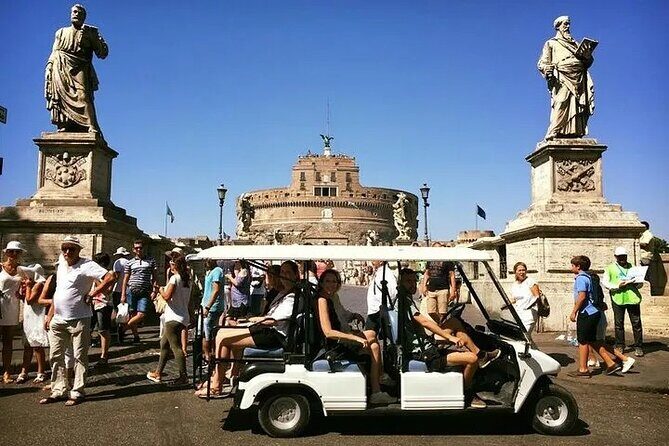
This tour consistently wins when the guide is confident, funny, and organized. People mention Hadi for deep context and good routes, Francesco and Sahar for warmth and pacing, and Marco and Ivana for clear explanations and a feel-good group vibe.
A common theme: the best guides do two things at once. They explain what you’re seeing, and they also help you understand what to do next—like where to stand for views or which neighborhoods feel worth revisiting after the tour.
One practical note from real-world experience: if your cart doesn’t have good audio, you might miss parts of the guide’s commentary. If you’re booking and audio clarity matters to you, it’s worth asking about speaker/listening support before you roll out.
Cost and value: is $160.91 per person worth it?
At $160.91 per person for about 3 hours, the price isn’t cheap, but the value makes sense if you treat it as an orientation tool plus comfort.
Here’s how I’d judge whether it’s a good deal for you:
- If you’re trying to cover major sites fast on limited vacation time, you’re paying to save time and walking fatigue.
- If you want a small-group feel with an English-speaking guide and pickup, you’re paying for convenience and direction.
- If you’re the type who likes learning details—why places matter beyond their photo—then the guided explanations are where the money turns into something you keep.
Where it can feel pricey is when the experience isn’t meeting expectations on pace, hearing the guide, or pickup clarity. That’s not about the monuments—it’s about the human and equipment side of the tour. If you go in with the right mindset—expecting a guided overview with short stops—it usually feels worth it.
Who this tour fits best
This works especially well if:
- you want a first-day overview so you know where everything is
- you’re traveling with teens, grandparents, or anyone with limited stamina
- you like photos but don’t want to sprint between stops
- you enjoy history explained in a friendly way while you ride between neighborhoods
It may not be ideal if:
- you want a slow, museum-level experience at one or two sites
- you’re extremely sensitive to audio quality and want guaranteed clarity at all times
- you prefer to linger for long meals or deep interior visits without a strict schedule
Should you book this Rome golf cart tour?
If your goal is to get your bearings fast and see Rome’s biggest highlights without spending your whole day in lines and on hills, I think it’s a smart buy. The private format, central pickup, and open-air comfort help a lot. And when the guide is strong—which seems to be the norm—you’ll leave with a mental map of Rome and a clearer idea of what to do next.
My advice: book it early enough that you can plan your remaining days around it, and be ready for short, efficient stops. If you’re the kind of traveler who needs long pauses at each attraction, pair this with one or two slower standalone visits afterward.
FAQ
What’s the duration of the Rome golf cart tour?
The tour lasts about 3 hours.
Is pickup included?
Pickup is offered from central Rome hotels. If your hotel is outside the central area, you’ll be told to meet at the designated meeting point or another central location.
Is the tour private or shared?
It’s private. Only your group participates.
What language is the guide?
The tour is offered in English.
Are there admission tickets included for the stops?
The stops listed are marked as admission ticket free.
Where does the tour start?
The meeting point is Piazzale delle Canestre, SNC, 00197 Roma RM, Italy.
What type of stops are included?
You’ll do a mix of outdoor landmark viewing, short walks for photos, and key interior moments such as the Pantheon and a church visit.
What’s the cancellation policy?
Free cancellation is available up to 24 hours before the start time for a full refund. If you cancel less than 24 hours before, the payment isn’t refunded.