REVIEW · WORKSHOPS
Rome: Ancient Mosaic Making Workshop
Book on GetYourGuide →Operated by Studio Cassio · Bookable on GetYourGuide
Marble dust beats sightseeing boredom. This hands-on class in Rome’s Monti neighborhood teaches you real Roman mosaic technique, and you’ll actually cut and place local marble tiles under a master’s guidance. I also like the way the workshop is set up to be relaxing, not lecture-heavy, so you feel like you’re making art instead of watching someone else make it.
You get a small-group studio experience (limited to 9 people) in a professional, family-run space near the Colosseum. One bonus that shows up in the vibe: the hosts can be warm and personal, including going the extra mile for special moments like birthdays.
The main drawback is simple: it’s a 2.5-hour workshop and it’s not designed for younger kids. If you’re traveling with children under 12, this won’t fit.
Studio Cassio Mosaic Workshop: Key Things You’ll Notice
- A master mosaicist teaches you the basics of texture, composition, and tile cutting
- You create a take-home mosaic about 7” x 5”, finished with a frame and packed in a sturdy box
- Local marble is part of the learning, so your materials match the Roman tradition
- Family-owned workshop feel, with hands-on tools and a calm pace
- English or Italian instruction for a small group capped at 9 people
In This Review
- Roman mosaics in a real Monti studio (not a craft demo)
- Your take-home mosaic: 7” x 5”, framed, boxed, and ready to travel
- The workshop flow: Roman mosaic history, then hands-on cutting
- Marble tile cutting: where the real skill shows up
- Who’s teaching and what the vibe feels like
- The neighborhood and timing: near the Colosseum, but a break from crowds
- Price and value: $106 for a real skill and a real object
- What to expect day-of: how you’ll use the studio time
- Who should book Studio Cassio (and who might want to skip it)
- Should you book this Rome mosaic workshop?
- FAQ
- How long is the Rome Ancient Mosaic Making Workshop?
- Where is the meeting point?
- What will I take home?
- Is this workshop suitable for kids?
- How many people are in each class?
- What languages do instructors speak?
- What’s included in the price?
- Is transportation included, and can I cancel?
Roman mosaics in a real Monti studio (not a craft demo)
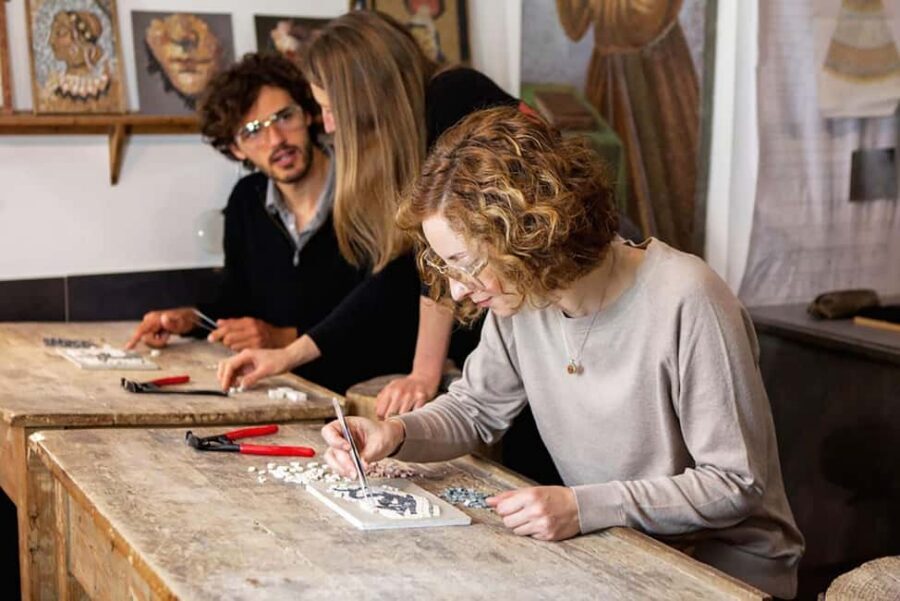
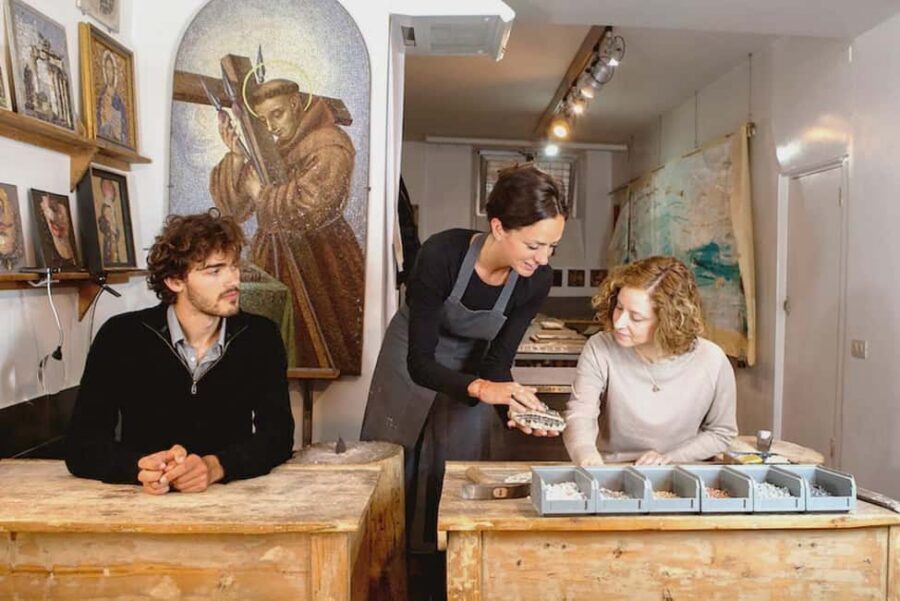
This is the kind of Rome experience that gives your eyes a break and your hands something to do. You’re in a professional mosaic studio in Monti, close enough to the Colosseum area that you can pair this with a classic sightseeing day. Then the focus shifts from monuments to materials: stone, texture, and careful cutting.
Two things make this workshop feel especially worth it. First, it’s built around technique, not just the final look. You learn how Roman mosaics achieve depth through texture and how pieces come together through composition. Second, you’re using high-quality natural local marble, which changes the whole experience compared to lightweight crafts or plastic-looking substitutes.
The tone from the studio is also important. People describe the instructors as friendly, supportive, and genuinely invested in their craft. That matters because mosaic-making can be surprisingly meditative once someone shows you the right way to handle tools and make cuts.
Your take-home mosaic: 7” x 5”, framed, boxed, and ready to travel
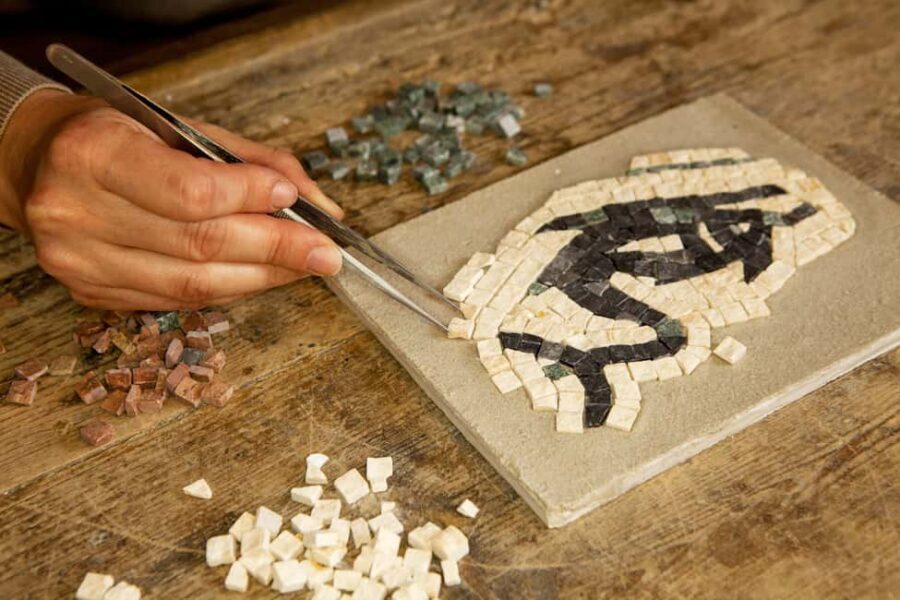
The payoff is clear and tangible. By the end, you’ll take home your own personal mosaic artwork sized at approximately 7” x 5” and weighing about 14 oz. You don’t just get a lesson and a souvenir photo—you get an object you made, with physical presence.
It also comes prepared for life after Rome. You receive a frame to create your artwork, plus a sturdy box that helps protect it during travel. That packaging is a big deal in practice. Mosaics are easy to bump, and Rome heat plus luggage chaos can be rough on delicate items.
If you’ve seen mosaics around Rome and wondered why some look shallow while others seem to shimmer, your final piece is the answer. Even at a small size, the studio teaches you to make choices that echo what ancient artisans understood: how light hits tiny surfaces, how stone colors shift, and how negative space affects the overall design.
You can also read our reviews of more tours and experiences in Rome


The workshop flow: Roman mosaic history, then hands-on cutting
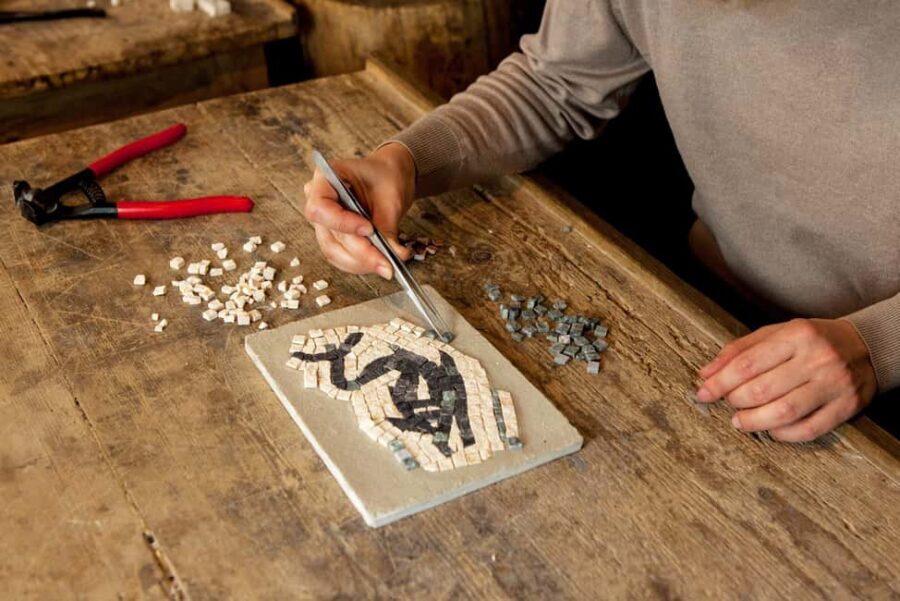
You’ll start with an introduction to Roman mosaic technique and history. The goal isn’t to turn the session into a museum talk. It’s more practical than that—history gives you context for why certain methods matter.
Then you get to the work. The session is structured around three core learning themes:
- Texture: learning how small surface differences create visual depth
- Composition: practicing how the design holds together as a whole
- Marble tile cutting: handling stone pieces with control rather than guesswork
The workshop is described as full-immersion in an authentic mosaic studio. That means you’re not standing at a distance watching. You’re handling the tools and working at a professional workbench in a real production-style environment.
You should expect the class to take most of the 2.5 hours. One of the perks of a timed session is that you’re not left with a half-finished “almost” project. The instructors help you reach a finished result you can confidently take home.
Marble tile cutting: where the real skill shows up
If you’ve never cut marble tiles before, you’ll quickly learn that it’s not about speed—it’s about control. The studio teaches the principles behind Roman mosaic craftsmanship, including how tile cutting affects how pieces fit and how they catch the light.
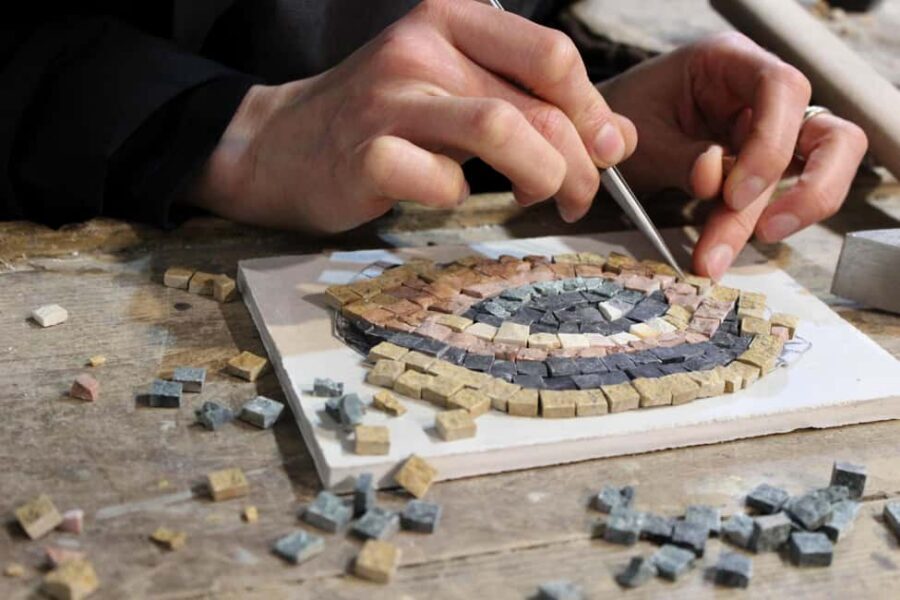
You’ll also use local marble throughout, which helps you understand why Roman mosaics have that specific look. Marble isn’t just a material; it’s a visual language. Each cut changes color tones and surface reflections. When you place pieces into a composition, you start seeing how the same stone can read differently depending on how it’s oriented.
The instructors guide you with specific tools designed for mosaic work. That’s part of what makes this class feel authentic. There’s a clear difference between a workshop that offers “mosaic-inspired” crafts and a workshop that teaches how mosaics are actually built.
Who’s teaching and what the vibe feels like
A big part of value in a workshop is who’s in front of you. The studio’s instructors are described as skilled mosaicists who also teach with patience and humor. Names that show up from firsthand accounts include Alex, and hosts listed as Julia, Hope, and Ellie (with Ellie sometimes spelled as Elandria).
What I like about this setup is that the studio team doesn’t treat teaching as babysitting. It’s more like coaching. You get corrections when you need them, encouragement when you hesitate, and enough guidance to keep your project on track.
The small group size—limited to 9—supports that. In a larger class, you might spend more time waiting. Here, you’re more likely to get direct help with cutting technique and placement choices, especially if it’s your first mosaic.
The neighborhood and timing: near the Colosseum, but a break from crowds
The meeting point is near the Colosseum, and it’s only a 2-minute walk from the Cavour stop on Metro Line B. That’s a practical detail because it keeps you from adding extra transit friction to your day. You can plan this after a big morning of Roman ruins without it turning into a time-sink.
This workshop also works well as an off-rush activity. People describe it as a relaxing change of pace—useful if you’ve already done the long-walk, long-line parts of Rome. A studio session in a controlled setting can feel like a reset, especially during hotter hours.
Because it lasts 2.5 hours, you can fit it between sightseeing plans without needing an all-day commitment. Bring the mindset that you’re switching gears: from stone monuments to stone craftsmanship.






Price and value: $106 for a real skill and a real object
At $106 per person, the price might make you pause if you’re used to free Rome experiences. But here’s the value logic: you’re paying for a master-guided, tool-based workshop that ends with a finished, framed mosaic you can take home in a protective box.
You’re not just buying supplies. You’re paying for:
- professional instruction on Roman mosaic principles
- access to quality natural local marble
- all necessary tools
- the frame and packaging that helps your mosaic survive travel
- drinks included (bottled water plus coffee and/or tea)
For many travelers, the best souvenirs are the ones you make. This hits that sweet spot. Your mosaic is small, but it’s meaningful, and it’s made with techniques you can actually understand. If you care about crafts, this is closer to a skill experience than a typical ticketed attraction.
What to expect day-of: how you’ll use the studio time
In practical terms, expect a structured start and then mostly active work. First comes the introduction to technique and history. Then you move into cutting and placing tiles as you build your design.
You’ll also be working with a frame as part of the process. That matters because it keeps the design contained and helps you visualize the finished piece while you work. In many DIY crafts, people wander and then panic at the end. Here, the frame approach supports a more Roman-like workflow: design decisions happen as the build happens.
For safety, the workshop recommends ages 12 and up. That’s not just a formality. You’ll be working with tools that require care, and the studio sets itself up for a safe hands-on experience.
Who should book Studio Cassio (and who might want to skip it)
This is ideal if you:
- want a break from monument lines and want something hands-on
- like crafts and want to learn technique, not just make a pretty object
- want a take-home souvenir that feels personal and built to travel
It may not be the best fit if you:
- need an experience for children under 12
- want a short, drop-in activity (this one is 2.5 hours)
- can’t do focused table work with tools and careful cutting
If you’re the type who loves visiting places, reading plaques, and then thinking, I want to understand how that was made, this workshop matches that curiosity. You’ll leave with a new way to look at Roman mosaics.
Should you book this Rome mosaic workshop?
Book it if you want a genuine craft experience in Rome’s Monti area, taught by a master mosaicist, with the payoff of taking home a framed mosaic you made yourself. The combination of natural local marble, tool-based instruction, and a protected take-home result makes the $106 price feel more like a workshop than a souvenir purchase.
If you’re mainly chasing quick hits and don’t like hands-on work, you may prefer another classic sightseeing option. But if you want to spend a couple hours learning something you can feel in your hands, Studio Cassio is a strong pick.
FAQ
How long is the Rome Ancient Mosaic Making Workshop?
The workshop lasts 2.5 hours.
Where is the meeting point?
It’s near the Colosseum, and it’s about a 2-minute walk from the Cavour stop on Metro Line B.
What will I take home?
You’ll take home your finished mosaic artwork, approximately 7” x 5” and about 14 oz, along with a frame and a sturdy box to protect it.
Is this workshop suitable for kids?
For safety reasons, it’s recommended for ages 12 and up, and it’s not suitable for children under 12.
How many people are in each class?
It’s a small group experience limited to 9 participants.
What languages do instructors speak?
Instruction is available in English and Italian.
What’s included in the price?
Included are the introduction to Roman mosaic technique and history, access to quality natural local marble and all necessary tools, a frame, a sturdy box, bottled water plus coffee and/or tea, and you keep your unique mosaic creation.
Is transportation included, and can I cancel?
Transportation to and from the workshop is not included. You can cancel up to 24 hours in advance for a full refund, and you can reserve now and pay later.