REVIEW · PRIVATE
Private Tour with guide & Luxury Car: Holy Churches of Rome
Book on Viator →Operated by Europe Odyssey Tours di Rahul Raghavan & C.sas · Bookable on Viator
Holy relics can feel heavy—this tour keeps them light. It’s a private 4-hour route that connects four landmark basilicas without turning your day into an all-day walk, and you get to hear the stories behind relics tied to the crown of thorns and the True Cross. I also like that the pace leaves room for prayer, reflection, and questions instead of a sprint from one photo spot to the next. One thing to consider: it’s a fixed circuit, so you’re choosing guidance and comfort over roaming freely for extra stops.
You’ll start at 8:30am in Trastevere and finish near the Scala Santa. Admissions at each basilica are listed as free, and you’ll use a mobile ticket. The tour is offered in English, and it’s set up so only your group participates.
The guiding style can make or break a church visit, and this one seems to land well—names like Justin and James show up in the feedback for being punctual and not rushing you. If you like asking questions and getting context that turns stone and relics into something you can actually follow, this format is built for that.
In This Review
- Key points before you go
- A 4-Hour Private Holy-Church Circuit, Lifted by Luxury Car
- Santa Croce in Gerusalemme: Constantine, Helen, and the Holy Cross
- Arcibasilica di San Giovanni in Laterano: Rome’s Cathedral and Papal Seat
- Santa Maria Maggiore: The Lady of the Snows and a Manger Link
- San Paolo Fuori le Mura: St Paul’s Tomb Beyond the Walls
- How a Private Guide Helps You Actually Understand Relics
- Is the $511.75 Price Worth It? Value Checks
- Who This Tour Fits Best (and Who Should Skip It)
- Should You Book Holy Churches of Rome?
- FAQ
- How long is the Holy Churches of Rome private tour?
- Which churches are included?
- Is admission included?
- Is the tour private?
- What language is the guide?
- Where do I meet, and where does the tour end?
- Does the tour run in any weather?
- Can I cancel and get a refund?
Key points before you go
- Luxury-car comfort for a church-and-relics day
- Four basilicas, with about 45 minutes at each
- Stories tied to Constantine, Helena, and papal Rome
- Time for prayer, reflection, and Q&A (not just photos)
- Free admissions listed for each stop
- Weather-dependent schedule (good weather matters)
A 4-Hour Private Holy-Church Circuit, Lifted by Luxury Car
This tour is designed for one simple win: you get a high-impact Rome church day without paying for it in sore feet and lost time. You’re picked up by car and move between four major basilicas in about 4 hours total, which is a smart trade if you’re short on time or you just don’t want to spend it walking across Rome’s streets.
What you’re really paying for is the combo: a guide + a car + a guided flow. Each stop runs about 45 minutes, which is enough to look around, listen, and ask questions without feeling herded. And because it’s a private tour, your group stays together and the pace can be shaped around your interests.
It also helps that each basilica admission is listed as free. That doesn’t mean you won’t spend time inside reading, praying, or looking closely—it just means you’re not adding extra ticket hassle on top of the day.
I’d also keep timing in mind. The start is 8:30am, with the tour meeting at Piazza di Santa Maria in Trastevere. If you’re a late-morning person, build your day around an early start, because church mornings tend to move fast and your best experience comes from showing up ready to focus.
One more practical note: this experience requires good weather. Since the schedule runs between multiple stops, rain or bad conditions can disrupt the flow, so plan to stay flexible if that happens.
You can also read our reviews of more guided tours in Rome



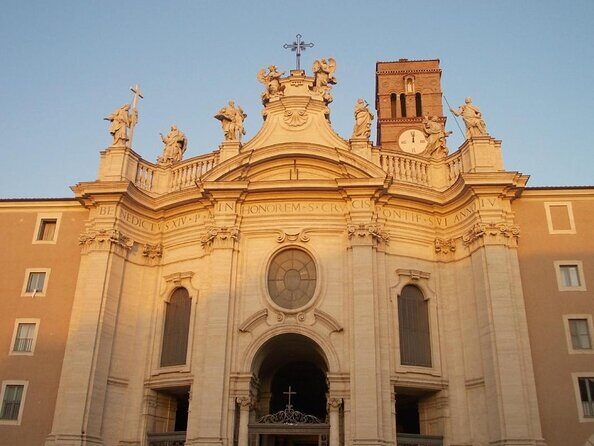
Santa Croce in Gerusalemme: Constantine, Helen, and the Holy Cross
Your first stop is Basilica di Santa Croce in Gerusalemme. This church has a legend-and-heritage story that feels almost like a chain reaction through Roman history: the basilica traces back to Constantine I giving this site to his mother, Helen. Helen built an initial chapel to house the relics of the Holy Cross that she found in Jerusalem and brought to Rome.
Later, that small chapel grew. It’s described as having started as the basilica Eleniana before becoming the major basilica you visit today. That matters, because it gives you something to listen for as you walk in: you’re not just looking at a church; you’re stepping into layers of how Rome absorbed sacred objects and made them part of daily religious life.
This stop also ties directly into pilgrimage patterns. It’s one of the basilicas connected to the “7 Churches” route that pilgrims used during Holy Week. Even if you aren’t doing a full walking pilgrimage, this connection helps you understand why these sites became anchors. They weren’t random stops. They were chosen because the stories made people travel.
You’ll get about 45 minutes here, and with the guide present, it’s a great moment to ask questions that make the relic connections click. For example: how did bringing relics from Jerusalem change Rome’s religious gravity? A good guide will help you connect the dots without making it feel like a lecture.
Potential drawback: since this is the first stop, it can set the tone for the whole day. If you show up rushed or distracted, you’ll probably feel it here first.
Arcibasilica di San Giovanni in Laterano: Rome’s Cathedral and Papal Seat
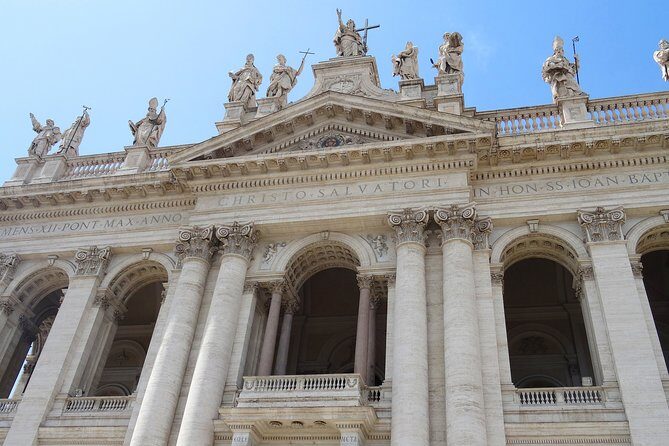
Next you’ll head to the Arcibasilica di San Giovanni in Laterano—Rome’s cathedral and historically tied to the pope’s own seat. This is one of the four papal basilicas, and the tour highlights it as the most important church in the world and the most ancient. It’s also presented as the original residence of the popes up until the 14th century.
That’s a lot of weight for one building, so this stop works best when you slow down. About 45 minutes is a reasonable amount of time to get bearings, hear why this church matters, and then let the significance land. When a church is described as Rome’s cathedral and connected to papal history, it helps to understand it as more than a pretty landmark. It functioned as a center of authority and a place where Rome’s religious role was lived out.
The practical benefit of having a guide here is that the “why it matters” is often harder to find on your own, especially when a church has centuries of status attached to it. The guide can keep you focused on what you can actually learn in a short visit—like how Lateran sits in the chain of papal basilicas and why that once made it a residence, not just a stop.
Potential drawback: this is a huge theme, and four stops in a row means you might have to pace your listening so it doesn’t become information overload. The private format helps, because if you want fewer questions and more looking, you can steer it that way.
Santa Maria Maggiore: The Lady of the Snows and a Manger Link
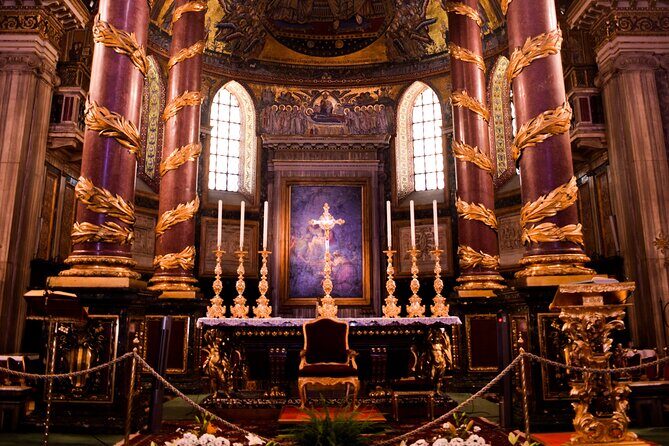
After Lateran, you’ll see Basilica di Santa Maria Maggiore, and the tour’s story here is wonderfully specific. The account you’re given centers on the claim that the Blessed Virgin Mary commissioned the basilica herself. She appeared to Pope Liberius and a Roman patrician named Giovanni, telling them she wanted a church built in her honor.
Then comes the miracle detail: on August 5th, the Blessed Mother sent a miraculous snowfall. The snowfall rested on the Esquiline hill and outlined the layout of the church. That’s how the basilica earns its title as the Lady of the Snows.
The tour also points you toward a physical, tangible connection to the Christmas story: the basilica is home to the manger of the Christ child. That detail turns the building into a place with a very direct devotional link, not just a distant legend.
You’ll have about 45 minutes at this stop, which is enough to take in the story, notice what you’re seeing, and ask questions about how these kinds of legends shape devotion and architecture. With a guide, you can focus on the core: what did Mary’s message do for how people understood this site?
Potential drawback: if you’re not into Marian devotion or miracle traditions, you may have to rely on the atmosphere and the building itself. The good news is that the tour frames the stop in a way that makes the legends easier to follow, even if you’re simply curious.
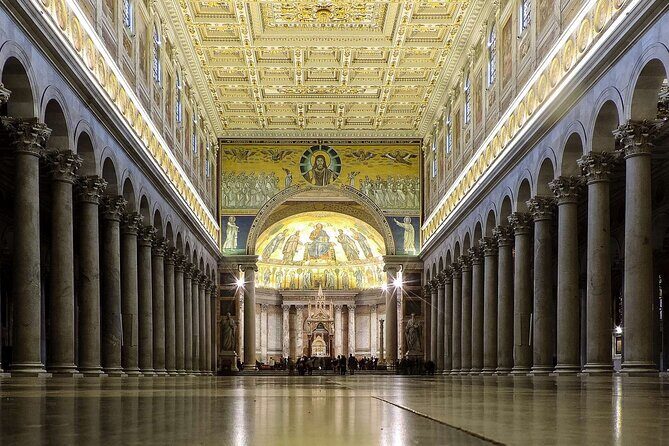
San Paolo Fuori le Mura: St Paul’s Tomb Beyond the Walls
Your final stop is Basilica Papale San Paolo Fuori le Mura, known as St. Paul Outside the Walls. This one has strong geography built into the story. It’s located on the outskirts of the ancient Aurelian wall, and the tour explains it as the burial place of St. Paul.
Originally, the site wasn’t a massive basilica. It began as a small memorial building called a Cella Memoriae. Then Constantine I commissioned a larger basilica to honor St. Paul, built on top of that earlier memorial structure.
The church you visit today also comes with the reminder that Rome’s major sacred buildings have had to survive time, repair, and rebuilding. The tour notes that it has been demolished and rebuilt several times, with restorations and expansions. It also highlights that it was the largest church in Rome until St. Peter’s was built—another way of emphasizing status and scale in papal-era Rome.
This stop lands well at the end of the tour because it ties together meaning and place. You’ve heard about relics, papal authority, and Marian legend; now you close with Paul’s burial and the long arc of how Rome kept re-making sacred space.
You’ll spend about 45 minutes here. A guide can help you keep your eyes on what matters in the short time you have, so you don’t just wander without a thread.
Potential drawback: since it’s outside the older core of the city, the car portion matters. The benefit is you’re not doing the slog on foot.
You can also read our reviews of more private tours in Rome


How a Private Guide Helps You Actually Understand Relics
One of the biggest values in this kind of tour is how it handles scale. Seeing four basilicas in a short span can feel like you’re collecting stamps. A good guide turns that into understanding.
This tour’s highlights call out relics connected to the crown of thorns, True Cross, and more. Those names are powerful, but they can also feel vague if you don’t have context. The guide’s job is to explain where these relic stories come from and why they became part of Rome’s religious pull—especially in relationship to emperors like Constantine and key figures like Helen.
The other big value is pacing. The feedback points to guides who don’t rush and who give you room to do something more than just look. One person mentioned prayer and reflection time plus Q&A. Another mentioned prompt guidance and that the driver and guide were exceptional.
You should expect a format that lets you ask questions in the moment, not at the end. That matters in churches. The best questions are often the ones you think of while you’re standing there, staring at the space where the story is supposed to live.
Also, because you’re going in a private group, your guide can respond to what you actually care about. If you want more focus on the papal angle, you can steer that. If you want more on Helena and Constantine, you can ask that too.
Is the $511.75 Price Worth It? Value Checks
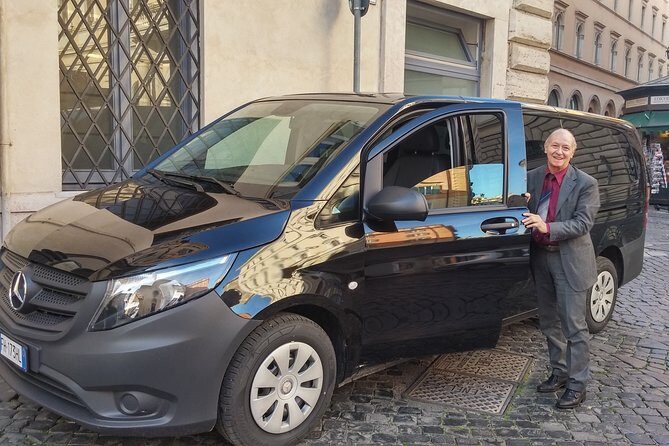
Let’s talk money without pretending it’s cheap. At $511.75 per person, this is not an impulse purchase. You’re paying for a private experience, a luxury car, and a guide to connect four major sites in a short time.
Here’s where the price starts to make sense. You’re getting:
- A guided route that explains what you’re seeing at each stop
- A car transfer that saves time and walking stress
- Free admission listed for each basilica
- About four hours total, with about 45 minutes per location
If you’re the kind of traveler who wants a structured day with high payoff and fewer logistics headaches, this price can feel fair. Rome can be easy to “do wrong” on a tight schedule—wrong order, too much time in one place, not enough in another. A guide helps you avoid that.
Where it might not feel worth it is if you’re traveling solo and you’re comfortable doing religious sights on your own. Or if you want a slower day with lots of optional side trips that aren’t included in the set four-stop loop.
My rule of thumb: if you value time, comfort, and clarity more than cost, this tour fits. If you’d rather spend less and accept more self-planning, then you might prefer a self-guided approach.
Who This Tour Fits Best (and Who Should Skip It)
This experience is a great match if you want:
- Four landmark basilicas without foot pain
- A guide-led explanation of relic stories tied to Rome’s major religious figures
- A schedule with real breathing room for questions and reflection
- A private setup where you’re not squeezed into a mass group
It also fits well for people who have limited time in Rome and want something concentrated. The itinerary is basically built around major religious anchors: Holy Cross in Jerusalem, Lateran’s papal cathedral role, Mary’s Snow miracle story, and Paul’s burial site outside the walls.
I’d be cautious if you prefer flexible day planning. Since the tour is a fixed circuit and weather matters, you’re choosing structure. If your ideal day is wandering until something grabs your attention, this may feel too scheduled.
Finally, consider the start time. An 8:30am beginning means you’ll want to be awake and ready to focus early.
Should You Book Holy Churches of Rome?
I’d book this if your goal is a high-quality, guided church day that doesn’t require you to figure out timing, transport, and context on your own. The combination of a luxury car, a private group setup, and four major basilicas with time for Q&A makes this feel like a smart value for the kind of traveler who hates wasting time.
Two practical reasons to lean in:
- The relic and papal context isn’t the type of thing you always get quickly on your own.
- The day is paced so you can actually process what you’re seeing, not just rush through it.
Two reasons to think twice:
- The cost is real, so you’ll want the guide and car value to match your priorities.
- Since it requires good weather, it’s not a “book it and forget it” kind of plan.
If your schedule can handle an early start and you’re excited by Rome’s sacred stories and relic traditions, this is a strong way to spend a morning and leave with a clearer sense of why these churches matter.
FAQ
How long is the Holy Churches of Rome private tour?
It lasts about 4 hours.
Which churches are included?
The tour visits Basilica di Santa Croce in Gerusalemme, Arcibasilica di San Giovanni in Laterano, Basilica di Santa Maria Maggiore, and Basilica Papale San Paolo Fuori le Mura.
Is admission included?
Admission tickets are listed as free for each of the four basilicas.
Is the tour private?
Yes. It’s a private tour/activity, and only your group participates.
What language is the guide?
The tour is offered in English.
Where do I meet, and where does the tour end?
It starts at Piazza di Santa Maria in Trastevere, 00153 Roma RM, Italy and ends at Pontificio Santuario della Scala Santa, P.za di S. Giovanni in Laterano, 14, 00185 Roma RM, Italy.
Does the tour run in any weather?
The experience requires good weather. If it’s canceled due to poor weather, you’ll be offered a different date or a full refund.
Can I cancel and get a refund?
You can cancel up to 24 hours in advance for a full refund. Canceling less than 24 hours before the start time won’t be refunded.