REVIEW · AUDIO TOURS
Trastevere: A Self-guided Audio Tour of Rome’s Medieval Village
Book on Viator →Bookable on Viator
Rome slows down in Trastevere. This self-guided audio tour takes you through cobbled lanes with GPS-triggered stories, helping you step away from the big tour crowds and hear the neighborhood like a local would. You also get practical guidance along the way, so your walk feels less like sightseeing and more like moving through a real part of town.
I especially like two things. First, the offline setup is a lifesaver: you don’t need Wi‑Fi or data because the audio, maps, and geodata are stored for you. Second, I like that the narration is built around the streets themselves, not museums—so you can pause, look up, and keep going when you want.
One drawback to plan around: you’ll want to stay close to the app’s route line. If you drift off, the app can hiccup and you may have to restart the guide, which breaks the flow. Also, if you’re hungry for dense architecture talk at every turn, you might find the walk a bit short on that.
In This Review
- Key Things To Know Before You Walk
- Why Trastevere Works Better on Your Own
- Price, Timing, and What 50 Minutes Means for Your Day
- Using VoiceMap GPS Audio Without Wi‑Fi
- Your Start and Finish: Piazza Trilussa to Piazza Dante
- Stop 1: Porta Settimiana and the Aurelian Walls in 271 AD
- Stop 2: Piazza di Santa Maria and the Night-Social Heart
- Stop 3: Fontana della Botte and the Rioni Connection
- Tips for Staying on Track (So the App Doesn’t Stall)
- Offline-First Travel: Why This Matters in Rome
- Food and Break Timing: Coffee, Gelato, and a Quick Reset
- How Much “History” You’ll Get (And How to Match It to Your Style)
- Who This Self-guided Tour Is Best For
- Should You Book This Trastevere Audio Walk?
- FAQ
- FAQ
- How long is the Trastevere audio tour?
- What does the tour cost?
- Does it work offline?
- Do I need to bring a smartphone?
- Where does the tour start and end?
- Are there tickets or museum entry fees included?
- Is this tour private?
- What’s the cancellation policy?
- Are service animals allowed?
Key Things To Know Before You Walk
- GPS-triggered narration means the story starts when you reach the right spot, not when you remember to press play
- Offline audio, maps, and geodata keep you going even if your phone struggles with signal
- Three major stops give you a clear walking thread through walls, squares, and a fountain tied to Trastevere
- Local-feeling pacing lets you pause for photos or a quick coffee without a group schedule
- Route discipline helps: staying on the map path reduces the chance you’ll need to restart
Why Trastevere Works Better on Your Own
Trastevere can feel like Rome does best: tight streets, older stone, and sudden little pockets where life is happening. But it can also be packed. This kind of self-guided audio walk helps because it shifts you from chasing sights to actually walking the neighborhood at human speed.
With a group tour, you get swept along. Here, you can stop when something grabs you—church facade details, street texture, a view down a lane—then continue when you’re ready. The tone matters too: the narration is set up to make the area feel lived-in, not like a checklist.
And for a first visit, Trastevere is a smart choice because it gives you a different side of Rome than the “always crowded” monuments. You’re not competing with buses at every turn. You’re just walking.
You can also read our reviews of more guided tours in Rome



Price, Timing, and What 50 Minutes Means for Your Day

This tour costs $9.99 per person and runs about 50 minutes. That’s good value if you like walking and you want context without paying for tickets or scheduling a private guide.
Here’s the practical take: 50 minutes is short enough that it won’t wreck your day if you’re touring other parts of Rome too. It’s long enough to feel like a real walk with a beginning, middle, and end—not just an audio track for one street.
Also, since there are no included museum tickets, you’re free to spend your money on things you actually want: a coffee break, gelato, or a simple meal. The app can help you plan those moments, rather than forcing you into someone else’s agenda.
Using VoiceMap GPS Audio Without Wi‑Fi

The experience runs through the VoiceMap application, and the big point is GPS-triggered audio. You don’t just listen to a guide while staring at your phone; the story cues are tied to where you are.
It also works offline. That means you can download and use the tour without hunting for data in dead zones—common in older Roman streets where signals act weird.
One smartphone reality check: the tour doesn’t include a phone. You’ll need your own device to run the app and follow the route. If your battery is low, bring a charger. A dead phone doesn’t pause the Roman day; it just turns your walk into guesswork.
Your Start and Finish: Piazza Trilussa to Piazza Dante
The route begins at Piazza Trilussa, 00153 Roma RM, and ends at casadante, Piazza Dante 8, 00185 Roma RM. That matters because it shapes how you’ll connect it with the rest of your itinerary.
Starting in Trastevere helps you ease into the neighborhood before you hit any bigger squares. Ending near Piazza Dante is handy if you plan to keep walking toward central Rome afterward, or if you want a smoother transition to other sights.
The experience is also set up as private for your group, so you’re not sharing audio space with strangers. If you’re the type who hates stopping every few minutes for the whole pack, this format feels more civilized.
Stop 1: Porta Settimiana and the Aurelian Walls in 271 AD
The first story point is tied to Emperor Aurelian. Back in 271 AD, Aurelian built defensive walls around Rome, and Trastevere was partially included in that fortified line.
You’re aiming for Porta Settimiana, one of the Aurelian Walls’ city gates. The key thing to understand is that what you see today isn’t the original medieval-day material. The gate was heavily restored in the late 1400s. That restoration detail is important because it changes how you look at the structure: you’re not just seeing ancient engineering. You’re seeing later layers that kept the idea of a boundary alive.
This stop works especially well early in the walk. It gives you a sense of why this area mattered and how Trastevere shifted from outskirts to part of the city’s ongoing story. Even if you’re not a hardcore history person, the wall context helps you read the neighborhood’s layout with better instincts.
What to watch for: if you’re expecting the “instant wow” of a major landmark, this part is subtler. But it’s a strong foundation for the rest of the walk because it explains the neighborhood’s place inside Rome’s defenses.
You can also read our reviews of more tours and experiences in Rome






Stop 2: Piazza di Santa Maria and the Night-Social Heart
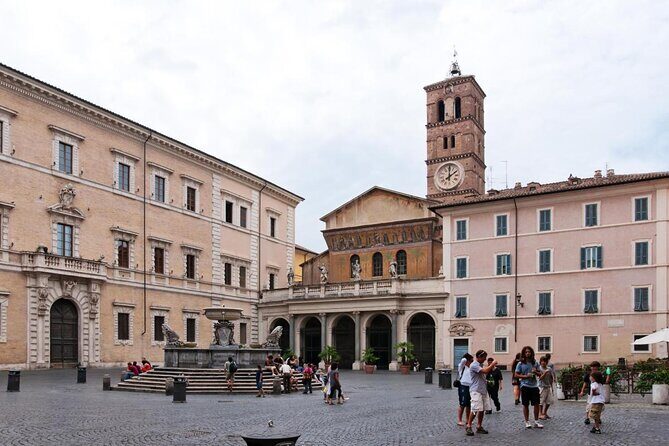
Next comes Piazza di Santa Maria, Trastevere’s main square. Squares in Rome are never just squares—they’re stages. This one is famous for being a meeting place where young people gather after sunset, when the district’s energy kicks up.
The narration here helps you notice things you might otherwise walk past. Instead of treating it like a photo stop, you experience it like a social hub that shifts by the hour.
Practical timing thought: since this tour is self-guided and runs with GPS triggers, you can choose when to do it during your trip. If you hit the square later, you’ll probably feel that after-dark “meet and wander” vibe more strongly. If you do it earlier, you’ll still get the square’s role in the neighborhood, just in a calmer mood.
Possible drawback: if you’re short on time and you only have one window in Trastevere, you may feel a bit “square heavy” early on. Still, the square is essential because it anchors the neighborhood’s daily rhythm.
Stop 3: Fontana della Botte and the Rioni Connection
The final stop centers on water and civic identity: Pietro Lombardi was commissioned in 1927 to create a set of nine fountains representing Rome’s rioni, or districts.
One fountain represents Trastevere: Fontana della Botte (the Fountain of the Barrel). It’s a neat way to understand that even in the 20th century, Rome was still building symbols—using art and street-level installations to keep local identity visible.
What I like about finishing here is the shift it creates. The first stop gives you walls and the ancient city. The second gives you social space. The third gives you modern Rome’s interpretation of neighborhood character. That arc makes the walk feel more complete than “three random points.”
If you’re the type who likes leaving a tour with at least one image in your head, this is the one to end on. A fountain is easy to remember, and it gives you something to point to when you talk about the area later.
Tips for Staying on Track (So the App Doesn’t Stall)
A key piece of advice from how this experience behaves: keep yourself close to the route in the app. When you follow the map line, GPS triggers tend to feel smooth. When you wander off, the guide may get stuck and you might need to restart.
So do this:
- Check the phone screen now and then, but don’t stare constantly.
- Treat the route line like a gentle suggestion, not a contract—but don’t ignore it either.
- If the audio doesn’t trigger, pause, reposition, and try again before you start walking in full confusion.
This isn’t just tech fussiness. It affects your enjoyment. The best part of this tour is how the narration meets you where you are. When it syncs, it feels like a local companion. When it doesn’t, you end up playing app mechanic instead of sightseeing.
Offline-First Travel: Why This Matters in Rome
I love tours that don’t demand perfect connectivity. Rome can be a patchwork of signal strength, and turning on roaming data mid-walk is a fast way to ruin your day’s mood.
Because this tour includes offline access to audio, maps, and geodata, you get more freedom:
- You can start the walk without checking cell service.
- You can keep walking if you move through a spot with weak reception.
- You can stay flexible if you detour for lunch or a quick coffee.
Just remember the one thing that isn’t offline: your phone itself. Keep your battery charged, and download before you begin if the app prompts you to. That’s the simple step that makes the rest work.
Food and Break Timing: Coffee, Gelato, and a Quick Reset
One of the more helpful sides of this audio tour is that it comes with practical suggestions for breaks—things like lunch, coffee, and gelato. That’s not just fluff. It’s smart because Rome’s best eating moments rarely line up with the exact minute a major sight opens.
I find this kind of guidance useful because it helps you decide on the fly. Instead of stopping and Googling while standing in the street, you can get back to walking and choose a nearby option that fits the moment.
Also, Trastevere rewards small pauses. If you’ve been doing long museum days, this walk gives you a lighter rhythm where food works naturally as part of the route, not a separate mission.
How Much “History” You’ll Get (And How to Match It to Your Style)
This tour covers clear anchors: Aurelian’s walls and Porta Settimiana, the social role of Piazza di Santa Maria, and the 1927 art project behind Fontana della Botte.
That’s a good mix for most people. But if your travel style is architecture-buff mode—every corner, every facade, tons of building analysis—you might want more than what this walk offers. The route is short and focused, so it doesn’t try to be a full research project.
Here’s how to match it:
- If you want a smooth, story-led walk with strong place context, this fits.
- If you want deep architectural detail everywhere, pair it with one additional sight or do a longer guided history route the same day.
The app gives you enough to feel oriented, but it doesn’t pretend to replace an hours-long education.
Who This Self-guided Tour Is Best For
This is a strong choice if you:
- Prefer walking on your own pace
- Want GPS-triggered storytelling instead of reading guidebooks
- Like saving money on tickets when you can
- Need an option that works offline
It also works well for couples and friends who don’t want to keep answering to a group schedule. Since it’s private for your group, you won’t get the awkward herd pacing that can drag down your enjoyment.
If you’re traveling with someone who gets restless in line-heavy settings, Trastevere’s slower feel plus audio pacing can be a good reset.
Should You Book This Trastevere Audio Walk?
I’d book it if you want an affordable way to understand Trastevere’s texture—its ancient boundary (Aurelian walls), its main square energy (Piazza di Santa Maria), and its district identity (Fontana della Botte). For $9.99 and about 50 minutes, it’s a practical use of time that doesn’t require tickets or planning gymnastics.
Skip it if you’re hunting for a long, stop-heavy itinerary with lots of architecture deep dives. This is a focused stroll with three meaningful story points. It’s best when you treat it as a neighborhood walk first, history lesson second.
If you do book, my one recommendation is simple: follow the route line and save your phone battery. When the GPS syncs, the walk feels like you’ve hired a friendly local voice to guide you through Rome’s in-between streets.
FAQ
FAQ
How long is the Trastevere audio tour?
It’s listed as about 50 minutes.
What does the tour cost?
The price is $9.99 per person.
Does it work offline?
Yes. The VoiceMap application includes offline access to audio, maps, and geodata, so you don’t need Wi‑Fi or data.
Do I need to bring a smartphone?
Yes. The smartphone is not included.
Where does the tour start and end?
It starts at Piazza Trilussa, 00153 Roma RM, and ends at casadante, Piazza Dante 8, 00185 Roma RM.
Are there tickets or museum entry fees included?
No. Tickets or entrance fees to any attractions along the way are not included.
Is this tour private?
Yes. It’s private, meaning only your group participates.
What’s the cancellation policy?
It’s non-refundable and can’t be changed for any reason.
Are service animals allowed?
Yes, service animals are allowed.