REVIEW · NAPLES
Pompeii: Skip-the-Line Entry Ticket with Audio Guide or Tour
Book on GetYourGuide →Operated by Vox City International · Bookable on GetYourGuide
Pompeii is easier when you skip queues. This ticket package gets you into Pompeii fast, then keeps you moving with a digital audio guide and map you can use at your own pace. I also like the fact that pickup is right at Piazza Esedra at the Vox City info point—so you’re not hunting around Naples hours before your visit. One drawback to plan for: the phone-based audio can be a bit hit-or-miss (autoplay/GPS sometimes acts up), so if you want zero friction and strong context, the optional live guide is the safer choice.
What you’ll see once you’re in is why Pompeii is still famous: streets buried under volcanic ash, temples dedicated to Venus, Apollo, and Jupiter, mosaics in the public baths, and major “wow” stops like the Forum and the House of the Faun. You’ll also get those chilling plaster casts of victims from the 79 C.E. eruption, with Mount Vesuvius in the backdrop.
In This Review
- Key Things I’d Focus on Before You Go
- Getting In Fast at Piazza Esedra (Vox City Pickup)
- The 2-Hour Window: How to See Pompeii Without Feeling Rushed
- Audio Guide with Digital Map: GPS Help, Manual Work, and Download Reality
- What You’ll See: Forum, Temples, Baths, Theater, and the House of the Faun
- The Forum and big public views
- Temples: Venus, Apollo, Jupiter
- Markets and everyday life
- Public baths and mosaic detail
- House of the Faun: household scale and comfort
- Sirico’s house and the human side of inscriptions
- Wine jars labeled Vesuvinum
- Grand theater, aqueduct remnants, and fountains
- The Eruption Story: 79 C.E. and Those Plaster Casts
- Optional Live Art-Historian Tour: When a Human Guide Saves Time
- Suburban Villas Aren’t Included: Plan for a Second Day or a Second Ticket
- Price and Value: Is $37 a Good Deal?
- Should You Book This Pompeii Ticket?
- FAQ
- Where do I pick up my Pompeii skip-the-line tickets?
- How long is the experience?
- What languages are available?
- Do I need to bring headphones or a smartphone?
- Does this ticket include the suburban villas?
- How do I get the audio guide?
- Is free cancellation available?
Key Things I’d Focus on Before You Go
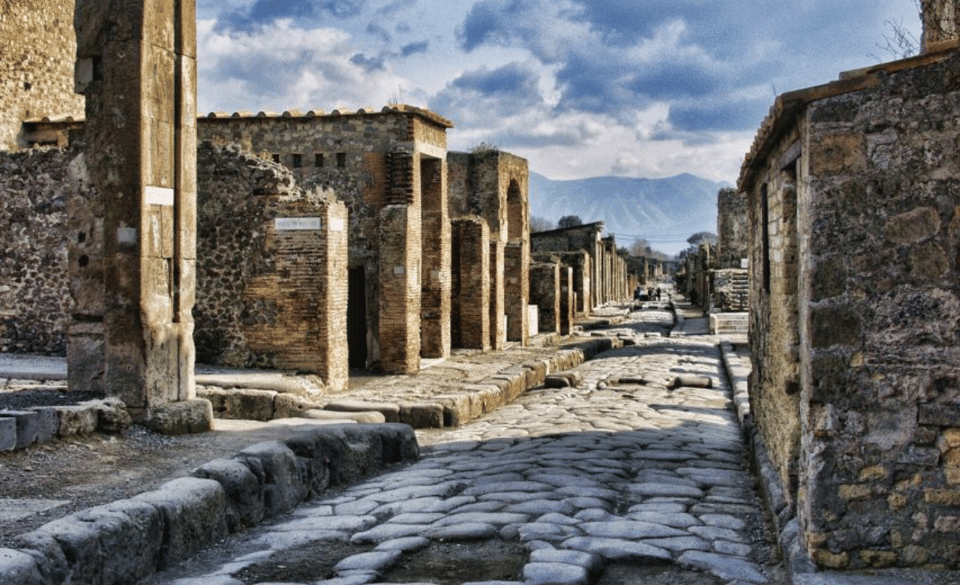
- Fast-track entry means less time standing and more time walking the site’s main areas
- GPS audio + digital map helps you find buildings and monuments without cramming a rigid schedule
- Temples, Forum, theater, baths give you a strong first-timer circuit in about 2 hours (plus extra time if you want)
- Eruption details and victim casts are the emotional core of the visit, not just “old stones”
- Optional art-historian tour is great if you want the history explained while crowds funnel you through the ruins
Getting In Fast at Piazza Esedra (Vox City Pickup)
Your biggest “win” here is how close the ticket pickup is to the action. You exchange your voucher at the Vox City info point in Piazza Esedra, in front of Hotel Vittoria. That’s where the official entry ticket exchange happens, and if you choose the guided option, that’s also where you meet your guide.
This matters because Pompeii’s entrance can be chaotic when you arrive without pre-booking. With this setup, you’re not trying to solve lines and signage while your day is ticking down. Instead, you go get your official ticket, then head straight into the site.
Timing tip: guided tours depart on your booked time slot. If you can, arrive about 5 minutes early so you’re not rushing while you’re trying to download the audio guide and get oriented.
What to bring:
- Headphones (not included)
- A charged smartphone (the audio guide is on your phone)
And yes, you need to plan on downloading the audio guide using the QR code on your voucher prior to arrival. That’s not “nice to have.” It’s how you actually get the audio running once you’re inside.
You can also read our reviews of more tours and experiences in Naples.



The 2-Hour Window: How to See Pompeii Without Feeling Rushed

The guided experience is 2 hours, but Pompeii itself is big enough that many people end up staying longer. Pompeii is open daily, and a typical visit is 2–4 hours, with the site covering about 44 square hectares (and you’ll also see it described as around 50 hectares depending on how it’s rounded).
So how do you avoid feeling like you’re sprinting? Think “priority walk,” not “checklist completion.” With the audio guide and map, you can steer toward the areas you care about most—then loop back if time allows.
A good way to frame your two hours:
- You start with the main public spaces and signature religious sites
- You move through residential and everyday-life highlights
- You finish with the eruption story pieces that make Pompeii unforgettable
Even if you don’t get a live art-historian guide, the audio guide approach supports this. It’s designed for you to walk, stop, listen, and keep going—rather than sitting through a lecture while the crowd shuffles you along.
And when you’re done with the guided portion, you can keep exploring. One reason this option works well is that it doesn’t force you to “exit right when the tour ends.” You can stay in the ruins and see more at your pace.
Audio Guide with Digital Map: GPS Help, Manual Work, and Download Reality
The included audio guide is multilingual, with commentary available in English, French, Spanish, German, and Italian (depending on what you select). It also comes with a digital map, so you can connect what you’re seeing to what you’re hearing.
Here’s the practical part: this audio guide is phone-based, and the experience depends on your setup.
- Some users report autoplay works well—the audio starts based on location.
- Others report autoplay doesn’t reliably trigger, which means you may need to manually select the next point of interest.
- A few people found the app hard to navigate when they wanted a fast overview.
So I’d treat the audio guide as flexible support, not a guaranteed “hands-free tour bus.”
My advice to reduce frustration:
- Download the audio guide before you arrive (QR code on your voucher)
- Bring headphones you already know work
- Make sure your phone battery is healthy and charged
- If the app feels confusing at first, don’t quit. Pause, check your map, then commit to a few named priorities (Forum, theater, baths, House of the Faun)
One extra heads-up: the app can list a very large number of points of interest. If you don’t pick a few “must-see” stops ahead of time, you can end up wandering a huge site without a clear focus. That’s not a fault of Pompeii—it’s just physics.
What You’ll See: Forum, Temples, Baths, Theater, and the House of the Faun
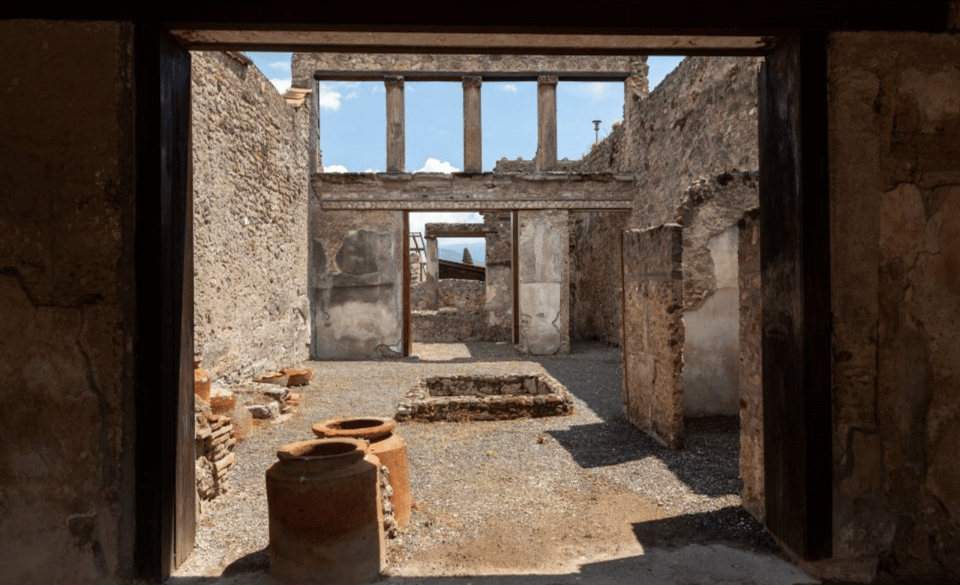
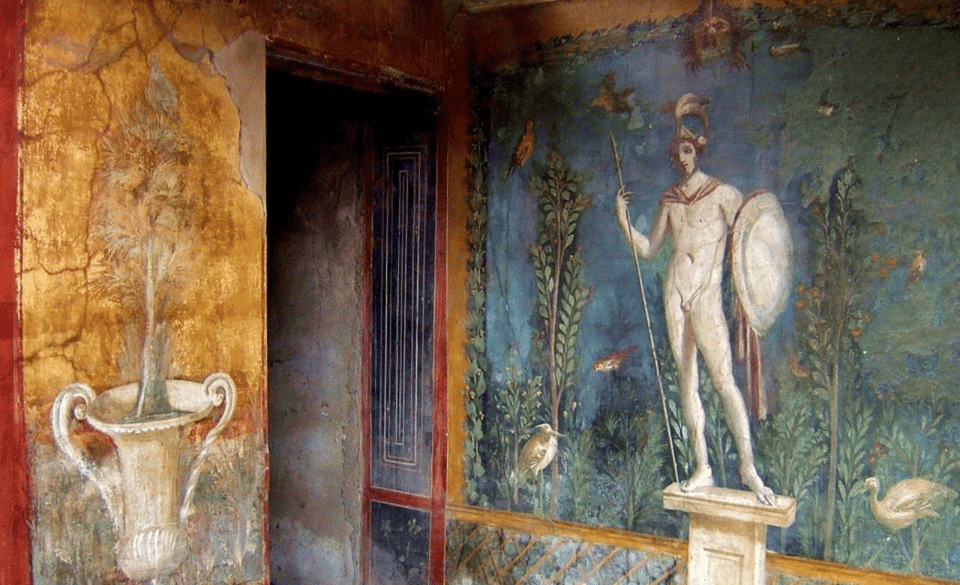
Once you’re inside, the ruins are arranged so you can piece together how a Roman city worked—public life, religious life, business life, and the private world of households.
The Forum and big public views
You’ll spend time in and around the Forum area, with Mount Vesuvius often visible in the background. That view is more than scenic. It anchors the story: you’re standing in a city that got buried during the 79 C.E. eruption, and you can point the geography back to what caused it.



Temples: Venus, Apollo, Jupiter
Pompeii’s religious sites are a core highlight in this package, including temples dedicated to Venus, Apollo, and Jupiter. These aren’t just pretty ruins. They show how Romans mixed civic identity with worship—what people prayed to was also what shaped the city’s calendar and social rhythm.
Markets and everyday life
The experience also leans into daily life: marketplaces and places that once supported commerce. If you’ve ever wondered what “regular Roman people” did, this is where Pompeii answers more honestly than most museums.
Public baths and mosaic detail
Another strong stop is the public baths, especially for the intricate mosaics. Pompeii’s preservation can make you forget the ruins are almost 2,000 years old. When you see mosaic patterns and tiling surviving under volcanic ash, you understand how carefully Pompeii can “teach.”
House of the Faun: household scale and comfort
You’ll also hit major residential highlights like the House of the Faun. Even if you don’t study Roman architecture, you can read the lifestyle difference between cramped, utilitarian spaces and homes that show taste and status.
Sirico’s house and the human side of inscriptions
Pompeii has plenty of “serious” history, but it also has jokes, branding, and personal messages. This ticket’s audio content includes notable details like the inscription at Sirico’s house, with the phrase Salve lucru (meaning Welcome, profit). It’s a reminder that everyday language—salesmanship, greetings, humor—was part of Roman life too.
Wine jars labeled Vesuvinum
You’ll also hear about wine jars labeled Vesuvinum, a playful reference to both the volcano and wine (vinum). It’s the kind of small detail that turns Pompeii from an archaeological site into a place that felt real.
Grand theater, aqueduct remnants, and fountains
The tour content also points you toward the grand theater and remnants of infrastructure like aqueducts and fountains. That’s a key value of Pompeii: it’s not only art and temples. It’s the plumbing and logistics of daily living, preserved in stone and plaster.
The Eruption Story: 79 C.E. and Those Plaster Casts
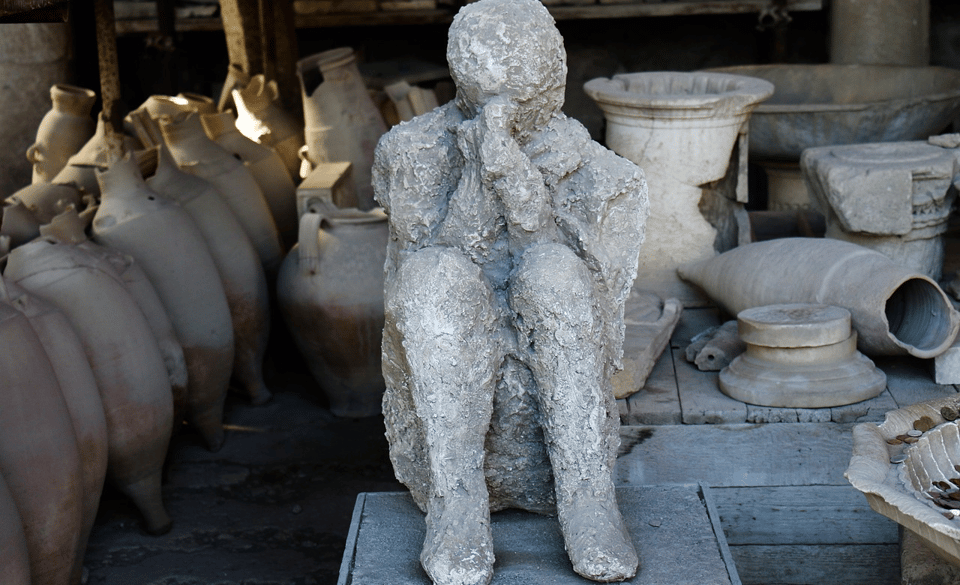
The emotional peak of Pompeii is always the eruption narrative. You’re walking through a city that survived for centuries, then got destroyed and preserved by the volcanic catastrophe in 79 C.E.
The ruins explain what happened in a way that lectures can’t. The streets under ash, the stopped moments, and the careful preservation of building interiors let you picture lives cut short—then preserved long enough for you to stand in their world.
This option’s audio content includes the notorious plaster casts of victims. Those casts do something uncomfortable but important: they turn Pompeii from “ancient city sightseeing” into a human story. It’s not pleasant. It is memorable—and it’s the reason Pompeii keeps pulling first-time visitors back in.
Optional Live Art-Historian Tour: When a Human Guide Saves Time
If you choose the optional guided tour, you get a professional art historian leading you in English, Spanish, or Italian (language chosen at checkout).
In practice, a guide helps in two ways:
- They build the connections between the ruins so you don’t just collect isolated facts.
- They route you efficiently through crowds and concentrated highlights, especially when you only have two hours.
Some guides you may encounter can be excellent at explaining details clearly and keeping energy up in a busy schedule. Names that have shown up in the experience include Grace, Maria, and Mario. If you get someone like that, you’ll likely feel you “got the big picture” much faster than with audio alone.
The trade-off is cost and timing discipline. The live guide departs on your booked slot. If you’re someone who wants total wandering freedom, the self-guided audio-only mode can fit better.
Suburban Villas Aren’t Included: Plan for a Second Day or a Second Ticket
This ticket does not include access to the suburban villas, including:
- Villa of the Mysteries
- Villa of Diomedes
- Villa Regina
That matters because those villas can be major highlights for some people—especially if you’re interested in gardens, country-life architecture, or high-profile residential estates.
If you’re dreaming of the full outer-ring Pompeii, you’ll need separate planning. If you mostly want the “heart” of Pompeii—the Forum, temples, baths, theater, and key houses—then staying within the included core can still be a very satisfying day.
Price and Value: Is $37 a Good Deal?
At $37 per person, you’re paying for more than the official ruins entry. You’re buying:
- Skip-the-line / fast-track entry
- The audio guide and digital map
- Optional live guiding by an art historian
- Booking fees (already included)
One review noted the official entry ticket is listed around 19 euros. If you compare that to what you pay here, the difference is what you’re really covering: speed, convenience, and the audio content.
So is it good value? For many people, yes—because time at Pompeii is the scarce resource. If you’re visiting on a tight day, avoiding the ticket queue alone can be worth it.
But if you already enjoy guiding yourself with your own research, and you’re comfortable troubleshooting phone-based audio, you might feel the add-on is less critical. In that case, the key is still the same: you’ll want good prep (headphones ready, phone charged, a few priorities picked).
Should You Book This Pompeii Ticket?

Book it if:
- You want fast entry so you can start sightseeing quickly
- You like a self-paced visit with a phone-based map and short audio segments
- You want a safety net of a guide option, especially if you’re visiting during busier hours
- You’re the type who enjoys details like inscriptions (Salve lucru) and themed wine branding (Vesuvinum)
Consider a different approach if:
- You need a strictly guided, no-tech experience (the audio app can require manual interaction)
- You hate relying on phone GPS or you’re worried about signal/battery issues
- You specifically want the suburban villas included in your ticket
If you’re on your first Pompeii trip and you want maximum return for your time, this is a very sensible way to do it: enter quickly, hit the big highlights, and use the audio to connect what you’re seeing to why it mattered.
FAQ
Where do I pick up my Pompeii skip-the-line tickets?
You exchange your voucher at the Vox City info point in Piazza Esedra, in front of Hotel Vittoria.
How long is the experience?
The guided tour component is about 2 hours. Many visitors spend 2–4 hours in Pompeii overall.
What languages are available?
Guided tours are offered in English, Spanish, or Italian. The audio guide includes multiple languages (English, French, Spanish, German, and Italian).
Do I need to bring headphones or a smartphone?
Yes. Headphones and a charged smartphone are required because headphones and mobile device access are not included.
Does this ticket include the suburban villas?
No. It does not include access to the suburban villas like Villa of the Mysteries, Villa of Diomedes, or Villa Regina.
How do I get the audio guide?
Scan the QR code on your voucher to download the audio guide prior to arrival.
Is free cancellation available?
Yes. You can cancel up to 24 hours in advance for a full refund.