REVIEW · NAPLES
Transfer from Naples to Positano with 2 hours Private Tour in Pompeii
Book on Viator →Operated by Askos Tours · Bookable on Viator
Pompeii in half a day is actually doable. This private setup pairs your ride south with a guided walk inside the Archaeological Area, so you get orientation and context without losing the whole day to logistics. I like that you get help from both the private driver and the Pompeii tour guide, which makes the transfer feel smooth instead of stressful.
I also really like that Pompeii admission is included, so you can focus on the ruins instead of ticket juggling. One thing to consider: the experience is timed to move, not linger, so if you want a slow, independent explore of everything, this format may feel a bit fast.
Key highlights at a glance
- Private Naples pickup at airport, central station, or your accommodation, with the driver holding a sign
- Pompeii entry included to the Archaeological Area, plus a guided plan through major stops
- Meet at Porta Marina Superiore, the main entrance for easy navigation
- Curated route mixing iconic public places with rich houses and theaters
- English guide with on-site assistance throughout your Pompeii time
- One-way transfer to Positano with hotel drop-off after the ruins
In This Review
- A private transfer that actually respects your time
- Price and value: what $467.63 per person gets you
- Pickup in Naples: where it starts and how it should feel
- Stepping into Pompeii at Porta Marina Superiore
- The fast, guided walk: Basilica, Foro, and the main street
- Basilica
- Foro de Pompeya (main square)
- Main street walk-through
- Granai del Foro: tables, fountains, casts, and meaning
- Casa del Menandro: what a rich house signals
- Stabian Baths and the Lupanar: public life and taboo life
- Stabian Baths (Terme Stabiane)
- Lupanar
- Casa del Fauno and the smaller theater moment
- Teatro Grande: the big finish with casts
- What’s included, and what you must plan for yourself
- Who should book this Naples to Positano Pompeii transfer
- Should you book this tour?
- FAQ
- How long is the Pompeii transfer experience?
- What is the price per person?
- Where can you be picked up in Naples?
- Where do you meet the Pompeii guide?
- Is Pompeii admission included?
- Is this a private tour?
- What language is the guide in?
- Are meals included?
- Is free cancellation available?
A private transfer that actually respects your time
This is the kind of plan that works when you’re short on time in Italy but still want the big Pompeii experience. Instead of treating Pompeii like an extra detour, it plugs into your travel day: you start in Naples, get picked up where you are, and your driver handles the one-way trip to Positano.
What makes it feel smarter is the pairing. You’re not just dropped at a ruin and told good luck. You have a Pompeii guide at the start, then a structured walk across the parts that are easiest to get excited about and hardest to skip.
This is also useful if you’re carrying bags. One real-world note: in at least one case, the car type wasn’t what the listing description suggested. The transfer might be a sedan instead of a minivan, so if you have bulky luggage, ask ahead what vehicle you’ll actually get.
Price and value: what $467.63 per person gets you
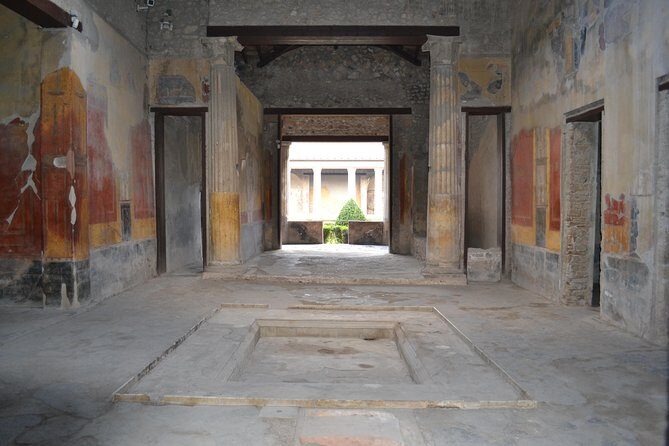
At $467.63 per person for a roughly 4-hour experience, you’re paying for three things at once: private transport, a guide-led Pompeii visit, and entry to the Archaeological Area.
Here’s why that can be good value:
- You get private air-conditioned transportation with pickup in Naples and hotel drop-off in Positano.
- You don’t have to buy separate Pompeii entry on your own since admission fees are included.
- You get a professional Pompeii guide to help you make sense of what you’re seeing as you move from stop to stop.
If you tried to stitch this together yourself, you’d likely spend extra time on scheduling, ticketing, and figuring out the best meeting point inside the ruins. This tour’s structure saves you that mental work.
The main value trade-off is time on-site. Pompeii is huge, and this route is designed for focus. You’ll see a lot of the top sights, but you won’t have hours and hours for independent wandering.
You can also read our reviews of more private tours in Naples



Pickup in Naples: where it starts and how it should feel
Your day starts with pickup in Naples—either the airport, central station (NAP), or your accommodation. The driver holds a sign with your name, which is a small detail that matters a lot when you’re arriving in a new place or you’re coordinating with multiple family members.
Car seats are available on request. Service animals are allowed. The tour also notes you’re near public transportation, which is helpful context in case you need a backup plan.
Two practical tips I’d follow:
- If you’re picky about vehicle size for luggage, confirm the actual car/van type before you go.
- If you’re arriving at the airport, give yourself a little buffer for that first handoff, since the Naples pickup window depends on where you’re starting.
Stepping into Pompeii at Porta Marina Superiore
Your Pompeii guide meets you at the main entrance called Porta Marina Superiore. This matters more than it sounds. Pompeii has a maze-like layout, and a good entry point helps you get your bearings quickly and reduces walking that doesn’t add much.
From there, the first stop is the Pompeii Archaeological Park area itself, with 10 minutes at the entrance plus the admission ticket included. Think of this as your warm start: you get into the ruins with a plan, and you’re not fumbling with where to begin.
If you like getting oriented fast, this start checks that box. It’s not just about seeing stone walls; it’s about understanding what comes next and why those locations are worth your attention.
The fast, guided walk: Basilica, Foro, and the main street
Once you’re inside, the route shifts through Pompeii’s key public spaces and central streets. The goal is to help you read the city while you walk.
Basilica
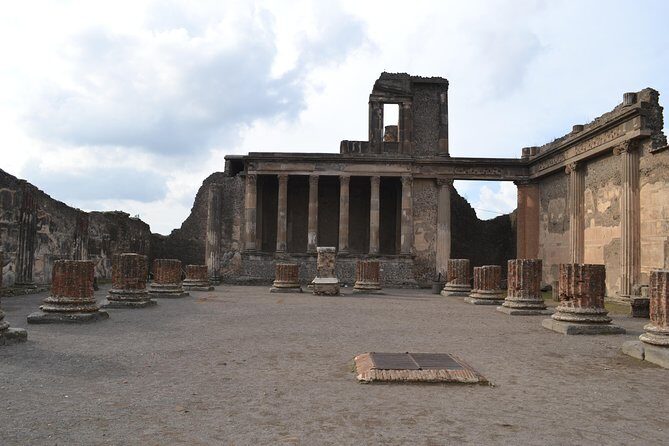
The Basilica stop is described as an open portico that offered shelter to merchants and other activities. In a short visit, this kind of place is a win because it teaches you how people used the space, not just what it looked like.
You’ll get about 15 minutes here, including time to absorb the idea of commerce and daily movement.
You can also read our reviews of more tours and experiences in Naples





Foro de Pompeya (main square)
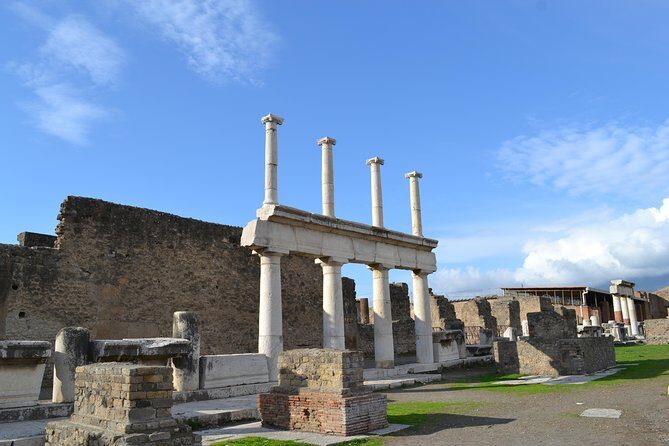
Next is the Foro de Pompeya, Pompeii’s ancient main square, again around 15 minutes. A forum-style area is perfect for a time-limited visit because it’s naturally central: it helps you visualize gatherings, processions, and everyday public life.
Main street walk-through
Between major named stops, you’ll also walk through the main street. This section is essential because it connects the dots. When you’re moving, you start seeing how buildings relate to the street and how the city would have felt when it was active.
One downside of a compressed route: you have less time to stop and study every corner. If you’re the type who loves long photo breaks, be ready to choose your moments.
Granai del Foro: tables, fountains, casts, and meaning
The Granai del Foro is where the tour gets more specific and a bit more emotional. You’ll see marble tables, plus baths for fountains that adorned house entrances. That’s the kind of detail that’s easy to miss if you just skim ruins.
You’ll also see something heavier: casts of victims of the eruption, including a dog and a tree. This isn’t just a weird side exhibit. It changes the mood of the entire visit because it shifts the ruins from architecture into lived experience and human impact.
You get about 15 minutes here, which is enough time to register the details and connect them to the surrounding areas. It may not be enough for deep reflection, but for many people, it’s the right balance on a transfer day.
Casa del Menandro: what a rich house signals
Next is Casa del Menandro, described as one of the richest and most magnificent houses in Pompeii, noted for architecture, decoration, and contents. That phrase matters: the tour isn’t selling you a random house stop. It’s positioning this one as a strong example of how high-status Pompeians lived.
You’ll spend about 15 minutes there. In that time, you can usually pick up a sense of layout and the contrast between decorative areas and more functional ones.
If you’ve ever wondered why some ruins look more dramatic than others, rich residences like this give you the answer. They’re built to show wealth, taste, and social standing.
Stabian Baths and the Lupanar: public life and taboo life
Two of the most memorable stops on this route are the ones many people either love or feel uncertain about—because they’re both very human.
Stabian Baths (Terme Stabiane)
The Stabian Baths occupy a vast area and represent the oldest thermal complex in the city, according to the tour description. You’ll get about 15 minutes here.
Bath complexes are great for a quick visit because they help you understand daily routines. People didn’t just see public buildings; they used them. Even in ruins, the scale of the baths gives you a sense of how much communal life mattered.
Lupanar
Then comes the Lupanar, described as the most famous brothel in the ruined Roman city of Pompeii. You’ll spend around 15 minutes.
This is a stop that may feel surprising if you expected Pompeii to be only noble statues and grand theaters. But it’s also part of how Pompeii can feel complete: it includes the uncomfortable parts of urban life.
If you want a tour that includes a range of experiences—public spaces, wealth, everyday routines, and taboo—you’ll likely appreciate this pacing.
Casa del Fauno and the smaller theater moment
Next on the list is Casa del Fauno, one of the largest and most impressive private residences in Pompeii. Again, you get 15 minutes, and the house format gives you a visual “zoom in” after the public bath and street-level stops.
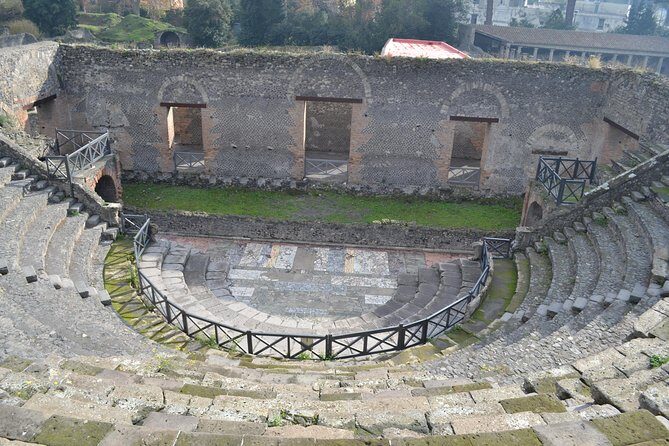
After that, there’s a brief look at the Teatro Piccolo. The tour description says you’ll have a look, without making it a long stop. For short visits, that’s smart. It keeps you from skipping the theater idea entirely while still saving time for the main event.
One thing to watch for in any Pompeii tour: uneven walking surfaces. You’ll be outdoors and moving between different areas, so wear shoes you’re comfortable hiking in.
Teatro Grande: the big finish with casts
The route ends with Teatro Grande, described as the most important theater in Pompeii, with about 15 minutes. The theater is often the highlight because it brings architecture, public gatherings, and scale together in one view.
The tour also notes you’ll see the house of Tragic Poet as well as famous plaster casts. Those casts are part of what makes Pompeii emotionally different from many other archaeological sites. They’re not just carvings or decorative mosaics; they’re evidence made visible through the ruins.
This combination—major theater plus casts—works well as a concluding sequence. It gives you both awe (the theater) and weight (the casts), which is an honest way to end a short visit.
What’s included, and what you must plan for yourself
Here’s the practical side. This experience includes:
- Transport by private air-conditioned minivan (though, as mentioned, the vehicle may not always match the word minivan in the way you expect)
- One-way private transfer from Naples to Positano
- Hotel drop-off
- Professional Pompeii guide and assistance while you’re in Pompeii
- All taxes
- Admission fees to the Pompeii ruins
Not included:
- Meals
That last point matters because Pompeii can make you hungry fast, and you’re doing this on a travel day. If you need food, plan to eat before you start or after you reach Positano.
Also, bring what you need for outdoor walking: water if you like it, sun protection, and comfortable shoes. The itinerary is paced for movement, not lounging.
Who should book this Naples to Positano Pompeii transfer
This tour fits you if:
- You’re moving around Italy and want Pompeii without spending a full day on it.
- You like structure—a guide-led route with major stops lined up.
- You want private pickup and drop-off, which is a big quality-of-life upgrade versus coordinating transit and timelines alone.
- You want Pompeii’s range: public spaces like the Foro, private homes like Casa del Menandro and Casa del Fauno, and the more specific stops like Stabian Baths and the Lupanar.
You might choose something else if:
- You want a slow, self-paced day with lots of time to linger in each area.
- You have mobility needs that make quick route changes difficult (the tour says most travelers can participate, but the format still involves walking).
Should you book this tour?
If you’re deciding whether to squeeze Pompeii into a transfer day, I’d say this is the kind of plan that makes sense. You’re getting private Naples-to-Positano transport, you’re not paying extra for Pompeii admission, and you get a guide to help you understand what you’re seeing as you move through key stops.
The biggest “do your homework” point is the vehicle. Based on one real experience note, the car can differ from what you expect, so confirm the actual vehicle type if you have a lot of luggage or you’re traveling with a lot of bags.
If your main goal is seeing Pompeii highlights efficiently and arriving in Positano without transport headaches, this one is worth considering.
FAQ
How long is the Pompeii transfer experience?
The duration is approximately 4 hours.
What is the price per person?
The price is $467.63 per person.
Where can you be picked up in Naples?
Pickup is offered at the airport, Naples central station (NAP), or your accommodation in Naples.
Where do you meet the Pompeii guide?
You meet the guide at the main entrance of Pompeii ruins called Porta Marina Superiore.
Is Pompeii admission included?
Yes. Admission to Pompeii’s Archaeological Area is included.
Is this a private tour?
Yes. It’s private, and only your group participates.
What language is the guide in?
The tour is offered in English.
Are meals included?
No, meals are not included.
Is free cancellation available?
Yes. You can cancel for free up to 24 hours in advance for a full refund, based on local time.