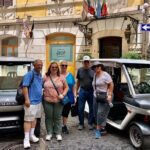
Rome does church-watching differently.
This private golf-cart tour is built for seeing more than you can comfortably manage on foot, with a smooth ride between six sights and time to actually take it in. I love the hotel pickup option when you’re within the golf cart zone, and I love how the guides mix driving skills with real explanations, like Luisa’s go-the-extra-mile service and Antonio steering you to the right details. One thing to plan for: one church stop can shift on certain religious or bank holidays, so be ready for a small change in the day’s order.
In This Review
- Why a Golf Cart Works So Well for Rome’s Churches
- Key things I’d plan around
- Six Stops, One Mission: More Rome in Less Time
- Stop 1: Piazza del Popolo and the Square That Plays Tricks
- Stop 2: San Pietro in Vincoli and Michelangelo’s Moses Up Close
- Stop 3: Church of St. Louis of the French (Caravaggio and Chapels)
- Stop 4: Chiesa di Sant’Ignazio di Loyola and the Ceiling Illusion
- Stop 5: The Pantheon and What You Learn Before You Look
- Stop 6: Piazza Navona and the Stadium Shape You Can Still See
- The Guides Make or Break It (And This One Has Strong Proof)
- Who This Tour Fits Best
- Where You Meet and How the Day Flows
- Value Check: Is $204.70 Per Person Worth It?
- Should You Book This Private Golf-Cart Church Tour?
- FAQ
- FAQ
- How long is the private golf-cart tour?
- What does the tour cost?
- Is hotel pickup available?
- Where do we meet?
- How many stops are included?
- Are entrance tickets included?
- What language is the tour offered in?
- Is this tour private or shared?
- What if religious holidays or closures affect a stop?
- Can I bring a service animal?
Why a Golf Cart Works So Well for Rome’s Churches
This tour is a smart fix for Rome’s big problem: distances add up fast, and cobblestones are not friendly after hours of walking. The golf cart lets you cover a lot of ground while still slowing down at each stop, instead of doing a frantic photo sprint. I especially like that it’s private, so you get personal pacing, and families can take breaks without feeling rushed. The main drawback is simple: you still want to be able to hop on and off and stand for short viewings, since the stops are only about 20 minutes each.
Key things I’d plan around
If you come expecting a quiet, long sit-down museum day, adjust your expectations. This is more like a guided, efficient “greatest hits” route of Rome’s sacred art and architecture, with quick stops timed for the 3-hour experience length.
You can also read our reviews of more private tours in Rome

Six Stops, One Mission: More Rome in Less Time
The route is focused, not random. You’ll roll from landmark squares into churches that pack famous art, optical tricks, and major religious symbolism. The best part is how the stops complement each other: you get dramatic squares, then you step inside for ceilings, chapels, and sculpture before ending back where you started.
Also, the price is not just for the vehicle. At $204.70 per person for about 3 hours, the real value is the combo of private guiding, hotel pickup (when possible), and the ability to fit six big stops into one day without burning your energy. It’s not the cheapest way to do Rome, but it is a practical one if you want efficiency and a guide who can call out what to look for.
Stop 1: Piazza del Popolo and the Square That Plays Tricks
You start in Piazza del Popolo, one of Rome’s best-known squares. It’s famous, but it still has mystery built into the layout, including the idea of twin churches that look identical from a distance. You’ll also hear about the way the space can affect sound, including the echo effect around the square.
Why this works: it’s a strong warm-up. You get oriented fast, you get a sense of how Rome stages its big public spaces, and then you’re ready for the smaller, more intense experiences inside the churches.
Practical note: the stop is about 20 minutes, so it’s not for lingering. Use the time to locate key lines of sight and take a few establishing photos.
Stop 2: San Pietro in Vincoli and Michelangelo’s Moses Up Close
Next is San Pietro in Vincoli, a church that’s described as a real hidden gem for its religious symbolism. The focus here is on the chains associated with Saint Peter, held both in Jerusalem and in Rome. Then the church turns into art history, because it’s also known for Michelangelo’s Moses.
The tour points out that the Moses statue carries a bit of a peculiarity, and that’s exactly the kind of detail you want on a church visit. You’re not just walking into a building; you’re being guided toward the specific feature that turns the stop from ordinary to memorable.
Why it’s worth your time: short stops are common on tours, but this one is built around two strong anchors—religious meaning plus a masterpiece you may already have heard of, now explained and easier to appreciate.
Stop 3: Church of St. Louis of the French (Caravaggio and Chapels)
This is one of the more art-and-details-driven stops: Church of St. Louis of the French. You’ll start with the breathtaking façade and then move inside to see multiple chapels and key artworks.
Highlights you should look forward to:
- The Chapel of St. Louis, noted as the first chapel entirely designed by a woman
- Contarelli Chapel, with three Caravaggio paintings
This stop is also explicitly free during the day, so you’re getting a lot of value without paying entry fees for that portion.
Important consideration: the church may be modified based on religious holidays, national and bank holidays, and/or road closures. If the day changes, treat it as part of the reality of Rome. The good news is that the tour is private, so changes can be handled without dragging a large group through delays.






Stop 4: Chiesa di Sant’Ignazio di Loyola and the Ceiling Illusion
Now you’re in Chiesa di Sant’Ignazio di Loyola, where the big attraction is the ceiling’s “false perspective” effect connected to Saint Ignatius. This is the kind of church feature that can feel almost like a magic trick: when you look at it the wrong way, it seems flat; when you look at it the right way, it becomes dimensional.
The tour adds a practical twist: if you just stop at the first part most people notice, you might miss something. The guide will keep you moving so you see what not everybody catches.
Why this stop matters: it’s one of those Rome moments where architecture isn’t just decoration. It’s a visual experience, and it’s easier to get the full effect when someone tells you where to stand and what to watch for.
Stop 5: The Pantheon and What You Learn Before You Look
Next is the Pantheon, and this is the only stop where admission is not included. It’s also where the tour gives you a useful perspective before you go inside.
You’ll be guided through the idea that this was once an ancient Roman pagan temple area and that, later on, it became a Catholic church. The tour also mentions that the surrounding area hosted an Egyptian sacred complex before all the later layers.
Why I like this approach: if you know what to look for, the building becomes more than impressive. It turns into a story you can piece together with your eyes.
Time check: about 20 minutes here. It’s enough to appreciate the main features, but if you want a slow, museum-style visit, plan to come back later on your own.
Stop 6: Piazza Navona and the Stadium Shape You Can Still See
You finish at Piazza Navona, which is famous for its distinctive shape. From ground level it looks like a lively square, but the tour explains that if you imagine it from above, it lines up with the old Stadium of Domitian concept, and that ruins are still partially visible.
The real value of this stop is the translation from ancient layout to modern streets. When you’re taught what used to be here, the square makes more sense, and your photos stop looking random. They start looking like evidence.
Time check: again, about 20 minutes. Think of it as a satisfying wrap-up—one last “this city is layered” moment.
The Guides Make or Break It (And This One Has Strong Proof)
The best part of this tour is the people driving it. Multiple guide names stand out in the experiences people described, and the common theme is not just facts, but how they bring the stops to life while handling Rome traffic and parking.
From the reviews you can see this pattern clearly:
- Luisa is praised for going above and beyond and making the day feel smooth and personal
- Antonio is highlighted for helping families and even adjusting the original plan to fit the day, including the chance to see another major basilica
- Marco gets credit for an engaging church explanation and for handling narrow cobblestones with confidence
- Carlos focuses on church knowledge and helped visitors understand the craft behind the beauty
- Yashar is described as amazing and excellent at getting to everything and more
- Gianluca is noted for on-time pickup and a comfortable cart ride starting the day right
One practical detail I’d take seriously: open-air carts can be a nice change in Rome heat and fatigue. One review specifically mentions a Fiat Topolino Dolcevita feel and that it was cool enough that no AC was needed. Even if your cart is different, the general point is useful: this is not a stuffy, slow bus day.
Who This Tour Fits Best
This tour is ideal if you:
- Want to see major churches and key squares without doing a long walking slog
- Prefer a private pace, especially if your group includes kids
- Enjoy art and symbolism and want help spotting what matters quickly
- Appreciate a guide who can connect the dots between architecture, religion, and famous artists
It can also be a good option if mobility is limited. One review mentions support for an amputee family member, and the tour’s setup includes a service-animal welcome.
Where You Meet and How the Day Flows
You meet at Piazzale delle Canestre, 00197 Roma RM, Italy. The tour ends back at that meeting point. Pickup is offered if your hotel is within the golf cart range, which is a big deal in Rome because starting from a convenient location cuts down your stress.
The experience is private, with only your group participating, and it’s offered in English. You’ll also receive a mobile ticket.
Value Check: Is $204.70 Per Person Worth It?
In Rome, “worth it” depends on what you’re buying. You’re not paying for long museum hours. You’re paying for:
- A private guide who can steer the day and keep it moving
- Efficient routing between six major church/square stops
- Hotel pickup when you’re close enough for the cart to reach
- Reduced fatigue compared with trying to chain these stops on foot
If you’re the type of traveler who spends your energy on getting from place to place, this tour saves you from that. If you’re comfortable walking all day and you love solo exploring at your own rhythm, you might prefer building your own church route. But if you want a guided day that hits key moments fast and smoothly, this is a strong match.
Should You Book This Private Golf-Cart Church Tour?
I’d book it if your priority is churches plus smart pacing. It’s especially compelling if you want a guided route that includes famous names like Michelangelo’s Moses and Caravaggio, plus the visual “wow” factor of Sant’Ignazio’s ceiling illusion. The strong guide track record, including Luisa, Antonio, Marco, and Carlos, also matters because Rome can be chaotic; having someone who handles the driving and teaches the art is the whole point.
I would skip it if you only want Pantheon-style deep time at a slower pace, or if you already plan to revisit many of these sites at length. This is a fast, focused, guided day, not a full-day slow immersion.
FAQ
FAQ
How long is the private golf-cart tour?
The tour runs about 3 hours.
What does the tour cost?
It’s listed at $204.70 per person.
Is hotel pickup available?
Pickup is offered if your hotel is located within the golf cart range.
Where do we meet?
Meet at Piazzale delle Canestre, 00197 Roma RM, Italy, and the tour ends back at the meeting point.
How many stops are included?
You’ll visit six stops: Piazza del Popolo, San Pietro in Vincoli, Church of St. Louis of the French, Chiesa di Sant’Ignazio di Loyola, the Pantheon, and Piazza Navona.
Are entrance tickets included?
Entrance is free for most stops mentioned, but Pantheon entry is not included.
What language is the tour offered in?
The tour is offered in English.
Is this tour private or shared?
It’s private. Only your group participates.
What if religious holidays or closures affect a stop?
The Church of St. Louis of the French may be modified based on religious holidays, national and bank holidays, and/or road closures.
Can I bring a service animal?
Yes, service animals are allowed.