REVIEW · NAPLES
Skip-the-Line Pompeii & Mt. Vesuvius Day Trip from Naples
Book on Viator →Operated by IAMME IA! - Gray Line Amalfi Coast · Bookable on Viator
Pompeii and Vesuvius in one packed day. This day trip from Naples is built for real-world time limits: skip-the-line entry at Pompeii and an air-conditioned coach that gets you inland without the stress of transfers. You’ll get a guided walk through major Pompeian landmarks, then head up to Vesuvius for big Gulf of Naples views from about the crater rim area.
I especially like two things: first, how the Pompeii guide helps you read what you’re seeing—Forum, baths, markets, big houses—so it’s not just walking through ruins. Second, the pacing gives you actual photo time on Vesuvius, not only a bus stop and a “good luck.” One consideration: a lot of this day is outdoors, and bad weather can make the climb miserable or lead to Vesuvius being closed.
In This Review
- Key Highlights to Expect
- Naples-to-Pompeii in Comfort: The Coach Part Matters
- What you’ll notice on the drive
- Pompeii With a Guide: How the Route Helps You See the City
- Guides and the human factor
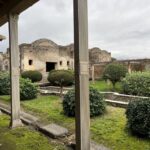
- The Pompeii Stops You’ll Actually Walk Past
- Forum: the daily engine of Pompeii
- Temple of Jupiter: statues you can visualize
- Macellum: the market, not the museum
- Via dell’Abbondanza: Pompeii’s main street energy
- Stabian Baths (Terme Stabiane): public life in bathing form
- Lupanar: what’s on the itinerary and why you might miss it
- House of the Faun (Casa del Fauno): wealth made visible
- Teatro Grande: the hill-shaped theater
- Basilica: where business and justice met
- Mt. Vesuvius: What the Climb and Crater Time Really Feels Like
- How high can you go?
- The guide situation on Vesuvius
- Views worth the effort
- Price and Value: Is $139.07 a Fair Deal?
- Weather, Crowds, and the Group Reality Check
- Pompeii crowds can still compress your experience
- Vesuvius closure backup
- Rain can turn the day into a wet slog
- Best For: Who Should Book This Day Trip
- Should You Book This Tour?
- FAQ
- How long is the Pompeii and Mt. Vesuvius day trip?
- What’s the price per person?
- Is Pompeii skip-the-line included?
- Do I get a guide in Pompeii?
- Are tickets included for Pompeii and Vesuvius?
- Will there be headphones?
- How high do we go on Mt. Vesuvius?
- Who guides the hike on Vesuvius?
- What if Mt. Vesuvius is closed?
- What’s included in the price besides transport and tickets?
- Is this tour suitable for cruise passengers?
Key Highlights to Expect
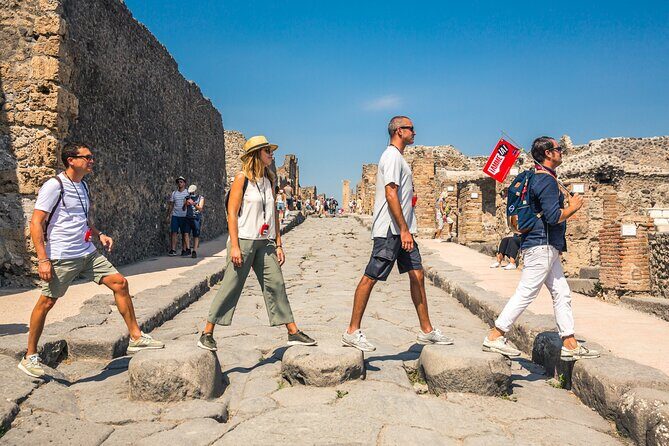
- Skip-the-line Pompeii entry: less waiting, more seeing, and your group typically arrives early.
- Pompeii guided narration with headphones: hearing the guide clearly in a noisy, crowded site.
- A focused Pompeii route: Forum, Jupiter temple area, markets (Macellum), baths, theater, and more.
- Crater-edge views from Vesuvius: stop near 1,280m plus time for your own pace on the trail.
- Realistic group size: up to 30 people, which can feel big in the densest areas.
- Backup plan if Vesuvius is closed: Herculaneum skip-the-line ticket can replace the volcano visit.
Naples-to-Pompeii in Comfort: The Coach Part Matters
This trip saves you from the usual Naples chaos. You meet at P.za Giuseppe Garibaldi, 91 (near Starhotels Terminus) and then ride inland by air-conditioned coach. For many people, that comfort is more than a luxury—it’s the difference between arriving ready to enjoy Pompeii and arriving tired before the walking even starts.
Pompeii is a “come early or suffer” place. The tour is timed so you get into the Archaeological Park with skip-the-line access, and several reviews note arriving among the first groups. In a site like Pompeii, early access isn’t just about convenience. It changes your experience: fewer people at key stops means you can look longer and take photos without squeezing.
You can also read our reviews of more tours and experiences in Naples


What you’ll notice on the drive
The ride inland shifts the mood fast. You’re leaving the coast behind and moving toward the volcano. It’s a quick mental preview of what you’ll see later on Vesuvius: this is not just Roman history—it’s Roman history shaped by a specific natural disaster.
Pompeii With a Guide: How the Route Helps You See the City
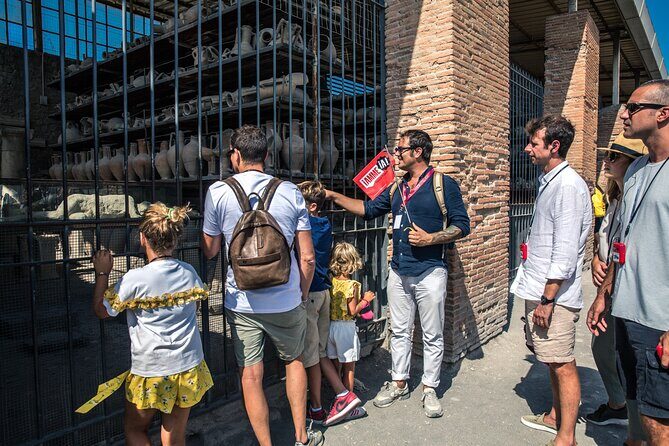
Pompeii covers a massive area, but this tour isn’t trying to “do it all.” Instead, it gives you a guided core route that makes the rest of the site make sense if you return later. You’ll spend about 2 hours in the Pompeii Archaeological Park with an official guide, plus short timed stops at standout structures.
In plain terms: this works best if you want a strong first visit. If you want to wander for hours with zero direction, a guided day can feel like you’re moving with a purpose and not at your own pace.
Guides and the human factor
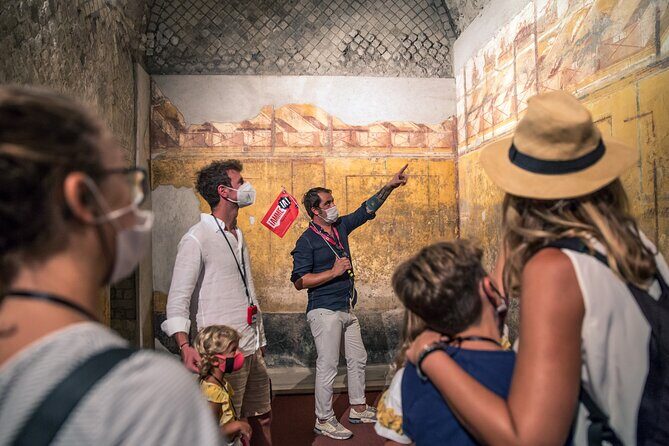
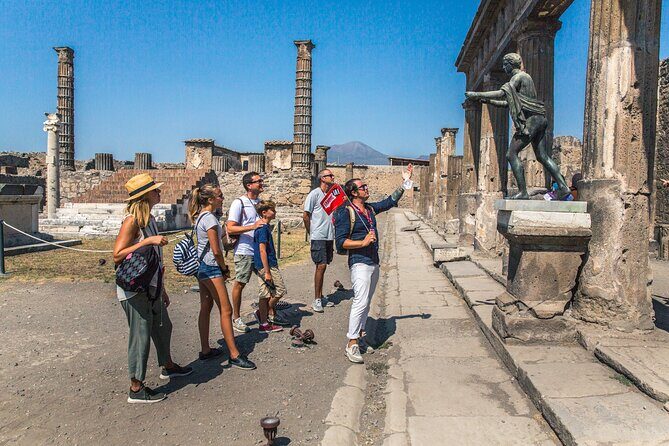
The quality of the Pompeii guide shows up clearly in reviews. People praised guides including Roberta, Isabella, Angie, and Rebecca for explaining what you’re looking at and keeping the day on schedule. You’ll hear the story behind places like the Forum and baths, and the guide helps you connect the ruins to daily life—food, politics, social status, and how buildings fit together.
Also, for groups bigger than 10, you get headphones. That’s a small thing that matters. Pompeii is loud, and standing in the wrong spot can make a guided tour feel like you’re watching someone talk into a wall.
The Pompeii Stops You’ll Actually Walk Past
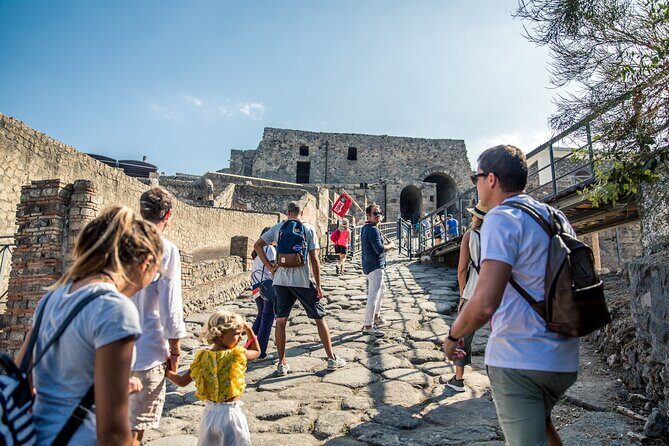
Here’s what you’ll see, and why each stop is worth your attention. Times are part of the reality check—some sights are quick photo stops, others are where your guide’s commentary really lands.
You can also read our reviews of more tours and experiences in Naples


Forum: the daily engine of Pompeii
The Forum sits at the center of civic life. It functioned as a thriving market and trade center and also tied closely to politics. When your guide points out how public space worked, you’ll start noticing the layout: where people moved, where business happened, and how power was displayed.
If you’ve ever wondered why ancient cities were planned like they were, Pompeii’s Forum gives you an answer you can feel.
Temple of Jupiter: statues you can visualize
At Tempio di Giove Capitolino, you’ll see the Capitolium-style temple theme repeated from Rome. The key detail is the statuary—Jupiter, Juno, and Minerva—placed high enough to be visible to passersby in the Forum. Even if you don’t memorize names, you’ll understand the message: this city wanted to look important.
Macellum: the market, not the museum
The Macellum was Pompeii’s provision market building. It was central to food supply and trade, and it shows how the city rebuilt itself after disruption—especially after the earthquake of 62 AD.
If you like archaeology that connects to everyday life, this is one of the stops that makes the ruins feel less distant.
Via dell’Abbondanza: Pompeii’s main street energy
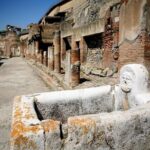
The ancient main street, Via dell’Abbondanza, was a crowded corridor of shops and workshops. Your guide may talk about the street as a “decumanus maximus” spine running east/west through Pompeii. The payoff: you start imagining the soundscape—people, sellers, and snacks—rather than just marble and stone.
Stabian Baths (Terme Stabiane): public life in bathing form
Behind the Jupiter temple area are the Stabian Baths, associated with the period after Sulla’s veteran colony. What’s interesting here is the structure: separate male and female entrances, then rooms that map to temperature ranges—dressing room, cold, warm, hot.
The tour doesn’t try to turn you into a bathhouse expert. Still, the stop gives you a reality check: Roman leisure wasn’t optional. It was built into the city.
Lupanar: what’s on the itinerary and why you might miss it
The Lupanar, Pompeii’s famous brothel, is listed as a highlight, known for its erotic wall paintings. But one review included a disappointment: the guide skipped it even though it appeared in the tour overview.
Here’s the practical takeaway: if seeing the Lupanar is your must-do, don’t assume it’s guaranteed in the exact same way every tour runs. In at least one instance, the guide adjusted the route to avoid long queues and keep the experience comfortable. That doesn’t mean the stop is never offered—it means timing inside Pompeii can shift.
House of the Faun (Casa del Fauno): wealth made visible
Casa del Fauno is one of Pompeii’s biggest luxury residences. It’s named for a bronze faun statue, and the big draw is the Alexander Mosaic—the famous battle depiction between Alexander the Great and Darius III.
Even if you only get a short look, this stop helps you understand Pompeii’s social layers. It’s hard to see houses like this and still think “everyone was the same.”
Teatro Grande: the hill-shaped theater
Teatro Grande takes advantage of a natural depression in the hill. It’s divided into sectors, and it was used for Greco-Roman tragedies. Standing near it, you’ll feel the logic of design: the city used terrain like part of the architecture.
Basilica: where business and justice met
Finally, the Basilica—the largest Forum building—served business functions and also administration of justice. It’s the kind of building that helps you understand that Roman “government” wasn’t a separate building across town. It lived in the same public zones as markets and speeches.
Mt. Vesuvius: What the Climb and Crater Time Really Feels Like
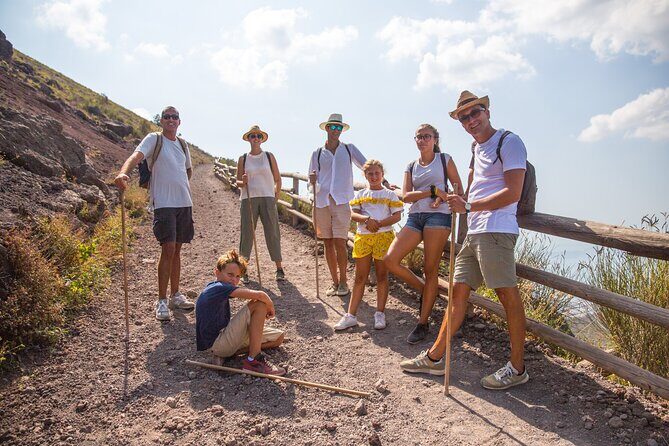
After Pompeii, the day shifts from archaeology to geology. You travel to Vesuvius National Park, reaching a stop around 1,280 meters for crater views. You’ll get about 30 minutes there, and you’ll also have additional time after being dropped around 1,000 meters.
The big difference between Pompeii and Vesuvius is the physical side. Pompeii is walking. Vesuvius is walking plus incline plus volcanic ground. The path is uneven, and reviews mention it can be steep with loose ash—not a smooth stroll.
How high can you go?
You don’t just get a viewpoint from a bus. You can climb toward the crater edge area on your own. Reviews describe people of different ages managing it at their pace, but also call out that the hike is not easy for everyone.
One helpful review detail: there are two snack shops on the trail, but facilities are only at the base. That’s the kind of info that changes how you plan what to carry.
The guide situation on Vesuvius
Your guide handles Pompeii. For Vesuvius, the climb is basically on your terms. There’s mention of a local mountain guide available should you want a guided tour at your own expense, but your main tour guide doesn’t accompany you all the way to the top. In other words: you’re hiking as a group, not being shepherded step-by-step to the crater funnel.
Views worth the effort
Even when weather turns iffy, Vesuvius is why people book this day. The crater rim gives you wide views across the Gulf of Naples. It also helps you understand why the Roman cities got caught so hard in AD 79. Seeing the terrain makes the eruption story stop being abstract.
Price and Value: Is $139.07 a Fair Deal?
At $139.07 per person for an about 8-hour full day, you’re paying for three things:
- Skip-the-line Pompeii admission plus an official guide.
- Round-trip transportation by air-conditioned coach.
- Vesuvius National Park admission plus time on the slopes.
If you were to plan the same day solo, you’d still spend money on entry tickets, transport, and the hassle of coordinating timing around crowds. The tour also reduces friction: you don’t have to figure out the best sequence for Pompeii highlights or worry about missing the last bus out of the volcano area.
That said, value depends on weather. This experience requires good weather, and one review described arriving at the volcano after driving up only to find Vesuvius closed for safety. In that case, some people received reimbursement after the fact. If you’re traveling at the start of a rainy stretch, the “cost” isn’t the refund—it’s the risk that the crater part becomes a consolation plan.
Weather, Crowds, and the Group Reality Check

This is where the tour’s strengths and limitations show up.
Pompeii crowds can still compress your experience
Even with skip-the-line, Pompeii gets busy. Reviews mentioned the group can feel large in dense areas, making it hard to see what the guide is pointing at if you’re toward the back. The tour is max 30 travelers, which is not huge, but Pompeii ruins are not forgiving.
Practical fix: stay close to the front where you can, and don’t treat this like a sightseeing bus loop. If you want the guide’s explanations to land, you need to be in earshot.
Vesuvius closure backup
If Vesuvius is closed, the operator offers an alternative: a skip-the-line ticket to visit Herculaneum instead. That’s an important value point. You’re not just stuck with no plan.
Rain can turn the day into a wet slog
One review called out the frustration of rain during a fully outdoor experience—umbrellas and ponchos make group movement difficult, and puddles build quickly. There’s no roof over the Pompeii walkways or the Vesuvius climb path. If your itinerary depends on perfect comfort, you’ll want to track the forecast closely.
Best For: Who Should Book This Day Trip

This tour fits best if you want:
- A first visit to Pompeii with a guide that helps you understand the major parts fast.
- A real Pompeii-and-volcano combo without spending the day on logistics.
- Comfortable transport out of Naples, with headphones to keep the story audible.
- A group-day pace that includes time for crater photos.
It may not fit if you:
- Want to roam Pompeii at your own slow speed, without timed stops.
- Get irritated by bigger groups in tight spaces.
- Need a gentle, well-paved hike. Vesuvius includes steep and uneven ground, and reviews warn the climb can be strenuous.
Should You Book This Tour?
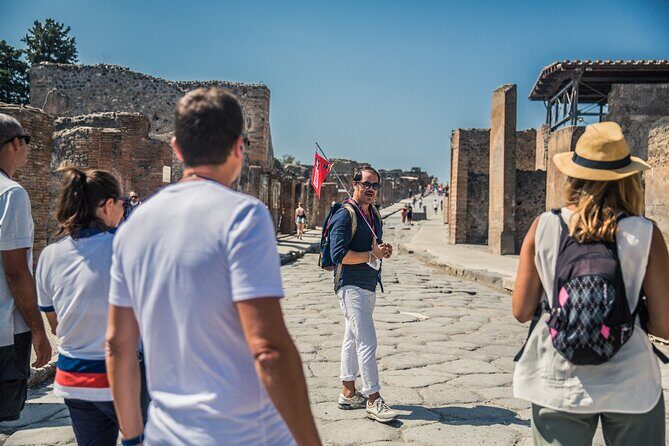
Yes, if you’re the type who likes structure and you want your Pompeii visit to make sense. Skip-the-line entry, an official Pompeii guide, and Vesuvius crater-edge time are the core reasons this works.
I’d still book with eyes open:
- Bring smart footwear and plan for the reality of an uphill volcanic trail.
- Check weather before you commit, because this day leans heavily on outdoor conditions.
- If the Lupanar is your single top must-see, understand it can be adjusted depending on timing and queues inside Pompeii.
If your goal is to see the essentials without spending a full extra day on planning, this is a solid, cost-conscious way to experience both Pompeii and Mt. Vesuvius from Naples.
FAQ
How long is the Pompeii and Mt. Vesuvius day trip?
The tour runs about 8 hours (approximately), including pickup, travel time, visits, and the return to the meeting point.
What’s the price per person?
The price is $139.07 per person.
Is Pompeii skip-the-line included?
Yes. You get skip-the-line access for Pompeii Archaeological Park.
Do I get a guide in Pompeii?
You’ll have an official guide in Pompeii.
Are tickets included for Pompeii and Vesuvius?
Yes. Entry/Admission – Pompeii Archaeological Park and Entry/Admission – Vesuvius National Park are included.
Will there be headphones?
In Pompeii, headphones are included for groups bigger than 10 passengers, so you can hear the guide clearly.
How high do we go on Mt. Vesuvius?
You’ll reach a viewpoint near 1,280 meters for crater views, and you’ll also have time after being dropped at about 1,000 meters.
Who guides the hike on Vesuvius?
A local mountain guide is available at your own expense if you want a guided tour there. Your main tour guide does not accompany the group to the crater top.
What if Mt. Vesuvius is closed?
If Vesuvius will be closed, the tour offers an alternative: skip-the-line tickets to visit Herculaneum.
What’s included in the price besides transport and tickets?
Included items are pickup from the central Naples meeting point area, round-trip air-conditioned coach transport, the Pompeii guide, admission for Pompeii and Vesuvius, and skip-the-line access. Lunch is not included.
Is this tour suitable for cruise passengers?
No. It’s listed as not suitable for cruise passengers.