REVIEW · MUSEUMS
Rome: Early Bird Vatican Museums Small Group Tour (MAX 6 People)
Book on Viator →Operated by Eyes of Rome · Bookable on Viator
Beat the Vatican crowds early. This early bird format is all about getting you into the Vatican Museums at first access, then steering you to the Sistine Chapel and St. Peter’s Basilica with a real guide. You’re not trying to wing it in a place where people surge, zigzag, and forget where they parked their brains.
I especially like the max-6 small group setup, because it makes it easier to stay together and ask questions without feeling rushed. I also like that the route focuses on the big visual hits fast, with skip-the-line entry helping you use your morning well.
One drawback to plan for: even at 7:30 AM it can still feel crowded, and the Vatican Museums are often hot with limited cooling. Go with comfortable shoes, bring water, and don’t expect a quiet, empty experience.
In This Review
- Key things to know before you go
- Early-Start Strategy: Be Inside Before the Vatican Turns Loud
- Meeting Point and Timing: The Logistics That Save Your Day
- Vatican Museums First Access: Pigna, Pomodoro, Maps, Tapestries, Candelabra
- Start in the Galleries That People Rush Past
- The “Short Stops” Are Actually Smart
- Sistine Chapel with a Guide: How to See More Than Ceiling Stars
- St. Peter’s Basilica: Pietà, Baldachin, and a Real Feel for the Scale
- Michelangelo’s Pietà
- Bernini’s Baldachin
- St. Peter’s Square: The Final View Geometry
- Dress Code, Heat, and Pace: Practical Tips That Prevent Regrets
- Price and Value: Is $179.81 Worth It?
- Who This Tour Fits Best (and Who Might Want to Think Twice)
- Should You Book This Early Bird Vatican Tour?
- FAQ
- How many people are in the tour group?
- What time does the tour start?
- What language is the tour offered in?
- Is skip-the-line entry included?
- Do we visit the Sistine Chapel and St. Peter’s Basilica?
- Is admission to St. Peter’s Basilica included?
- What should I wear for entry?
- Is transportation from my hotel included?
- How much walking is involved?
- Could parts of the Vatican be closed?
Key things to know before you go
- First access inside the Vatican Museums at 8:00 AM to cut down crowd stress
- Skip-the-line tickets so you spend less time queued and more time looking
- Sistine Chapel time with guidance (about 30 minutes) so you know what you’re seeing
- St. Peter’s Basilica highlights included including Michelangelo’s Pietà
- Bernini stops like the Baldachin and a focused look at St. Peter’s Square
- Small group cap of 6 for smoother movement and more personal attention
Early-Start Strategy: Be Inside Before the Vatican Turns Loud
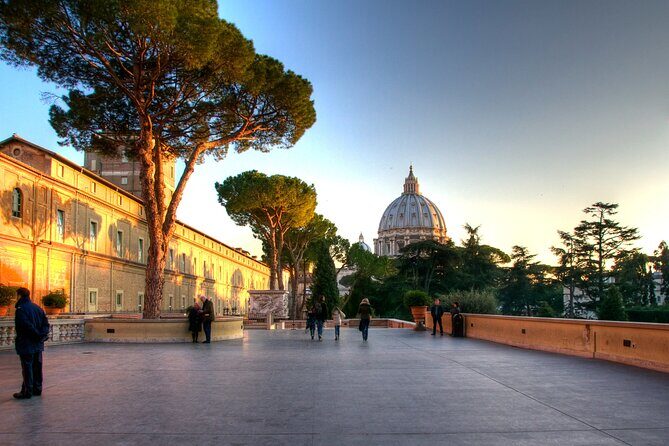
The smartest part of this tour is the timing. Starting at 7:30 AM and getting first access (listed as 8:00 AM) means you’re walking into the Museums before the day’s full wave. That matters because the Vatican isn’t just “busy”—it’s a maze built for crowds, and the longer you wait, the more you’ll fight for space.
This tour also keeps the group tight, which changes the whole feel. With just a handful of people, you can actually follow your guide’s pace and explanations, instead of constantly scanning for your group like it’s a high-stakes treasure hunt.
The other big reason early works: you’re positioning yourself to hit the Sistine Chapel while it’s still manageable. Later in the day, even with good planning, it’s harder to focus on art when you’re squeezed between shoulders.
You can also read our reviews of more museum experiences in Rome



Meeting Point and Timing: The Logistics That Save Your Day
You meet at Giuly’s Café, Via Santamaura, 3 (near public transportation). Then you end in St. Peter’s Square, which is convenient because you’re basically dropping into the exact heart of the area right after the tour.
The tour is about 3 hours 30 minutes (approx.), with a structured rhythm:
- Vatican Museums first stop (about 1 hour 10 minutes)
- Quick, targeted galleries (each around 5 minutes)
- Sistine Chapel (about 30 minutes)
- St. Peter’s Basilica (about 45 minutes)
- Then Baldachin (about 5 minutes) and St. Peter’s Square (about 15 minutes)
That schedule is intentionally “fast but not frantic.” If you like the idea of seeing key works and major spaces without dedicating an entire day, this format makes sense.
One note from real experience patterns at the Vatican: even with an early start, you may still encounter large numbers. A cool expectation to set is this: early helps, but it doesn’t magically make the Vatican empty.
Vatican Museums First Access: Pigna, Pomodoro, Maps, Tapestries, Candelabra
Once inside, the tour moves you through the Vatican Museums with a clear purpose: get you to the most rewarding pieces and areas without wandering aimlessly.
Start in the Galleries That People Rush Past
You begin with the Museums at first access. The first major visual detour is the courtyard area tied to the Courtyard of the Pigna and the larger Belvedere complex. It’s a great early stop because the space has big sculpture energy—your eyes adjust quickly and you get your bearings.
Then you’ll be pointed toward the Sphere within a Sphere by Arnaldo Pomodoro. It’s one of those works that turns into a conversation once someone tells you what to look for: a textured bronze outer form with a smaller sphere hidden inside. Even in a place full of famous objects, this one reads as “modern mind meets ancient setting,” especially when the light shifts as you walk around it.
The “Short Stops” Are Actually Smart
After that, the tour includes a run of compact gallery moments. They’re short by design, so you can cover more without burning out.
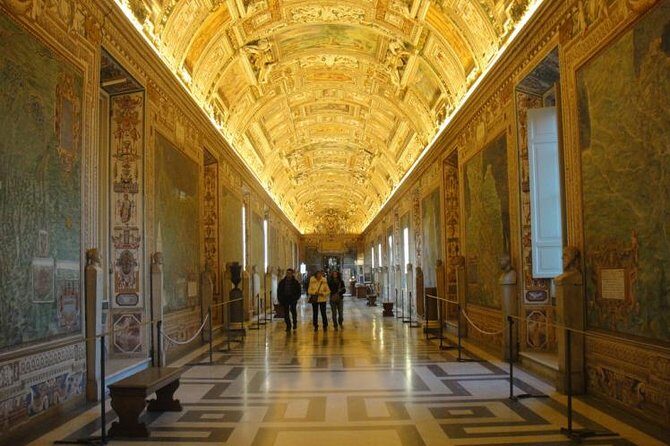
- Galleria Delle Carte Geografiche (Gallery of Maps): a long sweep of painted topographical maps of Italy created in the 16th century under Pope Gregory XIII. The tour time here is brief (about 5 minutes), but it’s the kind of room that changes how you picture the Renaissance. Instead of only seeing Rome and Vatican art as isolated masterpieces, you start to see how the era imagined the world.
- Gallery of Tapestries: woven works from the 15th and 16th centuries, inspired by designs from Raphael’s school, with biblical and historical scenes. Expect the guide to help you see the storytelling in the details, even if you don’t spend long.
- Galleria dei Candelabri: Greek and Roman sculptures, sarcophagi, and reliefs, organized around the marble candelabra that break the space into thematic sections. It’s a useful stop because it connects how the Vatican assembled art, not just what it contains.
A possible downside: if you’re the type who likes to linger and read every caption, this portion is built for momentum. The quick gallery format gives breadth, but it won’t satisfy a “let me spend 20 minutes per room” style.




Sistine Chapel with a Guide: How to See More Than Ceiling Stars
Your Sistine Chapel visit is about 30 minutes. That time is long enough to do more than stare upward, but short enough that you won’t get stuck in a bottleneck.
Here’s the practical advantage of having a guide: the Chapel is visually overwhelming. If you only arrive with the idea that it’s Michelangelo’s ceiling, you’ll still be impressed—but you may miss how the Chapel functions as a masterpiece of ceremony and symbolism. Your guide should help you read what you’re seeing so it feels like a coherent story instead of disconnected scenes.
The guide can also help you manage behavior expectations. You’ll likely run into the reality of crowd noise and people taking photos even though rules exist. This is one of those places where the atmosphere can make you forget what you came for, so having context before you enter helps you lock in faster.
If you’re worried about your tolerance for crowds, you’re not alone. Even early, the Sistine Chapel area can be dense. The good news: skip-the-line access and the timed entry strategy reduce the worst of the scramble, and your small group means you stay focused with less drifting.
St. Peter’s Basilica: Pietà, Baldachin, and a Real Feel for the Scale
After the Museums and Sistine Chapel, you head to St. Peter’s Basilica with about 45 minutes inside. The ticket for the Basilica is listed as included (admission ticket free).
Two highlights matter most here:
Michelangelo’s Pietà
You’ll see the Pietà by Michelangelo (dated 1498–1499). It’s housed in the basilica, and it’s the kind of work that lands differently once you’re standing in the actual space rather than looking at it on a screen. Your guide will point out why it’s such a big deal—especially the way Michelangelo created an emotional stillness that feels almost alive.
Bernini’s Baldachin
Then there’s the Baldachin by Gian Lorenzo Bernini, a bronze canopy over the high altar. It’s described as towering over 90 feet tall, and the point of the short stop (about 5 minutes) is to help you register scale. In a building that can swallow you, being shown a key focal point prevents you from only seeing “huge.”
St. Peter’s Square: The Final View Geometry
You finish with St. Peter’s Square (about 15 minutes). The tour highlights the elliptical design and the 284 Doric columns arranged in four rows. This is where your brain finally gets the Vatican’s outside architecture as a complete composition, not just a cathedral you entered through doors.
If you like your sightseeing to end with a sense of “place,” the Square is a strong landing spot.
Dress Code, Heat, and Pace: Practical Tips That Prevent Regrets
This tour includes sacred spaces, so you need the right outfit. The stated dress code is clear:
- No shorts
- No sleeveless tops
- Knees and shoulders must be covered for both men and women
The important part isn’t just compliance—it’s avoiding refused entry at exactly the wrong moment. Even if enforcement can be inconsistent, you’re safest following the rules strictly.
Now let’s talk about comfort. The Vatican Museums can be hot with limited cooling, and one review specifically points out “no AC” and recommends bringing water. Even early, plan for heat inside. Comfortable walking shoes matter because you’ll be on your feet through multiple floors and crowd corridors.
Finally, keep your expectations aligned with the pacing. This is a “best of” tour in a set time window. If you want unhurried wandering, you may want extra time later on your own.
Price and Value: Is $179.81 Worth It?
At $179.81 per person, it’s not a budget tour. The question is whether you’re paying for time saved, not just for access.
Here’s what you’re buying:
- First access at 8:00 AM reduces the worst crowd pressure
- Skip-the-line entry helps you start seeing sooner
- A guide steers you through high-signal stops instead of random browsing
- Small group (max 6) improves how smoothly you move and how much attention you get
That combination is valuable in the Vatican, where a self-guided plan can lose hours even if you’re organized. One of the recurring themes from guide-focused feedback is that the best tours don’t just “show you spots”—they keep you moving efficiently through closures and timing quirks.
So when is it worth booking?
- You want the major works in one morning without spending the whole day
- You’d rather pay than gamble on crowd conditions
- You appreciate a guide helping you understand what you’re looking at, not only where to stand for photos
When might it not be worth it?
- You prefer long, free-form museum wandering
- You’re comfortable navigating the Vatican crowds without a plan
Who This Tour Fits Best (and Who Might Want to Think Twice)
This is a strong fit if you’re coming for first-time Vatican highlights: Museums, Sistine Chapel, and St. Peter’s Basilica. It also tends to work well for families and mixed-age groups because the small group format supports questions and slower moments when needed.
It may be less ideal if you:
- Need a very quiet, slow pace (even early can still be crowded)
- Have a strict “no stairs, minimal walking” requirement (the tour states a moderate amount of walking)
- Want full, museum-style deep reading in every gallery (this route uses short stops)
That said, the guided approach keeps you from getting lost and helps you make smart choices about what to prioritize in a huge complex.
Should You Book This Early Bird Vatican Tour?
I’d book it if you want maximum impact with minimum wasted time. The early start plus skip-the-line entry plus a max-6 guide setup is exactly what you want at a site where crowd pressure can drain your enjoyment.
I’d think twice if you hate heat and noise, or if you plan to spend long stretches absorbing each room on your own. In that case, you might prefer a more flexible format and add extra time later.
If you do book: wear layers that cover shoulders and knees, bring water, and don’t treat this as a casual stroll. Treat it as a focused mission—then enjoy the payoff when you’re standing in the Pietà area and looking up at the Sistine Chapel with your guide’s context already in place.
FAQ
How many people are in the tour group?
The tour is a small-group experience with a maximum of 6 travelers.
What time does the tour start?
The start time is 7:30 AM.
What language is the tour offered in?
This tour is offered in English.
Is skip-the-line entry included?
Yes. The tour includes skip-the-line entry (skip-the-line ticketing is part of the experience).
Do we visit the Sistine Chapel and St. Peter’s Basilica?
Yes. You visit the Sistine Chapel and then St. Peter’s Basilica as part of the same tour.
Is admission to St. Peter’s Basilica included?
Yes. St. Peter’s Basilica is listed as admission ticket free and included in the tour.
What should I wear for entry?
A dress code is required: no shorts or sleeveless tops, and knees and shoulders must be covered for both men and women.
Is transportation from my hotel included?
No. Transfers from/to hotel are not included.
How much walking is involved?
The tour involves a moderate amount of walking, so comfortable shoes are recommended.
Could parts of the Vatican be closed?
Yes. The information notes that during the Jubilee, some monuments may be under restoration or closed due to extraordinary celebrations. Pay attention to any messages you receive about potential changes.