REVIEW · ROME
Relics from Passion of the Christ Tour in Rome
Book on Viator →Operated by Roman Vacations · Bookable on Viator
Rome’s relics aren’t just museum talk. This 3-hour Relics from Passion of the Christ tour moves through five major churches with entry included and an expert English guide connecting the dots between places, objects, and Christian tradition.
I like the pace and the headspace it creates. With a maximum of 10 travelers, you get enough time at each stop to look closely and ask questions, and guides such as Daniel or Paul are known for patient, detail-minded explanations.
One thing to consider: you’ll do a solid amount of walking, and the Holy Steps tradition of ascending on your knees isn’t part of the experience. If you want the full ritual, you’ll need to add time on your own.
In This Review
- Key highlights you will feel right away
- What you’re really buying with this Passion relic tour in Rome
- Meeting at Piazza Santa Maria Maggiore and keeping the day moving
- Stop 1: Santa Maria Maggiore and the wood from the manger
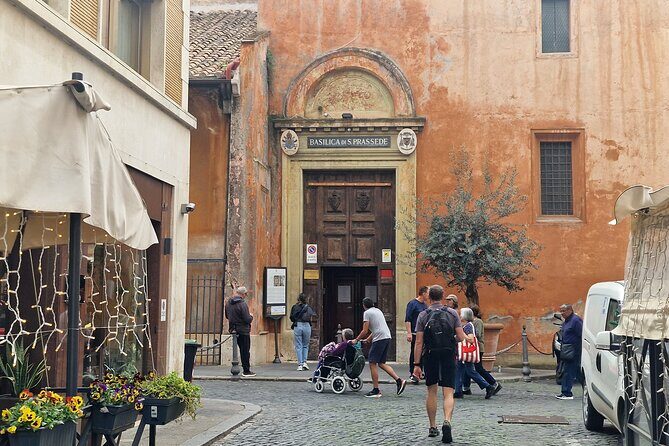
- Stop 2: Santa Prassede, 9th-century mosaics, and the scourging pillar
- Stop 3: Santuario della Scala Santa and what you see at the Holy Steps
- Stop 4: San Giovanni in Laterano and the symbolism above the high altar
- Stop 5: Santa Croce in Gerusalemme and the Passion relic “finale”
- Who should book this tour and who might prefer something else
- Should you book Relics from Passion of the Christ in Rome?
- FAQ
- How long is the Relics from Passion of the Christ Tour in Rome?
- What does the tour include?
- Are food and drinks included?
- How many people are in the group?
- Is the tour offered in English?
- Where does the tour start and end?
- Can I choose a morning or afternoon departure?
- Is there a mobile ticket?
- Is free cancellation available?
Key highlights you will feel right away
- Manger wood at Santa Maria Maggiore hidden beneath the main altar area
- The scourged pillar brought to Rome at Santa Prassede
- Holy Steps linked to St. Helena and what you can see at the top
- San Giovanni in Laterano’s art and symbolism, including a spot tied to Saints Peter and Paul
- A powerful finale at Santa Croce in Gerusalemme with multiple Passion-related fragments
- Up to 10 people so the guide can actually talk with you, not at you
What you’re really buying with this Passion relic tour in Rome
On paper, this looks like a simple church-and-relics loop. In practice, it’s more like guided meaning—why these objects are where they are, and how Rome turned sacred geography into something you can stand near.
At $102.25 per person for about 3 hours, the value comes from three things: you’re not hunting tickets, you’re not guessing context, and you’re not getting rushed. Site entry is included at every stop, and the guide’s job is to translate what you’re seeing into a clear story. If you’ve ever wandered into a Roman basilica and thought, I like it, but I’m not sure what I’m looking at—that’s the exact gap this fills.
Also, the group size matters. With max 10 travelers, you can actually look up during the explanation, not just keep moving. And because it’s offered in English and includes a mobile ticket, you avoid some of the usual hassle that can eat up the first hour of sightseeing.
A final note: this tour doesn’t include food or drink. That’s normal for a church circuit, but it does mean you’ll want to plan a snack stop on either side if you’re walking on an empty stomach.
You can also read our reviews of more tours and experiences in Rome.



Meeting at Piazza Santa Maria Maggiore and keeping the day moving
You start in the area of Piazza di Santa Maria Maggiore and finish at Basilica di Santa Croce in Gerusalemme. That matters because Rome basilicas can be scattered, and you’ll save time by letting someone else handle the route.
You also have scheduling flexibility: you can choose a morning or afternoon departure. That’s a practical detail that helps if you want to match this to your energy level. Afternoon can feel nicer when crowds build—though you’ll still be in working church sites, so you’ll want to dress respectfully and be ready for security-style slowdowns.
It’s also a walking tour. You should expect to cover distance between neighborhoods and to spend time inside each site. The good news is the stop timing is realistic—roughly 20–30 minutes per basilica—so you’re not watching the clock every five minutes.
If you rely on public transit, this is set up well for that: it’s described as being near public transportation. And most people can participate, which is helpful if you’re comfortable with walking but not looking for an all-day marathon.
Stop 1: Santa Maria Maggiore and the wood from the manger
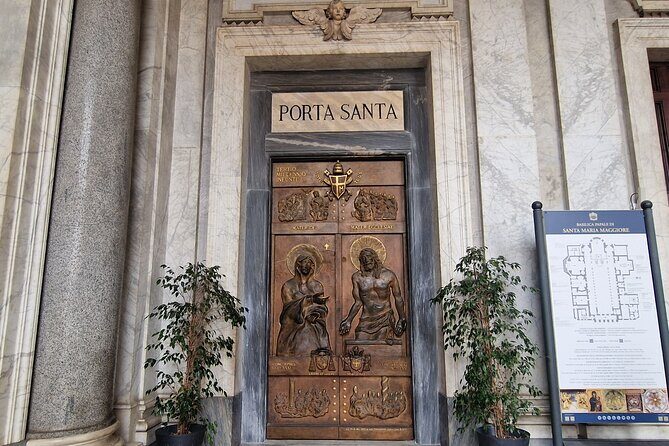
Your first stop sets the tone: Basilica di Santa Maria Maggiore, one of Rome’s oldest church landmarks dedicated to the Theotokos (Mother of God). The experience begins with something tangible—wood from the manger where the baby Jesus once lay, kept beneath the main altar area.
What I find meaningful here is the way this basilica treats holiness as physical and local. Rome isn’t just telling you a story from far away. It’s showing you an object that tradition places at the center of that story.
You also get a bonus that history fans will like: the basilica is connected with Gian Lorenzo Bernini. Even if you’re not hunting for every art detail, it’s the kind of place where multiple eras of Italian art show up in layers, so the relic isn’t isolated—it’s part of a larger visual world.
How long it lasts: about 30 minutes. That’s long enough to see the key points without turning into a hurried checklist.
What to watch for: go in expecting both sacred objects and classic basilica architecture. If you lean toward art, take a moment to look at the decorations as you move, not only when the guide points. The basilica rewards that kind of slow attention.
Stop 2: Santa Prassede, 9th-century mosaics, and the scourging pillar
Next you head to Basilica di Santa Prassede, famous for 9th-century mosaics. Mosaics can be hard to appreciate without context because from far away they look like color patterns. With a guide, you start to see what each section is doing and why it matters.
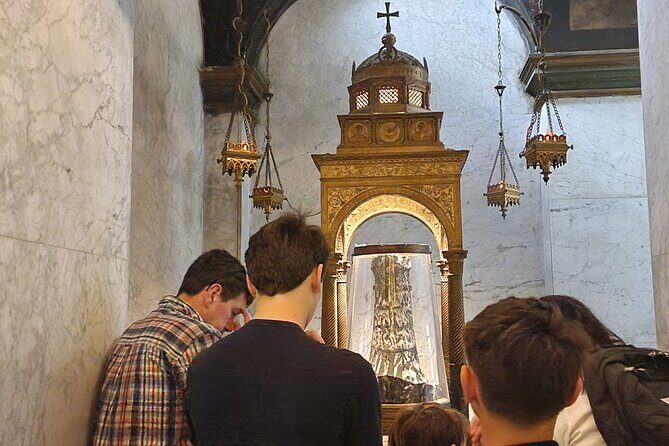
Then comes the relic focus: a stone pillar on which Jesus was scourged, brought from the Praetorium in Jerusalem to Rome in the 13th century.
This is a key moment in the tour because it moves you from Nativity-era symbolism into the violence and judgment of the Passion. It’s also one of those relic narratives that makes you think about how Christianity traveled and changed locations over time. Whether you view the relics with deep personal faith or as historical artifacts, the story has weight.
Time at this stop is shorter—about 20 minutes—so you’ll want to listen closely and take in the guide’s “what to look for” direction. The time is enough, but it’s not a sit-and-stare museum visit.
Practical tip: when mosaics are involved, it’s easy to miss details while craning your neck. Look where the guide directs first, then do a second pass where your eyes can relax.
Stop 3: Santuario della Scala Santa and what you see at the Holy Steps
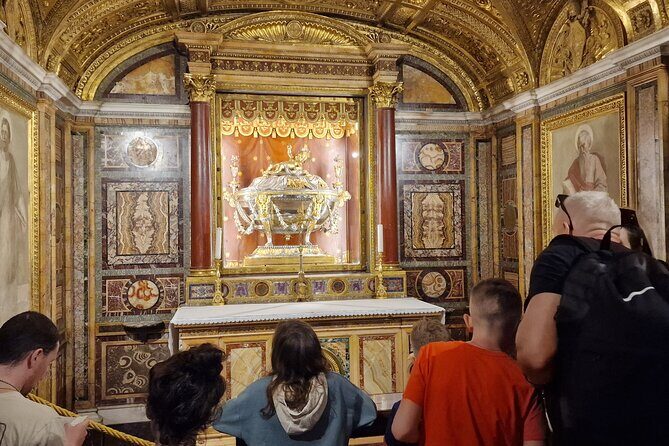
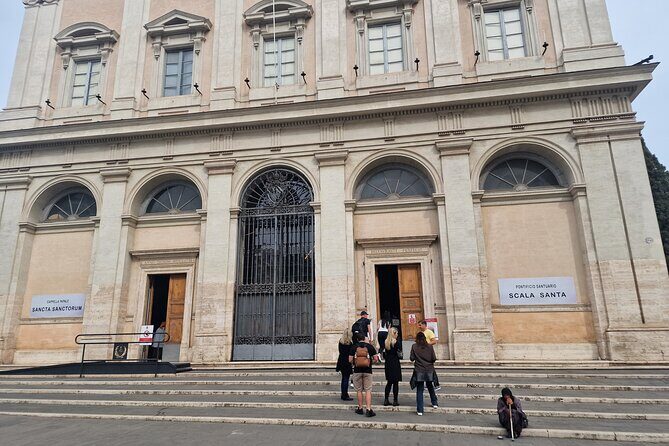
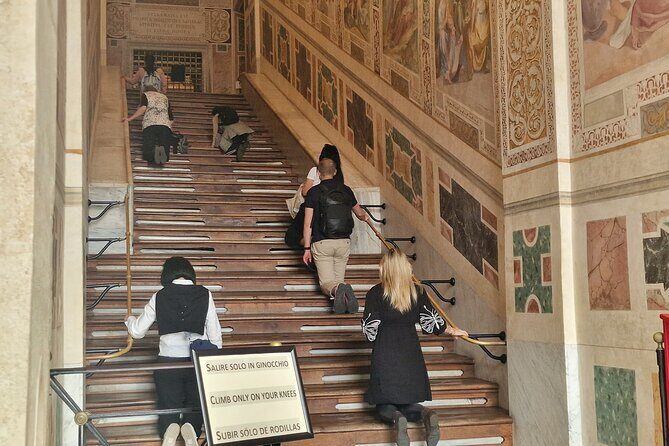
Then you reach Santuario della Scala Santa, also known as the Holy Steps. The tradition here is dramatic: these are the steps on which Jesus was judged by Pontius Pilate, transported to Rome in the 4th century by St Helena.
Here’s the practical catch: the tour notes that you won’t have time to ascend the stairs on your knees according to the pilgrim tradition. Instead, you’ll focus on what’s accessible during your visit, and you’ll peer into the Holy of Holies at the top to see the icon painted by the Gospel writer St Luke.
This is one of the moments where the tour design makes sense. If you’re short on time in Rome, you still get the core meaning—Jesus’ trial, the pilgrimage tradition, and the sacred imagery—without turning the whole visit into a long ritual that could swallow the rest of the day.
Time is about 30 minutes, which helps because this stop can feel intense. It’s good to have enough time to absorb it without rushing, but not so much time that you lose your focus.
What you’ll get out of it: a clearer link between the biblical timeline and the physical journey. You start to feel how the Passion story becomes a walkable map.



Stop 4: San Giovanni in Laterano and the symbolism above the high altar
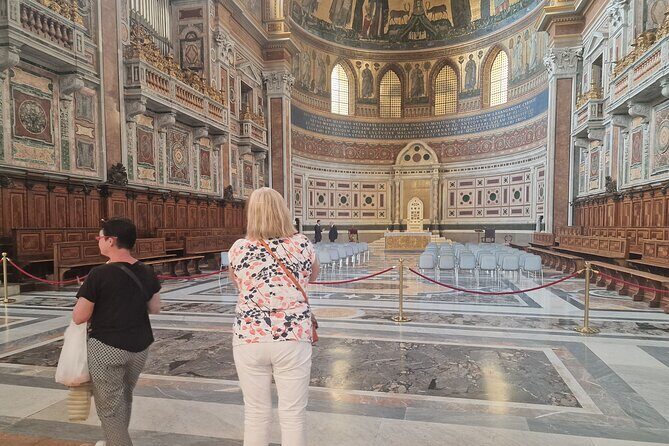
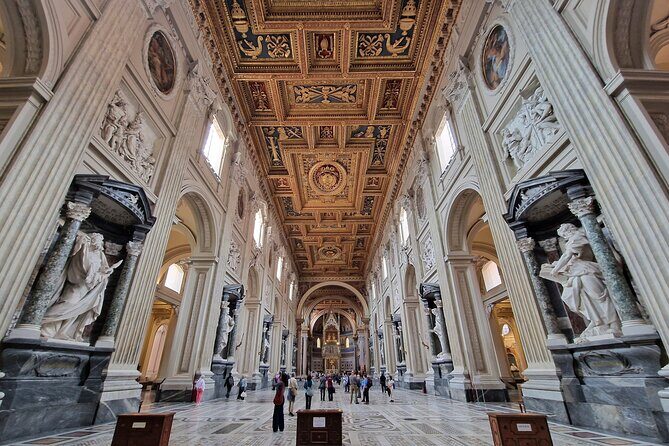
From there, you visit Arcibasilica di San Giovanni in Laterano—the Cathedral of Rome, San Giovanni Laterano. This stop shifts from relic narratives into symbolism and architecture.
You’ll focus on the architectural design of Borromini and the meaning behind the stunning mosaic your expert guide points out. This is where the tour helps you see beyond the obvious big picture. A basilica isn’t just pretty stone; it’s arranged to guide your attention and communicate ideas.
Then there’s a very specific relic-related detail: the guide points out the place above the high altar where the skulls of Saints Peter and Paul rest.
Time: about 30 minutes. That’s the right amount to understand the symbolism without getting trapped in an art lecture. It also pairs well with the previous stop, because you’re moving from trial imagery into a broader statement about apostolic authority.
How this helps you as a visitor: you’ll leave with a better sense of why these places matter to Catholic tradition, not just that they contain famous items. The “why” is the difference between passing through and really seeing.
Stop 5: Santa Croce in Gerusalemme and the Passion relic “finale”
The climax is Basilica di Santa Croce in Gerusalemme. If you want a tour that builds momentum, this is where it happens.
You start with the claim that the basilica is built on earth brought from Calvary in the 4th century. That immediately sets up the tone: this isn’t a single relic; it’s a whole concentration of Passion-related objects.
Then you enter to see fragments connected to multiple moments of the Passion story, including:
- fragments of the Holy Sepulcher and the Cave of Bethlehem
- a Nail of the Crucifixion
- two Thorns of the Crown of Thorns
- a small walnut board reading Jesus the Nazarene king of the Jews
- the wood of the Cross Jesus was crucified on
That’s a lot of sacred material in one place, and it can feel overwhelming if you’re not guided. This is where an expert local guide really earns their keep: they help you keep the story straight and connect the relics to the timeline rather than letting it turn into a blur of famous objects.
Time here is shorter—about 20 minutes—but it’s enough if you focus on the guide’s “this is what matters” points. The guide’s pacing is what keeps the stop from becoming a rushed photo session.
If you’re expecting a quiet spiritual ending, it can be. If you’re expecting only spectacle, it can surprise you the other way: you’ll likely leave feeling that the Passion is remembered here through objects you can actually face, not just read about.
Who should book this tour and who might prefer something else
This tour fits best if you fall into one of these groups:
- You’re a Catholic visitor or Christian visitor who wants the Passion story mapped onto specific Rome sites.
- You love religious art and want help reading it, especially mosaics and basilica symbolism.
- You like history, but you also want it tied to places you can stand in front of.
- You prefer small groups and hate being pushed through crowds like a human conveyor belt.
I think it’s also a good choice for couples. Several guides on this route have been praised for giving clear narratives with room for questions, which works well if you’re traveling as two and want a more personal rhythm.
Who might hesitate:
- If you want a long, traditional kneeling pilgrimage experience at the Holy Steps, this won’t fully satisfy that ritual craving because kneeling ascent isn’t included.
- If you hate walking inside churches and want only one stop, this is too many sites for a slow day.
- If you’re looking for Roman street life and big outdoor viewpoints, you’ll be spending most of your time indoors and near altars.
Should you book Relics from Passion of the Christ in Rome?
I’d book this if you want a more meaningful Rome experience than the usual grand monuments route. The combination of included entry, expert English guiding, and a tight five-stop circuit is strong value at this price level. You’re paying for context, not just access.
I’d skip or rethink it if your priority is outdoor sightseeing, long personal ritual time, or you want a slower pace with no walking. This is a “see, listen, absorb, move on” format.
If you do go, do one small thing that pays off: before the tour starts, tell yourself you’re there for the story. Let the guide steer your attention to the specific objects—manger wood, scourging pillar, Holy Steps icon work, the Lateran symbolism, and the Passion relics at Santa Croce. Once you follow that thread, the whole walk starts to feel connected.
FAQ
How long is the Relics from Passion of the Christ Tour in Rome?
The tour runs for about 3 hours (approximately).
What does the tour include?
Entry to each site is included, and you get an expert local guide.
Are food and drinks included?
No. Food and drink are not included.
How many people are in the group?
The tour has a maximum of 10 travelers.
Is the tour offered in English?
Yes, it is offered in English.
Where does the tour start and end?
It starts at Piazza di Santa Maria Maggiore, Roma RM, Italy and ends at Basilica di Santa Croce in Gerusalemme, Piazza di S. Croce in Gerusalemme, 10, 00185 Roma RM, Italy.
Can I choose a morning or afternoon departure?
Yes. The tour offers morning or afternoon departures.
Is there a mobile ticket?
Yes. The tour includes a mobile ticket.
Is free cancellation available?
Yes. You can cancel for free up to 24 hours in advance for a full refund.