REVIEW · NAPLES
Naples panoramic tour and Monumental historic center.
Book on Viator →Operated by AmalfiTourCampania · Bookable on Viator
Naples moves fast, and this tour keeps up. You get a smart mix of big viewpoints (from Vomero hill down toward the bay) and heavyweight culture, including time at the National Archaeological Museum with finds tied to Pompeii and Herculaneum. It’s the kind of route that helps you get your bearings fast, without turning the day into a hopscotch of confusing stops.
Two things I really like: first, you’re riding in an air-conditioned vehicle with WiFi and bottled water, so the “panoramic” part actually feels comfortable. Second, the onboard commentary ties the streets you see to the monuments you’re approaching. One consideration: entry tickets for several major sights are not included, and the commentary style can be more “orientation while driving” than deep, door-by-door lecturing at each building—so if you want lots of detail inside museums and churches, plan for extra time or add-on guidance.
In This Review
- Quick hits: what makes this Naples tour work
- Palazzo Reale in Piazza del Plebiscito: royal power in the public square
- Galleria Umberto I: a shortcut through a darker old neighborhood
- Castel Sant’Elmo: the viewpoint that makes Naples click
- Posillipo and the coast: Roman traces and a drive with sea air
- Lungomare Caracciolo: your sea-air breather
- Piazza del Gesù Nuovo: churches, monastic spaces, and Cristo Velato
- Naples Archaeological Museum: the big one for Pompeii and Herculaneum finds
- Coach-style commentary: what you get, and how to get more from it
- Price, timing, and tickets: where the real value is
- Who this tour suits best (and who should choose differently)
- Should you book this Naples panoramic tour and Monumental historic center?
- FAQ
- What’s the duration of the Naples panoramic and historic center tour?
- Is pickup offered?
- What’s included in the price?
- Are monument and museum tickets included?
- Which stops are free?
- Which stops require tickets?
- Is the tour private?
- What language is the commentary?
- Does the tour require good weather?
- How does mobile ticketing work?
Quick hits: what makes this Naples tour work

- Palazzo Reale context in Piazza del Plebiscito: royal residence history plus the museum-and-library setting.
- Galleria Umberto I stops your timeline: a 16th-century street web remembered in city folklore.
- Castel Sant’Elmo panoramic advantage: hilltop sightlines at about 250 m above sea level.
- Posillipo + Lungomare Caracciolo: sea-air breaks with Roman traces and coast road history.
- Piazza del Gesù Nuovo to the museum: you see the churches and then hit Naples at its archaeological best.
Palazzo Reale in Piazza del Plebiscito: royal power in the public square
This is one of those Naples landmarks that instantly explains the city’s “who ruled here, and when” story. The Royal Palace (Palazzo Reale) sits in Piazza del Plebiscito, and it’s not just an elegant facade. It’s where power actually lived: for more than a century and a half, the Spanish viceroys called it home, then the Bourbon dynasty took over from 1734 to 1861. There’s also a short but important interruption in the early 1800s under French control, linked to Giuseppe Bonaparte and Gioacchino Murat—a reminder that Naples was always strategically valuable.
Construction began in 1600, but the palace didn’t reach its final appearance until 1858. That long build time means you’re looking at work by multiple major architects—Domenico Fontana, Gaetano Genovese, Luigi Vanvitelli, Ferdinando Sanfelice, and Francesco Antonio Picchiatti. In other words, this isn’t one style slapped onto one era. It’s an evolving structure that tracks changing taste and changing politics.
The practical part: your visit here is roughly one hour, and the entry ticket isn’t included. That matters for your budgeting, and it also affects your pacing. If you’re the type who wants to read every plaque, plan to arrive ready to pick a few highlights instead of trying to absorb the whole place in one pass.
You can also read our reviews of more historical tours in Naples



Galleria Umberto I: a shortcut through a darker old neighborhood
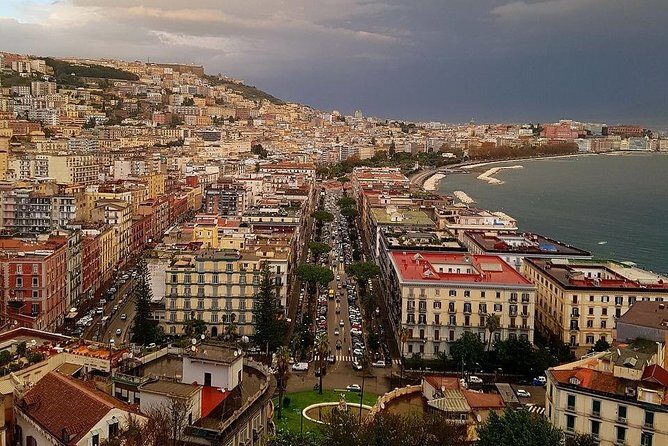
From palaces to mood swings: the stop at Galleria Umberto I is quick, but it’s a good lesson in how Naples layers time. The area under and around the gallery was heavily urbanized back in the 16th century, and it wasn’t known for polite strolls. You had a tangle of parallel streets connected by short alleys, opening out near Via Toledo in front of Castel Nuovo. Those alleys carried a bad reputation—taverns and crime were part of the reputation, including the infamous tavern of Cagliantese/Cagliantesa.
This is also where cultural memory kicks in. The area’s notoriety shows up in literature: Giambattista Basile referenced it in Le muse napolitane, which helped lock the neighborhood’s stories into print.
The good news is that there’s no admission charge for this stop. It’s more about getting the atmosphere and understanding why the city’s center feels like it has secrets under its shoes. You’ll get your photo moment, then move on.
Castel Sant’Elmo: the viewpoint that makes Naples click
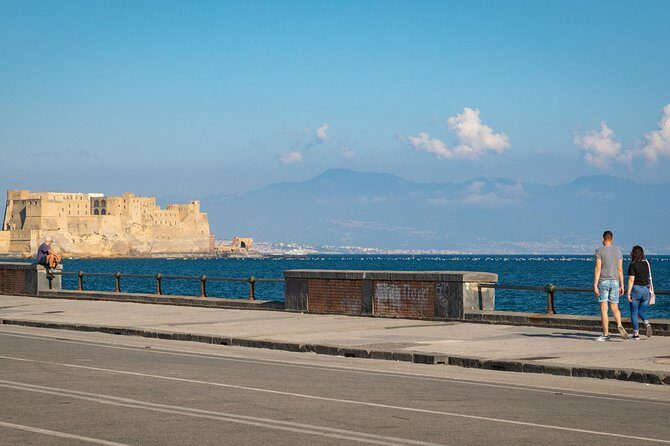
If you want one stop that acts like a “reset button” for the city, it’s Castel Sant’Elmo. This medieval castle sits on the Vomero hill near San Martino, and the location is the point. It rises roughly 250 meters above sea level, which is why it has always mattered strategically. When you’re up there, Naples isn’t just buildings—you start seeing the overall layout: the bay, the city spread, and the roads that bring you up from the hills.
Historically, the site is older than the castle shape you see today. It was once called Paturcium, and from the 10th century there was a church dedicated to Sant’Erasmo—and the spellings changed over time (Eramo → Ermo → Elmo). The castle’s origins also connect to a Norman observation tower called Belforte.
One detail I love for how it makes the place physical: parts of Sant’Elmo derive from living rock, specifically Neapolitan yellow tuff. You’re not looking at something “put on top” of the landscape; it’s shaped into it.
This stop also comes with a museum element and event history. The castle hosts a permanent museum called Naples Novecento, plus temporary exhibitions and events. The connection to pop culture is real too—Napoli Comicon used the castle as headquarters during spring from 1998 to 2011 (then moved to Mostra d’Oltremare).
The trade-off: this is a one-hour visit and tickets aren’t included. It’s worth it if the view is your priority. If you’re not a viewpoint person, you’ll still find the setting impressive, but the biggest payoff is what you can see beyond the walls.
Posillipo and the coast: Roman traces and a drive with sea air

Posillipo brings you back to Naples as a coastal city, not just a city of churches and stone facades. The area appears in ancient Greek sources, with early habitation on the promontory. Over time, Romans left traces too—near the shoreline and also near the highest point of the hill, you can see remains linked to the residence of Publius Vedio Pollione. There were openings tied to a tunnel that supported that residence, which is the kind of detail that makes a coastline feel like infrastructure, not scenery.
There’s also mention of amphitheater remains. After the ancient era ended, population clustered within fortified walls, and Posillipo declined—caught up in the bigger story of invasions and neglect.
Then you get the “modern layer” that helps explain why the area looks the way it does today. A major road—Via Posillipo—was constructed between 1812 and 1824, running from the port area of Mergellina along the coast. A lot of rebuilding happened after World War II, but some historic buildings survived, including Villa Rosebery, which is the residence of the President of the Republic.
Good news for your time: Posillipo is free as a stop. You’re getting the coastal perspective, plus a few anchor points of how old Naples connected to the sea.
Lungomare Caracciolo: your sea-air breather

Next comes Lungomare Caracciolo, the famous waterfront stretch where the day turns from “look at buildings” to “breathe in the sea air.” This stop is simple but effective: you get open views and a break from the tight-center feel.
It’s also a good moment to reset your eyes before you move back into dense historic squares and church interiors. If you tend to get museum-fatigue, this is a handy pacing tool. The stop is free, and you’ll feel it most if you’ve been spending the day looking upward—palaces, castles, bell towers—then suddenly the horizon gives your brain a rest.





Piazza del Gesù Nuovo: churches, monastic spaces, and Cristo Velato

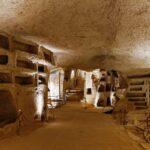
Now you’re back in the compact beauty zone around Piazza del Gesù Nuovo. Here, the main draw is the cluster of major religious sites nearby: the Church of Gesù Nuovo, the monastery complex of Santa Chiara, and the Cristo Velato located in the chapel of San Domenico Maggiore.
Even if you don’t go full-nerd on baroque details, this area is a classic Naples story in stone: multiple holy spaces, different orders and artistic choices, all packed close enough that you feel the city’s habit of layering faith into everyday geography. You also get that local phrase energy—there’s a reference to La Spacca Napoli, which fits the vibe here: the square is almost a crossroads of styles and narratives.
This is one of the stops where admission isn’t included, so it can cost you a little extra if you choose to go inside the sites you’re most curious about.
Naples Archaeological Museum: the big one for Pompeii and Herculaneum finds

If you want the day to end with something that feels truly substantial, aim your energy at the Museo Archeologico Nazionale di Napoli. This museum is the one that turns Naples from scenic to serious.
You’re looking at archaeological finds tied to Pompeii, Herculaneum, and Oplontis, plus sculptures and paintings that are treated as standout pieces. That’s a heavy promise, and it’s exactly why this museum stop earns time inside your 6-to-8-hour day.
The visit here is about two hours, and again admission isn’t included. Two hours is enough to see the major highlights, but it’s not enough if you want every room, every caption, and a full academic read of every artifact. If you’ve got limited museum stamina, pick a few sections you care about most—Pompeii/Herculaneum context, then pick sculptures or paintings based on what you’re drawn to.
Also, because the tour includes onboard WiFi and bottled water, you can use that time to quickly plan your museum focus on arrival. It makes the visit feel less like a sprint.
Coach-style commentary: what you get, and how to get more from it

Let’s talk about the guide format, because this is where expectations can clash. The tour includes commentary on board in the language agreed for your booking, plus the group is moved by an air-conditioned vehicle.
In one experience shared by the operator, the company clarified the difference between a chauffeur-driven orientation and a licensed guide who does deep, site-by-site interpretation. They pointed to an example driver-guide named Vincenzo di Matola and explained that the service is designed to provide general information and answer questions during travel, and that a more specialized licensed guide can be arranged for an extra charge if you want that level of detail.
So here’s the practical takeaway for you: if you love museums and you want more than “what you’re looking at,” bring a few questions. Ask about what to prioritize inside Palazzo Reale, what to focus on at Castel Sant’Elmo, and how to connect what you see at the museum back to the city scenes outside. Even with a more general commentary style, good questions turn the day into a dialogue.
If you hate Q&A, then the tour still works. Just know you’ll get better value by treating it as an orientation plus highlight route, not a full interpretive walking tour at every doorstep.
Price, timing, and tickets: where the real value is
The price here is $247.91 per person for a 6 to 8 hour experience. That sounds steep until you break down what you’re buying.
You’re paying for:
- Transport in an air-conditioned vehicle
- Bottled water
- WiFi
- Onboard commentary
- All fees and taxes that relate to the tour service itself
- A format that includes pickup and keeps the day moving
What you’re not paying for:
- Monument and archaeological site admissions
- Tip
- Lunch and dinner
So the value depends on your habits. If you plan to enter at the palace, the castle, the church/chapel area at Gesù Nuovo, and especially the museum, the total day cost becomes more predictable. If you only want photos from the free stops, you’ll feel the ticket add-ons more sharply.
Time is also part of the value. A route like this makes sense when you’re short on time or you’re not keen on figuring out Naples transportation and sequencing yourself. You get a structured flow: royal square → historic gallery area → hilltop fort → coast views → church square → museum depth.
As for weather: the tour is described as requiring good weather. If Naples is foggy or rainy, expect the operator to adjust with a different date or a full refund.
Who this tour suits best (and who should choose differently)
This tour fits you if:
- You want a panoramic overview plus at least one major indoor anchor (the archaeology museum).
- You like the idea of going from sea views to viewpoints without managing transfers.
- You’re traveling with a mix of interests and want something that doesn’t leave anyone behind.
It may not fit you as well if:
- You want a highly detailed licensed guide inside every monument for hours.
- You’re the kind of person who needs total control over pacing and ticket timing.
- You hate paying extra for admissions at multiple stops.
If you fall into the second category, consider adding a licensed museum-focused guide or choose a different tour format that includes fewer entries.
Should you book this Naples panoramic tour and Monumental historic center?
I think it’s a strong book if your goal is getting your bearings and still ending the day with real substance. The combination of Castel Sant’Elmo’s viewpoint, the sea-air reset at Lungomare Caracciolo, and the museum stop that centers on Pompeii and Herculaneum gives you a day that feels “Naples” rather than just “Naples, photographed.”
Book it if you’ll actually enter the ticketed sites and you’re comfortable with a chauffeur-style orientation rather than a deep expert lecture in every room. If that sounds like your style, this is a good value way to compress Naples’s highlights into one organized stretch.
If you want maximal detail inside churches and museums, either plan to ask lots of questions during the day or look for an add-on licensed guide arrangement—because that’s the main place this experience can feel a bit lighter than you might hope.
FAQ
What’s the duration of the Naples panoramic and historic center tour?
It runs about 6 to 8 hours.
Is pickup offered?
Yes. Pickup is offered, with a meeting point where you display a cartello (cartel) with your reservation name.
What’s included in the price?
The tour includes an air-conditioned vehicle, bottled water, on-board commentary in the agreed language, all fees and taxes, and WiFi on board.
Are monument and museum tickets included?
No. Entry tickets for monuments and archaeological sites are not included.
Which stops are free?
Stops described as free include Galleria Umberto I, Posillipo, and Lungomare Caracciolo.
Which stops require tickets?
Palazzo Reale, Castel Sant’Elmo, Piazza del Gesù Nuovo sites, and the National Archaeological Museum of Naples require admission tickets (not included).
Is the tour private?
Yes. It’s listed as private, with only your group participating.
What language is the commentary?
The tour offers commentary on board in English.
Does the tour require good weather?
Yes, it requires good weather. If canceled due to poor weather, you’ll be offered a different date or a full refund.
How does mobile ticketing work?
You’ll receive a mobile ticket.