REVIEW · PRIVATE
Private Golf Cart Tour in Rome
Book on Viator →Operated by Italy In Love Tours · Bookable on Viator
Rome is best when you control your pace. This private golf cart tour is a smart way to see the A-list sights without turning your day into an endurance test. You’ll zip between major landmarks with an expert driver-guide, stop for photos, and learn what you’re actually looking at—while your group stays together the whole time.
I especially like the convenience: the cart gets you close to places that are painful on foot, and it helps older travelers, kids, and anyone with limited mobility enjoy Rome’s highlights in a fraction of the walking. I also like the human factor. Guides such as Dino and Antonio (and others like Andrea, Marco, and Umberto) were praised for staying upbeat, handling crowds well, and sharing side streets and extra context when you want it.
One thing to consider: this is a fast-moving highlights run. If you want a long sit-down visit inside major monuments, you’ll likely need to pair this with additional time later—especially since entry tickets aren’t included (with the Pantheon called out separately).
In This Review
- Key things I’d bet on
- Rome by Golf Cart: Getting Oriented Fast Without Beating Up Your Feet
- Start in the City’s Middle, End at Piazza Venezia
- Colosseum and the Arch of Constantine: Where Your Rome Story Gets Real
- Circo Massimo and Bocca della Verità: Short Stops With Big Payoff
- From Hercules to Marcello: Temples and Theatres You’ll Actually Remember
- Piazza Venezia, Largo Argentina, and the Cat Sanctuary Moment
- Piazza Navona to the Pantheon: Fountain Drama and Roman Engineering
- Santa Maria Sopra Minerva and the Minerva “Chick”: Art With a Smile
- Piazza di Spagna and Trevi Fountain: Two Icons, One Timing Strategy
- Value and Who This Tour Fits Best
- The Guides: The Real Difference Between Seeing Rome and Understanding Rome
- Should You Book This Private Golf Cart Tour?
- FAQ
- How long is the private golf cart tour in Rome?
- How much does the tour cost?
- What’s included in the price?
- Are admission tickets included?
- Is this tour private?
- Is the tour suitable for kids or older travelers?
- Where do we meet and where does the tour end?
- What is the cancellation policy?
Key things I’d bet on
- Private group comfort: only your party rides together, with a guide guiding the story and the route.
- Expert guide narration: you get the why behind the sights, not just the what.
- Stops built for photos: quick windows to see, orient yourself, and take pictures without long lines (where possible).
- Cart-friendly sightseeing: it can reach and reposition faster than big vehicles on busy streets.
- Great fit for limited walking days: especially for seniors and families with kids who can handle short stops.
- Pantheon needs a ticket: plan on entry cost if that stop matters most to you.
Rome by Golf Cart: Getting Oriented Fast Without Beating Up Your Feet
Rome sprawls. Even when your must-dos are close on a map, they can feel far on foot because of the street layout, crowds, and the “one more turn” problem that drains a day. A private golf cart tour solves that by moving you efficiently while keeping the experience human-scale—your guide can adjust tempo as you go.
Here’s the practical advantage: you’re not guessing where to look next. The guide gives you a clean storyline from ancient Rome through the big showpieces of later eras. You’re also not stuck behind tour buses. In one review, a guest noted the golf cart beats a bus because it can get into and out of smaller places. That matters in Rome, where roads and access can be tight.
You’ll also get a group setup designed for hearing. One family of six mentioned ear pieces were provided so everyone could follow Dino’s commentary clearly. That’s a small detail, but it can completely change how much you enjoy the narration.
The “watch out” part is simple. Because the tour covers a lot ground, most stops are short. Expect brief photo moments and quick explanations—not long museum-style pacing.
You can also read our reviews of more private tours in Rome


Start in the City’s Middle, End at Piazza Venezia
The meeting point is at Italy In Love Tours, Via del Cardello, 31, 00184 Roma. The tour ends at Piazza Venezia. That end point is handy: it’s a major hub where you can regroup, grab a meal nearby, or continue walking to more sights at your own speed.
You’ll want to keep the meeting point in mind the way you’d plan for any central tour. Rome streets can be confusing, so it helps to build a little buffer before you arrive. The operator notes it’s near public transportation, which is useful if you’re stitching this day into a bigger itinerary.
Also, this is a private tour. Only your group participates, so you’re not negotiating with strangers about pace, photo stops, or curiosity level. In reviews, guides were praised for being open to suggestions. If you want to spend an extra few minutes on a particular view, the “private” format is what makes that possible.
Colosseum and the Arch of Constantine: Where Your Rome Story Gets Real
The route begins with two of the biggest ancient anchors in the city. First up is the Colosseum, the Flavian Amphitheatre. You’ll learn the basics quickly but clearly: it was constructed under the Flavian emperors, shaped like an ellipse, and built from stone, concrete, and tuff. You’ll also hear how it functioned—gladiatorial contests and public spectacles.
Why this stop works even if you don’t go inside: it helps you understand the scale and purpose of the entire Roman entertainment machine. From a quick orientation standpoint, standing near the Colosseum gives you instant context for why later monuments imitate ancient grandeur.
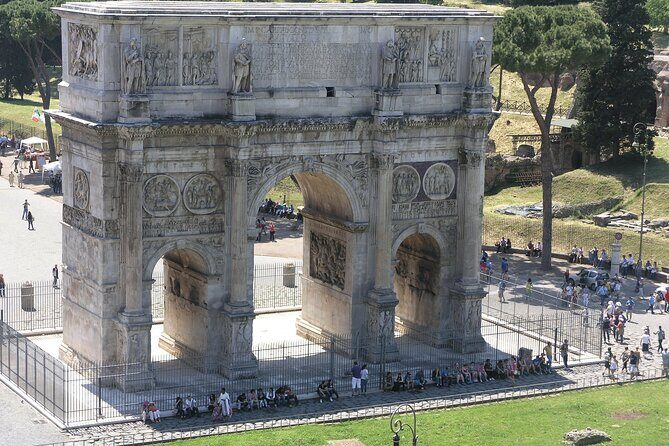
Then comes the Arch of Constantine. Completed in AD 315, it’s more than a trophy structure. It marks a political-and-cultural shift tied to Constantine and the early move toward Christianity in the Roman Empire. The arch also reuses reliefs and inscriptions from earlier monuments, which is a neat reminder that Rome didn’t throw its past away—it recycled it into new messages.
A small, realistic consideration: you’ll be outside for this part of the day. That’s good for mobility and quick orientation, but it also means you’ll feel the weather. If you’re doing this in hot months, bring water and protect your head. If it’s cool or rainy, plan a light layer and a rain-ready accessory.
Circo Massimo and Bocca della Verità: Short Stops With Big Payoff
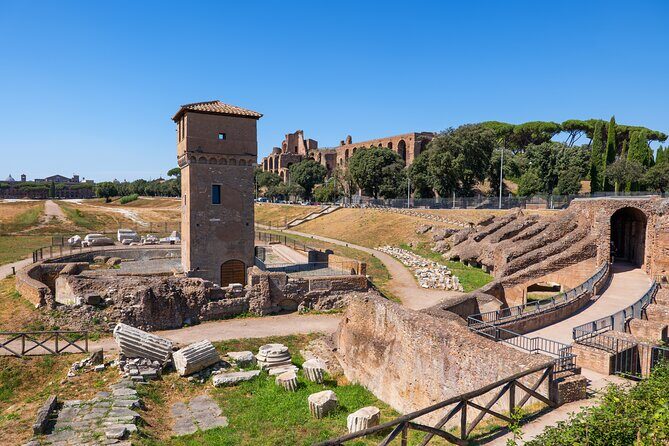
Next is Circo Massimo, the famous chariot racing stadium in the valley between the Palatine Hill and Aventine Hill. One reason this stop feels satisfying in a short window: it’s one of those places where you can see how Romans turned entertainment into mass culture. The site once held around 150,000 spectators, and it wasn’t just races—it also hosted public games and religious ceremonies.
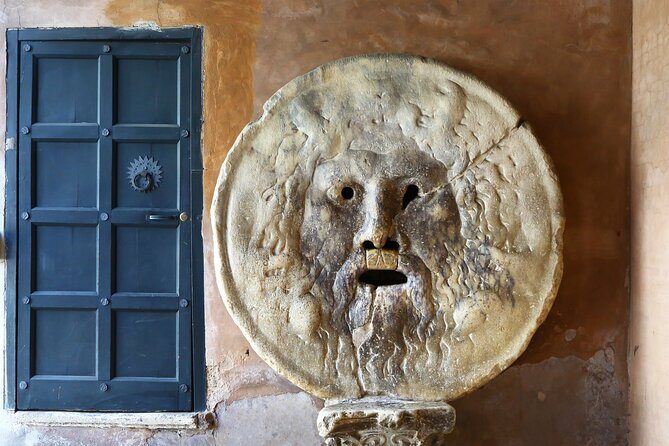
Then you’ll pause at Bocca della Verità, the Mouth of Truth. It’s a marble mask with a long list of theories about what it was originally used for—possibly a ceremonial cover or something decorative. The point here isn’t a single “final answer.” It’s that you’re looking at an artifact that people keep trying to decode. Your guide’s job is to connect that curiosity to the larger theme of ancient Rome: objects often got repurposed, reinterpreted, and wrapped in legend.
These stops are brief, but they’re smart filler between the heavier monuments. They keep the tour from feeling like a checklist and help you start noticing the texture of Rome—valleys, ancient footprints, and everyday-seeming artifacts that turn out to be historic plot twists.
From Hercules to Marcello: Temples and Theatres You’ll Actually Remember
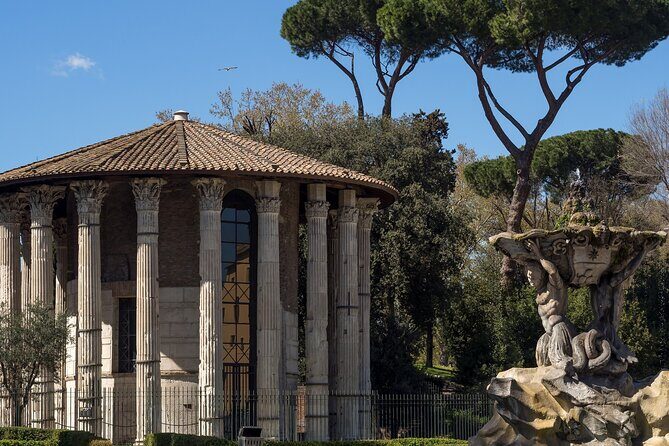
At Tempio di Ercole Vincitore (also known as Hercules Olivarius), you’re in a calmer corner of the Forum Boarium area near the Tiber River. The standout detail is the structure: a tholos (circular) temple with Greek peripteral design, plus a complete colonnade. You’ll get the sense that Roman architecture borrowed, adapted, and executed at a high level—and this is one of the better-preserved examples.
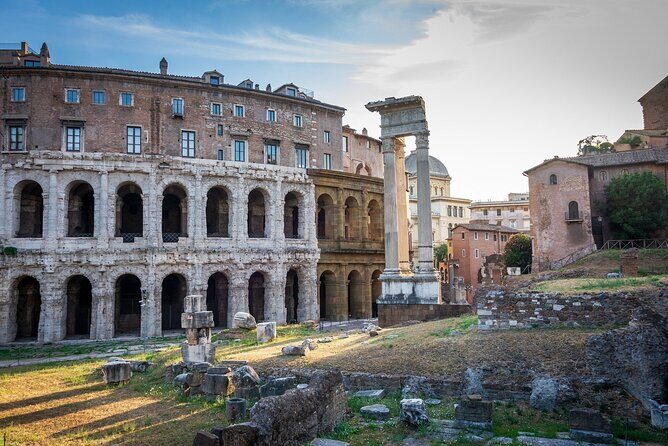
Right after that, you’ll visit Teatro di Marcello. This open-air theatre is often compared to the Colosseum in shape and vibe. It was commissioned by Julius Caesar and completed under Augustus, and it held about 20,000 people. Over time, it was remodeled and incorporated into private residences, so it doesn’t feel like an abandoned ruin in the usual way. Instead, it feels like Rome layered old and new until you get something totally unique.
Practical tip: take a minute to look for lines and levels. The “today” buildings and the ancient theatre structure coexist in a way that makes Rome’s architectural evolution click fast—especially when you’re seeing multiple eras in a single sitting.






Piazza Venezia, Largo Argentina, and the Cat Sanctuary Moment
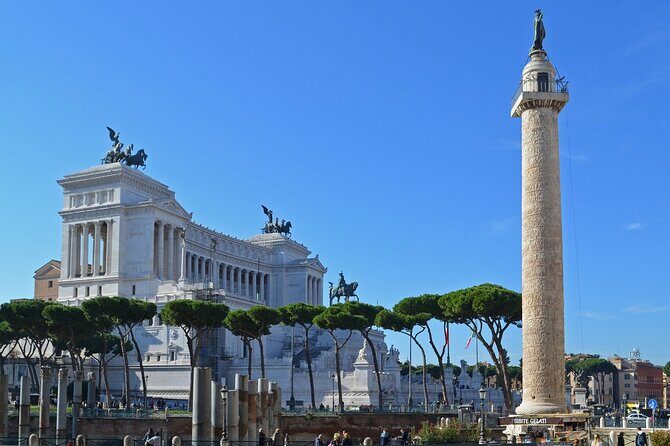
The tour then moves to Piazza Venezia, at the base of Capitoline Hill. It’s a major intersection with major meaning: you’ll learn about the surrounding architecture and the Altare della Patria monument tied to Italy’s unification. This is one of those stops where the history isn’t only ancient—it’s also modern nation-building, staged in stone and scale.
Next is Area Sacra di Largo Argentina (often referred to in connection with Largo di Torre Argentina). This square is packed with archaeological remains, including four Roman Republican temples and the remnants connected to Pompey’s Theatre—where Julius Caesar was assassinated. One added charm noted in the tour description: the area is also home to a cat sanctuary. That tiny detail matters because it breaks the “just monuments” feeling. It turns a dense site into something you can remember for its atmosphere too.
A reasonable drawback to keep in mind: these stops can be visually busy, with people moving around and lots to see. The cart gets you there efficiently, but you’ll still need to give yourself a moment to focus. If you want the clearest experience, don’t rush your camera. Look first, snap second.
Piazza Navona to the Pantheon: Fountain Drama and Roman Engineering
Then it’s Piazza Navona, famous for its three fountains, with Fontana dei Quattro Fiumi as the showpiece and an obelisk on top. You’ll also notice the baroque presence around the square, including the Church of Sant’Agnese in Agone.
This is where the tour becomes more than ancient Rome. Navona is a stage—Rome has always been about public spectacle, just with different costumes across centuries.
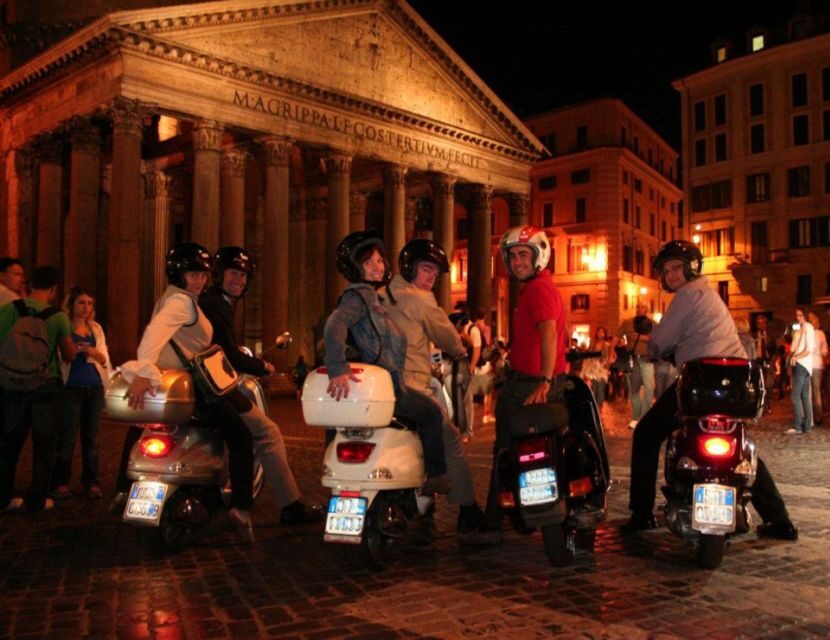
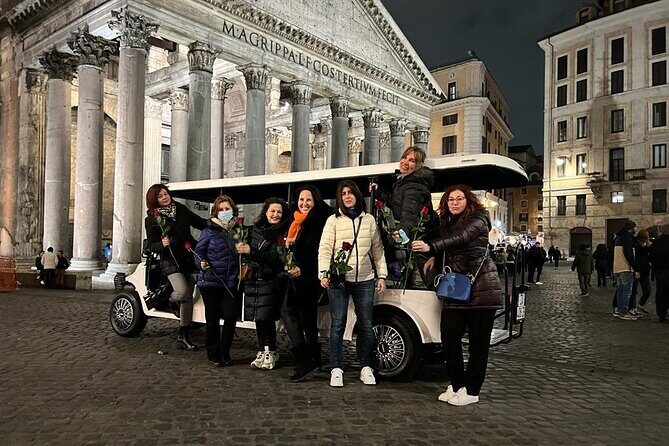
From there, you’ll head to the Pantheon. The architecture is the star: a grand portico with granite columns and a domed rotunda with a remarkable ceiling. Roman engineering turns up in a very physical way here, and the space helps you understand why this building influenced architecture for centuries.
Important for planning: Pantheon entry is not included. You’ll want to decide ahead of time if you want time spent at the door or if you prefer quick viewing from outside. If the Pantheon is high on your list, budget for the ticket and treat that moment as a priority within the tour window.
Santa Maria Sopra Minerva and the Minerva “Chick”: Art With a Smile
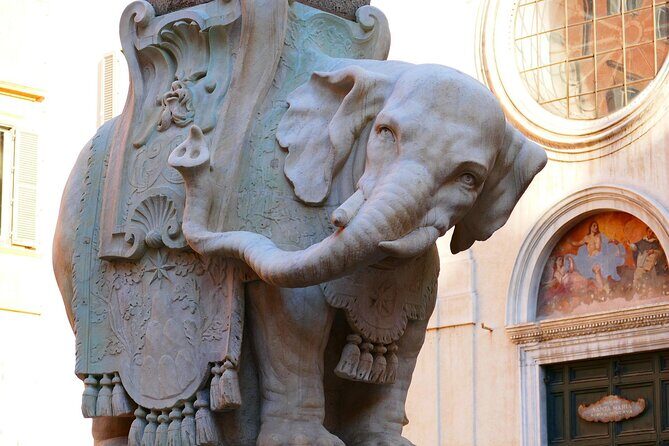
Next comes Chiesa di Santa Maria Sopra Minerva, where Bernini’s sculpture of an elephant carrying an obelisk is associated with the nickname Minerva chick. The backstory is a fun one: Bernini needed to satisfy a commission, and the final result is both playful and connected to the goddess Minerva, tied to wisdom and strength.
This stop is a good example of why having a guide helps. Without commentary, you might see an art detail and move on. With explanation, you catch the joke and the symbolism at the same time. It’s baroque theatre, but in sculpture form.
Time is still short here, so focus on the sculpture first. Look for the elephant-obelisk relationship and notice how the positioning turns it into a message, not just decoration.
Piazza di Spagna and Trevi Fountain: Two Icons, One Timing Strategy
The tour includes Piazza di Spagna, known for the Spanish Steps connecting the piazza to Trinità dei Monti church. This is a great spot for orientation because it shows how Rome’s big plazas work: stairs, streets, and views all choreographed for public life.
Finally, you’ll reach Fontana di Trevi, one of the most famous fountains in the world. It was completed in 1762 and designed by Nicola Salvi. The height and width alone are jaw-dropping—roughly 26.3 meters tall and 49.15 meters wide—with intricate sculptures and flowing water.
The coin tradition is part of the fun: toss a coin over your shoulder, and it’s said to ensure your return to Rome. One review mentioned a guide had coins available, which is a handy heads-up if you want to try it. If not, don’t stress—just enjoy the moment.
One practical consideration: Trevi is intense with crowds. The golf cart can still help by positioning you efficiently, but you should expect people, noise, and a steady stream of tourists. Keep your expectations realistic: the goal is to see it, not to have a quiet private moment in the middle of the square.
Value and Who This Tour Fits Best
Let’s talk value in plain terms. The tour price is $1,102.88 per group up to 6. If you fill all seats, that’s about $184 per person. If you’re traveling as a smaller group, the per-person rate climbs—but you’re still paying for private guiding plus a vehicle that reduces walking stress.
So who gets the best deal?
- Families with kids who can handle short outings but don’t want to spend a whole day on pavement.
- Seniors or anyone with limited mobility who wants the major outdoors sights without a long trek.
- People on a tight schedule who want a “Rome overview” before choosing what to revisit on foot.
- Groups who would otherwise pay for multiple separate tickets or spend half a day figuring out routes.
If you love museums and want deep time inside big monuments, you can still do this tour—but use it as your orientation and highlight layer. Then go back later when you have more time for interiors like the Pantheon.
The Guides: The Real Difference Between Seeing Rome and Understanding Rome
The cart is the vehicle. The guide is the reason it feels like more than sightseeing.
From the reviews, names keep popping up: Dino for passion and smooth handling of crowded streets; Antonio for being both informative and fun; Andrea and Marco for knowledge and pacing that works for families; and Umberto for going above and beyond on narration. There are also mentions of guides being adaptable—listening to suggestions and adjusting the experience to match your group’s interests.
That adaptability is important. Rome is different from city to city. You can’t always control traffic, crowds, or access. A good guide keeps the story moving and turns the day into something coherent rather than a pile of stops.
Should You Book This Private Golf Cart Tour?
I’d book it if you want a fast, comfortable way to hit the outdoor A-list sights with context, especially if your group includes kids who need shorter walking stretches or anyone who benefits from avoiding long distances. The itinerary makes sense for first-timers because it covers the big ancient anchors, then flows into the fountain-and-plaza Rome most people picture.
I would hold off if you’re the type who needs long time at major sites like the Pantheon and you’re counting on this tour to replace that. Think of it as a high-quality sampler and orientation tool. Pair it with a return visit where it matters most.
If your group wants to get your bearings fast and enjoy the ride while learning what you’re seeing, this is a strong choice.
FAQ
How long is the private golf cart tour in Rome?
The tour runs about 2 to 3 hours.
How much does the tour cost?
It costs $1,102.88 per group, up to 6 people.
What’s included in the price?
You get the golf cart tour plus a professional guide.
Are admission tickets included?
Entry tickets are not included. Several stops are listed as free, but the Pantheon specifically notes admission is not included.
Is this tour private?
Yes. It’s a private tour/activity, and only your group participates.
Is the tour suitable for kids or older travelers?
Most travelers can participate. The information notes it’s not for babies/children, but there are reviews that include families with school-age kids. If your child can handle a 2–3 hour ride and short stops, it may work well.
Where do we meet and where does the tour end?
Meet at Italy In Love Tours, Via del Cardello 31, 00184 Roma, and the tour ends at Piazza Venezia, Roma.
What is the cancellation policy?
You can cancel for a full refund up to 24 hours before the experience starts. If you cancel less than 24 hours before, the amount paid isn’t refunded.