REVIEW · POMPEII
Pompeii tour with archaeologist
Book on Viator →Operated by Pina Esposito · Bookable on Viator
Pompeii makes more sense fast.
This tour is interesting because it connects street-level ruins to real Roman life, step by step, with expert narration from Dr. Pina Esposito. I love how the walk moves beyond photo spots into cause-and-effect history, like what people ate, where they worshipped, and how the eruption reshaped everything. I also like the tight pacing for a 2.5-hour visit, with just enough time at each stop to keep your brain engaged. One thing to consider: the highlights move quickly, so if you want lots of lingering, you’ll likely want to plan extra time in the ruins after the tour ends.
You’ll cover a smart loop through Pompeii’s most memorable public buildings and everyday spaces, from the Forum to the theater district and even the brothel. The result is that Pompeii stops feeling like scattered walls and starts feeling like a city with routines, beliefs, and habits.
In This Review
- Why this Pompeii tour feels different (and worth it)
- Key highlights worth showing up for
- Meeting on the Pompeii Scavi side, then finishing at the Forum
- Stop 1: Foro di Pompei and the eruption story in 15 minutes
- Stop 2: Granai del Foro and the plaster casts that linger
- Stop 3: The Basilica’s real purpose, not just a big building
- Stop 4: Temple of Apollo and the clues in original finds
- Stop 5: Hotel Vittoria as a city gateway moment
- Stop 6: The Cave Canem mosaic at the House of the Tragic Poet
- Stop 7: Casa del Fauno (House of the Faun) and the Battle of Alexander mosaic
- Stop 8: Thermopolium Regio VI, Insula VIII, 8 and ancient fast food
- Stop 9: Temple of Vespasian and imperial cult politics
- Stop 10: Via dell’Abbondanza and the urban plan you can actually see
- Stop 11: Theater district, Teatro Grande and Teatro Piccolo
- Stop 12: Doric Temple and the Triangular Forum
- Stop 13: Stabian Baths (Terme Stabiane) and daily routines
- Stop 14: Lupanar and what the surviving art tells you
- Pacing, weather, and how to get the most out of 2.5 hours
- Price and value: what $42.01 really buys you
- Who this tour suits best
- After the tour: staying in the Forum and building your own Pompeii plan
- Should you book this Pompeii archaeologist tour?
- FAQ
- How long is the Pompeii tour with an archaeologist?
- How much does the tour cost?
- What language is the tour offered in?
- Where does the tour start and end?
- What’s included and what’s not included?
- What group size should I expect?
- What if weather is bad or plans change?
Why this Pompeii tour feels different (and worth it)
A Pompeii guide can either read off dates or help you see patterns. This one does patterns.
The best part is that you’re not only looking at monuments. You’re learning why those monuments mattered. You’ll hear about religion, social life, and city planning right next to the actual spaces where Romans lived it. The tour also stays small, with a maximum of 15 travelers, so questions don’t vanish into a crowd.
And you get it all in about 2 hours 30 minutes, which matters in Pompeii. You can’t conquer the whole site in one outing, but you can learn how to “read” it—and that’s where the value really shows.
Key highlights worth showing up for
- Dr. Pina Esposito brings context that turns buildings into daily-life stories
- Plaster casts of victims in the Forum area help the eruption feel real, not abstract
- Major Pompeii icons in one sweep, including the House of the Faun and key temples
- Everyday life stops like a thermopolium (ancient fast-food) and the lupanar brothel
- Outdoor-focused pacing that works well when you’re short on time in Naples
You can also read our reviews of more tours and experiences in Pompeii.
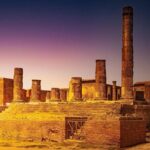
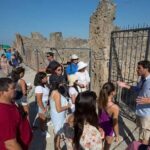
Meeting on the Pompeii Scavi side, then finishing at the Forum
The tour meets at Pompei Scavi Villa Dei Misteri (80045 Pompei) and ends at the Foro di Pompei. That matters more than it sounds. Starting near the Villa dei Misteri area helps you get into the excavation zone efficiently. Ending in the Forum means you’re near the heart of the action if you want to stay inside and explore on your own after the guided portion.
This is also a mobile-ticket tour, offered in English, and it runs year-round in daily hours from late morning through evening. Since Pompeii can get hot and crowded, your best move is to arrive with comfortable shoes and a water plan.
Group size is capped at 15. In practice, that usually means you’re not stuck behind a sea of heads at every stop.
Stop 1: Foro di Pompei and the eruption story in 15 minutes
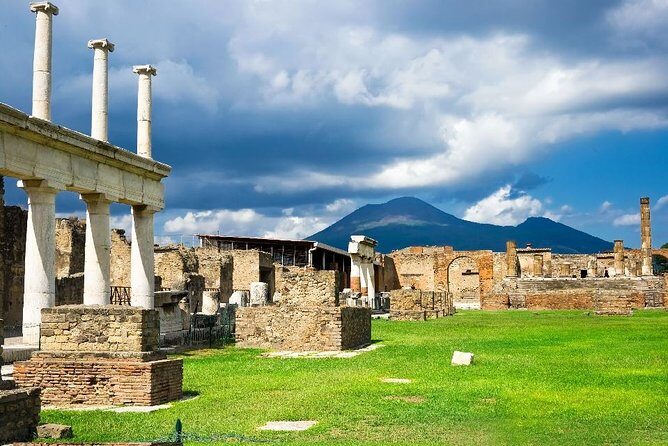
Your first stop is the Foro di Pompei, the public center where Pompeii’s civic and social life showed up in full force. In about 15 minutes, your archaeologist guide connects Pompeii’s origins through the eruption of AD 79 and helps you understand why this space was the city’s stage.
Why it’s valuable: the Forum gives you orientation. Once you understand what this place was for—meetings, announcements, public movement—you start recognizing that same “purpose” in other buildings you pass later.
Possible drawback: the Forum is a busy area in the park. If you’re easily overwhelmed by crowds, you may need to focus hard on your guide’s pointers rather than trying to take in everything at once.
Stop 2: Granai del Foro and the plaster casts that linger
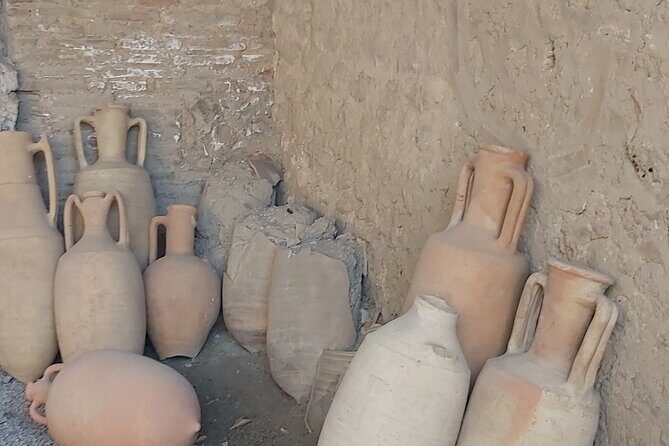
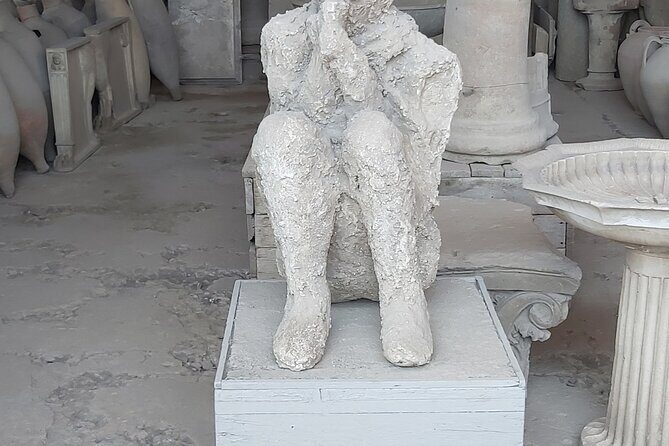
Next you’ll see the Granai del Foro, the Forum granaries. This is where the tour shifts from public life to material details—amphorae, sculptures, inscriptions, and the finds associated with storage and commerce.
The highlight here is the tour’s attention to plaster casts of victims from the eruption. Even in a short time, this is the kind of moment that changes how you experience the site. You stop seeing empty space and start imagining a sudden end to ordinary routines.
Practical note: because these kinds of stops can be emotionally heavy, it helps to keep your mind on what your guide is explaining—so you process it instead of just reacting.
Stop 3: The Basilica’s real purpose, not just a big building
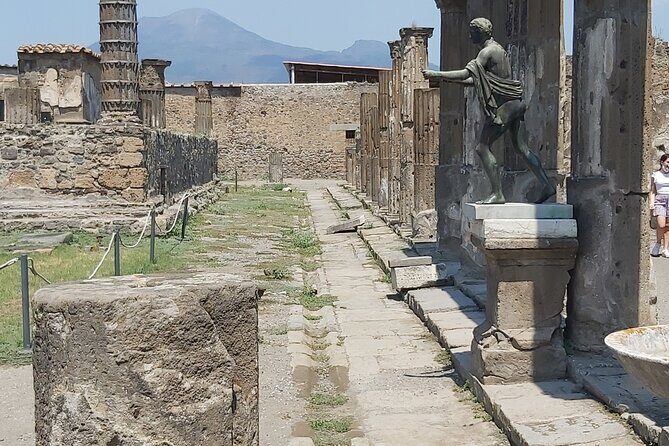
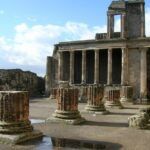
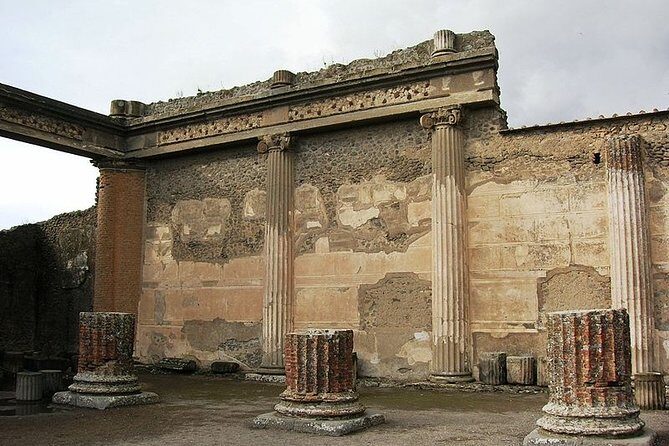
The tour heads to Pompei La Basilica, one of Pompeii’s most monumental structures. You’ll learn what it functioned for and why it’s architecturally impressive.
Why this stop helps: basilicas weren’t just “big rooms.” They were key places for public activity—where people gathered, discussed, and handled civic life. When you understand function, the scale makes sense.
Timing is tight here (about 15 minutes). If you like architecture, you’ll probably want to circle back later on your own after the guided portion, when you have more breathing room.
Stop 4: Temple of Apollo and the clues in original finds
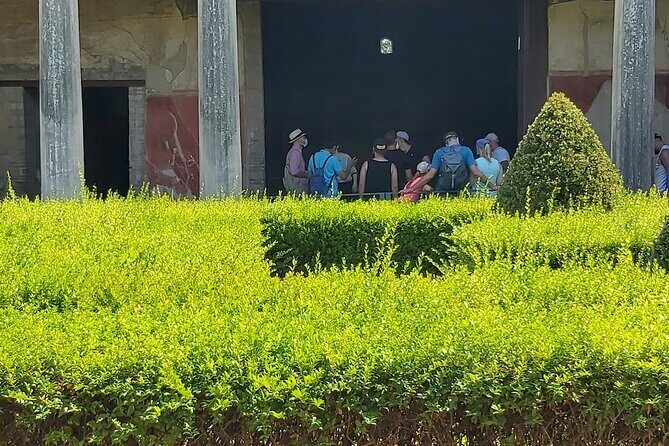
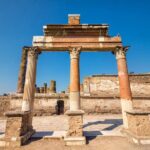
Then comes the Temple of Apollo, explained through what survives and what it tells you. Your guide walks you through original-style elements and details such as sculptures, altar areas, inscriptions, columns, a fountain, and even a Roman sundial.
Why it works: religion in Pompeii isn’t presented as generic spirituality. It’s presented as something built into the calendar, the architecture, and the public space. That’s the difference between seeing ruins and understanding a culture.
A consideration: if you’re hoping for long time inside every structure, this tour won’t be that. It gives you the framework, then moves on.
Stop 5: Hotel Vittoria as a city gateway moment
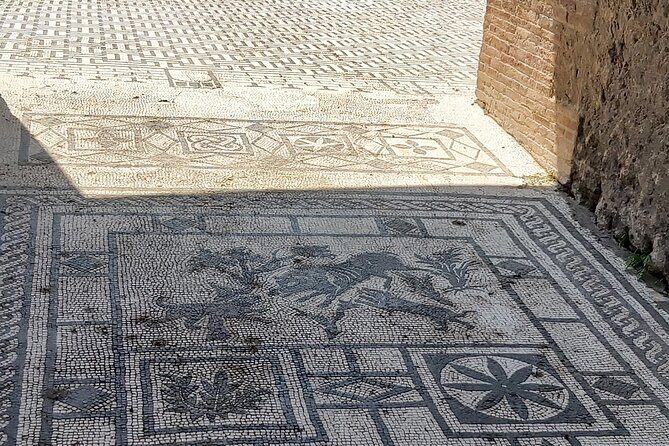
The short stop at Hotel Vittoria is about the city gateway and the surrounding area. It’s only around five minutes, but these kinds of stops matter because they show how Pompeii’s edges connected to movement and arrival.
Think of it as a reset button: after temples and civic buildings, you get a quick look at how the city’s “entry experience” would have felt.
If you’re the type who likes deep logistics and wayfinding, you’ll enjoy the way your guide keeps the city layout in your head.
Stop 6: The Cave Canem mosaic at the House of the Tragic Poet
One of Pompeii’s most recognizable visual moments is the Cave Canem mosaic placed at the entrance of the House of the Tragic Poet. You’ll spend around 10 minutes with this stop, enough time to understand what you’re looking at and why it’s famous.
Why it sticks: mosaics like this were not random decoration. They were messages—sometimes humorous, sometimes protective, always part of how visitors experienced a home. You start to notice how Pompeii communicated personality.
Best use of this stop: slow down for a moment. Let your eyes adjust. The details are part of the story.
Stop 7: Casa del Fauno (House of the Faun) and the Battle of Alexander mosaic
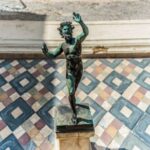
Next is Casa del Fauno, the largest house in Pompeii. Here your guide focuses on why it mattered, what masterpieces were found there, and two standout art objects:
- the bronze sculpture of the dancing Faun
- the Mosaic of the Battle of Alexander, assembled from more than a million tiny colored tiles
You get about 15 minutes at this stop. That sounds short until you realize what’s happening: your guide is tying art, power, and cultural taste into one place. Once you understand that, the mosaic isn’t just impressive—it becomes meaningful.
What you should know: if this is the one stop you care about most, plan to spend extra time after the tour. A guided summary is great, but the mosaic deserves a longer stare.
Stop 8: Thermopolium Regio VI, Insula VIII, 8 and ancient fast food
Then you’ll step into a thermopolium, one of the best preserved examples of ancient “fast food.” Your guide explains social life and what nutrition might have looked like in Pompeii.
Why this stop is so good: it’s the closest thing Pompeii has to everyday modern behavior. People ate quickly, ate on the go, and interacted. It’s a reminder that the city wasn’t only temples and politics.
Timing is about 10 minutes. If you love food history, you’ll probably want to take notes and then go looking for comparisons in the rest of Pompeii’s ruins.
Stop 9: Temple of Vespasian and imperial cult politics
The Temple of Vespasian, also known as the Temple of Genius Augusti, is where the tour connects architecture to Roman power. You’ll learn about the importance of the Roman imperial cult.
This stop gives you an angle most visitors miss. Pompeii wasn’t isolated. It participated in the empire’s identity and authority. When you understand that, the religion stops feeling abstract.
Possible drawback: if you’re mainly into landscapes and casual sightseeing, imperial cult details might feel dense. But the guide’s job is to translate it into something you can picture in daily life.
Stop 10: Via dell’Abbondanza and the urban plan you can actually see
You’ll walk down Via dell’Abbondanza, one of Pompeii’s famous roads. Your guide explains the road network and the urban plan.
This is an underrated stop. Many visitors get lost because they don’t realize Pompeii is organized. When you understand the street logic, you stop feeling overwhelmed and start feeling in control.
This part also sets you up for the theater district and baths later—because city planning helps you predict what comes next.
Stop 11: Theater district, Teatro Grande and Teatro Piccolo
Next is the theater area, where you’ll see the Teatro Grande, Teatro Piccolo, and the Quadriportico dei Teatri. You’ll get about 10 minutes here.
Why you’ll like it: theaters show how a city entertained itself and gathered socially. They were public identity centers, not just performance spaces.
The bonus is perspective. When you understand where people sat and how crowds moved, your mental map of Pompeii becomes sharper.
Stop 12: Doric Temple and the Triangular Forum
Then it’s the Doric Temple, described as the oldest temple in Pompeii, plus the Triangular Forum nearby. You’ll spend about five minutes.
Short stops can feel like a tease, but this one is useful because it helps you see layers of time. Pompeii wasn’t built at once. It evolved.
If you like tracing change over centuries, you’ll appreciate the quick “origin” note that your guide gives you here.
Stop 13: Stabian Baths (Terme Stabiane) and daily routines
At the Stabian Baths, you’ll get about 10 minutes on Pompeii’s thermal buildings. Baths were a major part of routine life—exercise, socializing, and cleaning were wrapped into one system.
Why this stop matters: it turns the city from a museum-like experience into a place with habits. You start thinking in schedules and routines, not just monuments.
A practical consideration: bath buildings can feel visually complex because there are lots of architectural elements. Keep your attention on your guide’s explanation so you don’t get lost in the details.
Stop 14: Lupanar and what the surviving art tells you
Finally, you’ll visit the Lupanar, the famous brothel. The tour focuses on how well preserved the bedrooms and erotic frescoes are, including depictions of different amorous positions.
This is the stop some people dread and others find fascinating. Either way, your guide keeps it grounded in context: what this space was, how it functioned socially, and why the art survived in such a recognizable way.
Keep an eye on your comfort level. This part can be graphic in topic, even if you’re not looking at it for shock value. If you’d rather avoid it, you can ask the guide how the tour handles it so you can adjust your focus.
Pacing, weather, and how to get the most out of 2.5 hours
At 2 hours 30 minutes, you’re getting a curated sweep. That’s a feature, not a flaw. Pompeii is massive. If you try to do everything on your own, you’ll lose time and context.
The trade-off is that each stop is brief. Some are 5 minutes, others 15. So use this tour like training wheels. When you leave, you’ll know what to revisit and what to skip.
Also, this experience requires good weather. If rain or heavy conditions are forecast, you may be offered a different date or a full refund. In Pompeii, even light weather can change the comfort factor, especially on cobbled surfaces.
Bring a hat and water. Even in cooler seasons, the sun can catch you between stops.
Price and value: what $42.01 really buys you
At about $42.01 per person, you’re paying for a focused archaeologist-led explanation over a wide range of sites. You also get a small-group experience, with a max of 15 people, which makes it easier to ask questions and stay oriented.
Entrance fees and food aren’t included. That said, many of your highlights are outdoor-facing or built into the park walking route, so you’re not paying for each minute of narrative in separate add-on tickets during the tour itself.
The real value is the “translator” effect. You don’t just learn that something exists. You learn what it was for, what people did there, and how the eruption changed the story. That’s the kind of knowledge you can’t easily squeeze out of plaques when you’re tired and moving fast.
Who this tour suits best
This is a great fit if:
- You want a fast, coherent intro to Pompeii in a single outing.
- You like being guided through major sites without getting stuck in indecision.
- You care about everyday life history, not only temples and statues.
- You prefer a small group and a guide who can handle questions.
It may be less ideal if:
- You want long, slow time inside every space.
- You’re not interested in the brothel stop’s social and historical context.
- You’re the type who needs hours of solitude for photos.
After the tour: staying in the Forum and building your own Pompeii plan
Because the tour ends at the Foro di Pompei, you have a smart next move. Use your guided experience as your map. If there’s one area that caught your imagination—art in the House of the Faun, architecture in the basilica and temples, or the everyday-life angle at the thermopolium—go back and spend time there.
Even if you only add 30 to 60 minutes, it helps you convert the guided framework into real understanding.
Should you book this Pompeii archaeologist tour?
Yes, if you want the simplest path from confused ruins to real context. I’d book it when you have limited time and you don’t want to waste hours wandering without a plan.
You’re getting a structured walk through the Forum, temples, major houses, baths, entertainment, and the lupanar, all explained in a way that helps you connect the dots. The small-group size and Dr. Pina Esposito’s scholarly approach are the kind of combo that makes Pompeii feel usable instead of overwhelming.
FAQ
How long is the Pompeii tour with an archaeologist?
It’s approximately 2 hours 30 minutes.
How much does the tour cost?
The price is $42.01 per person.
What language is the tour offered in?
The tour is offered in English (and the guided tour is provided in Italian or English or German).
Where does the tour start and end?
It starts at Pompei Scavi Villa Dei Misteri (80045 Pompei) and ends at the Foro di Pompei (Via Villa dei Misteri, 2, 80045 Pompei NA, Italy).
What’s included and what’s not included?
Included: a guided tour with an archaeologist/guide. Not included: food, drink, tip, and entrance fee.
What group size should I expect?
The tour has a maximum of 15 travelers.
What if weather is bad or plans change?
This experience requires good weather. If it’s canceled due to poor weather, you’ll be offered a different date or a full refund. Free cancellation is available up to 24 hours in advance for a full refund.