REVIEW · POMPEII
Pompeii Tour & Admission included in a Small Group
Book on Viator →Operated by Grand Tour Experience · Bookable on Viator
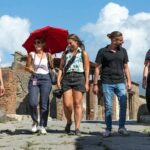
Pompeii turns history into a walk. This 2-hour small-group tour handles entry with Pompeii admission and keeps you moving with an archaeologist guide plus headsets. I especially liked the Porta Marina start and how the 79 AD eruption story connects to what you see on the ground. The possible drawback is that it’s packed for time, so you’ll get major highlights—not every excavation detail.
You meet at the Villa of the Mysteries and step into the park with a mobile ticket and a paper map to help you keep your bearings. It’s a good setup for first-timers who want direction fast, without feeling like you’re alone in a maze of stone.
Do wear sturdy shoes. Pompeii is full of uneven ground, curbs, and stepping stones, and this tour is built around walking between key zones.
In This Review
- Key things to know before you go
- Entering Pompeii from the Villa of the Mysteries
- The Porta Marina to Forum stretch: the city’s public heartbeat
- A quick reality check about pacing
- Forum landmarks you’ll actually remember: Venus, Apollo, and Jupiter
- Macellum and the Forum Baths: food, services, and how people relaxed
- Houses and street culture: the wealthy side of Pompeii
- Teatro Grande: how Romans staged emotion in stone
- Price and value: is $66.01 for two hours a fair deal?
- What to bring and how to plan your day
- Should you book this Pompeii Tour & Admission in a Small Group?
- FAQ
- How long is the Pompeii Tour & Admission included in a Small Group?
- Is admission to the Pompeii site included in the price?
- What language is the tour offered in?
- Do I get a headset?
- Where is the meeting point?
- What’s the group size?
- Is bottled water included?
- Can I cancel for a full refund?
Key things to know before you go
- Admission included: no scrambling for tickets once you’re there.
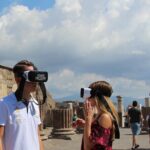
- Headsets when it’s busy: easier to hear your guide in crowded areas.
- A Forum-centered route: you’ll see the city’s public life fast—basilica, baths, temples, and markets.
- Daily-life details, not just monuments: theremopolium, Roman shops, and a food market stop.
- Vesuvius in the background: the eruption story feels real when the landscape is part of it.
- Two hours, small group: enough time to cover the big hits without feeling rushed all day.
Entering Pompeii from the Villa of the Mysteries
The tour begins near public transportation at the Villa of the Mysteries, Via Villa dei Misteri, 2, 80045 Pompei. You end back at the same meeting point. That matters more than it sounds, because Pompeii can eat time if you’re trying to match up your own route to closing hours and bus schedules.
Once you’re set, the tour focuses on getting you oriented at the right pace. You start at Porta Marina, with Mount Vesuvius rising in the background—an early visual cue that the city’s story doesn’t live only in books. Instead of dropping you into ruins and hoping you connect the dots, your guide builds the timeline as you walk.
You also get practical support: a mobile ticket (so you can show entry on your phone) plus a paper map. The map is useful for after the tour too, when you might want to wander a little longer on your own and not feel lost.
You can also read our reviews of more tours and experiences in Pompeii.
The Porta Marina to Forum stretch: the city’s public heartbeat
Stop 1 is your main introduction to Pompeii at the Archaeological Park, and it’s the most time-rich segment. You’ll walk through ancient streets tied to the final moments of the city and the upheaval of the 79 AD eruption. It’s the kind of story that lands best when you’re surrounded by the scale of the place.
As you move along the Roman Forum area, you’re not just looking at columns. You’re learning what the spaces were for: civic business, justice, religion, and the everyday movement of people through the city. Pompeii has a way of making you realize how tightly planned Roman life was—everything had a location and a purpose.
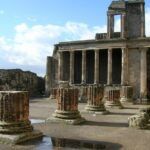
This is also where the route leans into places that help you picture routines. The Basilica stop is one example: it was the biggest administrative building in the Forum, a place for managing business and handling justice. Even if you only catch a few key architectural details, it’s easier to understand what “public life” meant when you’re standing where decisions were made.
You’ll also hear about Roman temples and public space aligned along major streets, including the Decumanus Maximus—the main east-west spine of Pompeii. Your guide uses these “street lines” to help you connect areas that would otherwise feel like separate ruins.
A quick reality check about pacing
The stops are brief—about ten minutes each for the listed landmarks. That’s not a problem, as long as you come for clarity and the big storyline. If you want to linger for 30 minutes in one spot, this format won’t be your favorite. But if you want an organized first pass, it works very well.
Forum landmarks you’ll actually remember: Venus, Apollo, and Jupiter
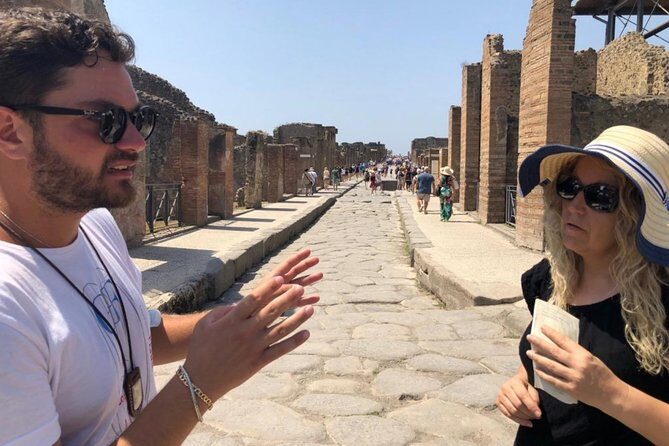
After the opening orientation, the tour strings together several marquee religious and civic landmarks. These are quick stops, but they’re chosen for how they explain Pompeii’s urban layout.
Stop 2 is the Temple of Venus, dedicated to the patron goddess of Pompeii. Venus might sound like one more “pretty temple” on a list, but it’s a helpful anchor for understanding local identity. When a town has a patron deity, it shows up everywhere—in symbolism, in art, and in how the city organizes sacred space.
Stop 4 takes you to the Sanctuary of Apollo, described as among the oldest worship areas in Pompeii. It sits at a strategic point along the street leading up from Porta Marina toward the public heart of the city. This kind of location tells you how processions and movement mattered in Roman planning—sacred space was not random.
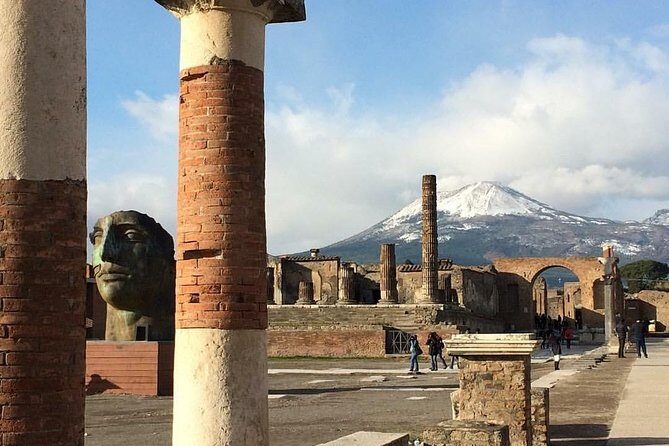
Stop 6 is the Temple of Jupiter, dominating the northern side of the Forum with Vesuvius rising behind it. That view isn’t just scenic. It reinforces why the eruption story hits so hard here. You’re seeing the geography that shaped the final day—where smoke, ash, and wind would have moved through a real landscape, not a map.
Between these stops, your guide’s job is to keep the city’s meaning tied to the buildings. If your guide is strong, you’ll leave with names and functions, not just photos of stone.
Macellum and the Forum Baths: food, services, and how people relaxed
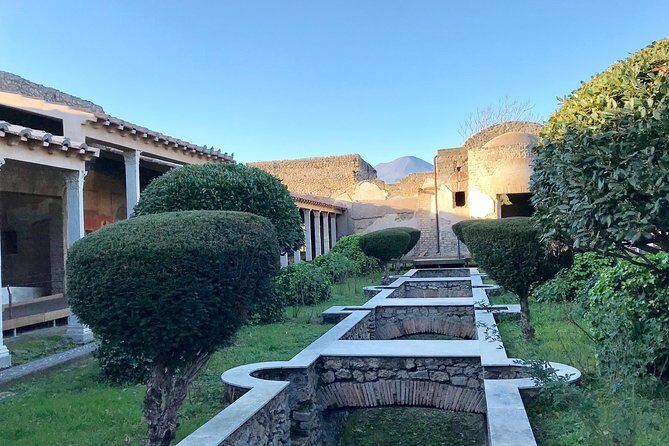
Stop 7 is the Macellum, a monumental food and consumer-products market. This is one of those places where you can almost hear daily life. Markets were not just commerce—they were social hubs where people met, checked what was available, and kept up with the city’s rhythm.
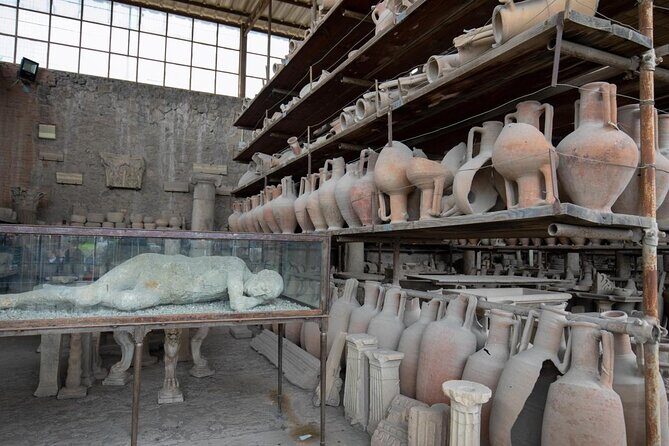
A highlight here is the presence of plaster casts (referred to as bodies) connected with archaeological methods used to understand what people were like at the moment of the eruption. This stop can feel heavy, but it’s also what makes Pompeii more than architecture. You get the human scale: the city wasn’t empty before the disaster, and it wasn’t just “lost buildings” after.
Stop 8 brings you to the Forum Baths, one of the best-preserved parts of Pompeii. You’ll see how baths worked with separate male and female entrances. It’s a small detail, but it’s exactly the kind of practical clue that helps you understand how Romans organized daily life.
Then Stop 9 shifts to street-level refreshment at the Thermopolium of Vetuzio Placido. A thermopolium was basically a diner—an easy place for residents to eat and drink. The value of this stop is that you don’t leave Pompeii thinking only about senators and temples. You see evidence of ordinary routines, the kind that made the city feel lived-in.
Houses and street culture: the wealthy side of Pompeii
Stop 10 is a two-part domus experience with the House of the Faun and the House of the Vettii. These are big-name residential areas, and they also show you how wealth expressed itself in Pompeii.
The House of the Faun is one of the largest houses in the city, and it’s noted for the Latin welcome inscription (HAVE) on the sidewalks. That’s a real “walk past it and notice it” moment—small lettering that tells you you’re moving through someone’s home-front world.
The House of the Vettii is described as one of the richest and most famous in Pompeii, with protection associated with Priapus, the god of prosperity. Since these houses can be subject to seasonal openings and closings, don’t assume every doorway will be accessible on your exact day. The good news is that even when access varies, the guide can still help you understand what the home sites were built to communicate.
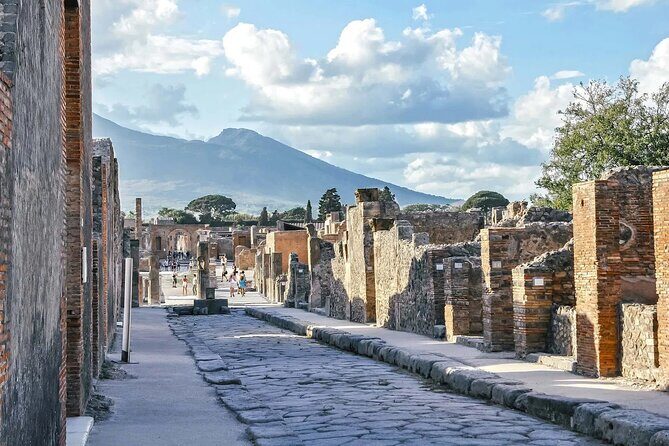
Stop 11 is Via dell’Abbondanza, the ancient main street (Decumanus Maximus). This is the kind of stop that makes the city feel like a place, not a museum. It’s a reminder that people didn’t move building to building—they walked routes that connected everything.
Teatro Grande: how Romans staged emotion in stone
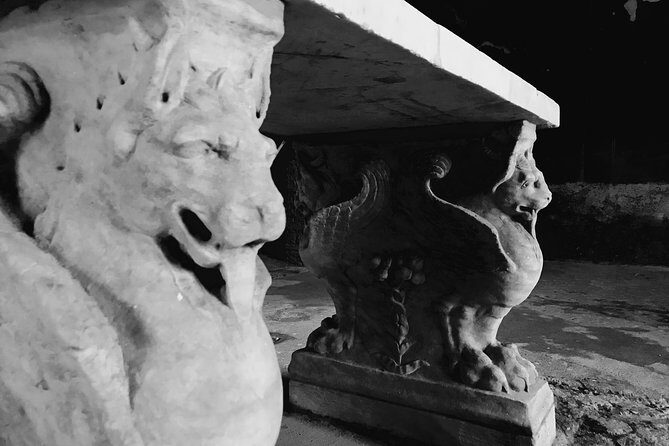
Stop 12 is the Teatro Grande, where comedies and tragedies in the Greco-Roman tradition were performed. Even without getting stuck in technical theater history, you can feel why this building mattered. Performance space wasn’t just entertainment. It was public culture—people gathered, reacted, and shared stories in the same physical environment.
If you’re the type who likes to connect art with daily life, this is a satisfying closer. It’s also a helpful contrast to the civic and religious stops earlier—Pompeii wasn’t one mood. It was many.
Price and value: is $66.01 for two hours a fair deal?
At $66.01 per person for about two hours, the value here comes from what you’re getting bundled together:
- Pompeii site admission included, so you don’t have to add another ticket decision mid-trip.
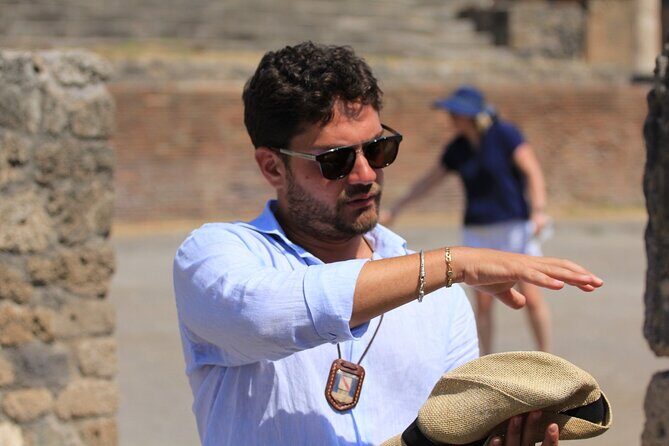
- An authorized guide / archaeologist, which usually makes the difference between random ruins photos and an actual sense of what mattered and why.
- Headsets when it’s crowded, which is not glamorous, but it’s practical.
- A Pompeii paper map that helps you after the tour, not just during it.
For this price, you’re basically buying a guided “first read” of Pompeii with entry sorted and your hearing sorted. That’s especially worth it if it’s your first time at Pompeii or if you’re short on time and want the main storyline done well.
One more value point: small-group size. The tour is described as maximum 15 travelers. On unusual operational days, the group may run slightly higher, but the overall model is still small enough that your guide can manage pacing and keep you together.
What to bring and how to plan your day
Pompeii rewards good footwear. Expect uneven terrain and real walking across curbs and stepping stones. If your shoes are soft, you’ll feel it. If your shoes have grip and support, the whole experience gets easier.
Also, bottled water is not included. Bring water and a snack if you’re prone to low energy once you’re walking and listening for two hours. You may be in and out of sun, and Pompeii can feel hotter than you expect.
Timing is another practical issue. Some areas in Pompeii close earlier than you’d guess. If your tour starts in the late afternoon, you might find certain sights are no longer accessible when you arrive or when you try to return on your own. This tour is short, but closures can still affect what you can add afterward.
If you’re booking, note that this experience is often reserved about 51 days in advance on average. That’s a hint: it’s popular, and dates can fill up when cruise schedules stack or when busier seasons roll in.
Should you book this Pompeii Tour & Admission in a Small Group?
I think you should book it if you want a structured, high-impact introduction to Pompeii. You get the big story—especially the eruption context—plus a smart sweep of major public spaces, temples, markets, baths, domus highlights, and the theater, all within about two hours.
Skip it only if you’re already a Pompeii super-fan with deep excavation interests and you want long, slow stays in one or two areas. This tour is built for breadth and clarity, not for hanging out for an hour in one courtyard.
If you want a first visit that feels organized, not chaotic, this is a strong choice—especially with admission taken care of and headsets included when the site gets crowded.
FAQ
How long is the Pompeii Tour & Admission included in a Small Group?
It lasts about 2 hours.
Is admission to the Pompeii site included in the price?
Yes. The admission ticket to the Archaeological Park of Pompeii is included.
What language is the tour offered in?
The tour is offered in English.
Do I get a headset?
Yes. Headsets are included in case the site is crowded.
Where is the meeting point?
The tour starts at the Villa of the Mysteries, Via Villa dei Misteri, 2, 80045 Pompei NA, Italy. It also ends back at the meeting point.
What’s the group size?
The tour is listed as a maximum of 15 travelers.
Is bottled water included?
No. Bottled water is not included.
Can I cancel for a full refund?
Yes, free cancellation is available. You can cancel up to 24 hours in advance for a full refund.