REVIEW · NAPLES
Herculaneum small group tour with an archaeologist – skip the line
Book on Viator →Operated by PompeiIn · Bookable on Viator
Volcanic ash made Herculaneum feel frozen in time. This skip-the-line guided visit takes you to a Roman resort town preserved for millennia, with an archaeologist helping you read what’s in front of you—houses, baths, and everyday spaces—plus the bigger story of how people faced the choice to flee or stay.
I love two things most: the tight small-group format (up to 20) that leaves room for questions, and the way the guide connects details you might miss—like carbonised wooden remains—to real human life and choices in the moment.
One thing to consider: this is a 2-hour sprint through the main stops, so you’ll see a lot, but you won’t get a slow, lingering pace at every room or corridor.
In This Review
- Key highlights worth your time
- Herculaneum’s ash cover: why this town feels different
- Skip-the-line entry and what $57.26 actually buys
- The archaeologist guide style: how you’ll learn without getting lost
- Stop-by-stop walkthrough: from villas to thermae
- Casa dei Cervi (stag statues and a household peristyle)
- La Terrazza di M. Nonio Balbo (a benefactor’s story in stone)
- College of the Augustales (religion, politics, and the Emperor’s cult)
- Casa del Rilievo di Telefo (a wealthy house with a private connection)
- Partem Domus lignea (the surviving wooden partition)
- House of the Skeleton (human remains give the name its weight)
- Central Thermae (men and women, separate entrances)
- Black Hall, courtyards, and the grand finale
- Casa del Salone Nero (the Black Hall and carbonised door remains)
- Casa Sannitica (Samnite-style arrangement with Ionic columns)
- Casa del Bel Cortile (a courtyard stairway and stone balcony)
- House of the Grand Portal (charred wood and elegant central spaces)
- Timing, comfort, and how to prepare
- Who this tour fits best (and who might want another option)
- Should you book? My take on value
- FAQ
- How long is the Herculaneum small group tour with an archaeologist?
- Is skip-the-line admission included?
- What group size is this tour?
- Where do we meet for the tour?
- Is transportation to Herculaneum included?
- Can I cancel and get a refund?
Key highlights worth your time
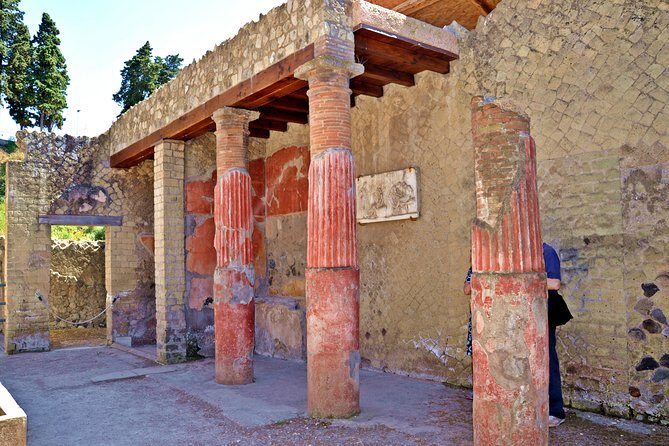
- Skip-the-line tickets included, so you spend less time queuing and more time looking closely at the site
- Archaeologist-led, live guidance that turns “old stones” into stories tied to specific buildings
- Plenty of question time in a group capped at 20 people
- Hands-on kinds of details, from carbonised doorframes to a surviving wooden partition inside a house
- Bathrooms with separate entrances in the Central Thermae, showing how gendered space worked day-to-day
Herculaneum’s ash cover: why this town feels different
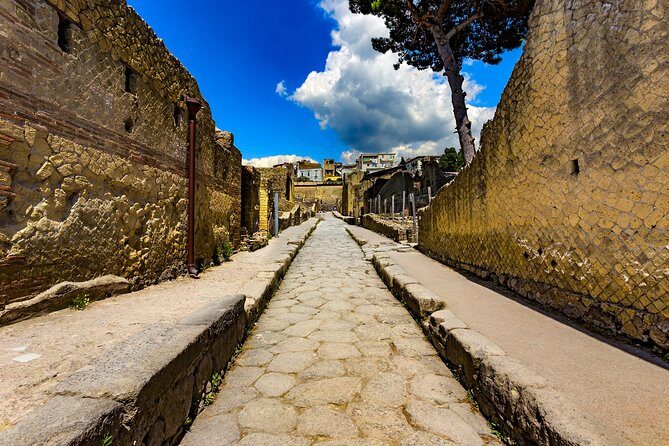
Herculaneum is preserved in a way that’s hard to match anywhere else. Instead of just ruins with walls standing back and farther apart, you get a sense of rooms, thresholds, and layouts that were buried and protected by volcanic ash for ages.
What I like about seeing it with an archaeologist is that the explanation stays grounded in evidence. You’re not just told it was “a Roman town.” You’re shown how people moved through it—where public life happened, where wealthy households had luxury touches, and where everyday routines unfolded in spaces like bath complexes and dining-related areas (the kind of details that make the past feel less abstract).
Also, the tour’s structure matters. You don’t get dumped into one monument. You travel stop-to-stop across the town, so the place starts to make sense as a whole.
You can also read our reviews of more tours and experiences in Naples

Skip-the-line entry and what $57.26 actually buys
At $57.26 per person, the headline is the skip-the-line access. But the real value isn’t just saving minutes. It’s that your time gets converted into guided interpretation.
Here’s the tradeoff you’re avoiding: if you arrive and spend a chunk of your schedule waiting for admission, you lose the best part of a guided plan—your momentum. With included skip-the-line admission fees and a 2-hour route, you’re using that day efficiently.
A few practical notes that help you get the most out of the money:
- You’ll want your mobile ticket ready on your phone at the start.
- The meeting point is the Archaeological Park of Herculaneum, Corso Resina, 187, 80056 Ercolano NA, Italy. Arriving a little early makes the start smoother.
- The tour is near public transportation, but you still need to physically get to the park itself (transport isn’t included).
If you’re visiting during busy hours, this is the kind of booking that helps you feel less rushed—because the guided part begins sooner.
The archaeologist guide style: how you’ll learn without getting lost
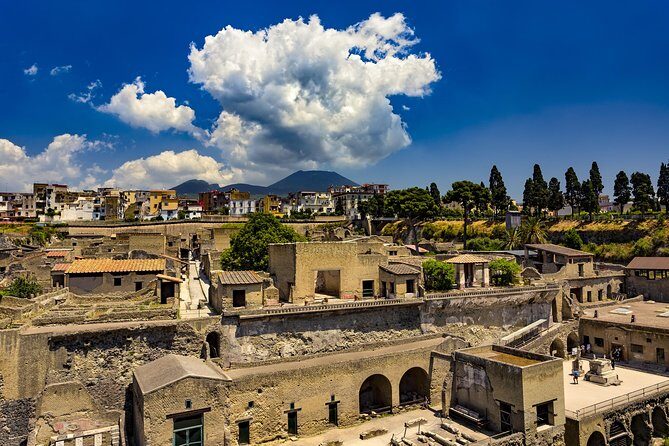
This is a licensed archaeologist guide tour with live, in-person explanations. That matters because Herculaneum is full of small, specific features—inscriptions, doorframes, room layouts, and construction clues—that are easy to overlook when you’re on your own.
In a group of up to 20, you can actually ask follow-up questions. That’s important here, because the explanations aren’t generic. They point to particular evidence tied to each stop, and then you get a chance to ask what it means for everyday life.
One small “expectation check”: the site can feel like it’s mostly open-air exploration rather than a big museum experience. If you’re hoping for lots of indoor interpretation, you might find the on-site museum portion on the small side and not packed with extra information. The guidance during the walk is where the learning payoff lands.
Stop-by-stop walkthrough: from villas to thermae
The tour is built around 11 stops, each with a set time window. I like this approach because it creates a rhythm: you focus on one key building, learn how to read it, then move on before you start mentally drifting.
Below is what each stop is doing for you—why it’s there, and what to look for as you move through.
Casa dei Cervi (stag statues and a household peristyle)
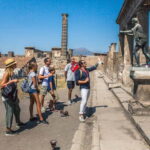
You start at Casa dei Cervi, named after marble statues of stags/deer found in the peristyle. Even if you’re not a Roman-art expert, the name alone is a clue: you’re meant to notice how decoration wasn’t just “pretty.” It was part of status, identity, and the way wealthy households presented themselves.
In a short stop, the guide’s job is to help you connect the art to the space it came from—so instead of seeing a room as “a room,” you see it as part of a social performance.
What to watch for: the peristyle idea—how this inner courtyard space functioned in daily movement and hosting.



La Terrazza di M. Nonio Balbo (a benefactor’s story in stone)
Next is La Terrazza di M. Nonio Balbo. This name ties to the city’s major benefactor, linked to restorations and new public buildings. After his death, he was made a patron and honoured in a long inscription tied to a funeral altar.
This stop is all about power and civic identity. It shows how wealthy patrons could shape the physical look of a town, and then how memory of that patron was preserved through inscriptions.
What to watch for: the inscription theme—how text and monument worked together to keep a person’s reputation alive.
College of the Augustales (religion, politics, and the Emperor’s cult)
Then you hit the College of the Augustales. The building is thought to relate to a cult connected to Emperor Augustus and possibly the headquarters of the Collegium Augustalium, or even the local curia.
This is where Herculaneum stops being only “pretty houses” and becomes a living social system. If you’ve ever wondered how Roman civic life blended religion and leadership, this is the kind of stop that answers it in a concrete way.
What to watch for: the idea that one building could represent both worship and organization.
Casa del Rilievo di Telefo (a wealthy house with a private connection)
Casa del Rilievo di Telefo is described as potentially belonging to one of the leading benefactors connected to Marcus Nonius Balbus. What makes it unusual is that it has its own private access to the adjoining Suburban Thermae to the south.
That detail is a big deal. It tells you something simple but revealing: luxury wasn’t only in grand rooms. It could include easy, controlled access to leisure spaces.
What to watch for: the layout logic—how a private entrance changes the relationship between house and bath area.
Partem Domus lignea (the surviving wooden partition)
Stop 5 is Partem Domus lignea – Casa del Tramezzo di Legno, famous for a surviving wooden partition, still present in the house layout.
This is the kind of feature that makes you slow down for a second, even in a fast tour. Wooden elements are so often lost. So when a partition survives, it gives you a rare look at how rooms were divided and how space could be managed inside a home.
What to watch for: the partition itself, and what it implies about privacy, function, and room use.
House of the Skeleton (human remains give the name its weight)
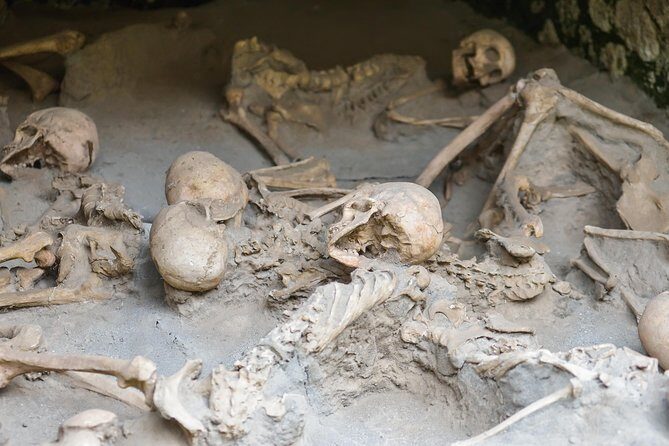
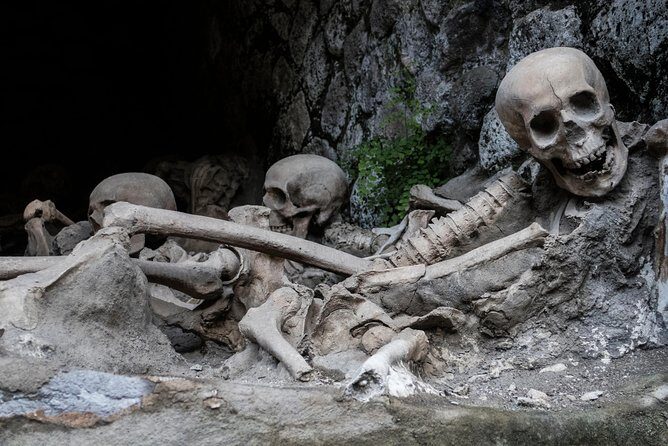
The House of the Skeleton gets its name from human remains found in a second-floor room in 1831. The story is heavy, and the guide’s role is to keep it respectful while still explaining what the evidence tells you.
This stop is where the tour connects tragedy to documentation—how discoveries over time shaped how we talk about the site today.
What to watch for: the second-floor naming logic—why location matters in understanding what happened.
Central Thermae (men and women, separate entrances)
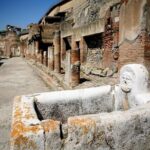
Then you reach the Central Thermae, built around the beginning of the 1st century AD. It was divided—according to the common practice—into men’s and women’s baths, with separate entrances.
I like this stop because it’s one of the clearest ways to understand daily life. Bathing wasn’t just hygiene; it was a social routine with built-in rules.
What to watch for: the separate entrance concept. You’re meant to see the plan as designed for distinct access, not one shared space.
Black Hall, courtyards, and the grand finale
After the baths, the tour shifts back to luxury houses and standout design ideas. These are the stops where you’ll notice how Herculaneum’s wealthy residents lived in a way that still feels oddly familiar: light, views, and showy interior planning.
Casa del Salone Nero (the Black Hall and carbonised door remains)
Casa del Salone Nero, the House of the Black Hall, is one of the more luxurious mansions. It has a monumental entrance, and you can still see carbonised remains of the doorposts and lintel.
This is where you’ll likely hear the story about carbonised things and people—because the site’s defining feature is how materials and even human traces survived in charred, preserved states. It’s not just spooky. It’s evidence that helps you understand what materials were present and how they were built.
What to watch for: the entrance structure—how the doorframe remains create a sense of scale and craftsmanship.
Casa Sannitica (Samnite-style arrangement with Ionic columns)
Casa Sannitica features an arrangement typical of the Samnites, a people from mountainous central Italy, described in relation to the Sabine race. The atrium is skirted by a gallery with Ionic columns, and the rooms have frescoes.
This stop adds variety to the tour. Instead of one “Roman template,” you see how local identity could influence design choices.
What to watch for: the atrium + gallery setup and the Ionic columns—plus how fresco decoration signals status.
Casa del Bel Cortile (a courtyard stairway and stone balcony)
Casa del Bel Cortile is one of the more original houses in Herculaneum. It has a courtyard with a stairway and a stone balcony instead of an atrium.
If you like architecture that tells you how people used space, this is a great one. A different courtyard-and-stairs layout changes how you imagine movement through the home.
What to watch for: the courtyard stairway and stone balcony concept—how that would shape sightlines and daily circulation.
House of the Grand Portal (charred wood and elegant central spaces)
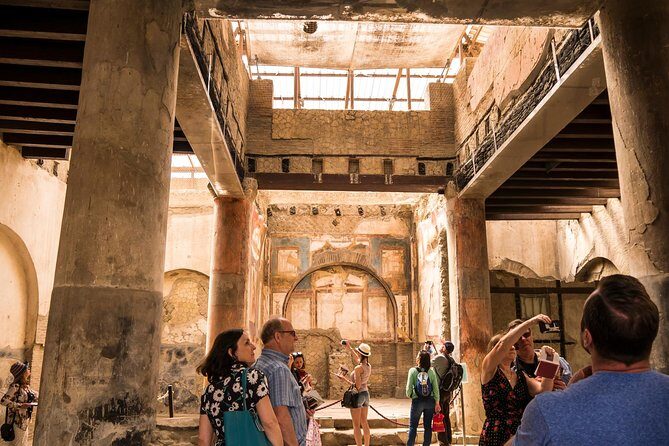
The last stop is the House of the Grand Portal. It’s located in the center of the archaeological area and includes various environments, collonnati (colonnaded areas), and frescoes. You can also see charred remains of wooden parts.
This finale helps tie the tour together. After you’ve seen baths, partitions, private connections, and unique courtyard planning, this stop wraps it up with a sense of grandeur and overall layout.
What to watch for: the mix—frescoes plus evidence of wood loss/charing—so you understand how multiple materials can survive in different ways.
Timing, comfort, and how to prepare
This tour runs about 2 hours, with multiple stops around roughly 10–15 minutes each. That means you’ll be walking and looking, not sitting in a classroom.
To keep it comfortable:
- Wear solid shoes. Some surfaces can be uneven.
- Plan for sun. One tip that’s easy to ignore until you feel it: bring a cap/hat. The light can be intense.
- Bring water if you can—though personal expenses aren’t included, so you’ll want to handle drinks on your own.
Also, start strong. If you’re worried about finding the exact meeting point, arrive early and double-check the park entrance details (Corso Resina, 187). A smooth start gives you more time to enjoy the stops rather than hunting for the right group.
Who this tour fits best (and who might want another option)
This is a strong fit if you:
- Want an evidence-based, archaeologist-guided walk through Herculaneum’s best-preserved spaces
- Enjoy asking questions and getting answers tied to real buildings
- Like architectural detail: partitions, doorframes, atrium layouts, bath layouts, and inscriptions
It may feel less ideal if you:
- Want a very slow, museum-style pace at a handful of locations (this is structured, timed, and you move)
- Expect a huge indoor museum experience with lots of extra interpretation beyond the site walkthrough
As a practical bonus, the group cap at 20 makes it feel personal enough that you can keep up with the guide without being swallowed by a crowd.
Should you book? My take on value
For $57.26, the biggest value is the combination of skip-the-line admission plus live archaeologist guidance. You’re not just paying to enter a park—you’re paying to understand what you’re seeing, stop-by-stop, within a tight time plan.
If you care about real context—how public spaces worked, how benefactors shaped buildings, how baths had separate entrances, and how wooden elements and charred remains can still tell a story—this tour is a very efficient way to experience Herculaneum without wasting time.
If you’re on the fence, here’s the decision rule I’d use: book it if you want guided structure and interpretation in a limited window. Skip it only if you’re looking for a long, unguided wander where you can spend an hour on one spot.
FAQ
How long is the Herculaneum small group tour with an archaeologist?
The tour is about 2 hours.
Is skip-the-line admission included?
Yes. Skip-the-line admission fees are included in the price.
What group size is this tour?
It is capped at a maximum of 20 travelers.
Where do we meet for the tour?
You meet at the Archaeological Park of Herculaneum, Corso Resina, 187, 80056 Ercolano NA, Italy, and the tour ends at the same location.
Is transportation to Herculaneum included?
No. Transportation is not included.
Can I cancel and get a refund?
Yes. You can cancel for a full refund up to 24 hours in advance of the experience’s start time.