REVIEW · CATACOMBS TOURS
Catacombs of Saint Agnes Entry Ticket & Guided Tour
Book on GetYourGuide →Operated by OPERA ROMANA PELLEGRINAGGI · Bookable on GetYourGuide
Under Rome, Agnes tells her story. The Catacombs of Saint Agnes visit is a short, focused way to hear how a young Roman martyr’s legacy shaped worship for centuries. With an official guide and a timed 30-minute format, you get context as you move through the underground spaces tied to Saint Agnes, a story that begins as far back as the third century.
Two things I really like about this experience are the guided storytelling (you’re not left guessing) and the fact that it’s short enough to fit into a busy day without dragging. One consideration: it’s not suitable for claustrophobia or mobility impairments, and you do go about 9 metres underground, even if the space is described as not tight.
In This Review
- Key highlights to look for
- First Stop: Ticket Office Timing and Smartphone Entry
- Going Underground: What the 9-Metre Descent Means for Comfort
- The Story Core: Saint Agnes, Martyr Traditions, and the Guide’s Thread
- Agnes’s Tomb and the Marble Slabs (and Why They Matter)
- From Family Hypogeum to Catacomb Network
- The Devotion “Above Ground” Connection: Constantine, Honorius I, and the Basilica
- The Mosaic in the Apse: Agnes Between Leaders
- Price and Value: Is $16 Worth It for 30 Minutes?
- What to Expect During Your 30 Minutes (Paced, Not Piling On)
- Who Should Book This Tour (and Who Should Skip It)
- Should You Book the Catacombs of Saint Agnes Entry Ticket & Guided Tour?
- FAQ
- How long is the Catacombs of Saint Agnes guided tour?
- How much does the tour cost?
- Where do I need to go for the tour?
- What do I need to show at the meeting point?
- How early should I arrive?
- What languages are available for the guided tour?
- Is a live guide included or is it self-guided?
- Are cameras allowed inside the catacombs?
- Is this tour suitable for people with mobility impairments?
- What is the cancellation policy?
Key highlights to look for
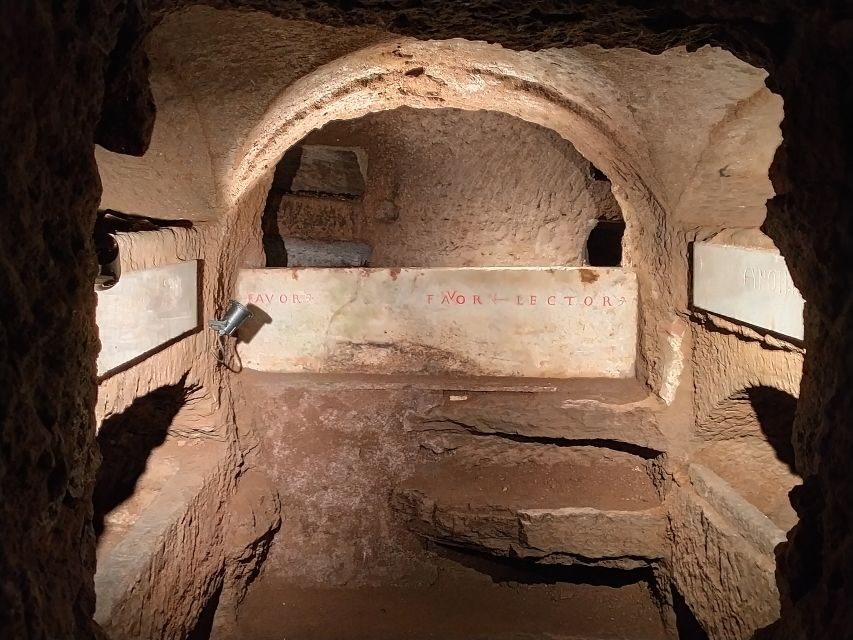
- Official guide on site: you’ll be led by a live, internal guide in English, Italian, or French.
- Fast and efficient 30 minutes: a well-paced visit that doesn’t eat your whole afternoon.
- Saint Agnes’s tomb details: the guide explains how her veneration connects to inscriptions and marble slabs.
- 3rd-century origins: you’ll hear how a family hypogeum grew into a larger catacomb network.
- Connection to the basilica above: the tour ties underground devotion to later buildings, including the mosaic imagery.
- Smartphone-ready tickets: get emailed tickets and show them at the entrance without printing.
First Stop: Ticket Office Timing and Smartphone Entry
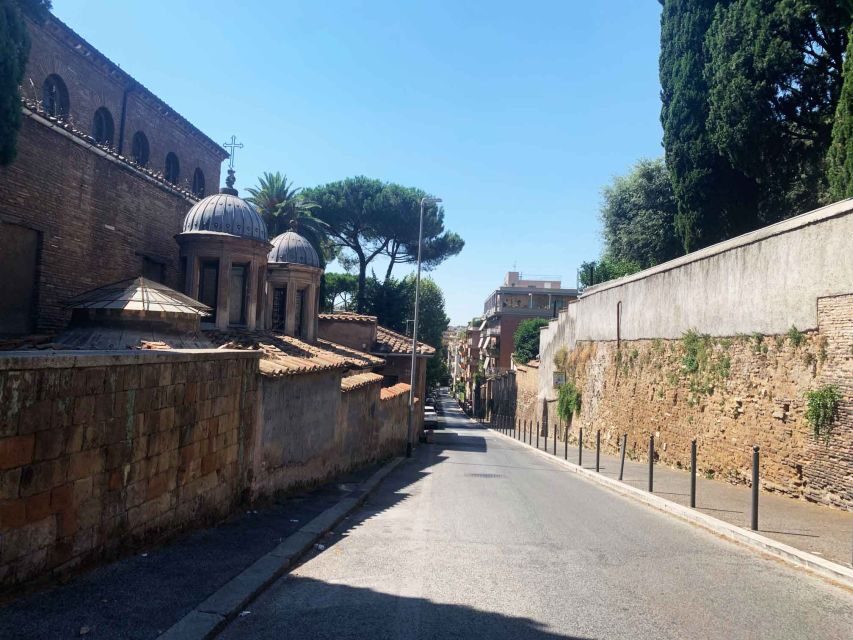
Plan on going directly to the Catacomb ticket office and showing your reservation at least 10 minutes before your scheduled tour time. This is one of those small details that makes the difference between a smooth start and a stressful scramble.
Your ticket is sent by email, and you can show it on your smartphone at the entrance. That’s convenient, especially if you’re already juggling directions, buses, and the rest of Rome. If you prefer paper backups, the rules here say smartphone display is fine, so don’t assume you’ll need anything printed.
The tour is run by Opera Romana Pellegrinaggi, and you’re booking an experience that explicitly includes the entry ticket plus a guided tour with an internal official guide in your chosen language. That matters because catacomb sites can feel confusing fast if you’re on your own.
You can also read our reviews of more tours and experiences in Rome



Going Underground: What the 9-Metre Descent Means for Comfort

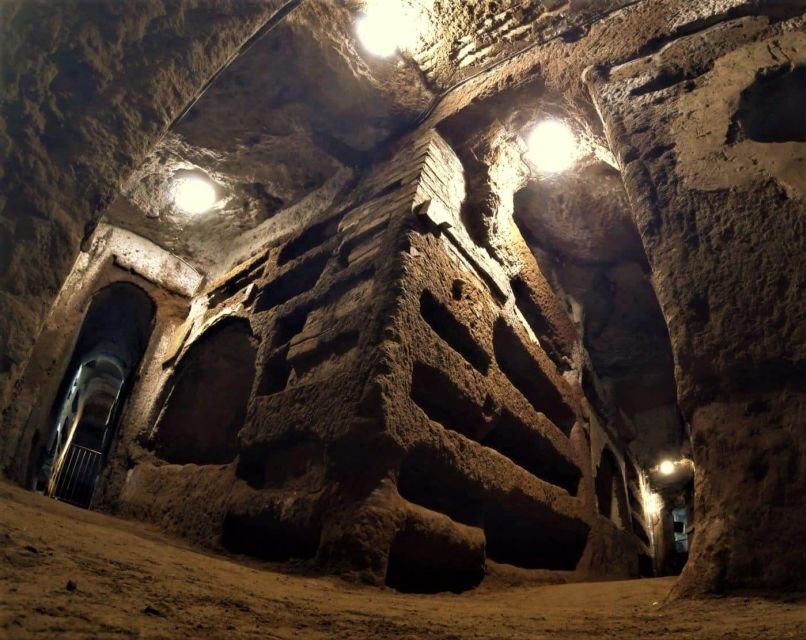
Expect a real underground experience. One review notes the visit goes around 9 metres underground. For most people, that’s part of the point—this isn’t a quick photo stop. But if you’re sensitive to enclosed spaces, treat this as serious.
The activity is clearly listed as not suitable for people with claustrophobia and not suitable for people with mobility impairments. Still, one traveler added a useful nuance: it’s not described as tight. So it may feel more like enclosed thoughts than literal squeeze-room walls—but the safe move is to respect the warning.
What to wear: comfortable shoes and comfortable clothes. Catacombs usually reward sensible footwear. Also note the rules: no cameras are allowed, and oversize luggage is not allowed. If you’re traveling light anyway, you’re already set.
Tip I’d follow: don’t pack your day with tight connections right before this. You want your brain calm when you’re stepping into a site that depends on focus.
The Story Core: Saint Agnes, Martyr Traditions, and the Guide’s Thread
This tour is built around Saint Agnes, one of Rome’s most famous and venerated martyrs. The guide explains that there are good reasons some traditions associate her martyrdom with the time of Decius or Valerian, while others connect the persecution to Diocletian. You don’t need to “solve” the historical debate yourself; the value is hearing how the tradition was understood and carried forward.
Agnes is described as dying at a very young age—at 12 years old. Pope Damasus is also mentioned in the story: he refers to a scene involving a stake where the saint would have thrown herself. The point of including this isn’t shock value. It’s to show how her memory became part of Christian storytelling and devotion.
The guide’s job here is to keep you oriented: who Agnes was, why her burial mattered, and how the underground spaces became a living shrine rather than just an old burial place.
Agnes’s Tomb and the Marble Slabs (and Why They Matter)
A major focus is the tomb associated with Agnes and how it was treated as devotion grew. The information given highlights that, at the time of Pope Liberius, Agnes’s tomb was decorated with marble slabs. One slab is said to be probably the one currently exhibited in the entrance staircase of the Honorian basilica, showing a young girl in a prayerful attitude between two panels with geometric motifs.
Even if you’re not seeing every detail from that display directly during your walk, I like how the guide links the underground site to what survives above ground. It turns “I visited a tunnel” into “I understand the symbols people preserved.”
Pope Damasus is also connected again: the inscription he dedicated to the martyr is described as being posted in the staircase. For you, the practical takeaway is simple: the guide will help you connect text and images to the veneration you’re seeing in the underground setting.
This is the kind of detail that makes a 30-minute tour feel longer in your head. You’re not only looking—you’re decoding.
From Family Hypogeum to Catacomb Network
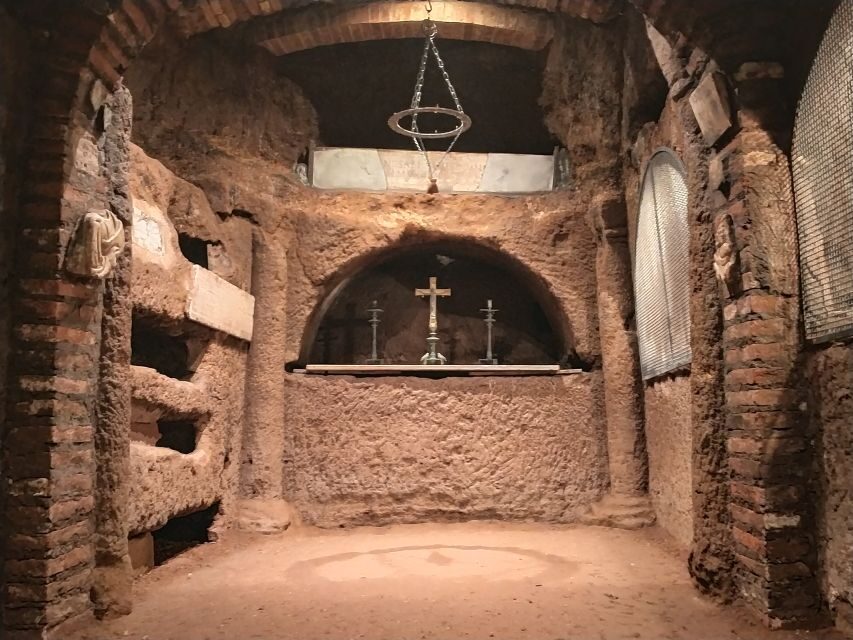
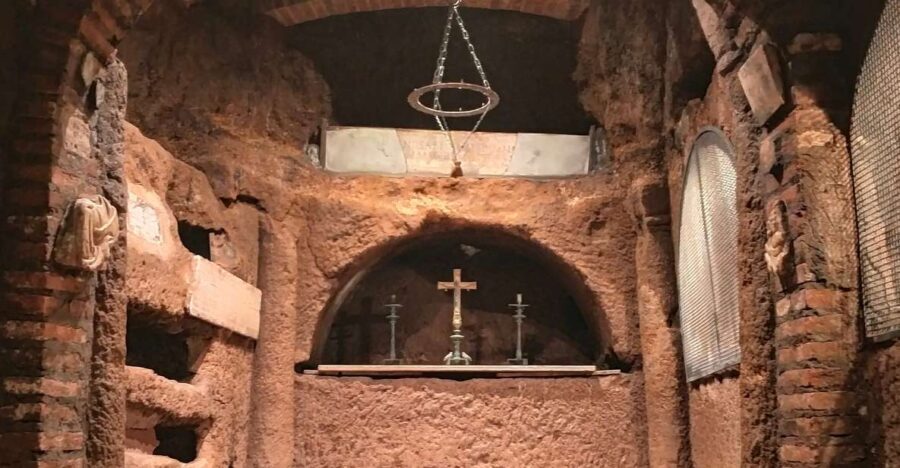
Here’s the historical engine of the site: after Agnes’s martyrdom, her body is described as being placed in a hypogeum owned by her family on the left of Via Nomentana. That hypogeum sat beside an existing surface necropolis with individual tombs and mausoleums.
Then comes the expansion. Once the venerated tomb became a focal point, a vast community catacomb network was set to develop underground from that original burial setting.
I like this part because it helps you picture what changed over time. You’re not just in a “catacombs section.” You’re in a place where a single burial place influenced how communities organized space, worship, and memory. The guide’s explanation gives the site a logic—even though you’re literally underground.
You can also read our reviews of more guided tours in Rome






The Devotion “Above Ground” Connection: Constantine, Honorius I, and the Basilica
The underground story doesn’t stop below your feet. A short distance from Agnes’s venerated burial—possibly on imperial property—the information states that a basilica was built in a style described as shaped like a Roman circus with an atrium. This was attributed to Constantine (or Constance), and the guide ties it to the fact that she was a devotee of Agnes.
Later, Honorius I is described as raising the current basilica on Via Nomentana, with access via the majestic staircase. The basilica is described as semi-underground, which is a nice contrast to the catacombs: you’re moving from one kind of sacred space to another, both connected to the same devotion.
Inside, the guide explains the structure: preceded by a narthex, it has three naves, and above that, a women’s gallery runs along the upper level. If you’re the type who wonders what worship space looked like over the centuries, this is exactly the kind of structural detail that makes a visit feel less like folklore and more like architecture tied to faith.
The Mosaic in the Apse: Agnes Between Leaders
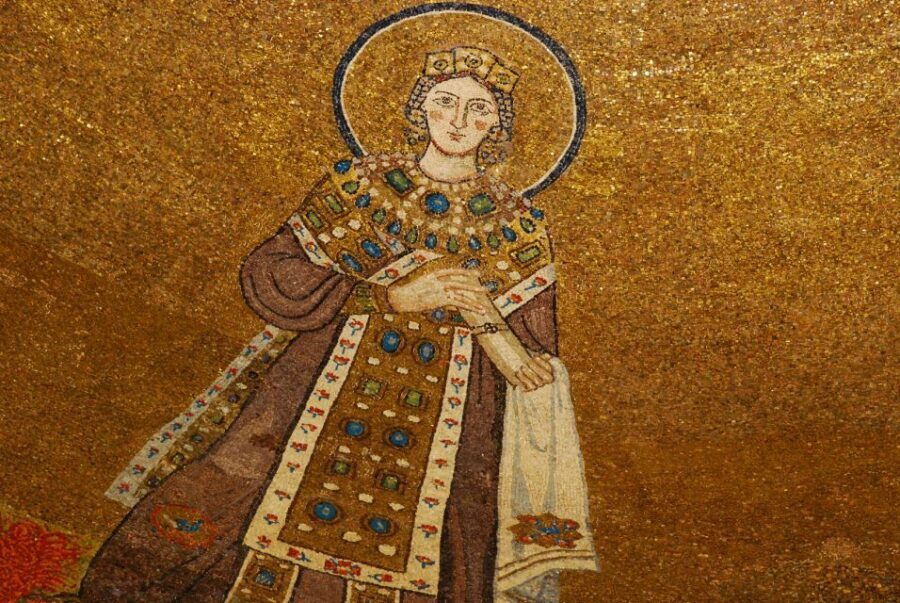
One of the most specific artistic details provided is the mosaic in the apse. The mosaic is described as early medieval Roman mosaic art and shows Agnes between Pope Honorius—who carries a model of the church in her hand—and probably Pope Symmachus.
I like including mosaics in this kind of guided experience because it gives you a visual anchor. Underground, the story can feel abstract unless a guide helps you attach meaning. Here, the mosaic description is the kind of thing that sticks after you leave.
If you’re paying close attention, this also helps you understand the broader theme: Agnes wasn’t only remembered in burial spaces. She was represented, honored, and staged in the sacred art linked to the church building tradition.
Price and Value: Is $16 Worth It for 30 Minutes?
At $16 per person for a 30-minute guided visit, you’re paying for one main thing: a live, official interpretation of a tight, complex site. And because the tour is short, the time-cost is low. You’re not losing half your day.
What’s included is straightforward: entry ticket, a guided tour with an internal official guide in English, Italian, or French, plus booking fees. Not included is transportation to or from the catacombs and food and drink, so you’ll want to plan your snack and transit separately.
Is it “cheap”? No. But for Rome, where self-guided entrances often leave you stuck reading stone without context, the guide component is the value driver here. If you want history plus direction, this price makes sense. If you only want quiet wandering and you don’t care about names, tomb details, and how the basilica connects to the catacombs, then you might feel the cost more sharply.
What to Expect During Your 30 Minutes (Paced, Not Piling On)
The experience is built around a short, guided route, with a 30-minute duration. That length is actually ideal for catacombs. They can be emotionally heavy and logically dense. A compact tour keeps your attention from fraying and makes it easier to absorb the key facts: Agnes’s background, the burial tradition, and how popes and later builders reinforced the site’s importance.
Based on the way the tour is described and the feedback tone, the guide focuses on the story and the connections, not just random facts. One review specifically praised that the visit lasted the full 30 minutes and felt like a good visit overall.
I’d treat it like a concentrated lesson: show up ready to listen, and let the guide do the heavy lifting.
Who Should Book This Tour (and Who Should Skip It)
This guided catacomb ticket is best for you if:
- you want official guidance instead of trying to interpret the site on your own
- you like Christian and Roman-era storylines centered on a specific figure—Saint Agnes
- you want a short Roman experience that fits into a packed itinerary
You should think twice or skip it if:
- you have claustrophobia (the tour is not suitable for it, and it goes about 9 metres underground)
- you have mobility impairments (also listed as not suitable)
- you rely on photography during visits (cameras are not allowed)
Should You Book the Catacombs of Saint Agnes Entry Ticket & Guided Tour?
If your goal is a guided, story-led catacomb visit that ties underground burial tradition to what happened above ground—basilica design, inscriptions, and mosaic symbolism—then yes, this is a solid booking. The official guide, the tight 30-minute length, and the emphasis on specific details tied to Agnes are exactly what make this value feel real.
If you’re claustrophobic, or you know you won’t enjoy enclosed underground spaces, don’t gamble. Pick a different Rome stop where you can move freely and comfortably.
FAQ
How long is the Catacombs of Saint Agnes guided tour?
The guided tour lasts about 30 minutes.
How much does the tour cost?
The price is $16 per person.
Where do I need to go for the tour?
Go directly to the Catacomb ticket office.
What do I need to show at the meeting point?
Show your reservation at the entrance using your smartphone.
How early should I arrive?
Arrive at least 10 minutes before your scheduled visit.
What languages are available for the guided tour?
The guide is available in English, Italian, and French.
Is a live guide included or is it self-guided?
A live guided tour is included, with an internal official guide.
Are cameras allowed inside the catacombs?
No, cameras are not allowed.
Is this tour suitable for people with mobility impairments?
No, it is not suitable for people with mobility impairments.
What is the cancellation policy?
You can cancel up to 24 hours in advance for a full refund.