REVIEW · NAPLES
Naples Skip-the-Line San Martino National Museum and Charterhouse Ticket
Book on Viator →Operated by Weekend in Italy · Bookable on Viator
Skip the line, then wander.
The San Martino Charterhouse is one of Naples’ most atmospheric stops, perched on Vomero’s hill with cloisters, a major church, and a museum that turns local history into something you can actually see. I like that priority entry helps you get inside faster and start with the cloisters instead of losing time outside.
What really makes this ticket worth your time is the mix: you get the monastery’s art and architecture plus the museum’s famed Neapolitan presepi, including the huge Cuciniello’s Crib. One drawback to consider: the skip-the-line promise can be temperamental if the ticket desk can’t process your document instantly, so bring your printed confirmation voucher and give yourself a little buffer.
Plan on about 2 to 3 hours, then leave when you’re ready—this is a wander-at-your-own-pace kind of visit.
In This Review
- Key things to know before you go
- San Martino Charterhouse: what you’re really buying with this ticket
- Skip-the-line entry: how to make it work for you
- Entering the cloisters: Naples’ stone calm (and the cemetery scene)
- The church and frescoes: what to look for in the first 10 minutes
- Museo di San Martino: where Naples’ story becomes objects
- Neapolitan nativity scenes: plan to pause more than you expect
- Terraced gardens and the Vesuvius payoff
- Timing: how to structure 2–3 hours without feeling rushed
- Value for money: why $12.80 can be a win (if it runs smoothly)
- Who this is best for (and who might want a different plan)
- Quick notes for planning your visit
- Should you book this ticket?
- FAQ
- What is the price of the ticket?
- How long does the visit usually take?
- Where is the San Martino Charterhouse and Museum?
- Does this ticket include skip-the-line entry?
- Do I need to print anything to enter?
- What if my preferred time isn’t available?
- Is the visit self-guided?
- Is a mask required inside?
- Are there reduced or free tickets for some visitors?
- Can I change or get a refund after booking?
Key things to know before you go

- Two cloisters with very different moods: the Procurators’ Cloister and the Great Cloister (with a monks’ cemetery and skulls on balustrades)
- A church ceiling worth slowing down for: frescoes by Giovanni Lanfranco and chapel art tied to major Italian artists
- A museum built around Naples’ identity: paintings, maritime exhibits, and “homeland memories” preserved since the 1800s
- Neapolitan nativity scenes are the star: the famous Cuciniello’s Crib plus other presepi you’ll want to circle back to
- Garden views that make the climb feel justified: Naples Bay and Mount Vesuvius from the terraced gardens
San Martino Charterhouse: what you’re really buying with this ticket
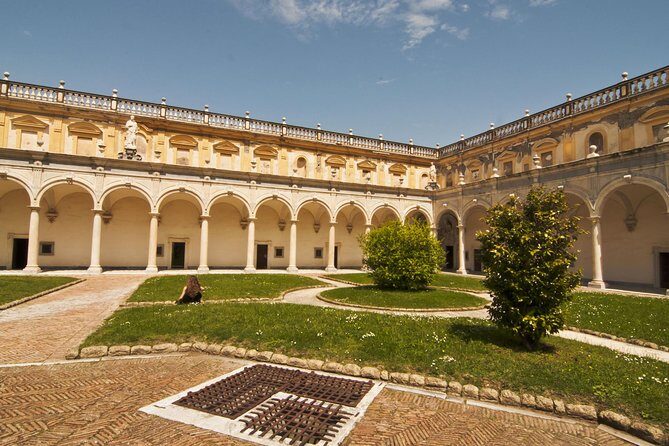
This isn’t just a “museum stop.” This ticket is your fast pass into a complex that used to be a Carthusian monastery and still feels like one—quiet spaces, stone courtyards, and art placed where it was meant to be encountered slowly.
Historically, San Martino was consecrated in 1368, originally in a Gothic direction. Then the look shifts over time—by around 1600, the style moves toward Baroque, and later additions include the Maddalena chapel, the refectory, and the cloisters. That change-over is part of the appeal: you’re not seeing one single “style,” you’re seeing how Naples’ taste and power evolved.
And because you’re visiting the museum and the charterhouse areas, you’ll get a fuller sense of why this place matters to the city: religious life, elite patronage, and the local tradition of nativity scenes all live here in the same walled world.
You can also read our reviews of more tours and experiences in Naples


Skip-the-line entry: how to make it work for you
The big promise is priority admission, and in practical terms, that usually means less time waiting at the main entrance. But with places like this, the experience depends on whether the ticket desk can quickly validate your booking.
Here’s how you protect yourself:
- Print your Weekend in Italy confirmation voucher and present it on arrival (this is explicitly required to redeem tickets).
- Arrive with a bit of slack in your schedule, especially if you’re going at a popular time.
- Plan your start inside as if you might still need a few minutes before you’re scanned and released.
I’ll be blunt: one or two real-world problems show up with ticketing—electronic vouchers that aren’t processed right away, or staff that struggle with a computer setup. That doesn’t mean you should abandon the ticket. It just means you should show up prepared and not assume the line will vanish completely.
If you’re the type who hates uncertainty, then you’ll enjoy this more if you go at a time you can handle a short wait. The payoff is that once you’re through, the building is absolutely worth the effort.
Entering the cloisters: Naples’ stone calm (and the cemetery scene)
Start where the atmosphere is strongest: the cloisters. San Martino has two standouts.
First is the Procurators’ Cloister. It’s the kind of place where your eyes do the work for you—arches, shadows, and quiet stonework that makes Naples feel like it has a second heartbeat beyond the street noise.
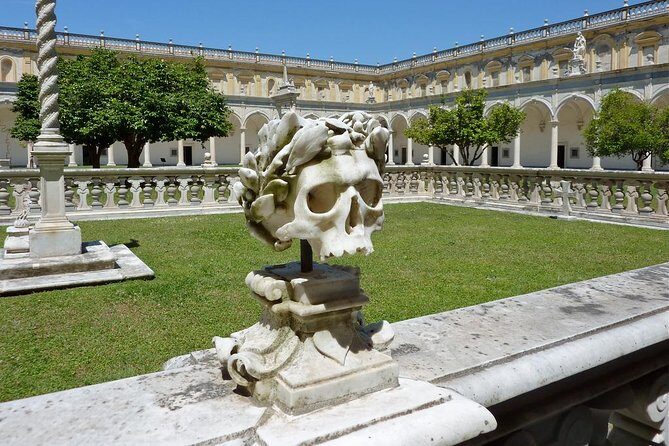
Then comes the Great Cloister—and this is where the experience turns memorable. The monks’ cemetery sits on the balustrades, and yes, you’ll see human skulls set into the space. It can feel startling at first, but that reaction is kind of the point. This is a monastery that doesn’t sugarcoat mortality. It’s art and architecture doing moral teaching without needing a lecture.
Even if you’re not a huge “monastery person,” take your time here. The courtyard sequence is the emotional spine of the visit. If you rush, you’ll miss why people call this stop moving.
The church and frescoes: what to look for in the first 10 minutes

After the cloisters, turn your attention to the church, because the ceiling fresco work is a major reason to come.
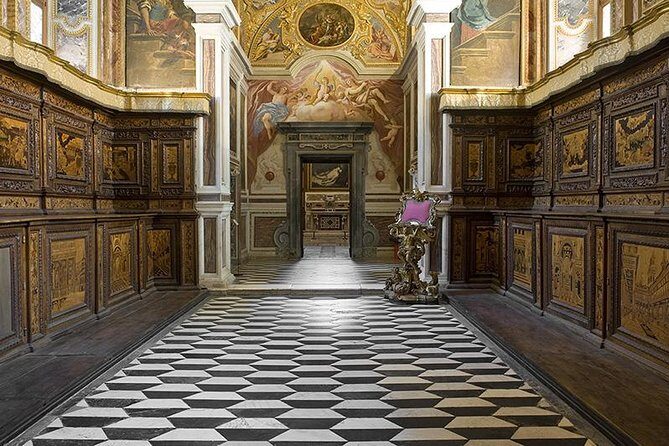
The standout detail is the frescoes by Giovanni Lanfranco. You don’t need to be able to name every figure to enjoy the ceiling—just slow down enough to let your eyes adjust. Fresco ceilings are meant to be viewed from a distance, and the scale is part of the shock. It’s not decorative wallpaper. It’s narrative painting wrapped around architecture.
You’ll also notice the chapel world inside: the Chapel of the New Treasury includes an 18th-century mural of the Triumph of Judith, by Luca Giordano. Again, no need to memorize captions. Just watch how the artwork “drives” your movement through the rooms.
Other church and chapels you may see include the Maddalena Chapel and areas like the Conversi Choir and sacristy, where the feel is more enclosed, more lived-in. Artists whose works appear here include Caracciolo, Finoglia, Reni, and Stanzione, plus names like Ribera tied to the broader collection.
Practical tip: if you arrive when rooms are crowded, look for a quieter moment rather than rushing. The church and chapels are better when you can take a breath and actually look up.
Museo di San Martino: where Naples’ story becomes objects

Once you move into the museum portion, the tone shifts from devotional space to cultural archive. This is where San Martino becomes a museum of Naples itself.
What you’ll find centers on:
- paintings and art objects connected to Naples
- artifacts tied to the region and the southern kingdom
- maritime exhibits that widen the story beyond religious life
- and the presepi tradition, including the famous Neapolitan nativity scenes
A key historical point: in 1866, Giuseppe Fiorelli founded the National Museum of San Martino, with the goal of preserving the city’s “homeland memories.” That matters because it explains the collection’s mindset. This isn’t random museum stuff. It’s about local identity held in stone, paint, and carved figures.
You can also read our reviews of more museum experiences in Naples



Neapolitan nativity scenes: plan to pause more than you expect
If you’ve never seen Naples presepi in person, treat the nativity rooms like a separate attraction inside the larger visit. The famous focus here is Cuciniello’s Crib (Presepe Cuciniello)—and it’s exactly the kind of work that rewards stillness.
You’ll often hear people talk about how moving these scenes are. The reason is simple: they’re not just religious display. They’re theater made from objects—tiny architecture, faces, and staging that makes you feel like you’ve entered another slice of Naples.
Even if you’re not into religion, you’ll probably enjoy the craft and storytelling. Plus, this is one of the rare museum experiences where you can take photos without feeling like you’re cheating the art. Just follow whatever rules are posted inside.
This is also where you’ll likely spend more time than planned. If you only have two hours, prioritize the nativity highlights and then work backwards through the rooms.
Terraced gardens and the Vesuvius payoff
Before you leave, don’t skip the terraced gardens.
The gardens are your “reset button.” After cloisters and indoor art, you get open air and a view that makes the climb feel worth it. From here you can see the Bay of Naples and Mount Vesuvius—the classic view, but still powerful because you’re not seeing it from a postcard distance. You’re looking out from the top of the city.
This stop also gives you something practical: a place to rest your feet and refuel mentally before heading back down Vomero.
Timing: how to structure 2–3 hours without feeling rushed
The ticket is designed for flexible visiting times, and that’s the right approach here. A typical flow that works well is:
1) start with the cloisters (so you’re fresh)
2) move into the church and chapels
3) spend your focused time in the museum rooms
4) finish with the terraced gardens for the views
If you’re short on time, focus on:
- Great Cloister and its cemetery detail
- the church ceiling frescoes by Lanfranco
- and the presepi rooms, especially Cuciniello’s Crib
If you have the full 2 to 3 hours, you can afford to slow down in chapel interiors and museum galleries where paintings and artifacts are less “one glance” and more “take your time.”
Value for money: why $12.80 can be a win (if it runs smoothly)
At $12.80 per person, this ticket is priced like an efficient, single-attraction entry. And for Naples, that’s a solid deal because you’re covering multiple spaces in one complex: cloisters, church, chapels, museum rooms, and the terraced gardens.
Your value hinges on two things:
- time savings from priority admission
- and whether the museum desk can validate your voucher quickly
If everything goes smoothly, you’ll feel like you got more than you paid for—especially because presepi and ceiling frescoes are not “small details.” They are the kind of highlights that make you remember the visit later.
If you’re unlucky with voucher processing, you may lose some of the time advantage at the start, but once you’re inside, the complex still delivers.
Who this is best for (and who might want a different plan)
This fits you if:
- you like art and architecture, not just one
- you want a quieter, more reflective Naples experience than the street-hustle
- you’re curious about the presepi tradition and want to see one of the big names up close
- you can enjoy a visit where the payoff builds in steps: cloister → church → museum → garden
You might think twice if:
- you hate any possibility of waiting at all
- you prefer fully guided commentary for every room (this experience is more about entering and exploring at your own pace)
Quick notes for planning your visit
You’ll travel independently to the San Martino complex on Vomero hill. The complex is near public transportation, but there’s no provided hotel pickup, and there’s no meeting point listed.
Inside, there are health rules: a mask is mandatory for visitors and museum staff during your time inside, and the museum uses measures like controlled entry/exit and distancing signage.
If you’re sensitive to packed interiors, keep your expectations realistic. Churches, cloisters, and nativity rooms can get busy. The best strategy is to move with purpose, then linger in the areas you care about most.
Should you book this ticket?
I’d book it if you want a high-impact Naples experience without over-planning. The combination of cloisters, a church with major fresco work by Lanfranco, and museum highlights like Cuciniello’s Crib makes it a strong use of a few hours.
Skip-the-line entry is the selling point, so your decision should come down to one thing: whether you’re comfortable arriving with the right paperwork and handling the fact that ticket desks are sometimes slow to scan or validate documents.
If you can do that, you’ll likely feel like San Martino is time well spent—especially once you step outside to the gardens and see Naples and Vesuvius from up high.
FAQ
What is the price of the ticket?
The ticket price is listed at $12.80 per person.
How long does the visit usually take?
Plan for about 2 to 3 hours.
Where is the San Martino Charterhouse and Museum?
It’s in Naples, on Vomero hill above the city.
Does this ticket include skip-the-line entry?
Yes, it includes guaranteed skip-the-line entry, and it’s meant to provide priority admission.
Do I need to print anything to enter?
Yes. You must print and present your Weekend in Italy confirmation voucher in order to redeem the tickets at the moment of the visit.
What if my preferred time isn’t available?
The time you select is your preferred time. The museum will automatically confirm the closest available time during opening hours on the selected date if your exact preferred time is no longer available.
Is the visit self-guided?
Yes. You travel independently to the site and explore at your leisure once inside.
Is a mask required inside?
Yes. A mask is mandatory for visitors and museum staff during the time spent inside the museum.
Are there reduced or free tickets for some visitors?
Reduced price tickets may be available for EU citizens aged 18 to 24 and for EU state teachers. Free tickets are available for people under 18.
Can I change or get a refund after booking?
No. The experience is non-refundable and cannot be changed for any reason.