REVIEW · AUDIO TOURS
The Roman Jewish Ghetto: A Self-Guided Audio Tour
Book on Viator →Operated by VoiceMap Audio Tours · Bookable on Viator
Rome’s Jewish Ghetto tells stories fast.
This self-guided VoiceMap audio tour lets you walk the neighborhood at your own tempo while learning what those streets meant to the community. I like that it includes offline access (audio plus maps and geodata), so you can keep going even if cell service is lousy. I also like how the route is simple: it starts at Via di S. Maria del Pianto and ends at Via del Portico d’Ottavia, so you’re not stuck guessing where to go next.
My favorite part is the way the narration connects sites you can actually see with changes over time. You’ll hear about places like Piazza delle Cinque Scole and the main synagogue, and the ending spot links back to ancient Rome. One possible drawback: if you don’t download the files ahead of time or you start the tour the wrong way in the app, you can miss parts of the audio or feel unsure of the path.
In This Review
- Key highlights to know before you press play
- How this VoiceMap audio tour works on foot (and why it matters)
- Piazza delle Cinque Scole: the name that survived when buildings didn’t
- The new synagogue opened in 1904: continuity, after disruption
- Portico d’Ottavia: ending your walk with Augustus and Octavia
- Price and value: $8.99 for offline audio and lifetime access
- Practical tips to avoid the common frustrations
- Who this audio tour suits best
- Should you book this Roman Jewish Ghetto audio tour?
- FAQ
- FAQ
- How much does the Roman Jewish Ghetto self-guided audio tour cost?
- How long is the tour?
- Is the tour available in English?
- Do I need cell service during the tour?
- Where does the tour start and where does it end?
- What do I need to bring?
- Are tickets or museum entrance fees included?
- Is this tour private?
- Is it non-refundable if I cancel?
- Are service animals allowed?
Key highlights to know before you press play

- GPS-driven playback helps your audio follow your walk, starting and stopping as you move
- Offline downloads mean the tour can run without cell reception once you’ve saved it
- Lifetime access gives you repeat visits for the same price
- Clear start and end points reduce decision fatigue in a dense neighborhood
- Three focused stops keep the tour short (about 30 minutes) and manageable
How this VoiceMap audio tour works on foot (and why it matters)

This tour is built for you to control the pace. You can start, pause, and restart as you like, which is handy in Rome where you may want to stop for photos, a doorway detail, or just to let traffic and pedestrians thin out. It’s English-only, and the stated length is around 30 minutes, so it fits nicely between bigger sightseeing blocks.
The practical win is that it’s designed to keep working offline. Once you download it, the audio and the supporting info (maps and geodata) don’t require reception. That means you can wander the Jewish Ghetto without worrying about signal dead zones or random data drops.
One thing to keep in mind: you’ll still need a smartphone to run the VoiceMap app, since the audio and maps live there. Also, while most travelers can do this, you’ll be walking a route in an urban area—so wear good shoes and expect that the sidewalk experience will be typical Rome-crowded.
Based on common trouble points, my advice is straightforward: download before you start, and use the tour’s start button so it plays in the right order. When the app is set correctly, the experience becomes much less stressful.
You can also read our reviews of more guided tours in Rome



Piazza delle Cinque Scole: the name that survived when buildings didn’t
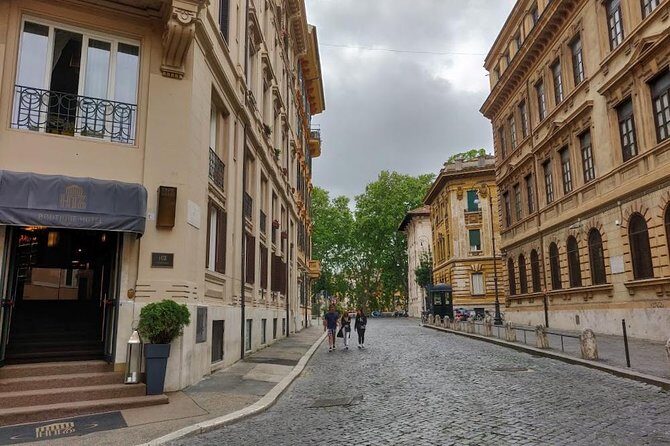
Your walk begins at Via di S. Maria del Pianto, 22 and quickly leads you to the story behind Piazza delle Cinque Scole. The tour explains that the word scola means synagogue. That’s why this square carries that identity even though the neighborhood changed.
Here’s the key idea you’ll hear: Piazza delle Cinque Scole once held multiple synagogues tied to different communities—labeled in the tour as the Temple, New, Castilian, Catalan, and Sicilian synagogues. Then, after the Ghetto’s emancipation, the complex was torn down. The physical buildings vanished, but the name stayed. That’s a powerful thing to notice while you stand in a modern square: language can preserve what architecture loses.
What I like about this stop is how it trains your eyes. Without a guide in your ear, it’s easy to treat the piazza like yet another Roman sidewalk scene. The audio nudges you to think like a historian for 10 minutes: what does the surviving name tell you about what used to be there?
A small caution: because this part is about memory and terminology, you’ll get the most if you listen carefully to the sequence of what once stood here and why the area’s identity endured.
The new synagogue opened in 1904: continuity, after disruption
Next, the tour focuses on the synagogue that became the main place of worship in Rome: the one with its big milestone in 1901–1904. You’ll hear that the community commissioned architects Osvaldo Armanni and Vincenzo Costa to design it. Then, in 1904, the new synagogue opened and went on to serve as the central worship space.
This stop matters because it shifts the story from what was lost to what was rebuilt. Instead of only looking backward, the audio gives you a sense of how the community reorganized and moved forward. That contrast can make the whole walk feel more complete. You’re not just reading about hardship; you’re watching the arc of recovery.
From a traveler’s point of view, this is also where the tour becomes most satisfying to many people: you’re listening to dates and names, but you’re also standing in front of a site tied to living practice. Even if you don’t go inside (tickets/entrance are not included), the narration helps you connect the exterior presence to what the building has meant.
The main “watch-out” here is simple: keep your ears on. This portion includes specific numbers and names, and missing them can make the story feel chopped up. With an offline setup and correct playback order, it stays smooth.
Portico d’Ottavia: ending your walk with Augustus and Octavia
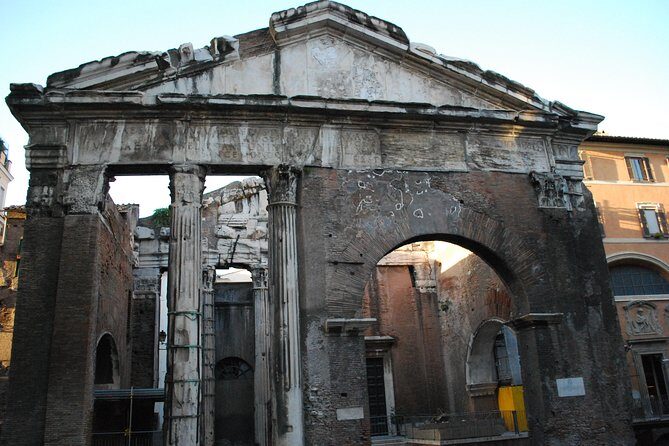
Your tour wraps up at Via del Portico d’Ottavia, 39. The final narration takes you to Portico d’Ottavia, built by the first Roman emperor, Augustus, in honor of his sister Octavia.
The audio highlights what you can see: a monumental arch and facade, then an internal portico area that originally held two temples. It’s a fitting way to end the tour because it widens the lens. You start with synagogue history and neighborhood identity. Then you finish with an ancient Roman structure tied to a powerful imperial family.
I like ending here because it gives your brain a clean landing zone. The ghetto narrative can feel heavy, depending on how you’re listening. This finale offers a different kind of context: the physical setting of Rome itself, stretching back before the ghetto story begins.
One practical note: since the tour is about 30 minutes total, plan to arrive ready for a quick closing loop. Don’t schedule your next stop so tightly that you’re rushing through the last scene.
Price and value: $8.99 for offline audio and lifetime access
At $8.99 per person, this tour is priced like a low-risk try and a good add-on to a Rome day. The bigger value isn’t the price tag—it’s what you get packaged with it: lifetime access plus the VoiceMap app experience with offline support (audio, maps, and geodata).
That lifetime element is real practical value. If Rome is a place you might revisit, or if you want to do a second pass at a slower pace, you’re not paying again. And if you’re traveling with a group who likes to move independently, the self-guided format keeps you from negotiating museum timings.
Tickets are not included, and that’s important to understand up front. This is primarily an audio walk, not a paid-entry circuit. So if your plan is to go inside multiple sites, you’ll need to arrange that separately.
Also, the app requires a smartphone (not included). If you’re trying to travel with no phone, this probably isn’t your setup. But if you do use one already, this format can be a very efficient way to get meaningful context without adding fatigue.
You can also read our reviews of more tours and experiences in Rome






Practical tips to avoid the common frustrations
A couple of small lessons show up repeatedly when self-guided tours go wrong, and they’re easy to prevent.
First: download fully before you begin. If you rely on shaky connectivity or a shared network/hotspot setup, you can end up with incomplete audio files. The tour is designed to work offline once downloaded, so do that part right, and you remove most headaches.
Second: start the tour the correct way. If you begin in a virtual or manual playback mode, the order and GPS timing may not match the intended route. My advice is to stand at the start location, press the tour start button inside the app, and let it guide you step by step.
Third: treat the route like a quiet conversation, not a race. The best reviews for this tour emphasize how easy it is to follow and how the narration can feel powerful. That comes through best when you’re not rushing, because the stops are short and the stories build.
Finally: pair it with a meal. One review tip is simple and useful: eat somewhere in the Roman Jewish Ghetto afterward. That’s a great way to connect what you learned with what you experience next—sound and story by day, food and everyday life later.
Who this audio tour suits best
This works especially well if you like structured independence. You want a storyline, but you don’t want a clock telling you when to move. The short 30-minute length makes it a good fit for days when you’re doing a lot of Rome walking and want something focused without a big time commitment.
It also suits first-timers to self-guided audio tours. Clear directions and audible guidance can make it feel easy, even if you’ve never used this style of trip before.
It might be less ideal if you want lots of on-site exploration inside buildings with timed entry. Since ticketed entrances aren’t included, you’ll mainly get what’s visible from outside plus the narration.
Should you book this Roman Jewish Ghetto audio tour?
If you want a short, meaningful way to understand Rome’s Jewish Ghetto through place-based storytelling, I’d book it. For $8.99, the offline audio plus lifetime access makes it a practical buy, not a one-and-done gimmick. Just do the one thing that protects the whole experience: download it properly, then start it from the right beginning point.
FAQ
FAQ
How much does the Roman Jewish Ghetto self-guided audio tour cost?
The price is $8.99 per person.
How long is the tour?
It runs for about 30 minutes (approx.).
Is the tour available in English?
Yes, it is offered in English.
Do I need cell service during the tour?
No. Once you download the tour, it works without cell phone reception, using offline audio, maps, and geodata.
Where does the tour start and where does it end?
The start is at Via di S. Maria del Pianto, 22, 00186 Roma RM, and the end is at Via del Portico d’Ottavia, 39, 00186 Roma RM.
What do I need to bring?
You’ll need a smartphone. The tour itself includes the VoiceMap app experience, but a phone is not included.
Are tickets or museum entrance fees included?
No. Tickets or entrance fees to museums or other attractions en route are not included.
Is this tour private?
Yes. It’s listed as private, meaning only your group participates.
Is it non-refundable if I cancel?
Yes. The experience is non-refundable and cannot be changed for any reason.
Are service animals allowed?
Yes, service animals are allowed.