REVIEW · NAPLES
The Perfect Private Walking Tour of Naples with Exclusive Guide
Book on Viator →Operated by Leisure Italy · Bookable on Viator
Naples changes fast when you have the right guide. This private 3-hour walk gives you a clear map of the Old Town and the stories behind it, from centuries of rulers to everyday street life. The guide (often named Raffaele, Giuseppe, or Corrado in past groups) brings the place to life with practical details, and you can shape the route to what you care about.
I love two things most: the way you learn to read architecture eras as you pass major buildings, and the fact that pickup can be handled for cruise arrivals at the port. You start with context, not random photos, so the whole walk feels like a connected lesson, not a sprint between stops.
One thing to consider: this is a focused historic-center walk. If you’re hoping for a wider tour beyond Old Naples or for day-trip areas, you’ll still need other plans, because the route is designed around monumental sights and classic streets.
In This Review
- Key takeaways before you go
- A 3-hour private Naples walk with a guide who actually explains
- Where you start at the port: Stazione Marittima to Piazza del Municipio
- Neptune and medieval-to-royal Naples: the sea theme in the center
- Galleria Umberto I: Belle Époque elegance between history and shopping
- San Carlo Opera House: Neoclassical grandeur and old performance culture
- Piazza Trieste e Trento and the daily-life Naples people use
- Artichokes, lunch energy, and the smaller symbols: Fontana del Carciofo
- Piazza del Plebiscito and the Royal Palace: Naples in ceremonial mode
- Via Toledo: the main drag where old and new walk side by side
- Quartieri Spagnoli: narrow lanes, laundry lines, and street art reality
- Spaccanapoli and the historic center: two streets that explain a whole city
- Piazza del Gesù Nuovo and the diamond facade of Chiesa del Gesù Nuovo
- Santa Chiara cloister option: when you want extra art and a calmer pause
- Piazza San Domenico Maggiore: a church and a dramatic spire
- San Gregorio Armeno: the Nativity-making district
- Duomo di Napoli and San Gennaro: cathedral power and miracle culture
- Via dei Tribunali: historic lane plus pizzeria culture
- Price and value: what you’re really paying for
- The best fit: who should book this tour
- Should you book this private walk?
- FAQ
- Is this a private tour or a group tour?
- How long is the Naples Old Town walking tour?
- What language is the guide offering?
- Is pickup available, especially for cruise passengers?
- Where does the tour start and end?
- Are admission tickets included?
- Can I enter the Santa Chiara cloister on this tour?
- What fitness level do I need?
- Are service animals allowed?
- Is there free cancellation?
Key takeaways before you go
- Private by design: It’s just your group, so you can ask questions and adjust the pace.
- Blue Badge guidance: Expect an expert guide who explains what you’re seeing, not just where it is.
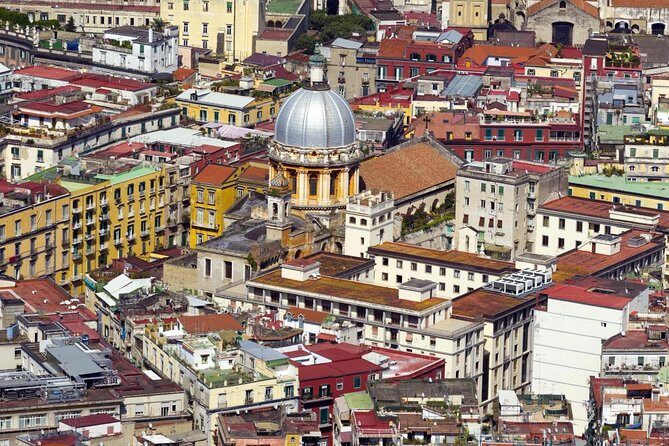
- Old Town in one sweep: Piazza del Municipio to Piazza del Gesù Nuovo covers a lot of Naples without feeling rushed.
- Sea-and-power theme: Neptune, Castel Nuovo, and the waterfront-adjacent squares connect Naples’ “marine brain.”
- Optional on-the-spot entries: Admission fees are optional, and Santa Chiara’s cloister can be requested.
- Works well for cruise days: You meet outside the cruise terminal and follow clear steps through a short tunnel with a Welcome to Napoli sign.
A 3-hour private Naples walk with a guide who actually explains
This tour is built for people who want Naples to make sense quickly. In about three hours, you’ll cover major squares, landmark facades, and the streets that locals use every day. The goal isn’t just sightseeing; it’s understanding why these places look the way they do and what changed over time.
You also get flexibility. The tour is fully customizable, which matters in a city where one turn can feel like a different century. If you’re drawn to churches and artwork, you can slow down there. If you care more about royal power, you can emphasize the palaces and fortifications.
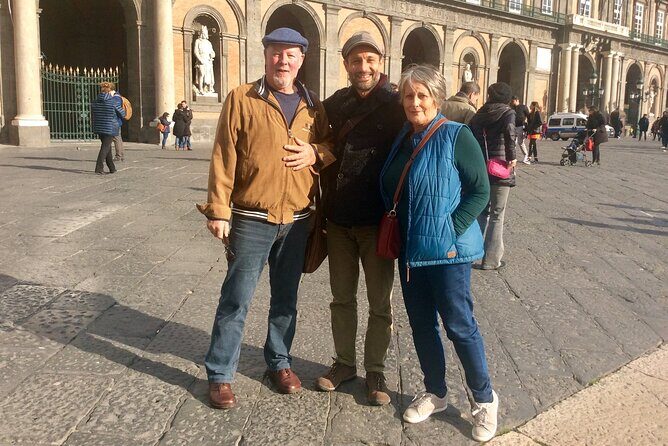
And yes, the guide is the heart of the deal. When I see names like Raffaele, Giuseppe, and Corrado showing up as guides, that tells me the experience likely depends on strong local interpretation. In practice, that means you’re not stuck with vague commentary.
You can also read our reviews of more walking tours in Naples



Where you start at the port: Stazione Marittima to Piazza del Municipio

Most people start at Stazione Marittima, Molo Angioino. If you’re coming by cruise, you’ll walk outside the cruise terminal and find a service area. From there, there’s a short tunnel with a sign at the top that reads Welcome to Napoli. You meet your guide holding a nameplate with your name.
This port meeting matters because Naples can be chaotic when you arrive and don’t have a plan. Instead of spending your first hour figuring out logistics, you begin with orientation and a history thread that connects the sights.
Then you head to Piazza del Municipio, a key introduction zone. The square sits between the historic center and the waterfront, which is important: Naples has always been shaped by what it can trade, control, and imagine from the sea.
Neptune and medieval-to-royal Naples: the sea theme in the center
One of the tour’s best moves is starting with Naples’ relationship to the ocean. You’ll see the Fountain of Neptune, centered on the sea god—an easy symbol, but it opens a bigger story. The point is that the Mediterranean isn’t just scenery here; it’s power, trade, and the city’s identity.
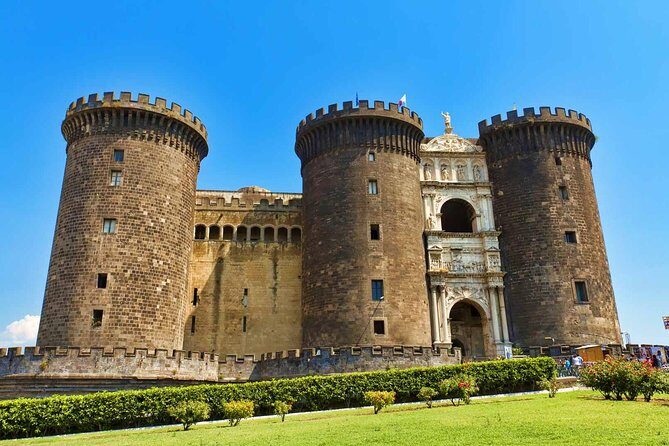
From there, you move toward Castel Nuovo (also called Maschio Angioino). Built in the 13th century, it once supported kings and royal court life. The mass of the towers and the triumphal arch help you “read” the fortress as more than a photo stop. Your guide can point out how the structure signals ambition, battles, and control.
Even if you don’t go inside, you’re still learning. The way you place a building in its era makes the rest of the city easier to understand. That’s one reason the tour works so well for first-timers.
Galleria Umberto I: Belle Époque elegance between history and shopping
Next up is Galleria Umberto I, Naples’ famous 19th-century shopping arcade. It’s known for its grand glass dome and Belle Époque style. In other words, this is where Naples shows a different face than the stone fortresses and church facades.
This stop is also a smart pacing break. You’ll walk through a covered space with architecture details you can actually study without constantly staring at street-level traffic.
It’s a reminder that Naples isn’t one era. The city layers styles the way it layers neighborhoods—by building on top of earlier life.
San Carlo Opera House: Neoclassical grandeur and old performance culture

You’ll also pass by the San Carlo Opera House, described as the oldest continuously active opera house in the world. It’s a Neoclassical landmark with standout acoustics and royal splendor. Even if opera isn’t your main interest, it’s still a useful stop.
Why? Because it signals that Naples invested in culture as a public statement, not just private taste. When you pair that with the fortress and palace stops later, you start seeing the theme: power shows up in stone, ceremonies, and performance.
You can also read our reviews of more guided tours in Naples




Piazza Trieste e Trento and the daily-life Naples people use
You’ll then reach Piazza Trieste e Trento, a lively central meeting spot with historic buildings and café culture. A named landmark here is Gran Caffè Gambrinus, which helps anchor the area in real local identity rather than just generic “pretty square” vibes.
This stop works best when you slow down for a few minutes. You’re not only absorbing buildings; you’re training your eyes to notice how Naples actually moves around its monuments.
Artichokes, lunch energy, and the smaller symbols: Fontana del Carciofo
You’ll also see the Fontana del Carciofo, a 20th-century fountain topped with sculpted artichokes. It’s whimsical on purpose, and that matters in a city where art and daily life often share the same street space.
If you’re the type who likes “small details,” this stop is a payoff. Naples has a habit of rewarding attention. You start to recognize that local creativity isn’t limited to museums.
Piazza del Plebiscito and the Royal Palace: Naples in ceremonial mode

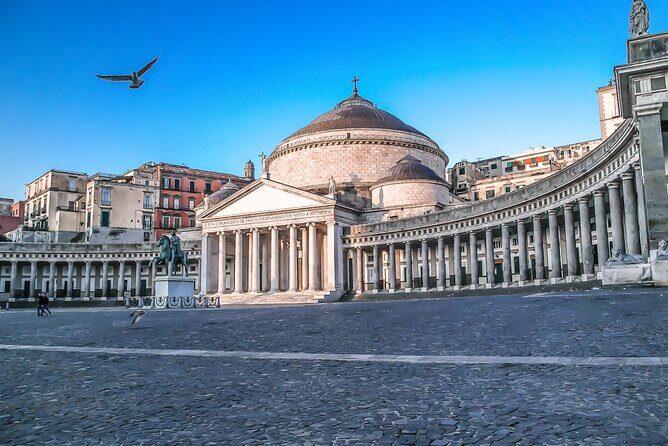
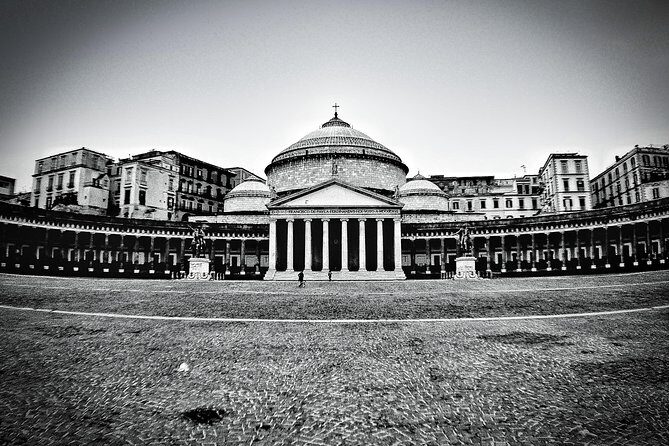
Then it’s time for Piazza del Plebiscito, Naples’ grand ceremonial square. It’s framed by the Royal Palace and the colonnade of Basilica of San Francesco di Paola.
This is where you feel how Naples used space for pageantry. The sheer scale changes how the city looks and sounds. You get a sense of why royal power needed open rooms to stage legitimacy.
The Royal Palace of Naples is a big focus from the square. With its 17th-century Bourbon background, it’s less about modern glamour and more about how rulers used opulence to communicate control. If your guide is good (and the experiences with guides like Raffaele, Giuseppe, and Corrado suggest they often are), you’ll learn to spot clues in the layout and details.
Via Toledo: the main drag where old and new walk side by side
Between big-sight moments, you’ll walk down Via Toledo. This is Naples in motion: historic palaces, shops, and active street life packed into one long avenue.
This part is practical too. It gives you a break from the “museum feeling” and returns you to the reality of Naples streets. It’s also a good moment to check in with your guide if you want extra time at a previous stop.
Quartieri Spagnoli: narrow lanes, laundry lines, and street art reality
You’ll enter Quartieri Spagnoli, the Spanish Quarters. Expect narrow streets, laundry overhead, street art, and everyday life unfolding close up. This is the area that makes you stop thinking of Naples as an itinerary.
Here, you’ll get a different kind of history: the history of people living in tight spaces and adapting the street into home. The tour’s value isn’t that you see it from a distance. It’s that you walk through, with a guide helping you understand what you’re seeing.
One tip: wear shoes with good grip. Old stones plus crowds equals slippery surprises.
Spaccanapoli and the historic center: two streets that explain a whole city
The tour then leans into the spine of Old Naples. You’ll be on Spaccanapoli, the narrow street that slices through the historic center. It’s lined with churches, artisan shops, and cafés, and it’s one of those places where the energy feels physical.
The walking rhythm matters. You’ll notice how the city’s layout funnels you from one landmark to another, almost like the streets were designed to keep you moving through eras.
Your guide can also connect the “big timeline” (ancient Greek foundations, Roman streets, Baroque churches, and lived-in piazzas) to what you’re seeing in front of you. That’s where the tour feels more than sightseeing.
Piazza del Gesù Nuovo and the diamond facade of Chiesa del Gesù Nuovo
Next is Piazza del Gesù Nuovo, with the imposing Gesu Nuovo Church dominating the scene. This church is known for its striking diamond-patterned facade and richly decorated Baroque interior.
This stop is a perfect example of why having an expert guide helps. If you only glance, you may see ornate stone. If you listen, you learn what the facade pattern and the Baroque interior are saying in context.
And it’s not just the church. The square itself is a meeting point where you feel the historic center working like a neighborhood, not a theme park.
Santa Chiara cloister option: when you want extra art and a calmer pause
You’ll also visit Complesso Monumentale di Santa Chiara, known for its Gothic church and the cloister decorated with colorful maiolica tiles. Entry to the cloister is noted as not included, but your guide can lead you through it upon request.
This is a smart decision point for you. If you want a quieter, more detailed break from the busiest streets, asking for the cloister can add real value. If you’re already church-fatigued, you can stick to exterior views and keep moving.
Either way, Santa Chiara is the kind of place where you’ll understand why Naples art and everyday materials—like decorated tile—became part of sacred spaces.
Piazza San Domenico Maggiore: a church and a dramatic spire
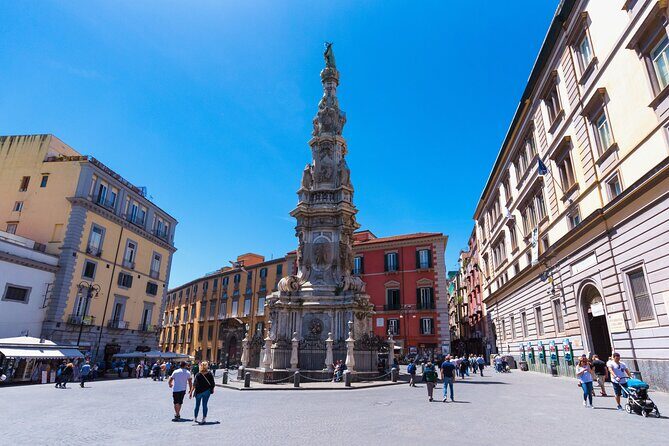
Another anchor is Piazza San Domenico Maggiore, dominated by the Church of San Domenico and the prominent spire of the same complex.
Squares like this work as “rest stops” for your brain. You’re absorbing dense detail all day, then suddenly you get a big vertical element—like the spire—that helps you orient and measure space.
A guide’s explanations can make that spire feel less like scenery and more like part of a historic urban plan.
San Gregorio Armeno: the Nativity-making district
Then comes Via San Gregorio Armeno, the heart of Naples’ Nativity-making district. You’ll observe the unique creations by local craftsmen, and your guide will explain this “minor art” tradition.
If you like crafts and small-scale artistry, this is one of the most memorable segments. You’re not just watching a building. You’re watching a living tradition of making.
There may be free time to explore the area on your own if you want it. That’s helpful when you want to browse slowly or buy small gifts.
Duomo di Napoli and San Gennaro: cathedral power and miracle culture
The tour reaches Duomo di Napoli, a 14th-century French Gothic cathedral and the seat of the Naples archdiocese. It includes the Crypt and the chapel tied to Naples’ patron saint, San Gennaro.
San Gennaro is central to local culture because of the famous liquefaction ceremony, which takes place three times a year. This tour also highlights the Cappella del Tesoro di San Gennaro, known for Baroque art—frescoes, sculptures, and precious relics.
This is where Naples feels emotional, not just historical. Even if you’re not religious, you’ll understand why people care. The guide can help translate symbols and settings so you feel what the ritual means to locals.
Via dei Tribunali: historic lane plus pizzeria culture
To wrap the city core, you’ll walk through Via dei Tribunali, one of Naples’ most historic streets. It’s lined with churches, historic buildings, and traditional pizzerias, which connects the religious and historical Naples to the food Naples people actually eat.
You’ll also get a route back toward the end point at Piazza del Gesù Nuovo. If you’d rather, you can enjoy lunch at recommended local restaurants and trattorias, and your guide can tell you how to return safely to Piazza del Gesù or to Naples’ Maritime Station.
Price and value: what you’re really paying for
At $211.72 per person for a private 3-hour tour, you’re paying for two things: time and interpretation.
If you were self-guided, you’d still see many of these stops, but you’d lose the “why.” This tour’s standout value is that your guide helps you identify architectural eras and connect landmarks into a coherent story. That’s hard to replicate with a basic walking app.
You also aren’t boxed into a rigid group pace. Because it’s private, you can ask questions and spend extra minutes where your curiosity goes. That flexibility is part of the value, especially in a dense city like Naples where the streets compress everything.
The optional admission fees are another consideration. Most listed stops are described as admission ticket free, but some entries may cost extra depending on what you choose. Santa Chiara’s cloister is specifically noted as not included, for example.
The best fit: who should book this tour
This is a strong fit if:
- you want to understand Old Naples fast with an expert guide
- you enjoy architecture and want help spotting eras
- you’re in Naples for a limited time, especially with a cruise day
- you like a walking tour that includes both landmarks and real street life
It may not be the best fit if you want:
- a day focused on only museums or only one theme
- a broad Naples-area route beyond the historic center
- long time in one building before moving on
Should you book this private walk?
Yes, if you want your first Naples day to feel organized and meaningful. The structure hits the key squares and churches, but the real benefit is the guided reading of the city—sea power, royal status, Baroque artistry, and everyday streets all connected by explanations.
I’d book this especially if you’re arriving by cruise or you’re short on time. Meeting at Stazione Marittima and walking into Piazza del Municipio with context is a smart use of limited hours.
Only skip it if you already have a very specific plan for Naples that doesn’t match a focused Old Town route. In that case, you’ll want a different tour style—or more time on your own—so you don’t feel “held” to the historic-center rhythm.
FAQ
Is this a private tour or a group tour?
It’s a private tour/activity, so only your group participates.
How long is the Naples Old Town walking tour?
The duration is about 3 hours.
What language is the guide offering?
The tour is offered in English.
Is pickup available, especially for cruise passengers?
Pickup is offered. For cruise ship arrivals, you walk outside the cruise terminal, find a service area, follow a short tunnel marked with a Welcome to Napoli sign, and meet the guide holding a nameplate with your name.
Where does the tour start and end?
The start point is Stazione Marittima (Molo Angioino). The tour ends at Piazza del Gesù Nuovo. You can also arrange to end in the historical city center or be brought back to Municipio Square/Port.
Are admission tickets included?
Admission fees to sights are optional and not included. Some stops are listed as free, and some entrances may cost extra depending on what you choose.
Can I enter the Santa Chiara cloister on this tour?
The Santa Chiara cloister is not included in admission, but the guide can lead you through it upon request.
What fitness level do I need?
The tour is listed as suitable for travelers with a moderate physical fitness level.
Are service animals allowed?
Yes, service animals are allowed.
Is there free cancellation?
Yes. You can cancel up to 24 hours in advance for a full refund.